We’re about to hit 100,000 friends on our Rick Steves Facebook page (like us to help me reach that number) — and I’ve decided to celebrate that milestone by funding a $100,000 initiative to protect the poorest Americans from cuts in government programs.
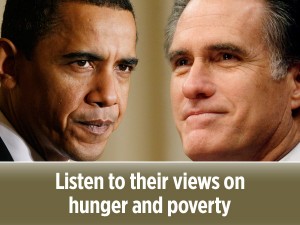
The first step in this project has been to have President Obama and Governor Romney each create a three-minute video that explains what he plans to do as president to fight hunger and poverty. These videos have been completed, and you can view them now.
Here’s why I got involved: An organization I admire, Bread for the World, has joined a coalition of Christian organizations across the political spectrum — from both conservative churches and liberal churches — to encourage our next president, whether Obama or Romney, to maintain a “Circle of Protection” around our nation’s hungry people as necessary cuts are made in government programs.
Their ingenious initiative establishes that hunger is neither a Republican nor a Democratic issue. And it will keep “hunger in America” on the agenda in a constructive way regardless of who occupies the White House after the election.
The $100,000 gift from Rick Steves’ Europe Through the Back Door will help promote these video clips in addition to funding a special hunger education program for thousands of churches in America. Through this program, we hope to hold our next president accountable for promises made about ending hunger. It will also pay for Bread for the World staffers to follow-through in the months after the election, working in our nation’s capital to protect the programs most vital to our poorest citizens.
We believe our travelers have a world view and care about hunger. The stark truth is: one in four American children is “food insecure” and the number is growing. We’ve long supported Bread for the World, and their Circle of Protection campaign has already prevented deep and egregious cuts to programs vital to the poorest people in America and around the world.
Please help us get to 100,000. Visit my Facebook page and “like” us. Share this with your friends. Together we can impress upon our next president and congress that fighting poverty and hunger needs to be a top priority.
Last month, while filming our new Travel Skills Special, I was at the beloved-among-beer-drinkers Andechs Monastery an hour south of Munich. Our intent was to talk about “going local” when eating. And in Bavaria, what’s more local than a knuckle of pork, spiral-cut radishes, sauerkraut, a huge pretzel, and a liter of beer. We had fun shooting me buying all of this and then delivering my lines. But eating the entire thing would have done me in. So, the big on-camera lunch actually ended up feeding our entire crew. But each man, of course, got his own big beer.
By the way, of all the great German beers, Andechs is my favorite. You can eat at an Andechs beer hall in downtown Munich or, more memorably, take a side-trip to this church-capped hill at the foot of the Alps and enjoy an amazing scene right at the monastery.
(Photos by Didrik Johnck, our second cameraman on this shoot.)
Seattle’s KCTS recently produced a TV special celebrating the 50th anniversary of the Seattle World’s Fair (and our Space Needle). Because I enjoyed the fair as a seven year-old back in 1962, the producers sat me down for an interview. It caused me to think about the random events in a person’s life that open them up to our world, and the long-term blessings that can result. Check out this 84-second video. Then think of what in your childhood may have contributed to your appetite for getting out of your comfort zone to enjoy and learn from other cultures. Then, if you like, share it with a comment here.
If you can’t see the video below, watch it on YouTube.
Our crew (left to right: director Simon, cameraman Peter, and host Rick), finished 20 hard days of shooting and production with all our work — the rough footage for three new TV shows — saved onto a single hard drive the size of an iPhone.
It was the last day of my trip — 25 days of guidebook research followed by 20 days of TV production. Finally, my crew flew home with the footage (not actually “footage” anymore — three weeks of filming is contained on a single, massive hard drive). I was free to do one of three things: stay in the room and edit the research I had done; just go out, relax, and have fun in London; or do all my London audio tours. With so many people using my free audio tours, I decided to do that.
It was a strangely entertaining day. I spent it doing the five London audio tours from my Rick Steves Audio Europe app. For six hours I listened to my voice narrating the very best of London, while my brain was finding ways to make these tours better.
My day went like this: Buy a £7 all-day tube/bus pass (a great deal at about $11), catch the Tube directly to Westminster, do my Westminster Walk (Westminster Bridge to Trafalgar Square), walk The Strand to St. Clement Danes Church, and do my City of London Walk (St. Clement Danes to London Bridge) — interrupting it midway to do my St. Paul’s Cathedral Tour. Then have lunch at the Counting House, taxi to the British Museum to do that tour, and then catch a bus to Euston Station to do my British Library Tour. Finally, catch the Tube for the direct ride back to my hotel in South Kensington. Time management was key: The British Library closed at 6 p.m., but my “off-peak” transit pass wouldn’t let me start until 9:30 a.m.
London’s subway was Europe’s first great system and is consequently the ricketiest — but it still works marvelously. With earbuds in my ears as I walked the streets, the constant churn of London — people, local professionals, big tour buses, taxis, and so on — was strangely more apparent. I was a keen observer. With my buds in, no one talked to me. I was invisible. I noticed what a great percentage of people on the streets were also lost in their buds.
Listening to my tour, I caught a few mistakes. Many of them reminded me of the dangers of travel writing anywhere. For example, I just assumed the Thames flowed. But looking into the river, I realized it is tidal and, when things are slack, it just sits there.
My goal for the audio tours is to make them “real time.” I found, for instance, there is a two-minute stretch on the walk from the Westminster Bridge to Parliament Square that could be filled with informative narration so people wouldn’t have to press stop and walk to the next spot.
The monuments of London have never looked so good. It was fun to be here in the wake of the Olympics. Everyone we talked with commented on how the games went swimmingly — but for tourism, restaurants, taxis, tour guides, and so on, it was a quiet three weeks. As is so often the case, profiteering (the threat of prices jacked up during an event) caused many people (like us, who made a point to arrive after the games finished), to stay away during the anticipated, overpriced commotion.
Whitehall — London’s Pennsylvania Avenue — was grand. Security was almost military — guards with machine guns at the ready strolling in front of the gate at #10 Downing Street (and at train stations and Heathrow Airport). Judging by the traffic, it seems the standard, big-bus sightseeing day trips seem to have been driven out of business by the double-decker, Hop-on Hop-off tour buses. In fact, “HOHO” buses seemed as numerous as regular city buses.
Reaching Trafalgar Square, I concluded that the Westminster Walk is nearly perfect. I’m very happy with it. From that point, I realized it would have been convenient if the City of London Walk started there rather than a mile east at the edge of The City. But walking The Strand to that starting point, I realized we left this stretch out for good reason — it’s boring.
It rained as I walked through The City, the one-square-mile, old town center now consumed by the financial district and Christopher Wren churches. It’s liberating to not care about the weather. For three weeks I needed sunshine to make good TV. Now, with the crew gone, I was singin’ in the rain.
For lunch, I dropped by the Counting House, a former, elegant bank building converted into a fancy pub that’s popular with the neighborhood’s professionals. I confirmed my feeling that, while there are plenty of “cheap and cheery” modern eateries in London, this is a great spot for a memorable lunch.
After touring St. Paul’s, I hopped into a cab thinking that would save me time as it was getting late. I was wrong. Traffic was slow, the meter reached £12, and I could have got to my next sight faster — and free — with my all-day transit pass. Still, I enjoyed the British Museum and British Library. Then, brain drained, I hopped the Tube and zipped directly back to my hotel in South Kensington.
It was an exhilarating day — not unreasonable for first timer to do it, too. And it was cheap: about £20 for transportation, the audio tours were free, and the sights were free (except St. Paul’s, which costs £15). Lunch cost £15 with a beer. The total: about £50 for a very full day in London.
All over Europe, great cities are adding great new buildings to their skylines. And great cities are taking old industrial zones — left derelict when shipping moved out to more modern quarters — and gentrifying them. I’ve noticed that what we call “the wrong side of the tracks” is, in Europe, often the wrong side of the river (think London, Rome, Florence, and Sevilla). Amsterdam is digging up its center to build a new north-south subway line which will move much of the transportation clutter across the IJ River to its (until now) undeveloped North Bank. And this side of the river — which will get a huge new boost when the new transit hub opens — is on its way to becoming a smart, new people zone. Free ferries shuttle mostly bikers back and forth from immediately behind Amsterdam’s big central train station. Now when you look over the river you see a striking new building — the Film Museum on the IJ. Here’s my new guidebook listing:
This striking new building on Amsterdam’s skyline is a complex of theaters in an edgy structure overlooking the IJ River. (IJ is pronounced “eye.”) That makes this the Eye on the IJ.
The Film Museum on the IJ
The big news for the skyline of Amsterdam is the arrival of the new Film Museum on the IJ, nicknamed “The Eye.” This striking, sleek modern building heralds the coming gentrification of the north side of the IJ River, immediately across from Amsterdam’s Central Station. The building is a complex of four theaters playing mostly art films with a particular theme that changes throughout the year. There’s also a monthly program of silent films with live musical accompaniment and exhibitions on film-related subjects, a free permanent exhibit in the basement, a gift shop, and a trendy café with great riverside seating on its terrace. Helpful attendants at the reception desk can get you oriented (Free entry, movies-€10, exhibit-€10, credit/debit cards only; daily 10:00-24:00, exhibits open daily 11:00-18:00; from behind the Central Train Station catch the free ferry labeled “Buiksloterweg” across the river and walk 200 yards, www.eyefilm.nl).
 We’re about to hit 100,000 friends on our Rick Steves Facebook page (like us to help me reach that number) — and I’ve decided to celebrate that milestone by funding a $100,000 initiative to protect the poorest Americans from cuts in government programs.


