What Our Rick Steves Tour Guides in Greece and Spain Are Saying About “Unrest”

Europe is dealing with a harsh reality: They are consuming more than they are producing. The entitlements they grew up expecting were made possible by a young society with lots of workers and not too many retirees. And today, they are living in a relatively geriatric society in need of some pretty harsh adjustments. Politicians understand the new arithmetic needed, but many of the people don’t. European workers are angry, afraid, and frustrated…and hitting the streets.

Demonstrating is woven into European democracies. And, while protesting is generally just too much trouble for most Americans, Europeans are quick to hit the streets when they want to raise their collective voice. I think it’s healthy. It’s my hunch that for many years to come, Europe will be sorting this out, and travelers will encounter parades and rallies in front of parliament buildings — and anarchists wanting to hijack these events to make their points and get on the news. As the TV news media loves vivid footage, this is easy to do.

The challenge for American travelers in Europe is to stay safe while not overreacting. If you want to be entirely safe, just avoid demonstrations. If you run into any inconvenience, I’ll bet it will be a strike. That’s certainly nothing new in Europe. Remember that while the USA has its “99 percent” issues, Europe is much tougher on that top 1 percent. It’s been my experience that while strikes are commonplace in Europe, most are “nuisance strikes” — just a day here and a day there. They are unpredictable, and designed to just temporarily make everyone frustrated and miserable (like the strikers are).

Austerity measures in Europe have triggered public protests during the past couple of weeks, most notably in Greece and Spain, where the unemployment rate is around 25 percent. News reports have focused on acts of violence that have occurred at some events, which gives the impression that entire cities or countries have become dangerous for travelers. We’ve been keeping a close eye on things, as we’ve had over 400 perfectly safe and successful tours enjoy Europe this year. Rather than basing our impressions exclusively on sensationalistic news coverage (as most casual observers do), we get timely, real-world reports from our guides on the ground. If you’re considering a trip and wondering about the impact of Europe’s economic problems on your travel fun, these very recent guide reports may interest you:

Pat O’Connor in Greece
Greetings from Monemvasia, where the weather is fantastic and David is leading a great Athens and the Heart of Greece tour. Per your request, here’s what I’ve encountered regarding unrest in Greece: In a word, zilch. Let me expand on that. When I was in Austria finishing leading my Germany, Austria, and Switzerland tour in mid-September, I saw on BBC News that a general strike was scheduled for September 26th in Athens. I flew from Vienna to Athens on September 24th, and our last Greece tour of the year kicked off that night. Our hotel is five blocks from the Acropolis and perhaps half a mile from Syntagma Square (where past demonstrations have focused). Our first full day in Athens (the 25th) was enjoyable, and we were able to visit the Acropolis in the morning and use the Metro to visit the Archaeological Museum in the afternoon. No problems — just predictable large crowds at the sites and urban commuters in the subway. The following morning (the 26th), we visited the new Acropolis Museum as it opened, and then got on our coach and drove out of Athens mid-morning. David said that the museum employees had voted not to strike and don’t see the point in turning away travelers that are so much a part of their economy. Our Greek driver was savvy enough to know to take a longer loop route out of the city to avoid any potential chaos near Syntagma Square. And from there, the tour has progressed beautifully.

We’ve encountered no animosity or general unease from the Greek people. They seem genuinely friendly and glad to have us visiting in a year that’s obviously a down year for tourism (I read in The Herald Tribune that visitors flying through Athens are down 14 percent this year). I heard no sirens in Athens. I saw no banners or marchers. I suppose we could have found trouble if we’d looked for it by going to Syntagma Square on the 26th. But, honestly, it’s been a complete non-event from a visitor’s perspective.

David Willett in Greece
There was no sign of any disturbance whatsoever on our Athens and the Heart of Greece tour. No sights missed. Tour members will return home and hear about this, and not believe they were in same place as the news described. They will be telling their friends that the media coverage of Greece is woefully wide of the mark. In fact, outside of a few protests at Syntagma Square (where a few extremists hijacked an otherwise peaceful demonstration and grabbed headlines in the US), Greece has been noticeably quieter than usual overall. Our tour spends most of its time outside of Athens, and people outside the city generally vote against striking, which is why we’re not inconvenienced at all.

The Greek (and southern European) tradition of dealing with issues is to go into the streets and protest. If it wasn’t the debt crisis, it would be something else. There is a festive, highly emotional aspect to this, so sometimes tempers can show. The media is always looking for visuals to simplify things, so two people walking down the street carrying signs makes the news. There will be more “drama” as the debt crisis plays out, so people need to get used to this kind of thing making headlines. But it has little if any real effect on travelers’ experiences here.

One of my goals on every tour is to put Americans in touch with typical Greeks, and see that these are still Europe’s most friendly and welcoming people. Nothing has changed about that!

Nygil Murrell in Spain
From my experience of walking around Madrid over the past several weeks, the focus of the demonstrations has been almost exclusively around the Municipal Congress Center, and the closest that demonstrators are able to get to the barricades, which is Neptune Square. While there have been different groups (labor unions, independent organizations, etc.) that have marched their way through city-center areas (Puerta del Sol, for example) to reach the demonstrations, these are peaceful marches that are simply trying to rally people to join in on the way to the Congress demonstrations. The average traveler isn’t affected by this in any way.

Following the first protest, which ended in police aggression, the demonstrations have been mellow affairs during the normal hours of the evening. They have only escalated when the remaining few, who are determined to stay on-site as long as possible, are forced out by police who use aggressive tactics in the wee hours of the morning. This action, which involves relatively few people, makes the headlines.
Because none of our various Spain tour groups have any reason to go near the demonstration site, I haven’t seen anything more than what’s been on the news. I think a sensational approach is being taken by both left and right newspapers. The left wants to show police brutality spurred on by the conservative government, while the right wants to show the “out-of-control” nature of the demonstrators with the goal of discouraging “normal” people from joining them. As always, the truth lies somewhere in the middle. And those of us who chose to stay away from this more theatrical way of exercising our freedom are simply doing our best to enjoy life in beautiful Spain.


App News: 23 New Tracks for Rick Steves Audio Europe™

We’ve added 23 new tracks to Rick Steves Audio Europe™, the free smartphone app that organizes my audio content (radio interviews, audiobook chapters, and self-guided tours) into country- or city-specific playlists. So far, 200,000 travelers have downloaded our app for free access to nearly 300 radio interviews and 37 self-guided audio tours via their iPhones or Android mobile devices.

This free travel information service, with much-improved features in its newest version, will continue to grow. We add batches of Europe-related radio interviews twice a year. And I’ll be producing four new audio tours on Munich and Amsterdam this winter.

This newest batch of interviews from my radio show includes conversations with some well-known folks who share my passion for travel: legendary photographer Annie Leibovitz, NPR host Steve Inskeep, and teen actor-turned-travel writer Andrew McCarthy.  I also talk with European travel experts about crafting the perfect Tuscan picnic, appreciating postwar Sarajevo, enjoying Paris after dark, and much more.  And if you’re planning a trip to Europe soon, the app has hours of trip-enhancing material of great value for anyone traveling with a mobile device. If you don’t already have the Rick Steves Audio Europe™ app, you can find it here: Rick Steves Audio Europe™

Promises about Poverty: Hold Candidates Accountable

Thanks to you, we’re able to fund a non-partisan campaign to keep hunger and poverty at the forefront of this election, and after.

Last week on Facebook I announced our support for an innovative anti-hunger initiative, and promised we’d send Bread for the World a check for $100,000 as soon as I reached 100,000 “likes” on my Facebook page (which I guessed would take about a week). We hit that goal in just a few hours, so I extended the challenge through October 1st. The friends kept coming, and at midnight we reached 104,222 total “likes.” As promised, this week I’ve happily written a check for $104,222 to Bread for the World.

I’m also thrilled to let you in on this week’s launch of a key piece of this initiative: “The Line,” a new 40-minute video documentary produced by Bread for the World and its partners. You can be among the first to watch this important, eye-opening, VIDEO PREMIERE: The Line.

The Line” tells the stories of a former banker, a single mother, a Louisiana shrimper, and a head busboy as they’ve struggled to move out of poverty. They’ve managed to turn their lives around with God’s help, some assistance from their families and the federal government, and their own hard work. I think this film brilliantly humanizes this issue. It’s so easy to enjoy the blessings of being relatively affluent Americans — and not realize the harsh reality that exists for so many in our country.

Last week we posted three-minute videos from President Obama and Governor Romney, each spelling out in his own words how he intends to deal with the problems of hunger and poverty in America. All during October, Bread for the World will coordinate emailing these video links to 10 million voters in 18 key states, urging them to view the presidential candidates’ videos. Their call to action is for people to remind the candidates that hunger is a non-partisan issue that is vitally important to people of faith across the political spectrum.

At the same time, Bread for the World is sending DVDs of the candidates’ statements to about 2,000 churches throughout the country, to stimulate a discussion addressing hunger from a Christian perspective.

The next component, which starts mid-October to coincide with the presidential debates, is the airing of 900 radio spots on Christian radio stations in Florida and Colorado. The message will remind the listeners to not only view the videos, but to urge the incoming president and Congress to create a “circle of protection” around programs that are vital to hungry and poor people.

After the election, Bread for the World will send 5,000 DVDs of the president-elect’s statement to key faith leaders and churches, along with a study guide aimed at holding the next president accountable for his promise to work to end hunger and poverty during his term in office.

It is only through your support of my travel business — buying guidebooks, travel gear, DVDs, rail passes and tours — that we’ve had the wherewithal to generously fund Bread for the World’s ground-breaking initiative to bring hunger and poverty to the forefront of this presidential campaign in an effective, non-partisan way. These efforts will bring about positive change in our country. Thanks — not just to our Facebook fans — but to all of you who have helped us become a force for thoughtful travel, and social good.

A Dozen Great Seaside Bars

With all the intensity in our domestic and political worlds lately, it’s a fine time for an escape — sunset glinting through the drink in your hand. Let’s fantasize about the best seaside bars in Europe. Whenever researching a guidebook chapter covering a port or seaside resort, I work hard to find the most romantic place to swizzle stick your vacation cocktail. Feel the breeze, smell the sea, enjoy the cry of the gulls, and let me share my favorites. These are each worth seeking out. (BTW, I’d love to read about your favorites. Please share.)

In Dubrovnik, Croatia
Cold Drinks “Buža” offers, without a doubt, the most scenic spot for a drink in Dubrovnik. Perched on a cliff above the sea, clinging like a barnacle to the outside of the city walls, this is a peaceful, shaded getaway from the bustle of the Old Town…the perfect place to watch cruise ships disappear into the horizon. Buža means “hole in the wall” — and that’s exactly what you’ll have to go through to get to this place. Filled with mellow tourists and friendly bartenders, Buža comes with castaway views and Frank Sinatra ambience ($4-7 drinks, summer daily 9:00-into the wee hours).

In Rovinj, Croatia
Valentino Champagne and Cocktail Bar is a memorable, romantic, justifiably pretentious place for an expensive late-night waterfront drink with jazz. Fish, attracted by its underwater lights, swim by from all over the bay…to the enjoyment of those nursing a cocktail on the rocks (literally — you’ll be given a small seat cushion and welcomed to find your own seaside niche). Or you can choose to sit on one of the terraces. Classy candelabras twinkle in the twilight, as couples cozy up to each other and the view. Patricia opens her bar nightly from 19:00 until as late as there’s any action. While the drinks are extremely pricey, this place is unforgettably cool ($8-11 cocktails, Via Santa Croce 28).

In Vernazza, Cinque Terre, Italy
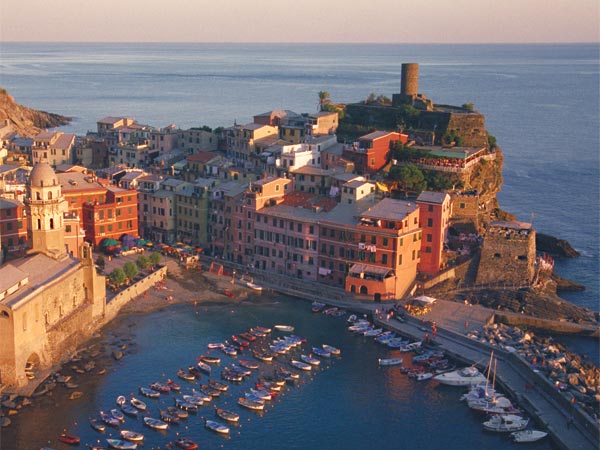
Ristorante Belforte’s tiny, four-table balcony lets you sip your vino della Cinque Terre overlooking the Mediterranean from the edge of a stony castle. You can feel the mist from the surf crashing below on the Vernazza breakwater. And the views of the ancient vineyard terracing all around you makes the experience a highlight. From the Vernazza breakwater, follow either the stairs or the rope that leads up and around to the restaurant.

In Hydra, Greece
Kodylenia’s Taverna is perched on a bluff just over Kaminia’s pocket-sized harbor, which shelters the community’s fishing boats. With a glass of ouzo and some munchies, as the sun slowly sinks into the Saronic Gulf and boats become silhouettes, you can drink to the beauties of a Greek isle escape. It has my favorite, irresistible dinner views on Hydra: This scenic spot lets you watch the sunset with Kaminia’s adorable port in the foreground. Owner Dimitris takes his own boat out early in the morning to buy the day’s best catch directly from the fishermen. For meals, you can sit out on the shady, covered side terrace above the harbor. For drinks, sit out front on the porch. Relax and take in a sea busy with water taxis, hydrofoils that connect this oasis with Athens, old freighters — like castles of rust — lumbering slowly along the horizon, and cruise ships anchored as if they haven’t moved in weeks.

In Istanbul, Turkey
The double-decker Galata Bridge spans the Golden Horn, a historic inlet that separates the old and new towns of Istanbul. And all along both the horn and the bridge, you’ll find dozens of inviting, no-name bars. Find a place to nurse some Turkish specialties: Drink an unfiltered, highly caffeinated “Turkish coffee” (which leaves a thick coating of “mud” in the bottom) or a cup of tea, and suck on a water pipe — called a nargile (NAHR-gee-leh) — filled with flavorful dried fruit. As you enjoy your drink and your hookah, be sure to play backgammon with (or at least among) the locals. If you’re on the lower level of the bridge, you can look up for a fun view of dozens of fishing rods twitching along the upper railing. Watch your head — sometimes an amateur fisherman carelessly lets his catch swing under the top deck. And keep an eye out for the flicker of a little silvery fish, thrashing through the air as it’s reeled in by a happy predator.

In Salema, Portugal
One bit of old Algarve magic still glitters quietly in the sun — Salema. It’s at the end of a small road just off the main drag between the big city of Lagos and the rugged southwest tip of Europe, Cape Sagres. Quietly discovered by British and German tourists, this simple fishing village has three beachside streets, many restaurants, a few hotels, time-share condos up the road, a couple of bars, English and German menus, a classic beach with a paved promenade, and endless sun. The Atlântico — noisy, big, busy, and right on the beach — has long dominated the Salema beach scene. It’s known for fun drinks, friendly service, and a wonderful beachside terrace.

At Burriana Beach, Near Nerja, Spain
Ayo’s is famous for its character of an owner and its beachside all-you-can-eat paella feast at lunchtime. For 30 years, Ayo — a lovable ponytailed bohemian who promises to be here until he dies — has been feeding locals. Ayo is a very big personality — one of the five kids who discovered the Caves of Nerja, formerly a well-known athlete, and now someone who makes it a point to hire hard-to-employ people as a community service. The paella fires get stoked up at about noon and continue through mid-afternoon. Grab one of a hundred tables under the canopy next to the rustic, open-fire cooking zone, and enjoy the beach setting in the shade with a jug of sangria. For $7.50, you can fill your plate as many times as you like. It’s a 20-minute walk from the Balcony of Europe, at the east end of Burriana Beach — look for Ayo’s rooftop pyramid (daily “sun to sun,” paella served only at lunch).

In Villefranche-sur-Mer, France
In the glitzy world of the Riviera, Villefranche-sur-Mer offers travelers an easygoing slice of small-town Mediterranean life. Luxury sailing yachts glisten in the bay — an inspiration to those lazing along the harborfront to start saving when their trips are over. The Chapel of St. Pierre, decorated by artist Jean Cocteau, is the town’s cultural highlight.  Le Cosmo Bistrot/Brasserie takes center stage on Place Amélie Pollonnais with a great setting — a few tables have views to the harbor and to the Cocteau chapel’s facade (after some wine, Cocteau pops). Manager Arnaud runs a tight-but-friendly ship and offers well-presented, tasty meals with good wines (I love their red Bandol).

In Conwy, Wales
This Welsh town, watched over by its protective castle, has a particularly charming harbor. Conwy was once a busy slate port (back when much of Europe was roofed with Welsh slate, Conwy was a boomtown). But today the harbor is a laid-back area that locals treat like a town square. On summer evenings, the action is on the quay (pronounced “key”). The scene is mellow, multigenerational, and perfectly Welsh. It’s a small town, and everyone is here enjoying the local cuisine — “chips,” ice cream, and beer — and savoring that great British pastime: torturing little crabs. Facing the harbor, The Liverpool Arms pub was built by a captain who ran a ferry service to Liverpool in the 19th century. Today it remains a salty and characteristic hangout.

In Staithes, England
A ragamuffin village where the boy who became Captain James Cook got his first taste of the sea, Staithes (pronounced “staythz”) is a salty jumble of cottages bunny-hopping down a ravine into a tiny harbor. This refreshingly unpretentious town on the North Sea is gloriously stubborn about not wooing tourists. The town has changed little since Captain Cook’s days. Seagulls seem to have picked the barren cliffs raw. There’s nothing to do but stroll the beach and nurse a harborside beer or ice cream. The Cod and Lobster, overlooking the harbor, has scenic outdoor benches and a cozy living room warmed by a coal fire. In nice weather, the best option is to enjoy a drink, snack, or light meal (i.e., fish-and-chips) sitting at an outdoor table fronting the harbor.

In Solvorn, Norway
Walaker Hotel, a former inn and coach station, has been run by the Walaker family since 1690 (that’s a lot of pressure on eighth-generation owner Ole Henrik). The hotel, set right on the Lustrafjord, has a garden perfect for relaxing and, if necessary, even convalescing. In the main house, the halls and living rooms are filled with tradition. (Patriotic hymns sit at the piano.) While great for its accommodations, the hotel also serves dinner and drinks. I love to savor my coffee and dessert on the balcony with a fjordside setting — mesmerized by Norwegian mountains. Rather than jagged, they’re bald and splotchy, with snowfields on top and characteristic cliffs plunging into inky fjords. One night I took my strawberries à la mode onto one such porch and sat there long after my coffee cooled and ice cream melted. After dinner, I strolled through the village enjoying the blond cherubs running barefoot through the stalled twilight. Cobbled lanes led past shiplap houses to rock cliffs — their gullies and cracks green with trees.

In Barcelona, Catalunya, Spain
Before the 1992 Olympics, Barcelona’s waterfront was an industrial wasteland nicknamed the “Catalan Manchester.” Not anymore. The industrial zone was demolished and dumped into the sea, while sand was dredged out of the seabed to make the pristine beaches locals enjoy today. The scene is great for sunbathing and for an evening paseo before dinner. It’s like a resort island — complete with lounge chairs, volleyball, showers, bars, WCs, and bike paths. Every 100 yards or so is a chiringuito — a shack selling drinks and light snacks. Originally these sold seafood, but now they keep locals and tourists well-lubricated. It’s a very fun, lively scene on a balmy summer evening. This is a nice way to escape the claustrophobic confines of Barcelona to enjoy some sea air and the day’s final sunrays. A double-decker boardwalk runs the length of the beach, with a fine walkway up above. There’s a series of great seafood restaurants and cocktail bars with romantic, candlelit, beachfront seating tucked down below.

100,000 friends and growing…and so is my donation

Wow, our “$100k for 100k friends” hunger initiative has inspired a frenzy of friending. I thought it would take days (not hours!) to reach this goal. You blindsided me. Thank you…and let’s keep going!

The full scope of Bread for the World’s innovative campaign against hunger and poverty launches on October 2nd, and that’s when I’ll write them the check. So, let’s make it out for this amount:

$1 for every “like” I have on the Rick Steves Facebook page as of midnight, October 1st.

How far above $100,000 will we go? That’s up to you…with a little help from your friends. As I post this, we’re at $102,200.

Please share the Facebook post, and make me write a bigger check.

To learn more about this exciting initiative, see the September 26th post on my Blog and Facebook Timeline.

Watch the 3-minute videos from Mitt Romney and Barack Obama that explain their plans for fighting hunger and poverty in America. (You won’t find the candidates talking directly about this important issue elsewhere as it doesn’t “poll well.”) I found it fascinating to examine each candidate’s carefully chosen words on this subject. You can, too.

Share this post, watch the videos, and let’s get more “likes.”