Even though I’ve been coming to Milano for a long time, I enjoyed some great new sights on my latest visit. Here’s another first-time-ever listing that will be part of the new and improved Rick Steves’ Italy guidebook for 2014.
Art from Milan’s Gallerie d’Italia takes you back into the 19th century—even into the confession booth.The Galleria Vittorio Emanuele II was famously the first place to be illuminated with electric lights in Italy. Imagine the wonder of it all.An entire section of the Gallerie d’Italia is devoted to art of the Risorgimento (the fight for Italian unification). Here we see a touching scene of a mother and her soldier son with a portrait of the inspirational revolutionary leader, Garibaldi, on the dresser, calling all good men to war.
Gallerie d’Italia
This museum fills two adjacent palaces that were once banks with the amazing art collections of those banks. One palace dates from the 19th century and boasts the nicest Neoclassical interior I’ve seen in town; the other is 20th century—Tiffany-like Historicism, with a hint of the coming Liberty Style. Impressive buildings in their own right, they are filled with the exquisite work of 19th- and 20th-century Italian painters. One has romantic landscapes; hyper-realistic, time-travel scenes of folk life; and Impressionism. And in the adjacent palace, marble reliefs by Antonio Canova are displayed in appropriately Neoclassical rooms, while upstairs you’ll find dramatic scenes from the Risorgimento—showing the thrilling story of the unification of Italy. You can even go downstairs and peer into the original bank vault, which now stores racks and racks of paintings not on display. Cost and Hours: Free entrance, free audioguides (for as long as the bank is feeling generous), Tue-Sun 9:30-19:30, Thu until 21:30, closed Mon, across from La Scala Opera House at Piazza della Scala 6, tel. 800-167-619, www.gallerieditalia.com.
I capped my Italy travels this year in the great city of Milano. And even though I’ve been coming here for a long time, I enjoyed some great new sights. Here’s a first-time-ever listing that will be part of the new and improved Rick Steves’ Italy guidebook for 2014.
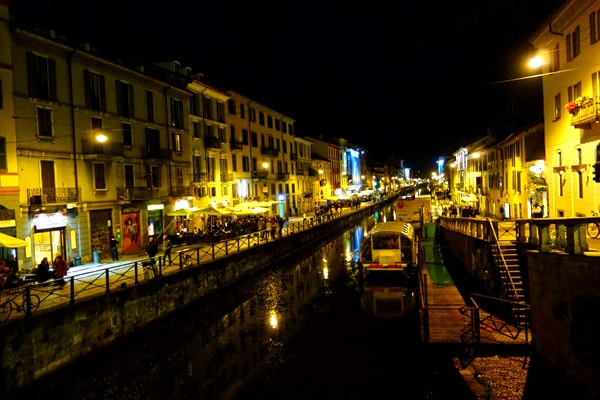
Milan’s rejuvenated old industrial canal is becoming one of the city’s top nightspots.
Naviglio Grande
Milan, while far from any major lake or river, has a sizable port. It’s called “The Big Canal.” Since 1170, a canal has connected Milan with the Mediterranean via the Ticino River (which flows into the Po River on its way to the Adriatic Sea). Five hundred years ago, Leonardo helped further develop the city’s canals and designed a modern lock system. Then, during the booming Industrial Age in the 19th century—and especially with the flurry of construction after Italian unification—the canals were busy shipping in the marble and stone needed to make Milan the great city it is today. In fact, a canal (filled in in the 1930s) once circled the walls of the city and allowed barges to dock with their stone right at the building site of the great cathedral. And in the 1950s, landlocked Milan was actually the seventh-biggest port in Italy, as its canals were instrumental in the rebuilding of the bombed-out city. Today, disused train tracks parallel the canal, old warehouse buildings recall the area’s working-class heritage, and former workers’ tenements—once squalid and undesirable—are much in demand and being renovated smartly. While recently rough and characteristic, today the area is trendy, traffic-free, and pricey—thriving with inviting bars and eateries.
The canal district, with its lively restaurants and bars lining the old industrial canal that once so busily served the city, is an understandably popular destination for dinner or evening fun. To get here, ride the Metro to Porta Genova, exit following signs to Via Casale, walk the length of Via Casale one block directly to the canal, climb halfway across the metal bridge, and survey the scene. To the left, on both sides of the canal, are plenty of great places to eat and drink. The best bars line the canal within a half-block of the bridge.
Eating at the Canal
Consider ending your day at the port of Milan. The Naviglio Grande has a bustling collection of bars and restaurants where you have your choice of memorable and affordable options that will come with a great people scene.
La Vineria is a fun place, serving wine from giant vats and cheap and fun plates of cheese and meats to a cool crowd with streetside seating (open daily, June-Sept dinner only from 15:30, Oct-May lunch and dinner except no lunch on Mon, Via Casale 4, tel. 02-8324-2440).
Pizzeria Tradizionale is a local favorite for pizza (open daily, at the far end of canal walk, Ripa di Porta Ticinese 7).
Ristorante Brellin is the top romantic splurge, with a dressy crowd and fine food. The menu is international while clinging to a bit of tradition (€14 pastas, €24 secondi, daily 12:30-15:30 & 19:00-24:00, behind the old laundry tubs at Vicolo dei Lavandai, tel. 02-5810-1351, www.brellin.it).
Osteria Cucina Fusetti is a charming little place serving good Sardinian cuisine. What’s that? Giuseppe speaks English, and enjoys explaining (€8 pastas, €15 secondi, closed Sun; near the curved bridge with the zigzag design at the Japanese restaurant, go away from canal to Via Fusetti 1; mobile. 340-861-2676).
Pizzeria Spaghetteria La Magolfa is a local fixture offering good, cheap €5 salads, pastas, and pizzas. You can sit inside, on a veranda, or at a table on the street. For €15, two people could split a hearty pizza and a good bottle of wine and get full…and a bit drunk (no cover, a long block off canal at end of Via M. Fusetti at Via Magolfa 15, tel. 02/832-1696).
My Orvieto guide was excited to surprise me with a visit to a very special and obscure site: the underground, fresco-covered, Etruscan tomb of the Hescanas family, which dates back to the fifth century B.C. It happened to be a tomb I knew very well, as for many years (back in the 1980s and 1990s), I would bring my tour groups here. We’d knock on the farmer’s door, and the old man would bring us through the fields, where we’d climb underground into this amazing tomb carved from the tufa rock in the middle of nowhere. We also filmed here in 2000. Today the farmer is gone, his house is abandoned and overgrown, and a local group of archaeologists has the key to the Hescanas tomb. And with the help of my guide, Manuela, I enjoyed a wonderful bit of tour guide nostalgia.
If you can’t see the video below, watch it on YouTube.
I was doing my best to stay in my hotel room and finish some writing. But there was a Pentecost festival going on outside, and the energy was building. I could hear it out my window. I couldn’t resist, and joined the multitude that had gathered on the square in front of the cathedral, as the citizens of Orvieto had for generations as part of their Pentecost celebrations. The tension built and built…and then, suddenly, it happened: A dove in a little plastic tube rocketed down a zipline and into a nest of fireworks at the front of the church, setting it all ablaze.
This ritual was almost comical. After the fireworks blew off, a fireman climbed up the little tower to see if the dove was OK. He was. And that was great news, as it brings good luck to the town and fertility to the last couple married in Orvieto.
When you travel, you can’t help but bump into festivals. I have to admit, I don’t plan for them. But they seem to come to me.
If you can’t see the video below, watch it on YouTube.
Orvieto is one of the most striking, memorable, and enjoyable hill towns in central Italy. And part of the charm is arriving by train or car (parking in the big, free lot just beyond the train station) and joining the locals to climb the town’s natural fortress hill on a slick funicular. As you step out of the funicular station up top, like clockwork, the hardworking little bus A meets you and zips you deep into town (covered by the same ticket), depositing you right in front of my favorite Gothic cathedral in Italy. From there, you are in a delightful, perfectly preserved, and virtually traffic-free world — within steps of great hotels, restaurants, and museums… not to mention a chapel slathered with dramatic Signorelli frescoes.
All day long, this bus shuttles loads of visitors enthusiastic about eating, sleeping, shopping, and sightseeing in Orvieto. There are lots of other great hill towns in Umbria and Tuscany, but none of them provides such a thoughtful welcome to the tourists who stoke the local economy.
But now, sadly, in a misguided attempt to cut costs, the town council of Orvieto is about to drop the handy shuttle bus from the funicular to Piazza del Duomo. By cancelling Bus A, they’re condemning those arriving in Orvieto to either take a long walk through town with luggage, or take their chances with expensive taxis.
I’ve never done this before, but I’d like to ask anyone who has enjoyed Orvieto’s “Bus A Welcome” to email any or all of the city officials here and briefly explain why you appreciate Bus A, and why canceling it would be a sad move for Orvieto. Thanks.