Barnacles and Bratwurst at the End of Europe

If you look at the map, it’s clear that Cape Sagres — at the southwest tip of Portugal —is also the geographical end of Europe. It’s understandable that in the days before Magellan and Vasco da Gama, this was considered the end of the world. Today travelers come here just to find the end of the road. The wives of fishermen sell hearty sweaters, knit while their men are at sea. And a small food stand advertises the” last Bratwurst before America.”

9-last-bratwurst

Goose barnacles, called percebes in Portugal, are a delicacy. They are expensive because they're dangerous to harvest — on rocky promontories where the waves are fierce. They’re nice to munch with a beer. And 300 grams with toast and a salad make a wonderful lunch.
Goose barnacles, called percebes in Portugal, are a delicacy. They are expensive because they’re dangerous to harvest — on rocky promontories where the waves are fierce. They’re nice to munch with a beer. And 300 grams with toast and a salad make a wonderful lunch.

Cape-Sagres

It’s Nice When the Chef Caught the Fish

Paulo at Restaurant O Lourenco in Salema, Portugal, knows his fish. Either he bought it himself at the fish auction in the next town, or he actually caught it himself. After lunch, he took me into the locker for a peek at dinner.

If you can’t see the video below, watch it on YouTube.

Salema—My Favorite Stretch of Portugal’s Algarve

For several years, I’ve been wanting to return to the Algarve (southern Portugal), my favorite stretch of Iberian coastline. I’m generally in Iberia in April, when the beach towns are pretty dead, so I don’t bother. Being here in June this year makes a huge difference — it’s lively, warm, and a great place to relax (as I wind up an intense two-month trip). And even after all this time, my favorite Algarve town remains Salema.

The economic hard times seem to be hitting both Spain and Portugal very hard. I can see the sadness in the eyes of the people. A “tough times future” seems to be the diagnosis, and there’s no promising cure. The character of the idyllic fishing towns (like Salema) is changing. Fewer people are fishing, and government policies (regulation and taxation) have tightened up, causing the little widows to not bother renting their rooms. Gourmet restaurants and boutique accommodations are appearing in spite of the tough times, as fishing towns are becoming the playgrounds of the gated communities and golf clubs of the jet-setting international crowd, who stay on the hilltops a bit inland. Still, the children of the old fisherman — at least, the ones who don’t go to the big city in search of economic promise — continue to cook up the fish and man the weather-beaten fort. And Salema remains a delightful stop on any Iberian itinerary.

I hope you enjoy these images from my recent visit.

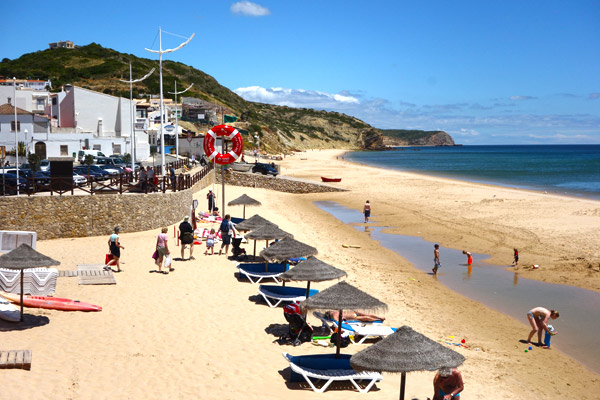
Salema, the Back Door jewel of the Algarve, comes with a delightful sandy beach overlooked by characteristic restaurants and the tranquil strum of a steady surf

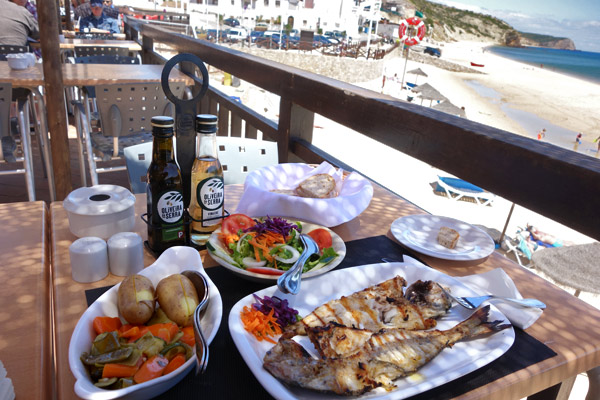
In beach resorts across the Mediterranean, competition is stiff. The fish is fresh, the vegetables are crunchy, and in the case of Portugal...the wine is green.
In beach resorts across the Mediterranean, competition is stiff. The fish is fresh, the vegetables are crunchy, and in the case of Portugal…the wine is green.

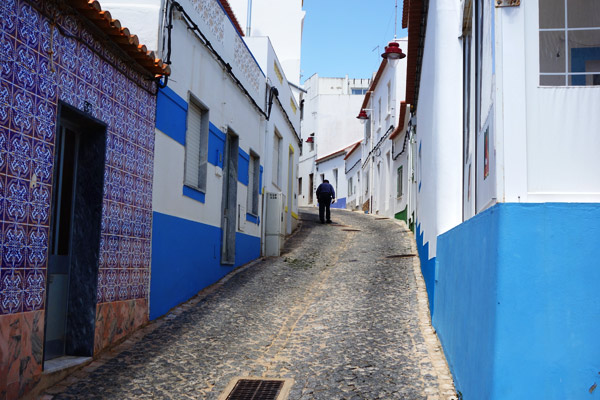
When I first came to Salema, in the late 1970s, I was driving a minibus of tourists. We’d park at the base of Salema’s “street of the fishermen” (Rua Pescador) and find rooms (quartos) in private homes for a few bucks each. Now the fishermen do more sitting and gazing at the sea than fishing (the business is done in bigger fish markets nearby, in Sagres and Lagos). The women have been terrorized out of running their small businesses by stricter (and necessary, as Southern Europe learns to pay its taxes) government regulations. There are fewer old-school, shoestring-budget backpackers to keep them in business anyway. Still, while it feels different, the street looks exactly the same.

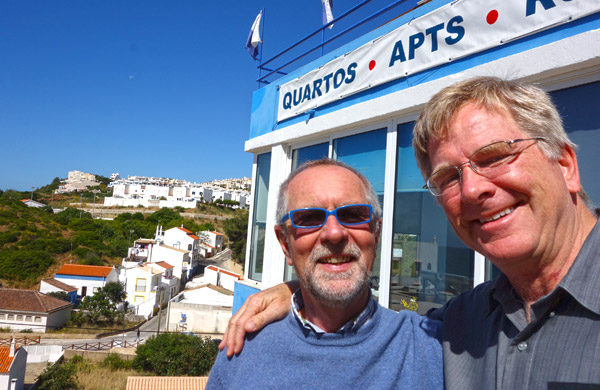
My friend John, from England, has run Pension Mare for three decades. I’ve been sending my readers there just about from the start, and we are like a team. I love his place. He lives in Bath and flew down to hang out with me as I updated my chapter on Salema. He was a great resource as I put the pieces of this town’s social puzzle together. This same weekend, John sold Pension Mare. The new owner promises to run it the same for my readers... but it’s a bit of a sad event for me.
My friend John, from England, has run Pension Mare for three decades. I’ve been sending my readers there just about from the start, and we are like a team. I love his place. He lives in Bath and flew down to hang out with me as I updated my chapter on Salema. He was a great resource as I put the pieces of this town’s social puzzle together. This same weekend, John sold Pension Mare. The new owner promises to run it the same for my readers… but it’s a bit of a sad event for me.

Kidnapped and Gagged in Rome—Then Rescued

The most horrible thing happened to me while doing my work in Rome. An evil man pretending to be me did all sorts of wicked things. It’s a long story…kind of a nightmare. But thankfully, three young and courageous girls — forces for cuisine justice — rescued me, and everything turned out OK. This video tells the saga of a day in Rome I’ll never forget.

Watch more of The Food Police’s adventures at http://foodpolice.it. Learn more about the producers at www.cross-pollinate.com and http://orvietoorbust.com.

In Milano, The 1% Salutes the 99% with a Massive Middle Finger

Milano may be Italy’s no-nonsense business and banking capital, but locals still have a sense of humor. Here’s a new listing (from my upcoming Rick Steves’ Italy guidebook for 2014) about a new monument that has quickly become a fixture:

p40-the-finger

Piazza degli Affari and a towering middle finger mark the center of Milano’s financial district. The bold Fascist buildings in the neighborhood were built in the 1930s under Mussolini. Italy’s major stock exchange, the Borsa, faces the square. Stand in the center, appreciate the modern take on ancient aesthetics (you’re standing atop the city’s ancient Roman theater), and find the stern statues representing various labors and occupations, and celebrating the nobility of workers—typical whistle-while-you-work Fascist themes. Then, notice the equally bold modern statue in the center. After a 2009 contest to find the most appropriate sculpture to grace the financial district, this was the winner. Of course, Italy has its financial problems, and a similar sentiment that powers the Occupy Movement in the USA rumbles in this society as well. Here we see how “the 99 percent” feel when they stand before the symbol of corporate power in Italy. (Notice how the finger is oriented–it’s the 1 percent, and not the 99 percent, that’s flipping the bird.) The 36-foot-tall, Carrara marble digit was made by Maurizio Cattelan, the most famous—or, at least, most controversial—Italian sculptor of our age. L.O.V.E., as the statue is entitled, was temporary at first. But locals liked it, and, by popular demand, it’s now permanent.

middle-finger