Gimmelwald: Getting to that World Apart

Enlarge photo

To commemorate the Smithsonian Presents Travels with Rick Steves magazine — now on sale online, and at newsstands nationwide — Rick is blogging about the 20 top destinations featured in that issue. One of those destinations is Gimmelwald, in the Swiss Alps.

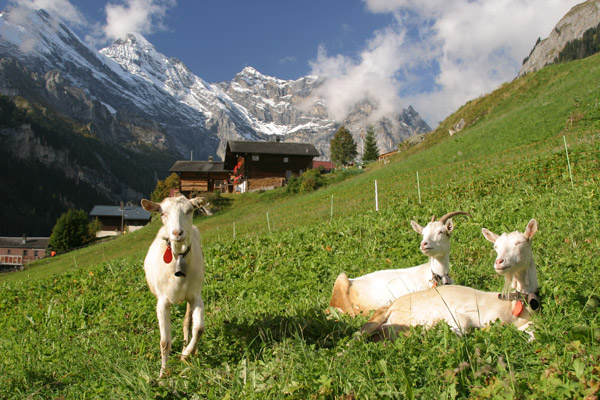
A great challenge in travel research is finding destinations that are a world apart. Gimmelwald, that remote and impossibly idyllic village high in the Swiss Alps, is a classic example. Parking you car in the valley floor and riding the cable car up is like going through a looking glass. You car shrinks, your stomach flip-flops, you look over the valley like a hang-glider, then suddenly you’re deposited — as if from a magical glass bubble — into another world. It’s a place where the air feels different — where the only noises are bees, bugs, and birds perusing alpine flowers, paddling water spilling from a hose into the hollowed-out log that keeps the cows watered, and gnome-like men sucking gnome-like pipes while chopping firewood.

Many of my “Back Doors” give this sensation. That’s probably why they appeal to me in the first place. It takes a little extra effort to reach them: Hallstatt (reached by lake ferry from the tiny train station buried in a forest east of Salzburg), Civita de Bagnoregio (you walk to it up a donkey path, then through a medieval gate, to enter a classic hill town an hour north of Rome), Salema (beyond the Portuguese resort of Lagos, near the far-southwest tip of Europe, at the end of a dirt road), Ærøskøbing (a traffic-free, ship-in-a-bottle dream town a ferry ride away from Svendborg in Denmark), and Inishmore (on the Aran Islands, off the rugged West Coast of Ireland). What place in Europe gives you that “world apart” feeling, and why?

Europeans Share Their Healthcare Experience, Part 4: Switzerland and Belgium

To bring some diverse experience into the discussion on health care reform here in the USA, I’ve asked my friends in Europe to share how health care works in their lives. In this final of four entries, here are comments from my friends in Switzerland and Belgium:

From Fritz in Switzerland:

In Switzerland, everyone has health insurance provided either through an employer (by payroll deduction) or by paying privately to a health insurance company. A family with two children has an annual premium of about 8,000 CHF (about $7,300). For every doctor’s bill, the insured person pays 10 percent. If a person becomes unemployed, then the goverment pays the premium based upon 80 percent of the average wage earned by that person over the past five years. The health insurance company reimburses the insured person, who then pays the doctor or hospital. There is talk of reforming this system because it has been misused.

Switzerland can no longer afford the luxury we’ve had in the past. We have over 1,000 hospitals — that’s too many for Switzerland. All the hospitals want the newest technology, scanners, MRIs, etc. Health care lobbying, corrupt politicians, an aging population, and billions in revenue makes changing the system almost impossible. So I pay and pay, this year 15 percent more than last year!

We have the system you are dreaming about, but our wishes and demands are so high that it gets unaffordable. Careless socialist politicians denied the missuse of our social security insurance and allowed hugh deficits. Now we have to stop and turn things around. When it comes to health care, no society can afford everything, top quality, any time, for everybody. Switzerland will now deal with that reality.

From Christian and Danielle in Belgium:

In Belgium we pay €20 (about $28) to see a general practitioner at his or her office. We are reimbursed 85 percent of this amount. Surgery is paid directly between the hospital and the social security system. A visit to the dentist is free once a year. Glasses are almost all at our expense.

One of the disadvantages of our system is a lack of responsibility. Patients have the right to change doctors without any reason given and then have the same exams done over. Doctors tend to charge for examinations which they did not do, or to do operations which are not needed. Retirement pensions are getting strained, because we live longer.

It seems that people in Belgium get their prescriptions almost always when their company is restructuring. That can be a problem. Half of the prescription is paid by your company and half by the state.

But as a whole, it is a good system, as we also pay for those who have no money at all.

Making Friends with Mr. GPS in Switzerland

This is the third of four reports guidebook researcher/writer Cameron Hewitt sent me just this week from his travels in Switzerland and beyond:

One highlight of my time updating our Switzerland guidebook was making friends with the computer voice of my rental car’s GPS system.

When I picked up my car, the rental agent said, “Sorry, I don’t have the size of car you requested, so I have to give you something a little bigger.” It turned out to be a Skoda Superb (made by my favorite up-and-coming Czech automaker) and was literally at least double the size of the car I’d reserved. You could fit our Norwegian rental car in the backseat, and have room left for a Smart Car in the trunk. While it was nice to have essentially a luxury sedan for the trip, it was sometimes challenging to nudge my tank through narrow mountain roads and tight city parking garages.

The car came with a GPS system that spoke in a buttoned-down British voice. I developed a real love-hate relationship with the GPS guy, who occasionally saved me tons of time and stress, but more than once steered me very wrong. Like an over-earnest navigator desperate to make a good impression, Mr. GPS periodically suggested bizarre and impractical routings. On our first day together, he sent me up narrow mountain roads (in some cases, ones I wasn’t sure I was legally allowed to drive), where I dodged cows and looked longingly down at the big, fast highway in the valley just below. (I’m guessing my GPS wanted to treat me to the “scenic” route. Yeah, thanks.)

On another occasion, I drove halfway across the country (from Gruyeres to Appenzell) at rush hour, hitting big traffic jams around Bern and Zürich. In order to “help” me avoid traffic on the Bern outerbelt, my GPS directed me to an exit to take surface roads through the city. Little did I know that he planned to send me straight through the heart of downtown. He was as confused as I was… “Turn left in 100 meters. Turn left now. No! Wait! Please make a U-turn if possible.” As I found myself doing a three-point turn right in front of the Bern train station, trying to ignore the bewildered stares of rush-hour commuters, I decided that Mr. GPS was on thin ice.

My increasing wariness proved useful a few days later, when — on the way from St. Moritz to Lugano via Italy’s Lake Como — I realized Mr. GPS had just directed me right past the Lugano turnoff. Hitting the brakes and checking the map, I figured out he was aiming to send me on the freeway, then on a ferry across the lake. I stuck with the slower roads on the correct side of the lake, and got in an hour earlier. (It reminded me of a recent news item, in which a Swedish couple touring Italy mistyped “Capri” as “Carpi” — and wound up several hundred miles from their intended destination.) The lesson: GPS is only useful in conjunction with a good map and some common sense.

The GPS guy would talk right over any music I was listening to. This created some odd duets. One time, listening to Janis Joplin on the radio, I heard, “Come on, take another little piece of my heart, now, baby… Please make a U-turn if possible.”

Pondering why I’m so fixated on my GPS experiences, I realize it’s probably because Mr. GPS was my main company for a few days. Now that he’s pestering some other driver, I kind of miss him.

Fringe Switzerland and Stinky Cheese

This is the second of four reports that editor/writer/researcher Cameron Hewitt sent me from his travels in Norway, Switzerland, and Poland as he’s updating our guidebooks. — Rick

Only when coming from Norway does Switzerland seem reasonably priced. Dropping $20 or $25 on a decent Swiss dinner felt like a big relief. (Later, when I was in Poland, I could eat like royalty for $20. In Warsaw I had lunch for $2…banana, egg-salad sandwich, and a bottle of water. But, as the stray hair I found in the sandwich attested, sometimes you get what you pay for.)

In the past I’ve usually focused on the Germanic core of Switzerland, so I forgot how diverse this little country is. This time, I zipped around the Romance language-speaking fringe — Lausanne and Gruyeres (French), Appenzell (OK, that’s still German), St. Moritz area (Romansh), and Lugano (Italian). Every day or two, I switched languages. Though I never crossed a border (aside from a 30-minute detour into Liechtenstein), there was as much culture shock from place to place as if I’d traveled from Paris to Munich to Rome. By the time I got to the Romansh area — where they speak an obscure Latin dialect that’s completely unfamiliar to me — I was so confused, I found myself grunting to my waiter in Croatian.

It’s not just language — the people in each part of Switzerland have their own quirks. For example, in France, people have a distinct formality, with protocol that visitors are expected to follow. The Swiss are known to be a bit aloof, with a focus on orderliness. And, while I actually appreciate those qualities when I’m in those respective countries, when they’re stacked together in French-speaking Switzerland, it feels overly uptight. It often seemed like I could do no right.

Meanwhile, Italian Switzerland — while certainly tamer than Italy proper — also has a dollop of Italian chaos. Usually, super-organized Switzerland is a dream for updating a guidebook. But Lugano kept me on my toes. Rushing around on Saturday night to check out some restaurants (which I knew would be closed on Sunday), I was told by two different restaurateurs, “It’s busy now. Can you come back tomorrow?” When I reminded them they were closed the next day, they’d wink sheepishly and answer my questions. And three separate times, Italian Swiss locals who I was using to update my information brushed aside my questions with, “Well, if it’s in that book, I’m sure it’s correct.” While I appreciate their faith in our book, how do they think it gets to be correct?

Fortunately, some things never change, no matter which language the people speak. Rivella, my favorite Swiss soft drink — which is made from milk serum, tastes like chewable vitamins, and comes in four different flavors — is available nationwide. Over a week, the front seat of my car filled up with (I hate to think of how many) Rivella empties.

It’s always interesting to hear observations from the local tourist industry. Middle Eastern travelers flock to Switzerland. A ticket seller at the boat dock in Lugano said that he had tons of Mideast tourists until a couple of weeks ago. Then Ramadan started…and he’s only seen one Middle Eastern family since (Christians from Egypt). Since Ramadan starts even earlier next year, Swiss hoteliers are predicting a short but very intense spike in demand early in the season.

I had one particularly cow-heavy stretch that combined Switzerland’s best cheeses and milk chocolates. One day I woke up in the town of Gruyeres (famous for its Gruyere cheese), toured two different cheesemaking facilities (with free samples), visited the Broc chocolate factory (more samples), then drove to Appenzell — another town famous for its stinky but delicious cheese. I like to do as the locals do — tea and a big English breakfast in Britain, croissants in France, borscht in Poland — but after a couple of days eating my way through Switzerland’s two cheese capitals, I needed dairy detox.

One highlight was arriving in the cutesy Germanic town of Appenzell on what happened to be one of the two or three days a year that the cows come down from mountain pastures. I made sure to be on main street when the farmer proudly paraded his several dozen cows through the village.
Euro Experiences from NW to SE — Part III

Let me stoke your travel dreams for 2009 by sharing some of my favorite European experiences, roughly from northwest to southeast. Maximizing the experience is a dimension of smart budget travel that’s just as important in challenging times as saving money. Imagine these…

High above Interlaken in the Swiss Alps, hike the narrow ridge from Schynige Platte to Faulhorn. As you tightrope along the ridge, lakes seem to stretch all the way to Germany on your left, and the Eiger, Mönch, and Jungfrau cut like broken glass into the sky on your right. Listen for the haunting legato tones of an alphorn just ahead, announcing that the helicopter-stocked mountain hut is open. It’s just around the corner, and the coffee-schnapps is on. That’s enough to make a Lutheran raise his hands and holler hallelujah.

Pump up your adrenalin in the same Swiss Alps on a rented mountain bike. Tiny service roads, paved smooth as a mansion’s driveway, are designed for the little hay wagons of farmers. While these scenic lanes are off-limits to cars, they are wide open for (and a hit with) bikers.

At the bottom of the Lauterbrunnen Valley (just south of Interlaken), drop by the rough and not-very-inviting Pub Horner. It’s the unofficial clubhouse for base jumpers—the hangout for those daredevils who exasperate local farmers by jumping off sheer cliffs, miscalculating with their little parachutes, and smashing messily into the fields below. Have a beer with these guys, begin to understand their passion for an adrenaline rush, and gain some appreciation that life may be short, but it’s not cheap for these amazing thrill-seekers.

Get as high as you can mechanically in Europe, riding the cable car from the French alpine resort of Chamonix to Aiguille du Midi. Up there, at 12,600 feet above sea level, just climbing a few steps gets you winded. The air is thin. Perfect strangers do the halfway to heaven tango, and people are giddy as they marvel at Europe’s tallest peaks around them. You can almost reach out and pet the white head of Mount Blanc just across the way.