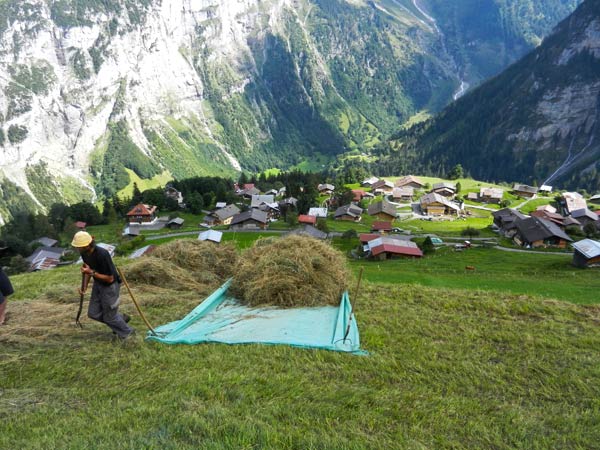
Cutting Hay in Gimmelwald

Climbing through steep fields of freshly cut hay on a sunny late afternoon, and getting to know a local farmer who climbs up and down all day without breathing heavily, gave a new dimension to a Swiss alpine village I’ve been visiting for over 30 years.

Farmer Peter piles hay onto a tarp tacked to the steep hillside by two pitchforks. The village of Gimmelwald was never developed like neighboring towns because its residents made sure it got rated “avalanche zone,” so developers couldn’t get building permits. Consequently, the town’s buildings are generally inhabited by locals all year long, while buildings in nearby towns (like Wengen and Grindelwald) are owned mostly by wealthy big-city folks who come by just a couple of weeks a year. The consequence: There's no real community in the resort towns, while Gimmelwald feels lived-in.

Farmer Peter and his boatload of hay bound down the steep slopes to an awaiting barn — its doors open wide in anticipation.

While I learn my lines, producer Simon Griffith sits in as my “body double” so cameraman Peter Rummel can frame and set up a good shot. Olle, our good friend from the village, stands by — helping as he always does when we come to town. Moments later, I took Simon’s spot and kicked off the third part of our three-part Travel Skills Special with one of my favorite on-camera show openers ever. It was fun because, rather than looking up at dramatic peaks cutting into blue alpine skies, this time we filmed down into a vast and fertile Swiss valley.

Thirty years ago, as a young tour organizer and guide, I kept my groups in the humble Gimmelwald youth hostel. One day I got a note from Walter Mittler, who invited me to the top of his village to tour his pension and to consider bringing my tour groups there. He convinced me, we moved “uptown,” and Walter’s Hotel Mittaghorn became a highlight of our tour groups’ alpine experience for over two decades. I visit Walter, who was born in 1924 and still runs his little hotel, whenever I’m in town. This time when I called him and asked how he’s doing, he said, “Everything still works.”

Hay, Gimmelwald!

Shooting our new, three-part Travel Skills Special was a particular joy for me because I got to revisit many of my favorite and original Back Doors. (We’re building 90 minutes of skills lessons around our “Best of Europe” tour route.) Here, high in the Swiss Alps in the village of Gimmelwald, I got to smell the hay in a whole new way, as we illustrated how traditional lifestyles and livelihoods survive throughout Europe.

If you can’t see the video below, watch it on YouTube.

Via Ferrata: The Iron Way

It’s hard to describe the thrill of the cable “hike” along the cliff under Mürren and over the Lauterbrunnen Valley. I hope these photos help take you there.

My friend Olle on a stroll along a cliff, 3,000 feet above the valley floor

I wouldn’t do this without a good guide

I was so scared, I barely looked down

Just climb the ladder

Finding a platform BASE jumpers use as their takeoff point

Reaching the end of the 1.25-mile cable

Having survived our little personal test, we were both very exhilarated

Via Ferrata — Scared Silly on the Iron Cableway from Mürren to Gimmelwald

I’m very careful not to list something in my guidebooks that might encourage our travelers to do a physical activity that’s out of their league. My favorite valley in the Swiss Alps has a new outdoor experience called a Via Ferrata, or “way of iron” — and, while locals were saying, “It’s great…no problem,” I decided to check it out personally.

I enlisted my B&B host, Olle, to join me. We hired a local guide, put on harnesses, and set out for what proved to be the highlight of my entire trip — and one of the biggest scares of my life. For the next several nights I awoke clutching my mattress. Here’s how I described it for the upcoming edition of our Switzerland guidebook:

Klettersteig Via Ferrata—Mountaineers and thrill-seekers enjoy a 1.25-mile steel cable essentially running from Mürren to Gimmelwald along the cliff. A Via Ferrata (literally “way of iron”) is a cliffside trail made of metal steps drilled into the cliff with a cable running at shoulder length above it. Mountaineers equipped with helmet, harness, and two carabineers make the three-hour journey always clipped to the cable. While half of the route is easily walked, several hundred yards are literally hanging over a 3,000-foot drop. I did it and, through the most challenging sections, I was too scared to look down or take pictures. Along with ladders and steps drilled right into the cliff, the trip comes with three thrilling canyon crossings — once by zipline (possible with guide only), once on a single high wire (with steadying wires for each hand), and finally over the terrifying hanging bridge (which you can see from the Gimmelwald-Mürren gondola ride, just above Gimmelwald). For a peek at the action, search “Via Ferrata Switzerland Murren” on YouTube. While experienced mountaineers rent gear (25 SF from the Gimmelwald hostel or Mürren’s Intersport) and do it independently, most should hire a licensed mountain guide (95 SF per person including gear and donation to the Via Ferrata, in small groups of 4 to 8, tel. 033-821-6100, www.klettersteig-muerren.ch, info@be-je.ch).


Convalescing in the Swiss Alps

With each television shoot this year, what could have been an easy job became demanding and stretched me to the max because the weather went south on us.

Mentally and physically fried after three weeks of guidebook research and TV production in Paris, I escape the big city, taking the train to the Swiss Alps. (En route, I email my editorial staff back home, saying I’m skipping Interlaken and that they’ll have to get someone else to update that city for our Switzerland guidebook. I need that Interlaken time to rest up.)

In Gimmelwald — a high-altitude village quaint and quiet as an Advent calendar — I check into the B&B of Olle and Maria Eggimann. Rustic and humble on the outside, perfectly cozy and charming on the inside, it feels made-to-order for the business at hand — convalescing and recharging.

Parked in my top-story window, gazing out at the village drenched in pristine nature, it occurs to me I’m part of an alpine cliché.  I marvel at how the best way to really enjoy the Alps is as a kind of cultural shock treatment — zipping here directly from Paris.

From my perch, I survey the village. Chocolate log cabins are buttressed by a winter’s supply of firewood lovingly stacked all the way to the eaves. Grassy fields radiate a vibrant green, as if plugged into the sun. Feeling part of the village — standing sturdy yet small under monster mountains — I marvel as nature puts my world properly in its place.

Leaving my shoes in the mud room and stepping into Olle’s slippers is like leaving my world and entering his. Now it’s purely people-to-people — the essence of travel — and we talk.

Appreciative of the hospitality I always receive here, I encourage Olle and Maria (as I do with each visit) to come to the States and visit. Maria says, “Now you’ve asked three times. We say you need three invites from an American before they really mean it. Now that our children are on their own, perhaps we will come.”

We talk about their experience as teachers in the village school. In the nearly 20 years they’ve been teaching here, the worldview gap between village kids and city kids has essentially vanished. A generation ago, village kids had more isolated views. Today they are as worldly as city kids — but you still know who’s who because city kids use umbrellas, while village kids just put up their hoods.

We talk of how running a B&B can try your patience. Olle recalls how one guest came to him distraught that her electronic noisemaker was burned out and wondered if they could loan her one. Olle asked, “What’s a noisemaker?” It makes nice sounds like birds and waterfalls so you can go to sleep. The need for such a device had never even occurred to Olle and Maria. We opened the door and stepped out onto the porch to enjoy a pianissimo lullaby of bird call, rushing water, and the calming rustle of leaves in the breeze. The same guests also needed an iron and ironing board, as their clothes were wrinkled. When preparing to go up on the mountain lift to the top of the Schilthorn, they asked how long the ride would be, and then, “Is the gondola car heated?”