 |
|
Enlarge photo
|
Swiss people are expert at living with nature. Their land, long a mountain fortress, is now a play round… “for big boys,” my friend Fritz adds. Fritz, a dynamo who runs my favorite little hotel in Interlaken, recently broke his collarbone. For the first time, I can keep up with him. He climbs a mountain on his bike just to see the sunset. I’m forever thankful to Fritz (who’s nearly my age) for alpine mountain-biking my son Andy into the ground — and then taking him “flying.”
Parasailing is Fritz’s passion. He is forever nagging me to “go flying.” Flying with Fritz (tandem parasailing) is his sideline. Andy still talks about his exhausting and exhilarating day with riding and flying with Fritz.
As a hotelier, Fritz is tuned into the phenomenon of Indians coming to the Alps in droves. “We love Indians — but they need to learn manners when staying in European hotels. We rent them a double, you turn your back, and you have seven people in the room — cooking curry on the carpet.” Fritz finds you can get out the smell, but not the stains. On regional buses, Indian tourists are so loud they even drown out the Americans.
Fritz explained that Indians are a huge part of Interlaken’s business. They come to see mountain scenes made famous in their movies. Kashmir is now too dangerous for movie production, and romantic Indian movies need mountain wonderlands for lovers to swoon with the maximum melodrama. (There’s even a restaurant now on top of the Jungfrau called “Bollywood.”)
I was with Fritz when a freak hailstorm pulverized Interlaken. It had been really hot. Locals — like squirrels before a storm — sensed it and were nervous. Something big was clearly coming. It got dark. Then…bam! Typhoon in the Alps. I parked my bike just in time to take refuge in the hotel.
 |
|
Enlarge photo
|
Standing on my balcony, I watched flower gardens hammered into pulp. The road became a river of flowing hail balls, leaves, and flower petals. Fifteen minutes later, we went out to survey the casualties: Fabric on chairs was ripped, an entire wall of old windows was left jagged, birds were stripped of their feathers and knocked silly. Car rooftops were blanketed in dents, and windshields were alligatored. I helped Fritz shovel the hail out of his basement before it melted. He joked, “A greeting from George W. Bush.” And then said it’s no problem–we Swiss are the most insured people in the world.
Of course GWB didn’t cause the violent weather and this is not the first hail storm to ruin a city’s cars. But, to people living close to the weather here in Europe’s Alps, the strange and changing weather is a troubling reality. There is a growing frustration with people who confuse their short term economic needs with the long term needs of the environment.
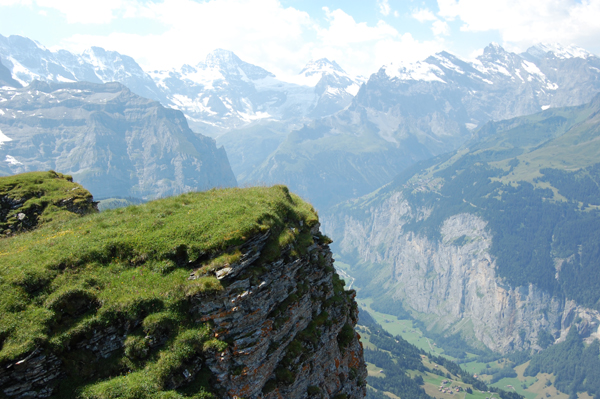
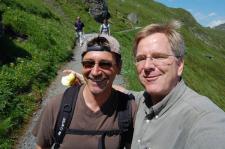
The next morning, Fritz and I went on a hike. Riding the lift to Männlichen, high on the ridge above Grindelwald and Lauterbrunnen, we stepped off and into a visual symphony: Before us towered the mighty Eiger, Mönch, and Jungfrau. Fritz, who worked at this mountaintop restaurant as a kid and bikes here for a little fresh air a couple of nights a week, talked of the changes he’s noticed here in the last decade. They’re subtle. Walking by a glacial pond, he recalls how, during his childhood, there would be hundreds of frogs singing. Now there are none.
 |
|
Enlarge photo
|
We studied a new ski lift being built. Before, they would just build a few towers. Now, a swath is cut right up the mountain as each lift is plumbed with snowmaking gear. Big water pipes stuck out of the concrete foundations seeming to trumpet a new age. You won’t have ski resorts in the future without manmade snow.
Today the Swiss ski industry is in crises: A third of the lifts are losing money, a third are in trouble, and only a third are good business. I pulled out the postcard Fritz gave me. Wiggling it, I saw the glacier come and go. The valley in 1907…filled with ice. The same valley in 2007…dry, with a shrunken glacier hanging like a hot dog’s tongue over the top of the valley high in the distance.
Gazing up at the North Face of the Eiger, Fritz tells me of speed climbers, leaving Interlaken on the early lift, scaling this Everest of rock faces, and getting back to Interlaken in time for a late-afternoon business meeting. Then he gets back onto global warming. As the permafrost thaws, there are more falling rocks, and mountain guides are abandoning once-standard ascents that are no longer safe.
Fritz is typical of Europeans who enjoy Americans enough to be comfortable challenging us with a political discussion. As I send them a good percent of their business through my guidebooks, they are careful not to upset me by angering my readers.
I tell him I believe part of the joy most Americans find in their travels is to be challenged by people who see things differently. I think one thing the Swiss and we Americans have in common is a self-assuredness that can border on arrogance. I asked Fritz how the American guests reacted to his interest in politics and if he saw a change in arrogance. He said there was a spike in arrogance a few years ago but that’s less so now.