Europeans Share Their Health Care Experience, Part 1: Scandinavia

To bring some diverse experience into the discussion on health care reform here in the USA, I’ve asked my friends in Europe to share how health care works in their lives. In this four-part series, we’ll start with the most highly taxed and socialistic part of Europe: Scandinavia.

From Hakan in Sweden:

In Sweden, we have free choice in health care. It means that patients can choose a hospital anywhere in the country.

In 2005, the cost of the health and medical care sector amounted to 8.4 percent of GDP (in the US, it was over 15 percent). This amount includes the cost of pharmaceutical products, dental care, eyeglasses, and patient fees paid by households.

We employ a “high-cost protection scheme” that means that no patient ever needs to pay more than a total of 900 SEK (about $125) over a 12-month period. For pharmaceutical costs, no patient has to pay more than SEK 1,800 (about $250) over a 12-month period for prescription drugs. This way, no citizen will be put into poverty because of health problems.

The fee for visiting a doctor or hospital varies from 100-300 SEK (about $14-32), but once you have paid 900 SEK in a 12-month period, the rest of the care is totally free — no matter what kind of treatment you need. Private-care providers are also “clients” of the government. A patient can choose a private doctor or hospital, pay the small fee, and the government pays the difference.

The health and medical services have an obligation to strengthen the situation of the patient, for example, by providing individually tailored information, freedom to choose between treatment options, and the right to a second opinion in cases of life-threatening or other particularly serious diseases or injuries.

Having lived here all my life and raised my family here in Stockholm, I honestly do not see anything bad with our health care system.

From Richard in Demark:

I have lived and worked in Denmark for 24 years and have had numerous encounters with the health care system. In all cases I was satisfied or impressed with the quality of service and the low cost (apart from the tax system — more about that later).

The health care system in Denmark is free to all who live here. Even visiting tourists will be treated free of charge in case of an emergency. A non-Danish friend of mine who sprained her ankle during a recent visit was X-rayed, bandaged, treated by a doctor, and even given a pair of crutches to use — and was not charged anything. She was only asked to return the crutches when she left Denmark.

The quality of Danish health care — which is not run on a profit motive — is very good, though there is a waiting time for some non-life-threatening operations like a hip replacement. But everyone will eventually get the operation they need. Hospitals are free, doctor visits are free, and medicine is highly subsidized so that those who need a lot of medicine get it at a greatly reduced charge. Dentistry is subsidized.

This is paid for through our tax system, which — at 52 percent — is perhaps the highest in the world. None of the 10 political parties in Denmark has ever wanted to change that, because they know that they would not get any votes. The vast majority of Danes are agreeable to pay these high taxes; they know that they get about 50 percent of the money back each year in a vast array of benefits. Seven out of 10 Danes are willing to pay even more taxes, if necessary, to maintain the health care system we expect.

Danes have the mature and realistic understanding that you cannot give everyone a quality health care system, good schools, and the elements that help to make for a good quality of life, without paying for it. Freedom does not mean not paying taxes. For us, freedom is paying taxes. By taking care of each other, and the weaker elements in our society, we all have a better quality of life with very low crime rates, few prisons, and a sense of security that it is not “me against the world.” That is part of what it means to be Danish.

From Hanne and Trond in Norway:

In Norway, everyone has, in principle, equal rights to health care. Norwegian hospitals are “free” for patients (being financed with taxes) and everyone is entitled to treatment, irrespective of income and insurance. However, many things are not always working well here.

When hospitalized, no one asks for insurance coverage. You can stay for as long as it takes without having to worry about costs. At the hospital, every part of the treatment is free, indefinitely. At home, people with chronic illnesses get medicine and necessary medical equipment almost for free, save for a limited, annual base payment.

But some parts of the system don’t function well. Depending on the illness, you could wait a long time for necessary hospital treatment (typically non-emergency surgery). For instance, you have to go through your family doctor in order to be referred to a specialist. When the family doctors have way too many patients and limited opening hours (and limited telephone hours!), this is often an obstacle. Of course, any emergency treatment is exempt from “queuing.”

As for the cost, the hospitals operate with a combined budget of approximately NOK 75 billion ($13 billion). Our health care is not free — we pay for it in our taxes: Our corporations pay a flat tax rate of 28 percent on their profits. Wage income is taxed under a progressive structure, from almost zero (very low, part-time wages) to a maximum marginal tax rate of 54 percent. The average “industrial worker” has a tax rate of 30 to 35 percent.

Hairspray and Vikings

I’m back in Edmonds now, finished with research and filming for the year. Like a big-game fisherman, finally back in port, I am pleased that we have six great shows in the cooler.

When filming I don’t give my wardrobe a second thought (obviously). The idea of putting on makeup is laughable. And I’ve never put anything on my hair…but the hair causes me problems. While I’m not picky about other things, I don’t like my hair blowing funny. If the wind is coming at me head-on, it’ll actually give me a good wind-blown look. But if it’s blowing against the grain, we have to wait for the wind to die down before we keep shooting. For a decade we’ve been waiting. We routinely lose great on-camera bits because of the wind and my hair. A couple times I’ve toyed with “product,” but I just can’t bring myself to use it.

As we were wrapping up our last show of the season, we were grabbing some glorious sun in windy Stockholm for on-cameras, and my hair was causing everything to grind to a halt. The weather was changing and we had to get the on-cameras shot. Someone said “hairspray,” and our local guide popped into a fancy hotel and bought a can. Simon, my producer, took me aside and spray-painted it all over my head. I stood on the pier with the wind coming at me from the wrong direction, nailed the on-camera, and the hair was perfect. It was like I’d just discovered hairspray. For ten years I’ve been fighting the wind. Now, as we wound up this shoot, I finally discovered hairspray. I have a new (and unlikely) friend.

Along with hair, I worked on taming Nordic history. I discovered how Scandinavians define their Middle Ages (which they do differently from the rest of Europe, because there was no Roman Empire to fall up in the north). The Viking Age is defined by the first and last Viking raids on England: 793 and 1050 A.D. And in Scandinavia, medieval times are also called the “Catholic Era” — stretching from the end of the Viking Age and the coming of Christianity (around 1050) until the Reformation (1527).

I got some more clarity on Scandinavian history. There were different Viking groups in each country. As Vikings, Norwegians went west to Iceland, Greenland, and America; Danes went south to England, France, and the Mediterranean; and the Swedes went east into Russia. (The word “Russia” has Viking roots.)

While Swedes went abroad readily, they were slower to open their doors to non-white immigrants. But Sweden has come a long way when it comes to accepting immigrants, as a popular story illustrates. In 1927 a black man worked in a Stockholm gas station. For Swedes who hadn’t traveled, he was the first black person they’d ever seen, and people journeyed from great distances to fill their car up here, just to get a look at him. (Business boomed, and his job was secure.)

Photos: Illustrating Scandinavia

A million people on this planet speak Estonian. When visiting Estonia, I’m inspired by a distinct and proud culture that somehow has survived living between Russia and Germany over the centuries. The language is unrelated to most European languages — and so are many of the deep-seated customs. For instance, Estonians bury their loved ones in forests so that they ultimately “live” with the trees.
Enlarge photo
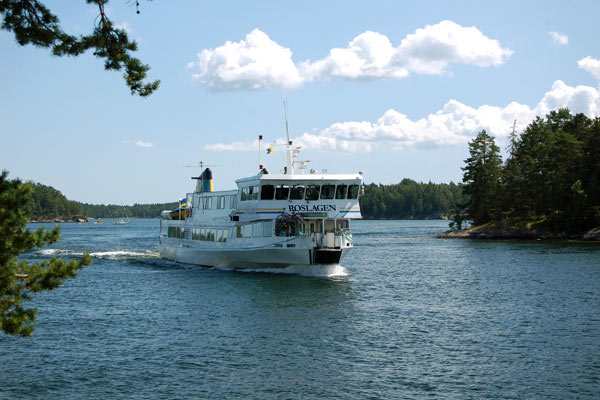
For years I’ve flown over Stockholm’s famed archipelago, or glided by it on a big cruise ship heading for Helsinki. Eighty miles of scenic islands stretch out from downtown Stockholm. (Locals love to brag that there are 34,000 islands — but that must count mossy little rocks, so I ignore that figure.) A hundred of them are served by ferries, providing Stockholmers with the ideal island escape. This year, finally, I did good research on the archipelago. It’s covered in our upcoming Scandinavia guidebook, and we had a gloriously sunny day that allowed us to include it in our upcoming Stockholm TV show.
Enlarge photo
Ice bars must be good moneymakers — $25 entry includes one vodka drink not “on the rocks” but “in a rock” — because they are popping up all over Europe. While they’re environmentally stupid, if it ever felt right to be in an ice bar, it would be in Stockholm. Apart from an actual ice hotel (in north Sweden’s Lapland), this ice bar is the original — with ice actually shipped down from Lapland.
Enlarge photo
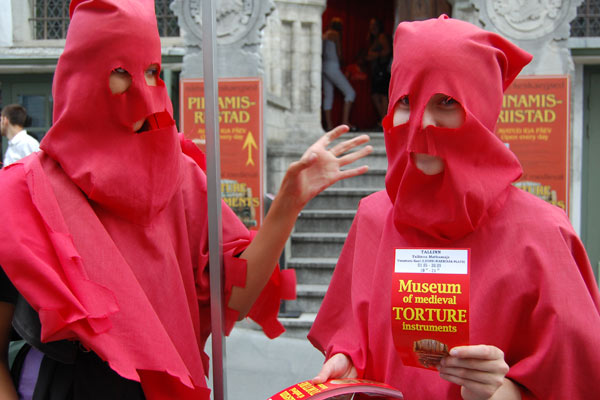
All over Europe, stupid torture exhibits are cleverly marketed. They make lots of money by appealing to the lowest desires of dumbed-down travelers. Nearly every major city has a “torture museum.” None have any real artifacts. I think there must be a catalog somewhere allowing people to equip a building with the scary and gory gear needed to open up a torture museum. The catalogue must promise that there will be an endless stream of bored tourists willing to pay $15 to ponder creative ways people have maimed and mutilated other people through the ages.
Enlarge photo
Even in notoriously expensive Scandinavia there are cheap ways to enjoy the good life. In Stockholm — the least expensive of the Scandinavian capitals — the old town is filled with feisty and competitive restaurants offering lunch specials for $10 (hot plate, salad, bread, and a drink). I can’t get that in my home town of Edmonds.
Enlarge photo
Those darn Scandinavians are so socialistic. Here some pinko dad is enjoying paid paternity leave with his new baby. Can you believe that each Swedish couple gets to split 16 months of parental leave? What ever happened to family values? And who’s paying for that? They probably have to raise their families with some single-payer health care system too. Incredible.
Enlarge photo
Berlin must be one of Europe’s cheapest and liveliest capitals. And when you want to eat cheap and lively, find the neighborhood Currywurst shop and munch with the locals.
Enlarge photo
The remains of your Currywurst plate might stoke the appetite of an abstract artist.
Enlarge photo

Killing Clichés and Chasing Lens Lice

Checking in with my Norwegian cousin Kari-Anne and her husband Knute, we got a little dose of the Scandinavian good life — while filming the delightful Oslofjord.
Enlarge photo

Europe is moving beyond its old-time clichés, and I’m weaning myself from these too. In fact, my theme this year, in both TV production and guidebook writing, has been to purge things that are recommended just because they’ve always been there. Sometimes it’s difficult after decades of singing a cultural tune to realize the melody has changed. This year I find myself thinking, “That was big in the 1980s, but…” as I work to keep my take on Europe fresh.

In Norway trolls may still be in the shop windows, but they have no business in a guidebook or TV show. Goofy legends about modern-age buildings having roofs inspired by upturned Viking ships are out. Sweden used to be a porn capital — but so much modern-day freedom in that regard seems to have made that industry passé. I remember when the TV towers in Berlin, Stockholm and Oslo were as breathtaking as Seattle’s Space Needle. Oslo’s is now closed to the public and the others are barely advertised.

There was a time when travelers ventured to Stockholm and Helsinki to see planned suburbs like Farsta and Tapiola — suburbs that organized people as if in juke boxes…and people clamored to get in. No one even talks about these places anymore. In the 1980s it seemed every other tourist in Helsinki was an architect, there to marvel at the modern buildings. Today Helsinki’s once-striking Finlandia Hall, by Alvar Aalto, is only striking out. I’ve always listed the Kon-Tiki Museum in Oslo as a must-see. It was one when it captured the imagination of would-be sea adventurers a generation ago. Today, the museum seems to be going the way of the log boat.

I have also realized that I need to be careful not to romanticize the nobility and intelligence of a people I’m predisposed to be impressed by. It’s so much fun to bump into entire societies that are both good-looking and seem to have it all figured out. You could travel through a place like Norway and think everyone was brilliant and beautiful. But seeing racks of National Enquirer-type tabloids in Bergen — papers as cheesy and idiotic as ours and England’s — reminds me that no society is immune from low-brow culture; there’s a huge market for that everywhere.

Having spent more time in Scandinavia this summer than ever before, I enjoyed a great chance to reconnect with my wonderful relatives. My uncle Thor in Sandefjord is a patriarch with beautiful grandchildren galore. My cousin Kari-Anne is a publisher with a fascinating circle of friends; she lives in Oslo, enjoying the best of Norwegian big-city life. And Hanne, the baby I held while watching the first moon landing, has three kids old enough to stay up late and contribute to our conversation.

Ten years ago, while filming in Bergen, Hanne kept sneaking into our shots. In Norway, she said, those obnoxious types who always try to get into the picture are called “lens lice.” I asked her if she’d like to be a part of the new show we’re filming, and she said, “My lens lice days are over.” (While I strongly disagree, I didn’t argue.)

I spent an evening with Hanne’s family enjoying the fun conversation. We talked about the challenges modern Norway has with immigrants. In this Lutheran corner of Europe, they explained, everyone enjoys the freedom to practice their religion, as long as the practice doesn’t violate Norway’s constitution, which guarantees a range of human rights — including women’s rights, gay rights, and children’s rights (e.g., parents are forbidden to beat their children). Fathers are intimately involved in parenting. In fact, throughout Scandinavia, rather than “maternity” leave, new moms and dads share 16 months of paid leave (dividing it as they like).

Hanne’s kids sat attentively as they soaked up the conversation. Hanne’s 13-year-old daughter speaks English so well that she played a game speaking American with her mom and British with her dad (as that’s how each speaks English with her). I asked her about cigarettes, alcohol, and marijuana. She said she and her friends had no interest in any of that. She explained that the government tried the “bad for your health” line in their education campaigns, and it was worthless. Then the schools started teaching that cigarettes made your skin ugly, stained your teeth, and gave you bad breath. They taught that alcohol lowers your metabolism, making you get fat more easily. This appeal to teenagers’ vanity, rather than their health, was by all accounts wildly effective.

By my small survey, I’ve found that throughout Norway and Sweden there’s extremely little interest in marijuana. People just don’t seem to even be intrigued by it. On the other hand, among young people (other than my relatives, of course), it seems that casual sex is rampant.

I have my vices though, and so does my film crew. We like a good drink after a day’s work. With the cost of alcohol here, we drink beer when we’d normally have a glass of wine. (A glass of beer here costs what a glass of wine would cost elsewhere, and wine costs much more.) And we got addicted to dropping by the ubiquitous convenience stores for a box of Iskaffe (iced coffee) — available for 19 krone ($3), the cost of a reasonably priced latte in a café. I am still fascinated by how this affluent corner of Europe seemingly prices so much of its populace out of restaurant going. Convenience stores fill the gap for people without much money — providing cafeteria lines of whatever you need, to be munched on benches or on the fly.

Nordic National Galleries: More than a Scream

In the last week, I’ve been in three national galleries: in Oslo, Stockholm, and Helsinki. Each one is a hardened little palace of culture, showing off the nature of the land and the psyche of its people in a proud and central architectural jewel box.

It just seems obvious that a national gallery would give a probing view into a people. Of the many national galleries, Scandinavia’s do this extremely well. (Others that come to mind — like London’s and Washington DC’s — mix it up with more generally great art.) But in a little country (with no history of art-grubbing royalty), in a land where the visitor who hits it on a bad month might wonder why anyone would want to even live up here…much less paint, a national gallery works to show visitors that people who live here are not nuts. (Do you have a favorite national gallery for giving an insight into a particular culture?)

In each case — whether Norway, Sweden, or Finland — the paintings exaggerate the power and awesomeness of nature. In those tangled, plush, tumultuous symphonies of nature, the piccolo section is the country folk — people in traditional peasant costumes, tiny but in sharp focus…surviving with grace. Or, in the most famous painting in Scandinavia, just letting out a bloodcurdling Scream.

Like the Swedes have Carl Larsson, each country has its Norman Rockwells who painted almost photorealistic looks at 19th-century Scandinavian life. Rather than paintings celebrating kings and popes, it’s people’s art — a bridal voyage (perfect to show off the traditional jewelry and formal wear), low church devotion (perfect to show the strength of renegade Lutherans not following the state dictates — until they ran out of patience and moved to Wisconsin), and solid families at work and play.

And the “slice-of-life” scenes seem to just as often be slice-of-death scenes: a stoic family filling their rowboat, oaring in the coffin of a dead daughter, her sister clutching the funeral flowers through the bitter ride, and the harsh season clear on the weathered faces of the heartbroken parents.

And there are the struggles with a puritan 19th-century Protestant society, and the psychological problems that result. Basically (if you spent much time with Edvard Munch), messed-up men who didn’t know how to handle women.

As is the case with so many minor cultures in Europe, the 19th century was a time of resurgence and awakening — Finns holding back Russification, Norwegians distinguishing themselves from the Danes and Swedes. Legitimacy can be founded on epic myths. In each of the galleries, huge murals celebrate the Paul Bunyan beginnings of their nationalities. In The Mid-Winter Sacrifice, the noble Viking king prepares to sacrifice himself to the gods so spring will return and his people will be fed. In The Wild Hunt of Odin,the rowdy horde of Viking-like warriors gallops across the sky, snatching up unsuspecting maidens and the souls of sleepers forever.

I’d suggest that anyone traveling across Scandinavia use each country’s national gallery as a cultural springboard for venturing further from the capital.