It’s Mardi Gras! In this clip from my public television special Rick Steves’ European Easter, we visit Switzerland and Slovenia to join local celebrations of Fat Tuesday.
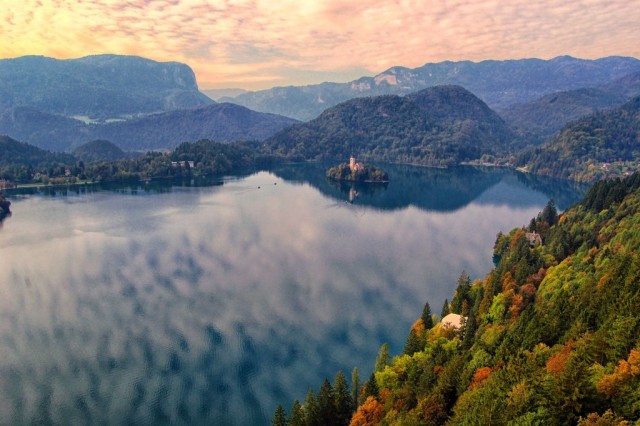
Cameron’s Photos of Lake Bled in All Seasons
I love how you can return to a place in different seasons and in different weather, and it refreshes itself endlessly. Among my guides and researchers, Cameron Hewitt (co-author of many Rick Steves guidebooks) is evangelical about Slovenia. As if to make believers out of those who don’t fully appreciate what he considers the most under-appreciated corner of Europe, Cameron has put together an amazing collection of photos of one lake over 15 years. Check out Slovenia’s Lake Bled through the seasons on his blog now.
By the way, if you enjoy Cameron’s take on Europe, be sure to “like” his Facebook page — he’s heading off to Europe in a couple of days and will be reporting from Italy’s Cinque Terre and Dolomites, Salzburg, and the Austrian Alps before meeting up with me and our TV crew in Bulgaria and Romania. Don’t miss out on Cameron’s keen insights.
“Foodie” Doesn’t Have to Mean Expensive: Cameron’s €25 Day in Ljubljana
As I like to do every couple of weeks, today I’m sharing a post from Cameron Hewitt (co-author of many of my Europe guidebooks). Cameron’s current blog series illustrates why Slovenia (of all places!) is his favorite country. And this post explains how a foodie may find that Slovenia’s surprisingly hip food scene may help the country find its way into your heart through your traveling tummy. If you like this insightful look at an underestimated corner of Europe, be sure to “like” Cameron’s Facebook page. Enjoy:
“Foodie” Doesn’t Have to Mean Expensive: Cameron’s €25 Day in Ljubljana
By Cameron Hewitt
“Foodie-ism” comes with a generation gap — just like the Charleston or the Beatles. And when I mention Foodie-ism to Baby Boomers, many seem to think “foodie” means “expensive.” But it doesn’t have to: It’s about the quality of the ingredients, the care of the preparation, and a knack for merging innovation with a healthy respect for tradition.
Slovenia — for my money, the most underrated country in Europe — embraces tradition and lives close to nature, but also has an un-snooty sense of style and sophistication. That’s an ideal mix for foodies on a budget. On my September trip to the Slovenian capital, Ljubljana, I had one of my best “eating days” of the year. I’d categorize each place I went as “foodie.” And I spent a grand total of €25.

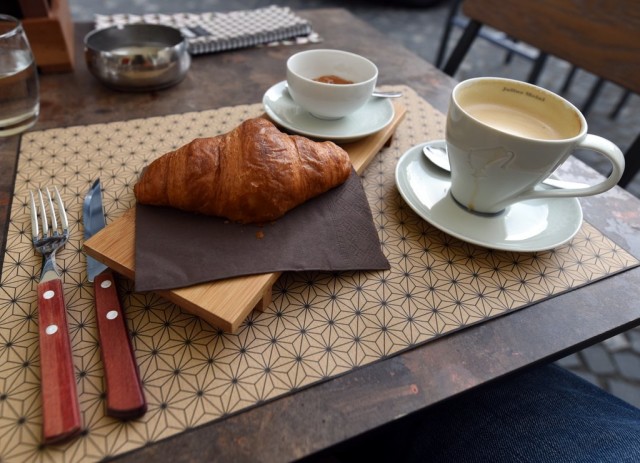
I was staying at a perfectly located rental apartment (Meščanka, overlooking the most colorful stretch of Ljubljana’s riverfront), so I was on my own for breakfast. They steered me to a fine little café in the mellow pedestrian zone under the town hall’s bell tower. I ordered a bela kava (like a latte), a glass of fresh-squeezed orange juice, and a crispy croissant. Total cost for breakfast: €6.
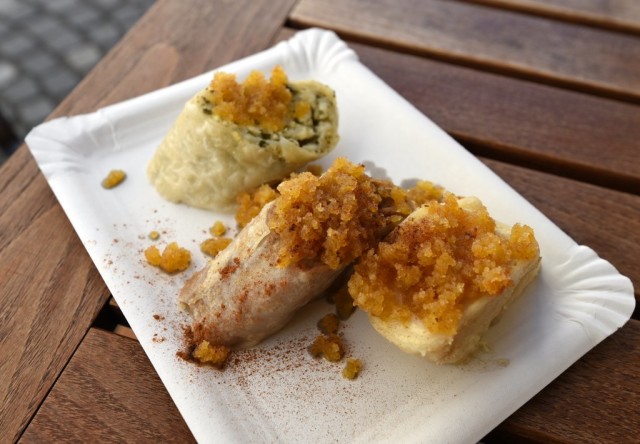
For lunch, I stopped by a hole-in-the-wall called Klobasarna. They specialize in doing one thing, and doing it very well: rustic sausages from the region of Cariniola. I got mine cut up into a bowl of jota — a traditional Slovenian soup made with marinated turnip. (Last summer, I got some heat on my blog for saying “cassoulet” must be French for “bowl of farts.” My hunch is that jota carries the same meaning in Slovene.) Klobasarna recently added one more traditional Slovenian item to the menu: štruklji, boiled dumplings stuffed with various fillings. One had tarragon, another had cottage cheese, and the last one — essentially a dessert — had walnuts and cinnamon. Sprinkled with coarse, buttery, sauteed breadcrumbs to complement the smoothness of the dough, they were both flavorful and a textural treat.
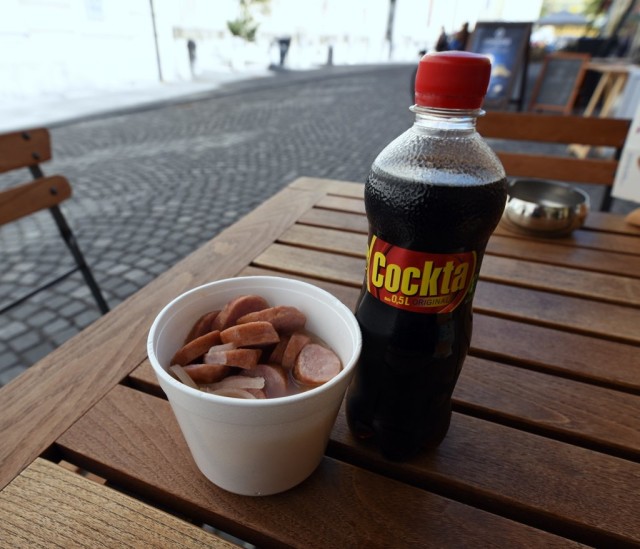
I washed the meal down with Cockta, one of those soft drinks that’s fiercely beloved in its homeland but utterly unknown everywhere else. (Cockta comes with its own epic origin story — how it was originally called “Cockta-Cockta,” and designed as an ersatz Coca-Cola during the austere Yugoslav period — but you’ll have to pick up my Rick Steves’ Croatia & Slovenia guidebook for that.) I took my order out to a tipsy table on the cobblestones, in the heart of one of Ljubljana’s most delightful pedestrian zones. Watching the tour groups follow their guides and the bikes whiz past, I had a delicious and filling meal. Grand total for sausages, jota, štruklji, and Cockta: €8.
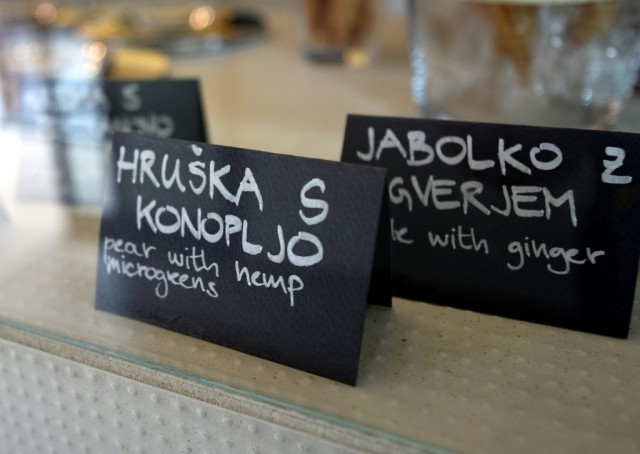
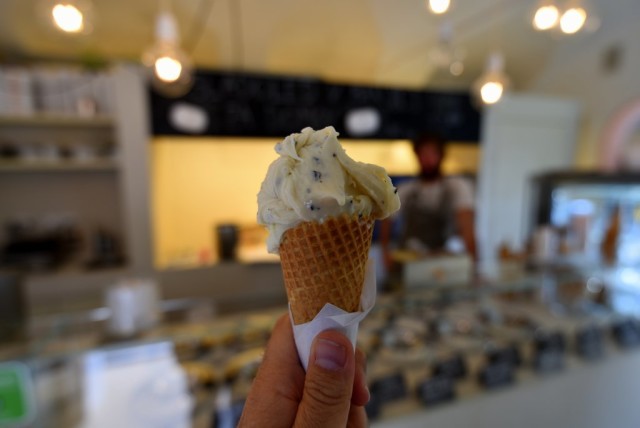
For a midafternoon snack, I stopped by a buzzy new gelateria called Romantica. Behind the glass counter, tidy silver-lidded containers held an array of deliriously creative flavors: chocolate-rosemary, pear with hemp microgreens, melon-arugula, line-basil, and so on. They also had some distinctly Slovenian flavors: pumpkin oil (a local favorite for salad dressings) and the national dessert, potica — a hearty nut layer cake with cinnamon and a drizzle of chocolate. Because Romantica doesn’t use artificial colors, everything’s white (except the chocolate). The clerk told me that he was in the middle of making that afternoon’s batch. He showed me a tub of fresh nectarines, just sliced and ready to toss into the blender. He was also preparing their chocolate and chili flavor, and explained that they’ve been experimenting to find just the right kind of chili powder to finish a pop of chocolate with that satisfying back-of-throat tingle. Total for ice cream: €2.
For dinner, some local friends took me to one of the hot new places in town, which prides itself on putting substance over style: Hood Burger. Taking “unpretentious” to extremes, it’s a glassed-in kiosk on the grassy fringe of the parking lot of the Interspar supermarket.

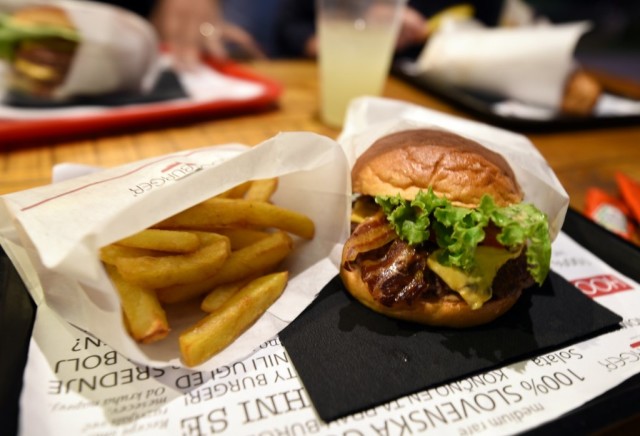
I’m skeptical of burgers in Europe, where they usually taste…off. The wrong mix of meat. The wrong spices. But the owners of Hood Burger, Til Pleterski and Klemen Ptičak, did their homework. Every bit up to speed with the hipster foodies in Portland or Brooklyn, Til and Klemen pride themselves on using locally sourced ingredients (“100% Slovenian beef!”), and cultivate a personal relationship with their producers. And the results speak for themselves: the best burger I’ve had in Europe. Hood Burger also has three house microbrews on tap. And on each table is a bottle of Čili Pipp sauce, the award-winning local answer to Tabasco started by a Slovene who simply enjoyed planting chilies in his backyard. Total cost for burger, fries, and mint lemonade: €9.
Slovenia — and Ljubljana in particular — is an ideal place for an affordable foodie experience. Sure, you could splurge on an upscale feast here. But sometimes the best meals are eaten outside, with plastic utensils.
Tito Said ‘No’ to Stalin…and We Look Suspicious with No Beards
We’ve been filming new TV shows in Slovenia, Croatia, Montenegro, and Bosnia for nearly three weeks.
 |
| Tito may have been the father of his country, but he’s dead and the only image I saw of him in the 20 days I spent in the former Yugoslavia was on this T-shirt. Enlarge photo |
Talking with locals about their memories of growing up in Yugoslavia (which broke apart in the 1990s), people have generally good memories of the times. Marshal Tito (its strong-arm dictator) is remembered in a single phrase: “He said ‘No’ to Stalin.” People remember the stability. And time and time again people said, “It was a good time…we could travel.”
Yugoslavians were free to travel when other Communist Europeans could not because they were happy to return. Locals here remember when their “Red Passport” was worth more on the black market than an American passport. That’s because Yugoslavia was on good terms with — and its citizens could travel in — both the First World and the Second (Communist) World.
People in these countries speak what used to be called Serbo-Croatian (or Croato-Serbian depending on your ethnicity). Today the languages are all still essentially the same but, as required by each new country’s constitution, they are called Bosnian, Montenegrin, Serbian, and Croatian.
Europeans differ in how their national pride compares with their pragmatic need to connect with the rest of the world. You can read it in the letters they choose to indicate their country on car license plates and road signs. Croatia is proud: “Hr” for Hrvatska. Hellas is pragmatic: “Gr” for “Greece.” Germany is proud: “D” for Deutschland. Östereich is pragmatic: “A” for “Austria.” Magyarország needs to be pragmatic: “H” for “Hungary.” France doesn’t need to show its cards since Franceis French for “France.”
It’s interesting to see how the images lodged in my mind from past trips ripen in my head over the years — or simply change with the country. I write a script calling for a great view, painting, café, or experience — we go there and my cameraman wonders “what were you thinking?” Years ago in Croatia, there were lots of goats roasting on spits. People’s tastes have changed, the cost is up, and a goat slowly spinning over a grill is no longer an icon of the region. (Actually, in three weeks traveling here, we’ve seen less than 100 head of any kind of cattle, sheep, or goats.) It’s like my image of Greece with old guys drinking retsina wine. The Greeks are into better wine now, retsina is considered rotgut, and it has faded away from the tavern scene.
I’ve noticed every region of the Mediterranean is pushing its wine industry. Occasionally, regional pride blinds them to quality. Each region of the former Yugoslavia seems proud of the wine they produce — and none of it is any good compared to what I drank in Spain, France, and Italy. I find wine here on par with Greece. The difference: Here waiters actually admit it’s overpriced. We paid $40 to try a bottle of the best wine in Croatia. In Greece, I asked a wine merchant what local wine he’d buy for $30. He said, “With $30, I’d get three $10 bottles.”
We’ve had some great people moments, especially in remote Montenegro. Dropping in on a mountaintop, Serbian-Orthodox monastery, the monks (their long black beards matching their long black robes) told me, “You look suspicious with no beards.” In prepping them for my interview, I said part of our mission was to help Americans understand rather than fear people who were different. They joked, “We’ll have to prove to them they have reason to fear.”
Later, in the middle of a Montenegrin nowhere, we met an American family traveling with their 91-year-old mother. We shared stories of beautiful times we’ve enjoyed and lessons we’ve learned getting to know the people in this region.
Later, the grandma gave me the most encouraging compliment I’ve heard on this trip. I had to call my film crew over so she could repeat it. “Your TV show inspires me to keep going when I should be staying home.”
Risk Having the Door Slammed in Your Face — To Risk Being Invited In
We just finished filming a new show on Slovenia and it occurred to me that a tiny, typically overlooked nation of two million people is diverse and fascinating enough to pack a fine, 30-minute program. Discussing this with my camera crew, I dreamed up a new measure for shows: locals per script.
I wondered out loud if this ratio was the lowest population per episode of the hundred and some shows we’ve done so far: one show for two million people. Then we remembered Ireland — four shows for four million people. Poland — one show for 40 million — is about our worst by that measure. Thirteen shows on Italy is a lot but still some five million Italians per episode.
Relating back to our recent discussion of noisy American travelers: Travelers needing to avoid the noise can go to smoking sections — where they still exist. I was once settling into the scenic “Norway in a Nutshell” train ride from Oslo to Bergen. My car was a noisy commotion of American tourists. You know I love Americans — even noisy ones (a group to which, on occasion, I belong). But I was in a quiet mood…just wanted to be me, the rhythm of the rails, and Norway’s best mountain scenery. I simply moved to the smoking car — not a tourist in sight, just quiet Norwegians.
The same trick works in restaurants. If you don’t like the tourist noise…move to the smoking section (or dine after nine when the tables are filled with discrete Europeans rather than Americans who dine earlier).
Here are some thought-provoking comments I’ve heard in the last few days: Rome is no Legoland. I’m very much against gastronomic fundamentalism (go ahead, drink red wine with fish). The last games with the Olympic spirit were Sapporo in 1972 (then came Munich). Slovenian women have the strongest handshakes in Europe. Croats seem self-assured in their ineptitude. Seeing the decrepit and massive old factories here makes me nostalgic for my stamp collection.
Walking across an almost desolate square in the almost desolate Istrian Peninsula hilltown of Motovun a couple nights ago, I was marveling at how dead the town was. Then I heard a men’s a cappella group practicing. I snooped around to find out where they were. Around the corner, I went up a short flight of stairs and stared at a closed door separating me from their heavenly singing. I gently pushed the door open just a crack to see the group. It was a dozen men sitting in a half-circle with their backs to me, led by a woman director with springy hair who looked like a mad, young, female Beethoven standing before them and her electric keyboard. She saw me, abandoned her group, and literally ran to the door I opened. She opened the door further and invited me in with enthusiasm in keeping with her directing style. I pulled out a chair and savored the chorus — a traditional klapagroup typical of the Dalmatian Coast.
Bringing in my film crew, producer Simon agreed it was a magic moment…and we captured it, kicking off our Croatia episode with a wonderful bit of what we call “positive serendipity.” The lesson (which I intend to work into the script): when out wandering, poke around and risk having a door slammed on you — in order to risk being invited in.