Open Mic at the Fado Joint

When traveling in Europe, we seek out the living traditions. And many of them survive only as clichés for tourists watching tacky stage shows. But Portugal’s fado (traditional, mournful folk tunes) can still be enjoyed in rustic, authentic settings like this characteristic little eatery (Restaurante A Baiuca, recommended in my guidebook), deep in Lisbon’s Alfama. I filmed in this joint years ago, capturing a magic moment for our TV show–and it’s been in my guidebook ever since. I was anxious to return, afraid that the magic would be gone. Thankfully, it survives. This is “fado vadio”–open mic where any amateur (like the man here) is welcome to share a song. Eating dinner here, with a line of neighbors hanging outside the restaurant door waiting their turn to sing, makes a delightful memory. The cost? Just buy dinner–about $20 with lots of wine.

If you can’t see the video below, watch it on YouTube.
Uncovering Hidden Meanings with a Local Guide

I’ll be researching, filming new TV shows, and enjoying our Best of Europe in 21 Days tour in the next two months. Each day of my research time I’ll be paling around with a local guide. This is my luxury as every minute spent with an expert and translator and friend at my side is filled with learning and insights I wouldn’t enjoy otherwise. Anyone can hire local guides to brighten their travels. In Portugal it costs about €100 ($130) to have your own private guide for four hours. Here, my guide Alex is taking me on a little scavenger hunt through Lisbon’s castle town (built back when nobles needed a safe place within the castle walls). She’s showing me new things I never noticed even after 20 years of visits to Lisbon.

If you can’t see the video below, watch it on YouTube.

Checking In with Lisbon

Lisbon feels to me like Europe’s San Francisco with rattling trolleys, a famous suspension bridge, a heritage dominated by a horrific earthquake (1755), and lots of fog. I’m kicking off my two months of spring research here–and I’ve hit the ground running to be sure everything in my Rick Steves Portugal guidebook is up-to-date for the 2015 edition.

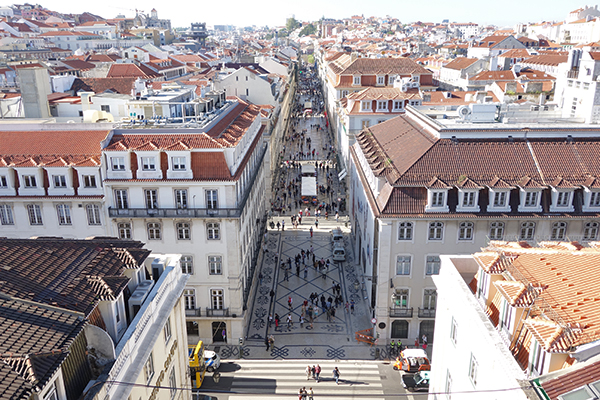
Rua Augusta: The triumphal arch that serves as a gateway to the city is now open for visitors, affording a grand view down the main drag, Rua Augusta.  As can be seen from the top of the arch, the center of town was rebuilt in a strict grid plan after the earthquake/tsunami/fire of 1755 left Lisbon a smoldering pile of rubble.
Rua Augusta: The triumphal arch that serves as a gateway to the city is now open for visitors, affording a grand view down the main drag, Rua Augusta. As can be seen from the top of the arch, the center of town was rebuilt in a strict grid plan after the earthquake/tsunami/fire of 1755 left Lisbon a smoldering pile of rubble.
Lisboners Like Their Sidewalks Slippery and Artistic: Lisbon’s characteristic limestone and basalt mosaics (calçada) decorating its sidewalks are an icon of the city. But they are slippery and expensive to maintain. With the tough economy, the city government is talking about replacing them with modern pavement. Lisboners are saying no way.
Quiosque Cafés Bring Life to Lisbon Miradors: Kiosks ("quiosques" in Portuguese) are the rage in Lisbon, giving squares and miradors (viewpoints) an outdoor café ambience. Judging by the crowds enjoying the spring sunshine, the economy is showing signs of happiness.
Quiosque Cafés Bring Life to Lisbon Miradors: Kiosks (“quiosques” in Portuguese) are the rage in Lisbon, giving squares and miradors (viewpoints) an outdoor café ambience. Judging by the crowds enjoying the spring sunshine, the economy is showing signs of happiness.
Fish Dinner...Cheap, Fresh, Tasty, and Memorable: Characteristic hole-in-the-wall diners hustle for business and offer both fresh fish and great prices. I always look for a small, handwritten menu in the local language only posted on a low-rent street filled with locals; that's my key to a good value. My longtime favorite in this crusty corner of town went out of business, so this eatery will take its place in the new edition. Prices in Portugal are amazing--hearty meals for €9 and they’re big enough to split...and that’s in the capital city. It gets cheaper in the smaller towns.
Fish Dinner…Cheap, Fresh, Tasty, and Memorable: Characteristic hole-in-the-wall diners hustle for business and offer both fresh fish and great prices. I always look for a small, handwritten menu in the local language only posted on a low-rent street filled with locals; that’s my key to a good value. My longtime favorite in this crusty corner of town went out of business, so this eatery will take its place in the new edition. Prices in Portugal are amazing–hearty meals for €9 and they’re big enough to split…and that’s in the capital city. It gets cheaper in the smaller towns.
Basta to Bankers Around the World: Locals are saying "basta" (enough) to financial austerity. The discussion these days in Portugal is how the finances of this society are rigged to keep the 99 percent down. Locals sing a sad song I’ve heard before: The banks, politicians, and economic elites are working together; the working blokes get the shaft; and the rich just get richer.
Basta to Bankers Around the World: Locals are saying “basta” (enough) to financial austerity. The discussion these days in Portugal is how the finances of this society are rigged to keep the 99 percent down. Locals sing a sad song I’ve heard before: The banks, politicians, and economic elites are working together; the working blokes get the shaft; and the rich just get richer.
Demonstrating with Smiles: In post-crisis Portugal (like Spain, Greece, and other countries with struggling economies) you’ll find workers and retirees complain by marching. In Portugal, the people are so sweet that demonstrations feel like festivals. I don’t know exactly was getting the brunt of their dissatisfaction, but it gave me warm and fuzzy feelings all over.
The Dictator’s School Books: Portugal has come a long way in the last generation. They overthrew their authoritarian government in the early 1970s--four years after the death of long-term dictator António Salazar. It’s amazing to think that within living memory Hitler, Mussolini, Franco, and Salazar were all buddies in Europe’s club of Fascist dictators. Today, you can buy textbooks reprinted from a time when schools were propaganda tools of the government.
The Dictator’s School Books: Portugal has come a long way in the last generation. They overthrew their authoritarian government in the early 1970s–four years after the death of long-term dictator António Salazar. It’s amazing to think that within living memory Hitler, Mussolini, Franco, and Salazar were all buddies in Europe’s club of Fascist dictators. Today, you can buy textbooks reprinted from a time when schools were propaganda tools of the government.

Barnacles and Bratwurst at the End of Europe

If you look at the map, it’s clear that Cape Sagres — at the southwest tip of Portugal —is also the geographical end of Europe. It’s understandable that in the days before Magellan and Vasco da Gama, this was considered the end of the world. Today travelers come here just to find the end of the road. The wives of fishermen sell hearty sweaters, knit while their men are at sea. And a small food stand advertises the” last Bratwurst before America.”

9-last-bratwurst

Goose barnacles, called percebes in Portugal, are a delicacy. They are expensive because they're dangerous to harvest — on rocky promontories where the waves are fierce. They’re nice to munch with a beer. And 300 grams with toast and a salad make a wonderful lunch.
Goose barnacles, called percebes in Portugal, are a delicacy. They are expensive because they’re dangerous to harvest — on rocky promontories where the waves are fierce. They’re nice to munch with a beer. And 300 grams with toast and a salad make a wonderful lunch.

Cape-Sagres

It’s Nice When the Chef Caught the Fish

Paulo at Restaurant O Lourenco in Salema, Portugal, knows his fish. Either he bought it himself at the fish auction in the next town, or he actually caught it himself. After lunch, he took me into the locker for a peek at dinner.

If you can’t see the video below, watch it on YouTube.