Daily Dose of Europe: Seaside Traditions in Portugal’s Nazaré

Perched on a far corner of Europe, a bit like these two birds, Nazaré is one of my favorite beach towns anywhere. It greets me with the energetic applause of the surf, widows with rooms to rent, and fishermen mending nets.

Even though we’re not visiting Europe right now, I believe a daily dose of travel dreaming can be good medicine. I just published a collection of my favorite stories from a lifetime of European travels. My new book is called “For the Love of Europe” — and this story is just one of its 100 travel tales.
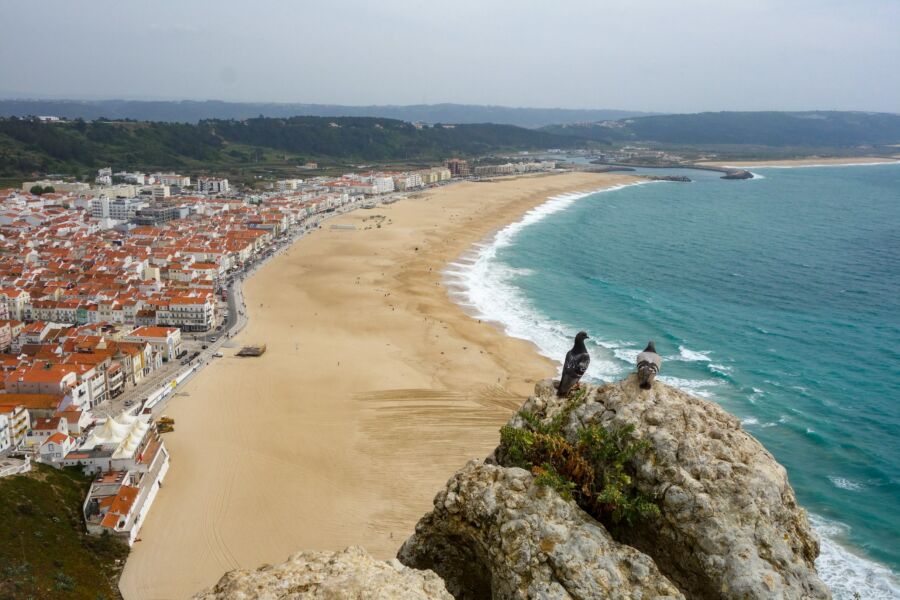
This fishing-town-turned-tourist-retreat, set between cork groves and eucalyptus trees and the open sea, is a place to relax in the sun. In Nazaré, I join a world of ladies in petticoats and men who still stow cigarettes and fishhooks in their stocking caps.

Settling into a grungy fishermen’s bar, I order a plate of barnacles. Yes, barnacles — called percebes here. My waiter is happy to demonstrate how to eat them: dig your thumb between the shell and the leathery skin to rip the skin off. The meat stays attached to the shell. Bite that off victoriously and wash it down with local beer. Fresh barnacles are expensive, as they cling to rocks in the turbulent waves along the coast and are difficult and dangerous to harvest. Savoring my plate of barnacles at sundown, I gaze out at the surf attacking that stark bluff. Because I know that’s where they were gathered just hours ago, investing in a plate of barnacles feels like money well spent. I’m enjoying the endearing charms of unassuming Nazaré being itself.

Though many locals seem older than most of its buildings, the town feels like a Portuguese Coney Island — humming with young people who flock here for the beach. Off-season, it’s almost tourist-free — the perfect time to take in the wild surf and get a feel for a traditional way of life.

The town’s layout is simple: a grid of skinny streets with sun-bleached apartment blocks stretching away from an expansive beach. The beach — in many places as wide as a soccer field — sweeps from the new harbor in the south to stark cliffs in the north.

It seems that most of Nazaré’s 15,000 inhabitants are in the tourist trade. But somehow traditions survive and it’s not hard to find pockets of vivid and authentic culture. I stroll through the market and wander the back streets where people happily trade ocean views for a little shade. Laundry flaps in the wind, kids ride plastic trikes, and fish sizzle over tiny curbside hibachis.

Nazaré is famous for its traditionally clad women who — at least according to local lore — wear skirts with seven petticoats. Is that one for each day, or for the seven colors of the rainbow, or…? Make up your own legend. While the story you’ll hear may be an invention for the tourists, it contains an element of truth. In the old days, women would wait on the beach for their fishermen to sail home. To keep warm in the face of a cold sea wind, they’d wear several petticoats so they could fold layers over their heads, backs, and legs as needed. Even today, older and more traditional women wear skirts made bulky by several — but maybe not seven — petticoats. The ensemble — with boldly clashing colors — is completed with house slippers, a hand-embroidered apron, woolen cape, head scarf, and flamboyant jewelry, including chunky gold earrings (often passed down from mother to daughter).

People-watching here is like going to a living art gallery. The beach, tasty seafood, and a funicular ride are the bright lights of my lazy memories. The funicular — which leads from the beach up to the Sitio neighborhood atop the cliffs — was built in 1889, the same year as the Eiffel Tower (and was designed by a disciple of Eiffel).

Sitio, with its own church, museum, and main square, feels like a separate village. Marking a rocky viewpoint high above Nazaré, a stone memorial honors the explorer Vasco da Gama, who stopped here before leaving Europe for India. Next to that, a little chapel marks the spot where a much-venerated statue of the Black Madonna was hidden in the rocks throughout four centuries of Muslim Moorish rule before it was rediscovered during the 12th-century Christian Reconquista. (When it comes to enjoying legends like these, gullibility is a skill that serves me well.)

Back down along the beach, a local folk-music group plays and dances. This troupe — with petticoats twirling to the beat of a percussion section of bongo gourds and extra-large pinecones grating against each other — has been kicking up sand since 1934.

When these dancers were younger, the vast beach was littered with colorful fishing boats that were hauled in by oxen or teams of fishermen. But ever since a new harbor was built south of town, the working boats have been moored out of sight. Today, only a few historic vessels remain, ornamenting the sand. On the boardwalk — an artful and traditional mosaic pavement of black and white stones — squadrons of sun-dried and salted fish are stretched out on nets left under the midday sun. Locals claim they’re delicious…but I’d rather eat barnacles.

This story appears in my newest book, For the Love of Europe — collecting 100 of my favorite memories from a lifetime of European travel. Please support local businesses in your community by picking up a copy from your favorite bookstore, or you can purchase it at my online Travel Store. You can also find a clip related to this story at Rick Steves Classroom Europe; just search for Nazaré Portugal.

Daily Dose of Europe: Esperanza in Évora

Europe’s remote corners are a delight. And when in Portugal, I love to head to Alentejo, and a fine little town called Évora.

With so many of us stuck at home for the foreseeable future, I believe a daily dose of travel dreaming can actually be good medicine. Here’s another one of my favorite travel memories — a reminder of what’s waiting for you in Europe at the other end of this crisis.

Alentejo is a vast and arid land — the bleak interior of Portugal, where cork seems to be the dominant industry. The rolling hills are covered with stubby cork trees. With their bark peeled away, they remind me of St. Bartolomeo, the martyr who was skinned alive. Like him, these trees suffer in silence.

The people of Alentejo are uniformly short. They seem to look at tourists with suspicion and are the butt of jokes in this corner of Europe. Libanio, my guide, circles the words “arid” and “suspicious” in my guidebook and does his best to turn my chapter into a promo for his dusty and downtrodden region. He says, “Must you say ‘arid’? Actually, in April, it is a lush countryside.” Then he adds, “But I won’t argue with ‘suspicious.’”

Libanio says it is a mark of a people’s character to laugh at themselves. He then tells me of an Alentejo man who nearly succeeded in teaching his burro to live without eating. He was so excited…until his burro died.

Libanio asks me, “How can you tell a worker is done for the day in Alentejo?” I say, “I don’t know.” He says, “When he takes his hands out of his pockets.” My guide continues more philosophically: “In your land, time is money. Here in Alentejo, time is time. We take things slow and enjoy ourselves.”

While this corner of Portugal is humble, there’s a distinct pride here. Every country has its Appalachia. I’m impressed when a region that others are inclined to insult has strong local pride, though I often wonder if it’s genuine pride, or just making the best of the cards they’re dealt.

For Alentejanos, quality and authenticity require the respect of tradition. The finest restaurants simply do not embellish a standard rustic dish. And they love their sweets so much that they seem to know the history of each tart.

Many pastries are called “convent sweets.” Portugal, with its vast empire, once had access to more sugar than any other European country. Even so, sugar was so expensive that only the aristocracy could afford to enjoy it routinely. Historically, many daughters of aristocrats who were unable to marry into suitably noble families ended up in high-class convents. Life there was comfortable, yet carefully controlled. Instead of sex, they could covet cakes and indulge in sweets. Over time, the convents became famous as keepers of wondrous secret recipes for exquisite pastries generally made from sugar and egg yolks (which were leftovers from the whites used to starch their habits). Barrigas de Freiras (Nuns’ Tummies) and Papos de Ango (Angel’s Breasts) are two such fancies.

Évora, the workaday capital of the region, is a fine place to taste the delights of Alentejo — both edible and historic, as well as musical and social.

Évora has barely any buildings over three stories high, but it is crowned by the granite Corinthian columns of a stately yet ruined ancient Roman temple. And just outside of town stand 92 stones three times as old as that, erected to make a Stonehenge-type celestial calendar.

I’m happy to find a romantic little restaurant that offers live fado music three nights a week. Esperanza, the woman who runs the place, explains that she likes the diners to be finished by 10 p.m. so the musicians can perform without waiters wandering around. I am impressed by her commitment to the art.

I sit in the back, enjoying the ambience. It’s been a long day, so during some applause, I sneak back out and head home. When I’m half a block away, Esperanza runs out the door and charges after me. I worry that she’s angry that I left without paying a cover charge, or that the door made too much noise, or that I had insulted the musicians. Like a guilty little boy, I nearly duck down an alley and run away. Then I decide to turn back and face the music.

She apologizes for not welcoming me and begs me to come back for a glass of port and to meet the musicians. The rest of the evening is a plush experience — complete with nuns’ tummies and angel’s breasts. Esperanza — whose name means “hope” — keeps the art of fado singing alive in Évora.

(This story is excerpted from my upcoming book, For the Love of Europe — collecting 100 of my favorite memories from a lifetime of European travel. It’s coming out in July, and available for pre-order.)

Daily Dose of Europe: Portugal’s Sunny Salema 

Who could use a beach break? In the interest of “flattening the curve,” I’m steering clear of beaches for now. But I can still daydream about my favorite beach in Europe…

With so many of us stuck at home for the foreseeable future, I believe a daily dose of travel dreaming can actually be good medicine. Here’s another one of my favorite travel memories — a reminder of what’s waiting for you in Europe at the other end of this crisis.

The flatbed fish truck rambles into the village tooting the “1812 Overture” on its horn. Today’s my beach day and I was ready to just sleep in. But it’s market day in Salema and the parking lot that separates the jogging shorts from the black shawls fills up, one vehicle at a time, with horn-tooting merchants. First the fish truck rolls in, then the bakery trailer steaming with fresh bread, followed by a fruit-and-vegetable truck, and finally a five-and-dime truck for clothing and odds and ends. Groggy yet happy, I quickly get dressed and join the scene — savoring one of the last true villages on the Algarve.

Any place famous as a “last undiscovered tourist frontier” probably no longer is. But the Algarve of my dreams survives — just barely. It took me three tries to find it. West of Lagos, Luz and Burgau both offered only a corpse of a fishing village, bikini-strangled and Nivea-creamed. Then, just as darkness turned couples into peaceful silhouettes, I found Salema.

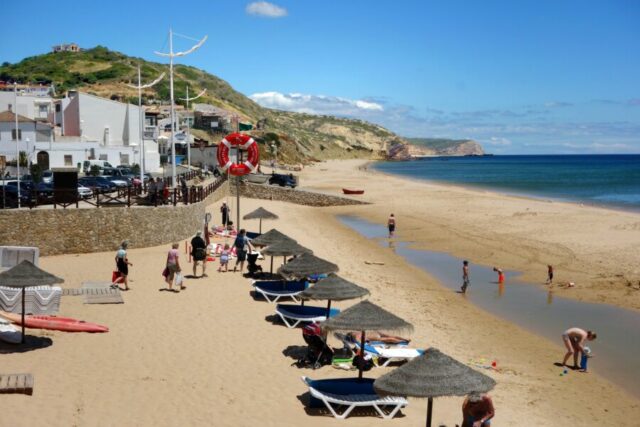
It’s my kind of resort: three beachside streets, a dozen restaurants, a few hotels, time-share condos up the road, a couple of bars, English and German menus, a classic beach with a paved promenade, and endless sun.

Where a small road hits the beach on Portugal’s southwestern tip, Salema is an easy 15-mile bus ride from the closest train station in Lagos. Still a fishing village — but only barely — Salema has a split personality: The whitewashed old town is for residents, and the more utilitarian other half was built for tourists.

Residents and tourists pursue a policy of peaceful coexistence at the beach. Tractors pull in and push out the fishing boats, two-year-olds toddle in the waves, topless women read German fashion mags, and old men really do mend the nets. British and German connoisseurs of lethargy laze in the sun, while locals grab the shade.

While the days of black-clad widows chasing topless Nordic women off the beach are gone, nudity is still risqué. Over the rocks and beyond the view of prying eyes, Germans grin and bare it.

Unwritten tradition allocates different chunks of undersea territory to each Salema family. While the fishermen’s hut on the beach no longer hosts a fish auction, it provides shade for the old-timers arm-wrestling octopi out of their traps. The pottery jars stacked everywhere are traps, which are tied about a yard apart in long lines and dropped offshore. Octopi, looking for a cozy place to set an ambush, climb inside, unaware they’ve made their last mistake.

The wives of fishermen serve up whatever’s caught in huge pots of Portugal’s beloved seafood stew (cataplana) in steamy hole-in-the-wall eateries, where tourists slurp it up.

Salema’s tourist-based economy sits on a foundation of sand. As locals watch their sandy beach wash away each winter, they hope and pray it will return with spring.

Restaurateurs are allowed to build a temporary, summer-only beachside restaurant if they provide a lifeguard and run a green/yellow/red warning-flag system for swimmers. The Atlântico Restaurant, which dominates Salema’s beach, takes its responsibility seriously — providing lifeguards and flags through the summer…and fresh seafood by candle­light all year long.

Tourism chases the sun and quaint folksiness. And the folksiness survives only with the help of tourist dollars. Fishermen boost their income by renting spare bedrooms (quartos) to the ever-growing stream of tan fans from Europe’s drizzly North. Quartos line Salema’s main residential street, offering simple rooms with showers, springy beds, and glorious Atlantic views.

Salema’s sleepy beauty kidnaps my momentum. At the end of the day, after enjoying a nice plate of fish, I take a glass of white wine from Atlântico and sip it with the sunset. Nearby, a withered old woman shells almonds with a railroad spike, dogs roam the beach like they own it, and a man catches short fish with a long pole. Beyond him is Cape Sagres — 500 years ago, it was the edge of the world. As far as the gang sipping port and piling olive pits in the beachside bar is concerned, it still is.

(This story is excerpted from my upcoming book, For the Love of Europe — collecting 100 of my favorite memories from a lifetime of European travel. It’s coming out in July, and available for pre-order. And you can also watch a video clip related to this story: Just visit  Rick Steves Classroom Europe  and search for Portugal.)

Daily Dose of Europe: Fado — The Lisbon Blues  

“O waves of the salty sea, where do you get your salt? From the tears shed by the women in black on the sad shores of Portugal.”

Because of the coronavirus, Europe is effectively off-limits to American travelers for the next few weeks (and likely longer). But travel dreams are immune to any virus. During these challenging times, I believe a daily dose of travel dreaming can actually be good medicine. Here’s another one of my very favorite travel dreams-come-true…a reminder of what’s waiting for you in Europe on the other end of this crisis.

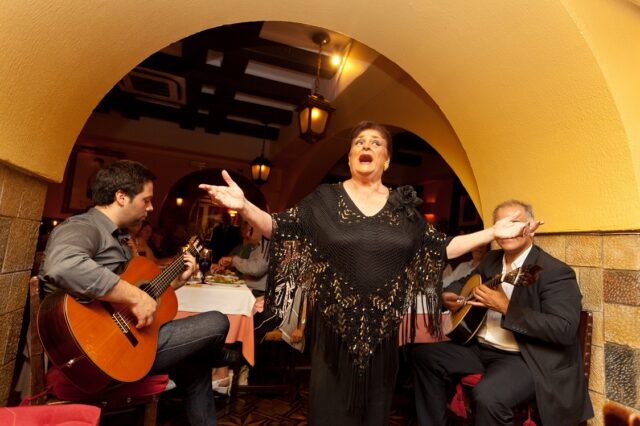
It’s after dark in Lisbon’s ramshackle Alfama neighborhood. Old-timers gather in restaurants, which serve little more than grilled sardines, to hear and sing Portugal’s mournful fado: traditional ballads of lament.

I grab the last chair in a tiny place, next to two bearded men hunched over their mandolins, lost in their music. A bald singer croons, looking like an old turtle without a shell. There’s not a complete set of teeth in the house. A spry grandma does a little jive, balancing a wine bottle on her head. The kitchen staff peers from a steaming hole in the wall, backlit by their flaming grill. The waiter sets a plate of fish and a pitcher of cheap cask wine on my table and — like a Portuguese Ed Sullivan — proudly introduces the next singer, a woman who’s been singing here for more than 50 years.

She’s the star: blood-red lipstick, big hair, a mourning shawl over her black dress. Towering above me, flanked by those mandolins, she’s a fusion of moods — old and young, both sad and sexy. Her revealing neckline promises there’s life after death. I can smell her breath as she drowns out the sizzle of sardines with her plush voice.

The man next to me whispers in my ear a rough English translation of the words she sings. It’s a quintessential fado theme of lost sailors and sad widows: “O waves of the salty sea, where do you get your salt? From the tears shed by the women in black on the sad shores of Portugal.” Suddenly it’s surround-sound as the diners burst into song, joining the chorus.

Fado is the folk music of Lisbon’s rustic neighborhoods: so accessible to anyone willing to be out late and stroll the back streets. Since the mid-1800s, it’s been the Lisbon blues — mournfully beautiful and haunting ballads about long-gone sailors, broken hearts, and bittersweet romance. Fado means “fate” — how fate deals with Portugal’s adventurers… and the families they leave behind. The lyrics reflect the pining for a loved one across the water, hopes for a future reunion, remembrances of a rosy past, or dreams of a better future. It’s the yearning for what might have been if fate had not intervened. While generally sad, fado can be jaunty…in a nostalgic way.

The songs are often in a minor key. The singer (fadista) is accompanied by stringed instruments, including a 12-string guitarra portuguesa with a round body like a mandolin (or, as the man whispering in my ear said, “like a woman”). Fado singers typically crescendo into the first word of the verse, like a moan emerging from deep inside. Though the songs are often sorrowful, the singers rarely overact — they plant themselves firmly and sing stoically in the face of fate.

While fado has become one of Lisbon’s favorite late-night tourist traps, I can still find funky bars — without the high prices and big-bus tour groups — that feel very local. Two districts, the Alfama and the Bairro Alto, have small, informal fado restaurants for late dinners or even later evenings of drinks and music. Handwritten “fado tonight” (fado esta noite) signs in Portuguese are good news, but even a restaurant filled with tourists can serve up fine fado with its sardines.

After thanking the man who’d translated the songs for me, I leave the bar late that night feeling oddly uplifted. An evening seasoned with the tears of black-clad widows reminds me that life, even salty with sadness, is worth embracing.

(This story is excerpted from my upcoming book, For the Love of Europe — collecting 100 of my favorite memories from a lifetime of European travel, coming out in July. It’s available for pre-order.)

A Stop in Porto, Portugal’s Second City


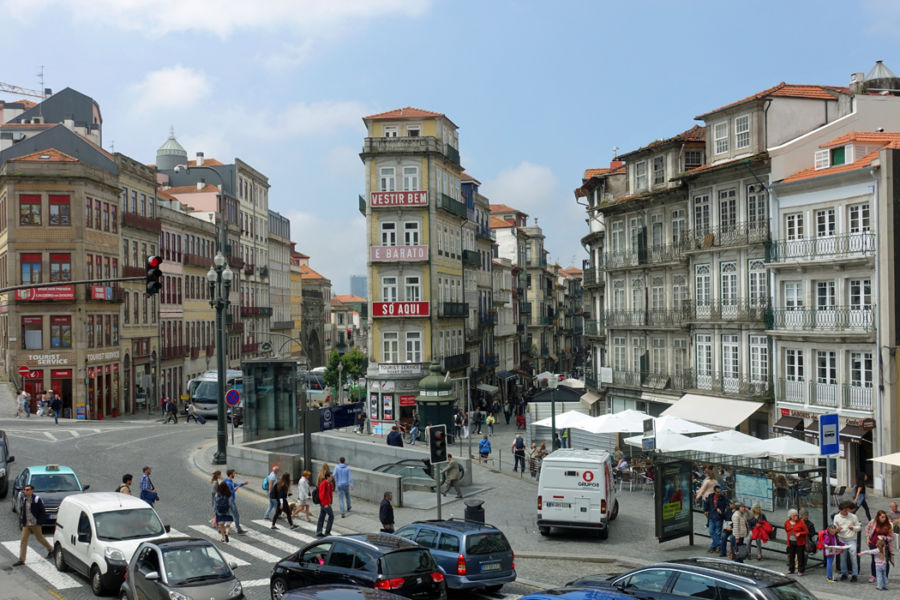
The city of Porto (about three hours north of Lisbon) is well worth working into your Portugal itinerary. The cityscape is amazingly well-preserved. I like the way that something built in a fleeting-yet-elegant style 100 or 150 years ago can grow old and run-down over a generation or two of neglect and economic doldrums — and then be burnished with a modern love of heritage and affluence. The result is a city twinkling with crusty and fun-loving facades that are filled with an inviting world of shops, cafés, and happening eateries. Just walking the streets of Porto (especially like I get to — with a great local guide at my side, to give everything meaning) is a travel treat.

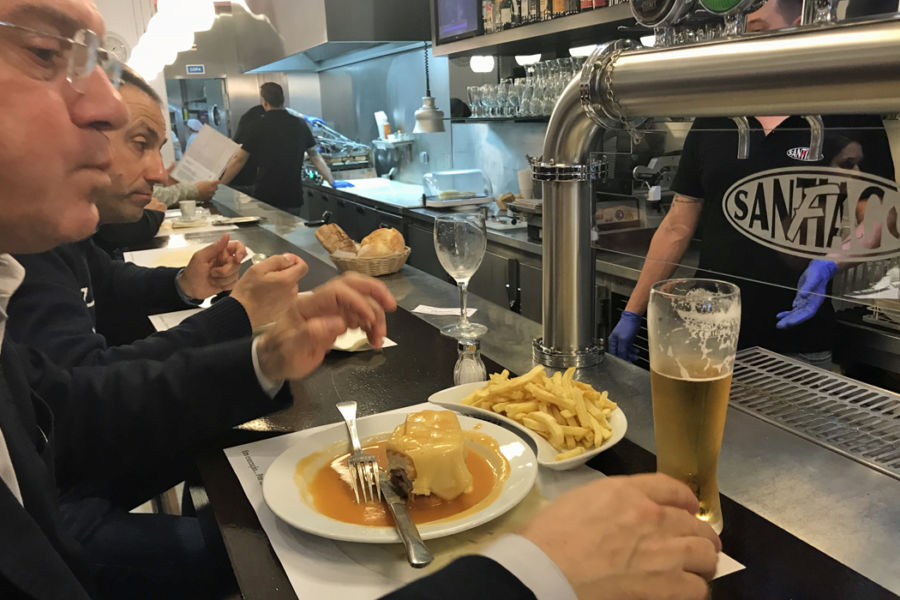
Porto has its own very strong culture. The local gut-bomb is the Francesinha, a Portuguese multi-layer patty melt smothered in a special gravy. I have to admit, it sounds horrible to me, and I’m trying to eat healthily, so I’ve never actually tried one…until this trip. Sitting at the bar in a popular diner, I snapped a photo of two locals with Francesinhas, who appeared to not be totally enjoying the sandwiches they were choking down.


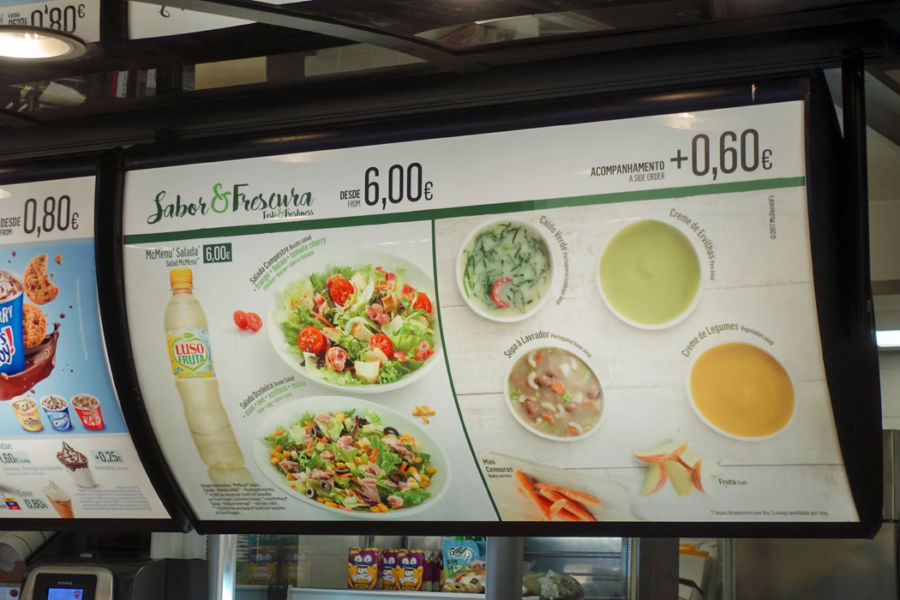
In Portugal, local food traditions are so strong, they can bend a McDonald’s menu. My guide explained that Portugal is a soupy culture — so soupy that McDonald’s would not survive without including basic Portuguese soups in its menu.


Flying home reminded me of the wisdom that even smaller cities can have efficient airports. While many American travelers in Porto might assume they’d need to return to Lisbon to fly home, remember to take full advantage of “open-jaw” flying from wherever you end up. Returning to Seattle was a breeze: Just a quick hop from Porto’s delightful little airport to Amsterdam, and then the big transatlantic flight back home.


I’m home now for a short break — and to figure out what I’m doing with my beard. (What do you think? Should I keep it?) Stay tuned for part two of my 100-day trip to Europe, beginning with Day 61 in Budapest — and then heading to Vienna, Prague, Berlin, Scotland (where I’m filming three new episodes of Rick Steves’ Europe), and Iceland.

Thanks for traveling with me — and stay around for more travel fun!


Join our traveling community — connect with me on Facebook and Twitter.