Baden-Baden: Globalization and Leaky Borders

Enlarge photo

To commemorate the Smithsonian Presents Travels with Rick Steves magazine — now on sale online, and at newsstands nationwide — Rick is blogging about the 20 top destinations featured in that issue. One of those destinations is the German spa resort of Baden-Baden.

Germany’s spa town of Baden-Baden is a fun and relaxing place to splash around in a thermal bath. But, as with many resort towns, a more substantial history bubbles just beneath the surface. And, in the case of Baden-Baden, that history still has ripples today.

After the czars banned gambling, many Russians flocked to Baden-Baden, creating their own little Russian enclaves. (Many lost their fortunes, borrowed a pistol, and did themselves in on the so-called “Alley of Sighs.”) While the Russian expat community dwindled for a while, in recent years (after the end of communism), ultra-wealthy Russians have sought out safe property investments all over Europe…and Baden-Baden has re-emerged as a favorite destination. Russians have bought up property here like crazy. You’ll see Russian on multilingual signs around town. On my last visit, the lady who ran the launderette spoke German and Russian…but no English.

This is worrying to locals. The mayor — saying his town must either take action or let itself become essentially Russian-owned — recently declared that Russians were no longer allowed to purchase Baden-Baden real estate.

With immigration a persistent and complex issue in the USA, it’s good to remember that we’re not the only nation struggling with how to handle the realities of race, class distinctions, foreign investment, and use of government services. I see the same challenges all over Europe.

A vast suburb of Tallinn, Estonia, is filled with Russians. They were planted there during Soviet rule, and — although Estonia is now its own independent nation — they still refuse to embrace the local language, Estonian. They live as a separate, Russian-speaking community within Tallinn.

Norwegians — who pride themselves on not being racist — are upset with unemployed Pakistanis living in their country who, they say, don’t share the Norwegian work ethic, but take advantage of the luxurious Norwegian welfare state. I sense that Norwegians don’t know how to discuss this issue comfortably.

I was just in Gibraltar, and the buzz there was about a $20 million mosque built with money from the Middle East for the humble local community of 900 Muslims workers.

Just as people with less money go to work in wealthy lands, people with more money turn their vacation and retirement funds into maximum joy and comfort in cheaper places. I have a friend who’s a retired postman living very comfortably on his meager pension in southern Portugal. A Venetian friend of mine is excited about her new holiday home in Tunisia. No crowds, great beaches, very cheap — she said Tunisia is all the rage among Italians. Belgians have staked out their enclave in Spain’s Costa del Sol — just one more community where the stray Spaniard complains that some eateries don’t offer menus in Spanish. Americans are buying fixer-uppers in droves in rural Italy. And they’re doing it with the encouragement of a government that appreciates the economic boost these romantic Frances Mayes-wannabes bring to regions that need expat newcomers to keep from withering.

There are immigration issues everywhere you travel. Second-generation Turkish Germans can honestly say “Ich bin ein Berliner.” Construction work throughout France would slow to a trickle without Polish builders. While many are now careful to refer to Gypsies as “Roma,” there’s still not enough money to build a Holocaust memorial in Berlin to this group, which suffered a genocide that was comparable, in many ways, to what happened to the Jews.

Like the Swiss are afraid of minarets, the French are afraid of women with covered heads, and America is afraid of a leaky southern border, a lot of anxiety is driving current legislation in all these countries. In Europe, as in the USA, it’s hard to talk about immigration and race issues for fear of offending people. But one thing is clear: Race and immigration concerns are not unique to any one country, and they are here to stay.

While travel may not give us answers, it does give us perspective and a clear sense that we will all ultimately live together…whether we like it or not. The other day, a frightened white woman asked me to sign a petition, saying, “We’ll soon be in the minority.” As a traveler, I know “we” already are in the minority on this planet…and that’s fine with me.

Europeans Share Their Health Care Experience, Part 1: Scandinavia

To bring some diverse experience into the discussion on health care reform here in the USA, I’ve asked my friends in Europe to share how health care works in their lives. In this four-part series, we’ll start with the most highly taxed and socialistic part of Europe: Scandinavia.

From Hakan in Sweden:

In Sweden, we have free choice in health care. It means that patients can choose a hospital anywhere in the country.

In 2005, the cost of the health and medical care sector amounted to 8.4 percent of GDP (in the US, it was over 15 percent). This amount includes the cost of pharmaceutical products, dental care, eyeglasses, and patient fees paid by households.

We employ a “high-cost protection scheme” that means that no patient ever needs to pay more than a total of 900 SEK (about $125) over a 12-month period. For pharmaceutical costs, no patient has to pay more than SEK 1,800 (about $250) over a 12-month period for prescription drugs. This way, no citizen will be put into poverty because of health problems.

The fee for visiting a doctor or hospital varies from 100-300 SEK (about $14-32), but once you have paid 900 SEK in a 12-month period, the rest of the care is totally free — no matter what kind of treatment you need. Private-care providers are also “clients” of the government. A patient can choose a private doctor or hospital, pay the small fee, and the government pays the difference.

The health and medical services have an obligation to strengthen the situation of the patient, for example, by providing individually tailored information, freedom to choose between treatment options, and the right to a second opinion in cases of life-threatening or other particularly serious diseases or injuries.

Having lived here all my life and raised my family here in Stockholm, I honestly do not see anything bad with our health care system.

From Richard in Demark:

I have lived and worked in Denmark for 24 years and have had numerous encounters with the health care system. In all cases I was satisfied or impressed with the quality of service and the low cost (apart from the tax system — more about that later).

The health care system in Denmark is free to all who live here. Even visiting tourists will be treated free of charge in case of an emergency. A non-Danish friend of mine who sprained her ankle during a recent visit was X-rayed, bandaged, treated by a doctor, and even given a pair of crutches to use — and was not charged anything. She was only asked to return the crutches when she left Denmark.

The quality of Danish health care — which is not run on a profit motive — is very good, though there is a waiting time for some non-life-threatening operations like a hip replacement. But everyone will eventually get the operation they need. Hospitals are free, doctor visits are free, and medicine is highly subsidized so that those who need a lot of medicine get it at a greatly reduced charge. Dentistry is subsidized.

This is paid for through our tax system, which — at 52 percent — is perhaps the highest in the world. None of the 10 political parties in Denmark has ever wanted to change that, because they know that they would not get any votes. The vast majority of Danes are agreeable to pay these high taxes; they know that they get about 50 percent of the money back each year in a vast array of benefits. Seven out of 10 Danes are willing to pay even more taxes, if necessary, to maintain the health care system we expect.

Danes have the mature and realistic understanding that you cannot give everyone a quality health care system, good schools, and the elements that help to make for a good quality of life, without paying for it. Freedom does not mean not paying taxes. For us, freedom is paying taxes. By taking care of each other, and the weaker elements in our society, we all have a better quality of life with very low crime rates, few prisons, and a sense of security that it is not “me against the world.” That is part of what it means to be Danish.

From Hanne and Trond in Norway:

In Norway, everyone has, in principle, equal rights to health care. Norwegian hospitals are “free” for patients (being financed with taxes) and everyone is entitled to treatment, irrespective of income and insurance. However, many things are not always working well here.

When hospitalized, no one asks for insurance coverage. You can stay for as long as it takes without having to worry about costs. At the hospital, every part of the treatment is free, indefinitely. At home, people with chronic illnesses get medicine and necessary medical equipment almost for free, save for a limited, annual base payment.

But some parts of the system don’t function well. Depending on the illness, you could wait a long time for necessary hospital treatment (typically non-emergency surgery). For instance, you have to go through your family doctor in order to be referred to a specialist. When the family doctors have way too many patients and limited opening hours (and limited telephone hours!), this is often an obstacle. Of course, any emergency treatment is exempt from “queuing.”

As for the cost, the hospitals operate with a combined budget of approximately NOK 75 billion ($13 billion). Our health care is not free — we pay for it in our taxes: Our corporations pay a flat tax rate of 28 percent on their profits. Wage income is taxed under a progressive structure, from almost zero (very low, part-time wages) to a maximum marginal tax rate of 54 percent. The average “industrial worker” has a tax rate of 30 to 35 percent.

Norway’s Lofoten Islands: Cod Only Knows Their Beauty

Enlarge photo

Enlarge photo

I just got a great report from Cameron Hewitt, lead editor/writer and guidebook co-author at ETBD, sharing his take on Norway, Switzerland, and Poland. As Cameron often does, he toured the fringe areas that I don’t get to as often as I’d like, and he’s made some great observations I’d like to share with you. To collaborate with travel writers of this caliber is one of the great joys in my work. Here’s the first of four blog entries by Cameron — reporting on an amazing bit of Norway I’ve yet to see.

I almost always enjoy the places that I travel to for work. But only a few special destinations thrill me enough to lure me back on my own dime. Norway’s one of them. After a week driving around southern Norway’s mountains and fjords to update our Scandinavia book a couple of years back, this summer I brought my wife with me to venture to an almost mythical pinnacle at the end of the earth: The Lofoten Islands.

The Lofoten are a chain of spiky islands way up at the northern end of Norway, well above the Arctic Circle…comparable to the northern reaches of Alaska. Why make the effort to travel so far? For years I’ve drooled at photos of astonishing scenery, like fjords on steroids cast away in the sea. In reality, it was even more astonishingly beautiful…the most breathtaking scenery we’d ever laid eyes on.

To reach the islands, we went to Oslo (already at Alaskan latitudes), then flew due north for about an hour and a half. For the final hop to the islands, we loaded onto a tiny propeller plane, making a brief stopover to pick up two passengers at a practically uninhabited hunk of rock halfway across the sea. The tiny plane had to jam on its brakes the second its wheels hit the tiny runway.

Even here in the northernmost point I’ve ever visited, the warm Gulf Stream keeps the climate mild. We had great luck with the weather: After a rainy first day, we enjoyed perfect sunny skies and temperatures in the mid-60s the rest of the week. While we were a bit late for the midnight sun, the sky glowed until well after midnight.

Things are casual in the Lofoten. When we picked up our cheapo rental car at the airport and asked about dropping it off before our return flight, the rental agent said, “You can yoost leave the keys above the visor with the door unlocked. Or give them to that guy,” pointing at the security agent. (Sure enough, a week later, “that guy” happily took our keys.)

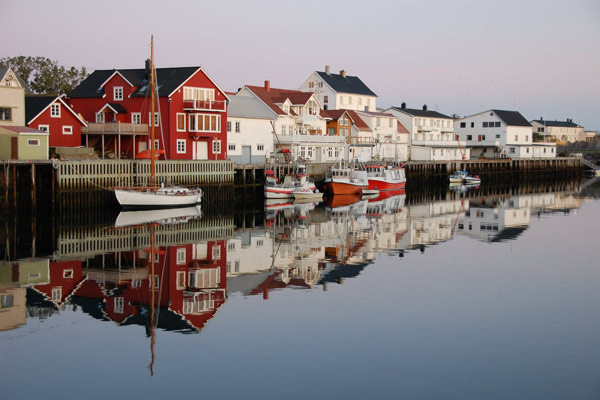
We spent our first two nights in a charming little fishing village called Henningsvær, with a smattering of galleries and cafés. From there, we side-tripped into the main town of the Lofoten, Svolvær, where we took an RIB (rigid inflatable boat, a.k.a. Zodiac) high-speed boat tour bouncing across the waves to the surrounding inlets, fjords, and islands, at speeds approaching 50 knots. It was a thrill ride punctuated with incredible views.

Everywhere we went, we stayed in rorbuer, which are little fishermen’s cabins that stand on stilts above the water. These have been rehabbed to varying degrees to house tourists, and come with modern bathrooms and kitchens. The rorbuer were perfect for relaxing in a rustic environment, enjoying the scenery, and tuning into the pace of village Norwegian life.

Enlarge photo

Enlarge photo

Our favorite stop was the town of Reine, in the middle of a fjord immersed in the most spectacular stretch of Lofoten scenery. Our rorbu there was meticulously renovated, perfectly combining rustic charm and modern comfort (www.reinerorbuer.no). We checked in, stepped in the door to our cabin, and immediately said, “Let’s stay here longer.” (Within minutes, we’d made arrangements to extend our stay.) We never got tired of staring out at the billion-dollar views from our rorbu. Basing in Reine, we took a fjord cruise, rented sea kayaks for a tranquil paddle, and went on intoxicating lakeside and fjordside hikes. It was just a 15-minute drive to the remote fishing village called Å (the last letter in the Norwegian alphabet, and the last town in the Lofoten), where we toured its humble museum and gagged down a taste of cod liver oil. And we strolled along also some fantastic, broad, white-sand beaches. While we saw a few brave swimmers go in the water (mostly kids), even in August we found it too cold to go deeper than our ankles.

The Lofoten feels impossibly remote. It’s improbable that this chain of islands is even populated. But those warm Gulf Stream waters flush schools of cod way up here in the winter, making local fishermen very happy. Rickety-looking wooden cod-drying racks are everywhere.

It’s clear that these days, tourism has eclipsed fishing as the main industry. Even this distant corner of Norway feels civilized — we paid for most everything with our credit card, and everyone we met spoke perfect English. And yet, amenities are sparse. Each village seems to have a catch-all store that combines the bare minimum necessities: convenience store, grocery, gas station, and post office. After stumbling onto a good latte on the first day of our trip, we never found one again. Missing were all the little trappings of a resort area…no ice-cream parlors, tacky trinket shops, Internet cafés, and so on. While this sounds idyllic, we were surprised to find ourselves wishing for some of those comforting little subconscious signposts that we were on vacation. One night, after wandering through a desolate village searching for an after-dinner ice-cream cone, we finally settled for an ice-cream sandwich from the convenience store’s freezer.

The few restaurants we splurged on ranged from excellent (a melt-in-your-mouth Arctic char) to…memorable. We were determined to try bacalao, the dried-and-salted cod dish that’s a local staple. Even dressed up in a flavorful stew, it was tough to swallow. Another night, one of the cheapest items on the menu was whale steak. Feeling adventurous — and despite the server’s description (“quite gamey, similar to elk or reindeer”) and the animal-rights controversy that the menu acknowledged — I went for it. It came out bleeding-rare and reeking of game…which I suddenly remembered makes me gag. In general, food is not the big attraction here. (When we got back to Oslo, we gratefully wolfed down a cheap Indian meal.) And food prices, like all other prices, are almost comically high. When a candy bar or a can of pop costs $5, you really have to do some soul-searching with each purchase: OK, do I really need this?

Enlarge photo

Even though it was the last week of August, and despite the perfect weather, the extremely short tourist season was already grinding to a halt. On several occasions, we were told that something had just closed “yesterday.” One evening, after having confirmed that the village’s lone tavern would be open for dinner, we showed up only to find they had just one dish available: fish soup with cracker bread. (We drove to the next town for something more appetizing.) We did run into several fellow intrepid travelers gasping at the scenery. However, in a full week in the Lofoten, we never once encountered a single other American.

Photos: Navigating Norway

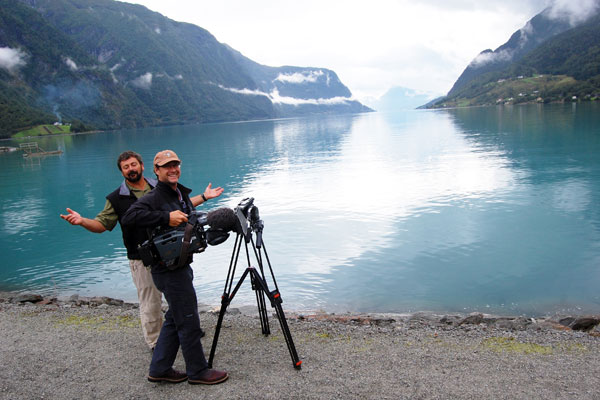
As a TV producer, it’s a challenge when my crew sees a gorgeous view and I want them to wait for a better view that I know is just up ahead. After driving all day across Norway, from Oslo to the fjord country in the west, we descended from the mountains, and this was our very first fjord sighting. Even though I knew better vistas awaited, the crew had to get out and film the sight. This is the farthest point inland of Norway’s longest fjord — Sognefjord.
Enlarge photo
When the sun came out, we made sure we were in position for vistas like this to show off the fjord’s wonder. Simon Griffith (producer) and Karel Bauer (cameraman) worked tirelessly for 20 days last month, helping me bring home three exciting new shows on Scandinavia.
Enlarge photo
A big part of my research work is running down leads. Most are dead-ends. At the end of a busy day on the fjords, I followed one such lead up a gravelly road to a cluster of 27 abandoned farmhouses — once a goaty gang of farm families, then abandoned, and now coming back to life. Thanks to Lila, who’s monitoring this project, Otternes Farm is a place where travelers can connect with Norway’s past on a breathtaking perch high above Aurlandsfjord. It’s in our upcoming TV show and covered in the new edition of our Scandinavia book.
Enlarge photo
For years, I’ve told the story about the eureka moment I had as a 14-year-old kid in Oslo’s Vigeland Sculpture Park. I noticed how my parents were loving me so much, and I looked around and saw a vast park speckled with others’ families — parents loving their children just as much. Right then it occurred to me how our world is filled with equally lovable children of God. While I’ve traveled with this wonderful truth ever since, I’ve never been able to capture that feeling on film. And every time I’m in Oslo I try.
Enlarge photo
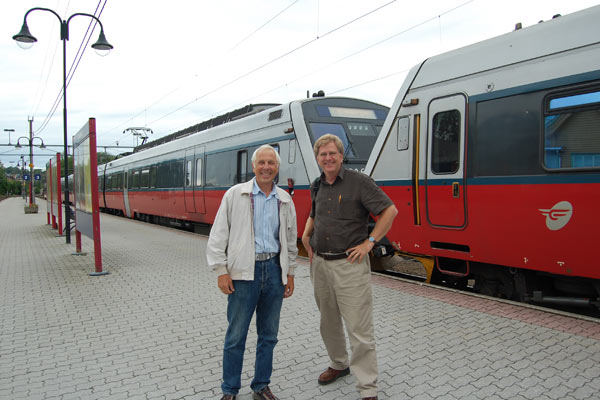
As a teenage ragamuffin vagabond slumming through Europe (with high-school buddy then and co-author buddy now, Gene Openshaw), I’d pop in on relatives in Norway. It was a much-needed depot for a bit of family warmth and some good food (notice the bulging bag Gene is toting). Thirty-five years later, Uncle Thor still meets me at the train station in his little town of Sandefjord. While I no longer need the free food, I still enjoy the dose of family warmth just as much.
Enlarge 1973 | Enlarge 2009

Killing Clichés and Chasing Lens Lice

Checking in with my Norwegian cousin Kari-Anne and her husband Knute, we got a little dose of the Scandinavian good life — while filming the delightful Oslofjord.
Enlarge photo

Europe is moving beyond its old-time clichés, and I’m weaning myself from these too. In fact, my theme this year, in both TV production and guidebook writing, has been to purge things that are recommended just because they’ve always been there. Sometimes it’s difficult after decades of singing a cultural tune to realize the melody has changed. This year I find myself thinking, “That was big in the 1980s, but…” as I work to keep my take on Europe fresh.

In Norway trolls may still be in the shop windows, but they have no business in a guidebook or TV show. Goofy legends about modern-age buildings having roofs inspired by upturned Viking ships are out. Sweden used to be a porn capital — but so much modern-day freedom in that regard seems to have made that industry passé. I remember when the TV towers in Berlin, Stockholm and Oslo were as breathtaking as Seattle’s Space Needle. Oslo’s is now closed to the public and the others are barely advertised.

There was a time when travelers ventured to Stockholm and Helsinki to see planned suburbs like Farsta and Tapiola — suburbs that organized people as if in juke boxes…and people clamored to get in. No one even talks about these places anymore. In the 1980s it seemed every other tourist in Helsinki was an architect, there to marvel at the modern buildings. Today Helsinki’s once-striking Finlandia Hall, by Alvar Aalto, is only striking out. I’ve always listed the Kon-Tiki Museum in Oslo as a must-see. It was one when it captured the imagination of would-be sea adventurers a generation ago. Today, the museum seems to be going the way of the log boat.

I have also realized that I need to be careful not to romanticize the nobility and intelligence of a people I’m predisposed to be impressed by. It’s so much fun to bump into entire societies that are both good-looking and seem to have it all figured out. You could travel through a place like Norway and think everyone was brilliant and beautiful. But seeing racks of National Enquirer-type tabloids in Bergen — papers as cheesy and idiotic as ours and England’s — reminds me that no society is immune from low-brow culture; there’s a huge market for that everywhere.

Having spent more time in Scandinavia this summer than ever before, I enjoyed a great chance to reconnect with my wonderful relatives. My uncle Thor in Sandefjord is a patriarch with beautiful grandchildren galore. My cousin Kari-Anne is a publisher with a fascinating circle of friends; she lives in Oslo, enjoying the best of Norwegian big-city life. And Hanne, the baby I held while watching the first moon landing, has three kids old enough to stay up late and contribute to our conversation.

Ten years ago, while filming in Bergen, Hanne kept sneaking into our shots. In Norway, she said, those obnoxious types who always try to get into the picture are called “lens lice.” I asked her if she’d like to be a part of the new show we’re filming, and she said, “My lens lice days are over.” (While I strongly disagree, I didn’t argue.)

I spent an evening with Hanne’s family enjoying the fun conversation. We talked about the challenges modern Norway has with immigrants. In this Lutheran corner of Europe, they explained, everyone enjoys the freedom to practice their religion, as long as the practice doesn’t violate Norway’s constitution, which guarantees a range of human rights — including women’s rights, gay rights, and children’s rights (e.g., parents are forbidden to beat their children). Fathers are intimately involved in parenting. In fact, throughout Scandinavia, rather than “maternity” leave, new moms and dads share 16 months of paid leave (dividing it as they like).

Hanne’s kids sat attentively as they soaked up the conversation. Hanne’s 13-year-old daughter speaks English so well that she played a game speaking American with her mom and British with her dad (as that’s how each speaks English with her). I asked her about cigarettes, alcohol, and marijuana. She said she and her friends had no interest in any of that. She explained that the government tried the “bad for your health” line in their education campaigns, and it was worthless. Then the schools started teaching that cigarettes made your skin ugly, stained your teeth, and gave you bad breath. They taught that alcohol lowers your metabolism, making you get fat more easily. This appeal to teenagers’ vanity, rather than their health, was by all accounts wildly effective.

By my small survey, I’ve found that throughout Norway and Sweden there’s extremely little interest in marijuana. People just don’t seem to even be intrigued by it. On the other hand, among young people (other than my relatives, of course), it seems that casual sex is rampant.

I have my vices though, and so does my film crew. We like a good drink after a day’s work. With the cost of alcohol here, we drink beer when we’d normally have a glass of wine. (A glass of beer here costs what a glass of wine would cost elsewhere, and wine costs much more.) And we got addicted to dropping by the ubiquitous convenience stores for a box of Iskaffe (iced coffee) — available for 19 krone ($3), the cost of a reasonably priced latte in a café. I am still fascinated by how this affluent corner of Europe seemingly prices so much of its populace out of restaurant going. Convenience stores fill the gap for people without much money — providing cafeteria lines of whatever you need, to be munched on benches or on the fly.