Oslo’s Holmenkollen Ski Jump: Old, New, Great Views, and Big Thrills

I’ve left Stockholm, and have landed in Norway’s capital — Oslo. My first stop is a famous old ski jump that has a fresh new look.

A top sight in Oslo is the legendary Holmenkollen Ski Jump. One of the world’s oldest ski jumps (from 1892), Holmenkollen has hosted many championships, including the 1952 Winter Olympics. To win the privilege of hosting the 2011 World Ski Jump Championship, Oslo built a bigger jump to match modern ones that had been built elsewhere. You can ride an elevator to the top and stand right at the starting gate, just like an athlete, and get a feel for this daredevil sport. The jump empties into a 30,000-seat amphitheater, and you’ll enjoy one of the best possible views of Oslo.

As you ponder the jump, consider how modern athletes continually push the boundaries of their sport. The first champion here (in 1892) jumped 21 meters. In 1930, it took a 50-meter jump to win. In 1962, it was 80 meters, and in 1980, the champ cracked 100 meters. Most recently, a jump of 140 meters took first place.

While the view is exciting from the top, even more exciting is watching thrill-seekers rocket down the course on a zipline from the same lofty perch (600 Norwegian kronor per trip — that’s $100…yes, Norway’s expensive).

Cruising Northern Europe: Our Day in Oslo

Continuing on our Northern European cruise, we enjoyed a classic cruise day in Oslo. Our cruise ship docked right in Oslo’s harbor, and we popped off the ship to see the city before “all aboard” at the port. Photos by Trish Feaster, see her blog at The Travelphile.com.

When I was a 14-year-old kid, traveling through Europe with my parents, one of my best memories was sleeping on the ship from Copenhagen to Oslo and waking up to the pristine Oslofjord. Sitting on the deck and enjoying the Norwegian scenery — the land of my grandparents — for the first time was a delight. So, forty-plus years later, sailing down this same fjord was a wonderful travel déjà vu. That evening, sailing south, the fjord scenery was just as beautiful.
Oslo is a relatively small city, and seeing the sights is easy. Facing the harbor is the City Hall. Built with Norwegian materials and Norwegian talent, it’s the pride of the city.
Throughout Europe, heavy industry is moving away from the costly city-center real estate, and industrial harborfronts are being dug up and turned into people-friendly parklands. If there’s an industrial wasteland where a great European city hits the harbor — Oslo, Copenhagen, Hamburg, Antwerp, Barcelona, Cardiff, you name it — it’s slated for a major work-over. In a few years, Oslo’s waterfront will be a five-mile-long strolling and biking promenade — with nearly all the noisy traffic zipping through the city in underground tunnels.
Each morning, a giant cruise ship ties up just next to the sparkling new Oslo Opera House. As thousands of visitors pour out of the ship and into the city, many explore this striking new icon on the skyline of Oslo. We happened in just as the fine, hour-long English tour was departing. Sure, it costs money — but how do you put a price on bringing high culture to an entire city? Artisans were sewing costumes and making stage sets, musicians were practicing, children were at ballet lessons, schools were attending matinées performances...the place was a hive of activity.
Each morning, a giant cruise ship ties up just next to the sparkling new Oslo Opera House. As thousands of visitors pour out of the ship and into the city, many explore this striking new icon on the skyline of Oslo. We happened in just as the fine, hour-long English tour was departing. Sure, it costs money — but how do you put a price on bringing high culture to an entire city? Artisans were sewing costumes and making stage sets, musicians were practicing, children were at ballet lessons, schools were attending matinées performances…the place was a hive of activity.
In Oslo's main train station, I was impressed by the modern departure boards and how people-friendly the place was. This was just a 10-minute walk from our cruise ship.
In Oslo’s main train station, I was impressed by the modern departure boards and how people-friendly the place was. This was just a 10-minute walk from our cruise ship.
Oslo gathers around its main street, Karl Johans Gate, which runs from its royal palace on the hilltop to the main train station. Oslo is so expensive that people share their drinks and munch sandwiches on park benches. It seems you chew slower and order smaller quantities here in Norway. Still, there’s lots of fun and color in the streets to enjoy. And the best museums and sights (such as City Hall, the National Gallery, and Frogner Park with Vigeland's evocative sculptures) are free. These yogis who levitate their partner gather crowds all over Europe. People ask, “How do they do it?” (The stunt is made possible by a steel frame that the lower guy sits upon; the frame goes up his arm, and then around to support his partner up in the air.)
Oslo gathers around its main street, Karl Johans Gate, which runs from its royal palace on the hilltop to the main train station. Oslo is so expensive that people share their drinks and munch sandwiches on park benches. It seems you chew slower and order smaller quantities here in Norway. Still, there’s lots of fun and color in the streets to enjoy. And the best museums and sights (such as City Hall, the National Gallery, and Frogner Park with Vigeland’s evocative sculptures) are free. These yogis who levitate their partner gather crowds all over Europe. People ask, “How do they do it?” (The stunt is made possible by a steel frame that the lower guy sits upon; the frame goes up his arm, and then around to support his partner up in the air.)

Northern European Cruise Ports — A Springboard for Action

Our two cruise ports guidebooks (for both the Mediterranean and Northern Europe) are derived from our existing country guidebooks. To make them, we tailor existing chapters from these guidebooks to the needs of the independent-minded cruise traveler and assemble them in special editions so people can buy a single book rather than several to cover their itinerary. And my main research focus on this trip will be the ports.

Northern European ports lend themselves to independent travel. In many cases (including certain ports in Tallinn, Bergen, Oslo, and Copenhagen), they’re right in the city center and an easy walk from the sightseeing action — and when they aren’t, there’s good public transportation to the center of town. The ports themselves are generally not pretty, but mighty — industrial zones giving you a very honest look at the workings of these great cities. (Photos by Trish Feaster, see her blog – The Travelphile.com.)

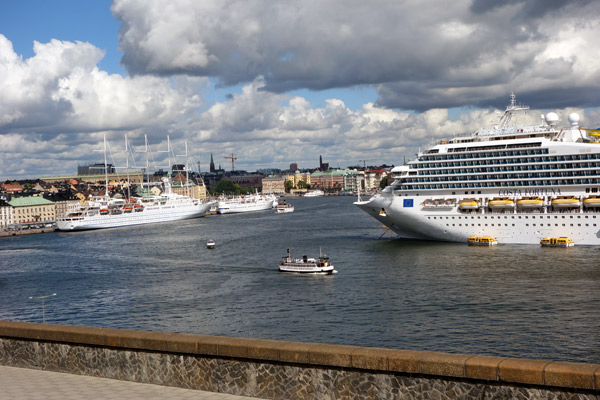
This is Stockholm, where, as in many cities, there's a cruise dock in the center and a bigger one a bus ride away. Smaller and more expensive ships often dock right downtown, while most of the full-sized ships dock in the industrial zone farther out. You almost never drop anchor and use tenders to get ashore in Northern Europe — although in this shot, a big ship has dropped its hook just off Stockholm’s Gamla Stan (old town).
This is Stockholm, where, as in many cities, there’s a cruise dock in the center and a bigger one a bus ride away. Smaller and more expensive ships often dock right downtown, while most of the full-sized ships dock in the industrial zone farther out. You almost never drop anchor and use tenders to get ashore in Northern Europe — although in this shot, a big ship has dropped its hook just off Stockholm’s Gamla Stan (old town).
Cruise ports work hard to organize the masses. There are clear charts of each port (like this one for Copenhagen), shuttle buses if necessary, small temporary tourist information tents that are set up when a ship is in, and even painted lines in the pavement that take the guesswork out of getting to and from the town center.
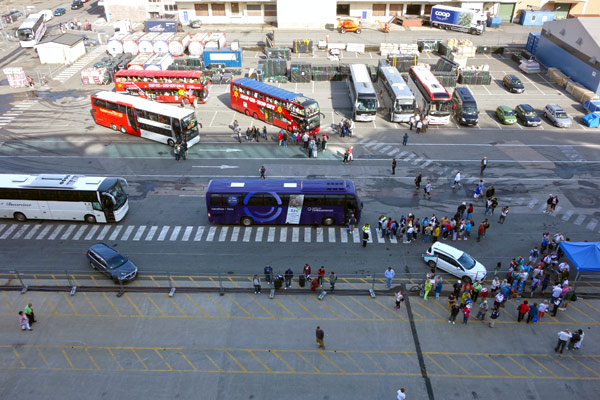
Each ship dumps off thousands of tourists, raring to have the best seven or eight hours possible in each port. Just off the gangplank, you’ll find several options: Tour buses awaiting those who signed up for ship-sponsored excursions (the standard option); hop-on, hop-off buses for budget and independent travelers (all-day, $25 tickets cover a 90-minute loop with a recorded narration, and include hop-off-and-on privileges as buses come by about every 20 minutes all day); public buses dedicated to connecting cruisers with the town center; and taxis (both standard and minibus — economical for small groups).
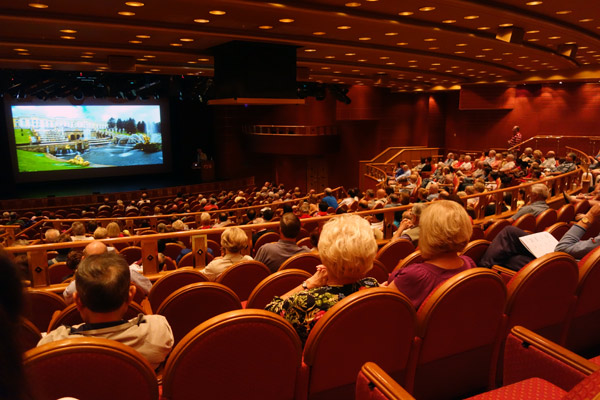
Princess Cruise Lines puts a big effort into helping its cruisers be prepared for each port (better than the other lines I’ve sailed with). On the Emerald Princess, our ship lecturer was John Lawrence, who has decades of experience cruising Northern Europe and knows each port intimately. Each evening, John gives a talk to a full theater about the next day’s port of call. That talk would then air repeatedly on the ship’s TV station. John even provided a live, guided narration of the most scenic stretches of island scenery we passed (like the archipelago we sailed through leaving Stockholm).
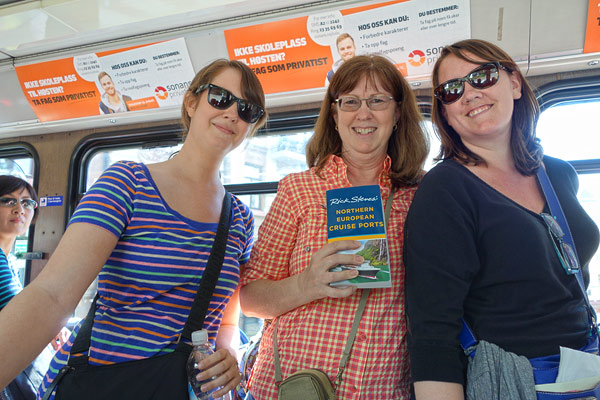
As I had to have my hot-off-the-press copy of our Rick Steves' Northern Europe Cruise Ports guidebook expressed to me in Copenhagen, I was surprised to find this family with the brand-new book in hand. After two years in print, our Rick Steves' Mediterranean Cruise Ports guidebook is already the leading seller for that region. It’s my hope that this book will be a hit, too. Judging from the fun these travelers were having with the help of our new book, I think we’re on the right track.
As I had to have my hot-off-the-press copy of our Rick Steves’ Northern Europe Cruise Ports guidebook expressed to me in Copenhagen, I was surprised to find this family with the brand-new book in hand. After two years in print, our Rick Steves’ Mediterranean Cruise Ports guidebook is already the leading seller for that region. It’s my hope that this book will be a hit, too. Judging from the fun these travelers were having with the help of our new book, I think we’re on the right track.
In each city, when it comes to tour guides, it’s all hands on deck when a cruise ship docks. I tagged along on this young man’s tour on a cruise excursion from Warnemünde (Germany), and he was great. Perhaps I enjoyed it so much because he seemed like he could be my son.
If there are 3,000 tourists relaxing on vacation, it’s because there are over a thousand crew members working day and night to keep them fed, watered, and clean. I have always been very impressed by the crews of our ships. Most are from the developing world and work very hard for low wages plus tips to support families they left behind. Our ship was staffed by several dozen nationalities, but mostly by Filipinos. Most ports have a special lounge for crew members, who make a beeline there to get online cheaply and connect with loved ones back home. Tourists are welcome to use the same cheap Wi-Fi service at these port lounges (which is a big help, as on-ship Wi-Fi is notoriously expensive and slow).

A Dozen Great Seaside Bars

With all the intensity in our domestic and political worlds lately, it’s a fine time for an escape — sunset glinting through the drink in your hand. Let’s fantasize about the best seaside bars in Europe. Whenever researching a guidebook chapter covering a port or seaside resort, I work hard to find the most romantic place to swizzle stick your vacation cocktail. Feel the breeze, smell the sea, enjoy the cry of the gulls, and let me share my favorites. These are each worth seeking out. (BTW, I’d love to read about your favorites. Please share.)

In Dubrovnik, Croatia
Cold Drinks “Buža” offers, without a doubt, the most scenic spot for a drink in Dubrovnik. Perched on a cliff above the sea, clinging like a barnacle to the outside of the city walls, this is a peaceful, shaded getaway from the bustle of the Old Town…the perfect place to watch cruise ships disappear into the horizon. Buža means “hole in the wall” — and that’s exactly what you’ll have to go through to get to this place. Filled with mellow tourists and friendly bartenders, Buža comes with castaway views and Frank Sinatra ambience ($4-7 drinks, summer daily 9:00-into the wee hours).

In Rovinj, Croatia
Valentino Champagne and Cocktail Bar is a memorable, romantic, justifiably pretentious place for an expensive late-night waterfront drink with jazz. Fish, attracted by its underwater lights, swim by from all over the bay…to the enjoyment of those nursing a cocktail on the rocks (literally — you’ll be given a small seat cushion and welcomed to find your own seaside niche). Or you can choose to sit on one of the terraces. Classy candelabras twinkle in the twilight, as couples cozy up to each other and the view. Patricia opens her bar nightly from 19:00 until as late as there’s any action. While the drinks are extremely pricey, this place is unforgettably cool ($8-11 cocktails, Via Santa Croce 28).

In Vernazza, Cinque Terre, Italy
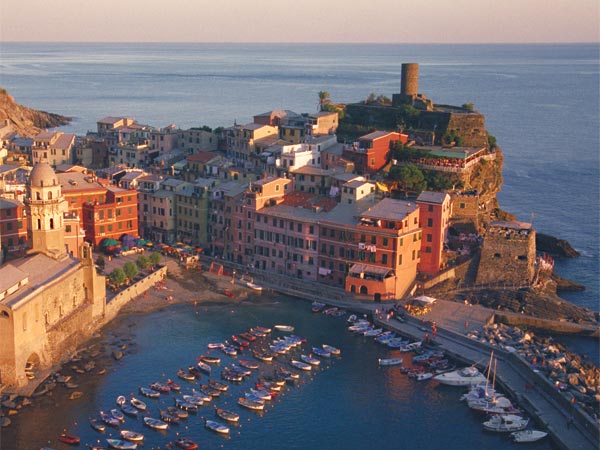
Ristorante Belforte’s tiny, four-table balcony lets you sip your vino della Cinque Terre overlooking the Mediterranean from the edge of a stony castle. You can feel the mist from the surf crashing below on the Vernazza breakwater. And the views of the ancient vineyard terracing all around you makes the experience a highlight. From the Vernazza breakwater, follow either the stairs or the rope that leads up and around to the restaurant.

In Hydra, Greece
Kodylenia’s Taverna is perched on a bluff just over Kaminia’s pocket-sized harbor, which shelters the community’s fishing boats. With a glass of ouzo and some munchies, as the sun slowly sinks into the Saronic Gulf and boats become silhouettes, you can drink to the beauties of a Greek isle escape. It has my favorite, irresistible dinner views on Hydra: This scenic spot lets you watch the sunset with Kaminia’s adorable port in the foreground. Owner Dimitris takes his own boat out early in the morning to buy the day’s best catch directly from the fishermen. For meals, you can sit out on the shady, covered side terrace above the harbor. For drinks, sit out front on the porch. Relax and take in a sea busy with water taxis, hydrofoils that connect this oasis with Athens, old freighters — like castles of rust — lumbering slowly along the horizon, and cruise ships anchored as if they haven’t moved in weeks.

In Istanbul, Turkey
The double-decker Galata Bridge spans the Golden Horn, a historic inlet that separates the old and new towns of Istanbul. And all along both the horn and the bridge, you’ll find dozens of inviting, no-name bars. Find a place to nurse some Turkish specialties: Drink an unfiltered, highly caffeinated “Turkish coffee” (which leaves a thick coating of “mud” in the bottom) or a cup of tea, and suck on a water pipe — called a nargile (NAHR-gee-leh) — filled with flavorful dried fruit. As you enjoy your drink and your hookah, be sure to play backgammon with (or at least among) the locals. If you’re on the lower level of the bridge, you can look up for a fun view of dozens of fishing rods twitching along the upper railing. Watch your head — sometimes an amateur fisherman carelessly lets his catch swing under the top deck. And keep an eye out for the flicker of a little silvery fish, thrashing through the air as it’s reeled in by a happy predator.

In Salema, Portugal
One bit of old Algarve magic still glitters quietly in the sun — Salema. It’s at the end of a small road just off the main drag between the big city of Lagos and the rugged southwest tip of Europe, Cape Sagres. Quietly discovered by British and German tourists, this simple fishing village has three beachside streets, many restaurants, a few hotels, time-share condos up the road, a couple of bars, English and German menus, a classic beach with a paved promenade, and endless sun. The Atlântico — noisy, big, busy, and right on the beach — has long dominated the Salema beach scene. It’s known for fun drinks, friendly service, and a wonderful beachside terrace.

At Burriana Beach, Near Nerja, Spain
Ayo’s is famous for its character of an owner and its beachside all-you-can-eat paella feast at lunchtime. For 30 years, Ayo — a lovable ponytailed bohemian who promises to be here until he dies — has been feeding locals. Ayo is a very big personality — one of the five kids who discovered the Caves of Nerja, formerly a well-known athlete, and now someone who makes it a point to hire hard-to-employ people as a community service. The paella fires get stoked up at about noon and continue through mid-afternoon. Grab one of a hundred tables under the canopy next to the rustic, open-fire cooking zone, and enjoy the beach setting in the shade with a jug of sangria. For $7.50, you can fill your plate as many times as you like. It’s a 20-minute walk from the Balcony of Europe, at the east end of Burriana Beach — look for Ayo’s rooftop pyramid (daily “sun to sun,” paella served only at lunch).

In Villefranche-sur-Mer, France
In the glitzy world of the Riviera, Villefranche-sur-Mer offers travelers an easygoing slice of small-town Mediterranean life. Luxury sailing yachts glisten in the bay — an inspiration to those lazing along the harborfront to start saving when their trips are over. The Chapel of St. Pierre, decorated by artist Jean Cocteau, is the town’s cultural highlight.  Le Cosmo Bistrot/Brasserie takes center stage on Place Amélie Pollonnais with a great setting — a few tables have views to the harbor and to the Cocteau chapel’s facade (after some wine, Cocteau pops). Manager Arnaud runs a tight-but-friendly ship and offers well-presented, tasty meals with good wines (I love their red Bandol).

In Conwy, Wales
This Welsh town, watched over by its protective castle, has a particularly charming harbor. Conwy was once a busy slate port (back when much of Europe was roofed with Welsh slate, Conwy was a boomtown). But today the harbor is a laid-back area that locals treat like a town square. On summer evenings, the action is on the quay (pronounced “key”). The scene is mellow, multigenerational, and perfectly Welsh. It’s a small town, and everyone is here enjoying the local cuisine — “chips,” ice cream, and beer — and savoring that great British pastime: torturing little crabs. Facing the harbor, The Liverpool Arms pub was built by a captain who ran a ferry service to Liverpool in the 19th century. Today it remains a salty and characteristic hangout.

In Staithes, England
A ragamuffin village where the boy who became Captain James Cook got his first taste of the sea, Staithes (pronounced “staythz”) is a salty jumble of cottages bunny-hopping down a ravine into a tiny harbor. This refreshingly unpretentious town on the North Sea is gloriously stubborn about not wooing tourists. The town has changed little since Captain Cook’s days. Seagulls seem to have picked the barren cliffs raw. There’s nothing to do but stroll the beach and nurse a harborside beer or ice cream. The Cod and Lobster, overlooking the harbor, has scenic outdoor benches and a cozy living room warmed by a coal fire. In nice weather, the best option is to enjoy a drink, snack, or light meal (i.e., fish-and-chips) sitting at an outdoor table fronting the harbor.

In Solvorn, Norway
Walaker Hotel, a former inn and coach station, has been run by the Walaker family since 1690 (that’s a lot of pressure on eighth-generation owner Ole Henrik). The hotel, set right on the Lustrafjord, has a garden perfect for relaxing and, if necessary, even convalescing. In the main house, the halls and living rooms are filled with tradition. (Patriotic hymns sit at the piano.) While great for its accommodations, the hotel also serves dinner and drinks. I love to savor my coffee and dessert on the balcony with a fjordside setting — mesmerized by Norwegian mountains. Rather than jagged, they’re bald and splotchy, with snowfields on top and characteristic cliffs plunging into inky fjords. One night I took my strawberries à la mode onto one such porch and sat there long after my coffee cooled and ice cream melted. After dinner, I strolled through the village enjoying the blond cherubs running barefoot through the stalled twilight. Cobbled lanes led past shiplap houses to rock cliffs — their gullies and cracks green with trees.

In Barcelona, Catalunya, Spain
Before the 1992 Olympics, Barcelona’s waterfront was an industrial wasteland nicknamed the “Catalan Manchester.” Not anymore. The industrial zone was demolished and dumped into the sea, while sand was dredged out of the seabed to make the pristine beaches locals enjoy today. The scene is great for sunbathing and for an evening paseo before dinner. It’s like a resort island — complete with lounge chairs, volleyball, showers, bars, WCs, and bike paths. Every 100 yards or so is a chiringuito — a shack selling drinks and light snacks. Originally these sold seafood, but now they keep locals and tourists well-lubricated. It’s a very fun, lively scene on a balmy summer evening. This is a nice way to escape the claustrophobic confines of Barcelona to enjoy some sea air and the day’s final sunrays. A double-decker boardwalk runs the length of the beach, with a fine walkway up above. There’s a series of great seafood restaurants and cocktail bars with romantic, candlelit, beachfront seating tucked down below.

June Steves: Losing My First Travel Partner

While two weeks has passed since her death, I’m still coming to grips with my mother being gone. I’ve had a busy holiday season and, in the midst of so much else churning all around me, I wanted to share with my friends on Blog Gone Europe the news of her passing. In case you might be interested, I’ve gathered here memories of my first trip to Europe when my travel partner was my Mom, photos of us in 1969 and in 2011, her obituary, and an essay I wrote from the notes of the talk I gave at her memorial service.

Memories of Travels with June

When I think of how my Mom catapulted me into the wonderful life I’ve enjoyed, it was she who first took me to Europe. As my Dad was busy doing business with European piano-builders (he imported pianos), Mom was my first travel partner.

Back when I was a 14-year-old who had hardly set foot on an airplane, together we were immersed in the wonders of Europe. On that first dip into Europe, we stood in front of our first hotel in the Netherlands watching bicyclists gather at a stoplight on the way to the fields — wooden shoes filling their little handlebar baskets. Mom helped me collect a cigar box full of sugar cubes wrapped with advertising from the restaurants we visited all over Europe. Together we collected souvenir pins to fill my Bavarian felt hat. Venturing into our first subway ride ever, we found our way to a stop called Trocadéro, emerged, turned the corner, and set eyes for the first time on the jaw-dropping Eiffel Tower. Together we puzzled at buildings that looked both new and ancient (Neoclassical monuments in Paris) — built in the style of ancient Rome, but dating only from the age of Napoleon. When friends in Germany gave us a tin of white asparagus, we opened it and marveled together at what looked like a rare albino vegetable. And, with Norwegian relatives, we traveled to the fjord where we found the actual house from where my mother’s mother left for the “New Land” — in her case, Canada.

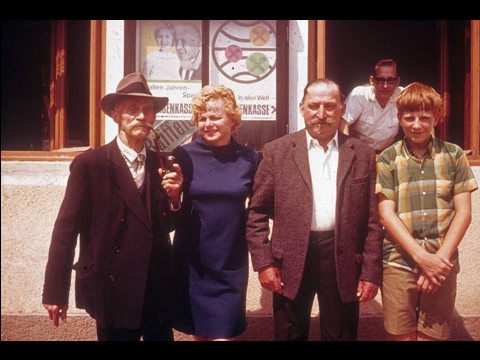
On that first trip, I was attached to my Mom — literally — as back then a mother and her child could share the same passport. And flying home from that first foreign adventure, I have a hunch my Mom had a hunch she had helped plant in me a seed that would sprout into a lifelong passion for travel. One of my favorite photos is of me and my Mom with our hosts in Austria in a dusty village on the border of communist Hungary. It was 1969, and Mom had just introduced me a man (far left) who claimed to have witnessed the assassination of Archduke Franz Ferdinand in 1914, which kicked off World War I. Whether he actually saw it or not, the story he told had me wide-eyed — and when I look back on it, I think it was a pivotal moment in my life that directed me toward my history degree and a passion for learning and teaching through thoughtful travel.

June Erna Steves (1931-2011)

June was born of Norwegian immigrants Harold and Erna Fremmerlid on June 29, 1931, in Edmonton, Alberta, Canada. She died in Seattle early in the morning on Thursday, December 29, 2011. She passed away from complications after a heart attack, surrounded in love by her family and pastor.

June grew up skiing and enjoying family, friends, and the great outdoors as a child in Edmonton. She left the homestead and moved to White Rock near Vancouver, where she went to high school. Her family then moved to Seattle where her father started and ran Oslo Electric Company. She lived near Green Lake with Harold, Erna, and siblings, Harold Jr., Sylvia, and Norman.

Once in Seattle, June soon met Dick. (June struck him as so gorgeous; she nearly knocked him off his skates at a local roller rink.) They were married in 1951. June supported Dick as he finished his university studies, taught band in public schools, and tuned pianos. June ran the home front in Crown Hill, Kenmore, and Edmonds with love and energy, raising with Dick three children: Rick (born 1955), Janis (born 1956) and Linda (born 1958). Later, June helped Dick run “Steves Sound of Music” — their store, in which they imported great European pianos.

Each weekend for decades, June organized camping and boating excursions. She harvested the sea and cooked it up expertly. She was a traveler, a skier, a parent, a partner, and a friend who complemented Dick as if a match designed in heaven. She will be remembered as a loving wife, mother, first mate of the good ship Junie, and friend who provided a Christian foundation for an entire family. Those who survive June — her husband, three children, six grandchildren (Caleigh, Nicole, Tyler, Kelsey, Andy, and Jackie), and brothers Norman and Harold — will remember her with thanks and love.

While we will miss June dearly, we celebrate her eighty years on this earth as a lifetime well lived and filled with adventure, a passion for life, and love.

June Steves, My Mom

Losing your mother takes you places you’ve never been. There’s a void. You see things differently. You realize how much emotion is inside you. You find there’s a bucket of tears reserved especially for our mothers.

As this experience unfolded around me, it was as if God had a plan. Just hours before Mom’s death, I visited a friend of mine who has just a few months to live as cancerous tumors take over his brain. I wanted to spend a few quality moments with my friend, and we ended up talking at length about death and love. His mystical Muslim approach to love and God and his passion for the teachings of Rumi inspired me. I had a rich afternoon with my friend exploring how we are here to give love. How death is part of life. How people are good. Nature is good. God loves us. And how, in death, we see God’s love and learn more about how we can love each other. I had never had such a talk before. I had never thought so deeply about death.

My phone rang during our time together, but I didn’t answer it. After leaving my friend’s house, I checked in and learned that my Mom had been taken to the hospital. First diagnosis: pneumonia. But it was worse. A few minutes later, we learned she had had a heart attack and would need a pacemaker. Half an hour after that, the doctor was on the phone asking about Mom’s end-of-life wishes. Within the hour, I gathered with loved ones at Mom’s deathbed.

Exploring the meaning of death with my friend serendipitously helped prep me for my mother’s death. At 1:30 a.m., on December 29th, 2011, I held Mom’s hand and stroked her head as she peacefully took her last breath.

In thinking about my Mom’s life in the context of her death, I see God’s love more clearly, and I’ve been learning about how we can love better.

I appreciate that divine love in how my Mom and Dad were such a great couple. Their love inspired people in its simple purity. The way they loved each other, especially those years when it was within the dictates of Alzheimer’s, was emblematic of what love is all about.

My Dad chose not to talk at Mom’s memorial service. He didn’t need to. His love of June was more powerful than any spoken message. It was love 24/7, all over town. It was “June and Dick.” Dick loved June and June loved Dick. They were a team.

In the last few years, it was an Alzheimer’s love. While Alzheimer’s disease is a terrible curse, with my Mom’s death, I found it actually had a silver lining. Alzheimer’s, while a horrible shroud that keeps out so many joys of life, also blanketed away the aggressive and shrill dimensions of modern life. Alzheimer’s made Mom and Dad’s love more simple: two children of God together. Not fancy — just pure. To me, their love became even more inspiring.

I see Mom’s heart attack as divine deliverance from a very difficult road ahead. Mom suffered a cuddly, cheery, even humorous brand of Alzheimer’s. And, with death, she was spared its ugly stage. On December 29th, June Steves flew out of her riddled brain. She left Alzheimer’s on the hospital bed and was given freedom.

We are so blessed that she was cheery and a joy until the very end. She sang her heart out by candlelight at church on Christmas Eve. Together we lit each other’s candles and sang “Silent Night.” The day before she died, an unusually big and joyous assembly of grandchildren gathered with Mom at a Chinese Restaurant. Mom was high-fiving, singing, spinning a lazy Susan heavy with yummy dim sum, and snatching dumplings off Dad’s plate.

Sorting through photos in preparation of Mom’s memorial service, it was clear that Mom dedicated her life to family. Some may wonder: What did she do? In a conventional sense, not much. She held no prestigious positions. She won no big awards. But if we are here to love — as Jesus teaches us, and as my ailing friend helped teach me — she was a true champion.

In retrospect, Mom’s life was one of selfless devotion. She made it her purpose to help her family spread its wings and for each of us to fly. Mom lived the prime of her life in a Mad Men age when women were silent heroes at home. She never took her eyes off the target: caring for her family. And all of us were huge beneficiaries of that.

In my Mom’s family, being “good stock”  was the ultimate compliment. Her mom and her mom’s mom always talked about that. It must be a Norwegian thing…good stock to survive a hard life. It was as if offspring were plants that needed to survive a winter snow. Mom certainly was good stock. In fact, my fear was that her tough Norwegian body would long outlive her Alzheimer’s brain. In that regard, her death was both timely and a blessing.

At home, she was the classic mom…very traditional. But at sea — vacationing on their beloved boats (the RikJanLin and, later, the Junie) — look out. June Steves was a fierce hunter-gatherer. Across the San Juan Islands, when it came to catching clams, oysters, and crabs, she was like Xena…“June the Warrior Princess.”

Mom never tried to be a fancy intellectual. But looking back, she was wise in disguise: Work hard. Be patient. Pull up a prawn trap using your body more than your arms. To stretch your juice, simply add more water. Never fold up a canvas tent damp. The best way to control nature is to obey her. Learn to type — you might find that useful someday. And Jesus loves you (one of her favorite hymns).

A hospital is a sterile place to die. I’m not comfortable in that environment. That night, after considering the industrial efficiency of it all and how death must get almost routine in the ICU, I met a woman whose job title was “flow supervisor.” Despite being surrounded by softly beeping monitors, stainless steel, and latex gloves, I was struck by how—gathered around her bed–we created a completely different zone, a circle of love.

For the last few years, my Mom has been an Alzheimer’s June. It can be pretty unglamorous. Looking at her on her deathbed — even with her pale face, drained of life — I saw a noble woman of beauty and strength. I saw the power of maternal love. I saw, and I will remember, a strong, timeless woman of good stock — Viking stock.

Collecting my thoughts about Mom’s death, I find myself going ethnic…going primeval. Coming together as Mom died, we cradled her. It was as if we created with our family, loved ones, and pastor a Viking ship in some torch-lit burial ceremony a thousand years ago in Norway, the home of her ancestors.

At that dreaded but epic moment, I appreciated cyclical nature of life. June Steves brought us in, and those she raised and loved saw her out.

They say we get four score, and anything beyond that is a bonus. Mom lived four score and six months to the day. God blessed us with her. He blessed our Mom with a full and well-lived life. Her life was a beautiful 80-year-long arc. She lived her last few years as a child again. And, finally, God took her home in a merciful way.

On the last day of 2011, friends and family filled Trinity Lutheran Church in Lynnwood, creating another circle of love. While we grieved Mom’s death, we also celebrated her life and all she brought to this world. You understand the treasure of friends and loved ones in a new way when they come together at such a memorial.

If I could tuck a little note for my Mom onto that Viking ship as it sails away, here’s how it would read:

Dear Mom: I now enter a stage of my life with that void that only those who have lost a mother can truly understand. I’ll savor precious memories of you until I see you in heaven — where I have a hunch we’ll ultimately sit together with Dad, Jan, Linda, and other loved ones too, enjoying the heavenly equivalent of a campfire on the beach at sunset in a place very much like Sucia Island, sharing a bucket of fresh-caught butter clams. As you look down on all of us as we carry on, enjoy the view. We love you. And we’ll treasure how you touched us and how your beautiful spirit will endure in our lives forever. Amen.