Bewitched by Europe

Nearly each day in my travels, I meet a charming local guide. It’s like cheating socially — I’m the only student for three hours with someone who loves their town, loves people, and loves to teach. And they are paid to answer my questions.

These local friends have a passion for speaking English and are so generous with their information, I like to gift them with little insights into the fun of our language. Checking out a great little hotel, I explained “this one’s a slam-dunk.” Working out the directions from the bus stop, I had to explain “dogleg left.” My guides lap it up.

Europe grows up with American culture, but occasionally things shift in transit. If I hum the “I Dream of Jeannie” theme, they know the program… as “My Beloved Witch.” They’ll enjoy a lifetime of movies by a great American star — artfully dubbed by the best voices in Italy. Then, when they finally hear a TV interview with George Clooney or Elizabeth Taylor actually talking, they are hugely disappointed by the weak voices.

In Bolzano, my guide, Nancy, met me under a statue. The day’s first factoid: This statue is made of Lasa marble — the same marble the USA chose after WWII for 80,000 crosses and stars of David destined for places like Normandy. She said it was hard, white, and weather-resistant. (I almost responded, “Like me.”) Nancy was young, sprightly — seemed like a ski bum who guided in the summer — and wore a costume-jeweled American flag on her lapel (the kind my grandmother wore). I told her, “I’ve never met an Italian wearing an American flag in Italy, and I’ve never met a Nancy in Italy.” She said, “Maybe I’m eunuch in Italy. My grand grand father moved to New York. I want to live there some day.” Letting “grand grand father” go, I explained to her the difference between eunuch and unique.

As I walked with Nancy through Bolzano, she lamented we had only “a pair of hours.” We passed Romina, the receptionist from my hotel. Romina is the kind of person who giddily spends an entire lifetime working for a family-run business with no hope for any advancement — as family members hold the few good spots — but is still thrilled to be there. (I see this a lot in Europe.) Romina was a human shield, standing firmly on an available parking spot wonderfully close to the hotel, waiting for travelers to show up. She said, “A family is coming who has your book. So here I am. This is a true piece of life.”

All over Italy I’ve been using two easy statements: “Complimenti,” meaning “my compliments to you,” and “Buon lavoro,” meaning “best wishes in your work.” Here in Südtirol, where 68 percent of the Italians speak German first, I asked my guide for the equivalent of “buon lavoro” in German. She said, “Gute Arbeit.” That just didn’t sound right. I shouted to Romina, “Buon lavoro!”


Kraut in Italy’s Alps

I’m in Kastelruth, in the Italian Tirol. My chalet–sturdy as a bomb shelter, yet warm and woody–comes with a generous fluffy down comforter and serious German plumbing: Ka-chunk…ahhhh.

High in the Dolomites, tourism is huge. But April is the limbo time between the skiers and the hikers. The lifts are still. Most hotels are closed. It’s a lousy time to be researching. I survey the town from my two-chair balcony. There are no tourists…just busy-as-a-beaver locals getting things ready for the coming rush. A man in blue overalls swings a pickax. Children run free in the guest house lounges and gardens — learning to rollerblade, playing rollicking games of foosball.

As I sat down to lunch today with four representatives from the tourist board, they asked me, “Do Americans know this region as Südtirol or the Dolomites?” I answered, “the Dolomites,” and complimented their town as the only one that didn’t feel like a ski resort in the summer. We were presented with plates of shaved cabbage sprinkled with bits of bacon. Ignoring the meat, Günter, the man across the table, said, sadly, “Kraut.”

I’ve been on the road nearly a month. I’ve had just two hours of rain. I’ve enjoyed meeting countless Americans. All seemed to be having a great time (except a woman who shut the car door on her coat and needed a cleaner, a man whose wife was forcing him to tour the Siena Pinacoteca, and a kid from Michigan State who just couldn’t accept the fact that “pepperoni” was green peppers and not spicy sausage).

And during this month I’ve had absolutely no news. When at home, I consume news as entertainment — probably an hour a day. And for 30 days now I have not seen a TV or newspaper. I read a brilliant rant from Lee Iacocca (Lee Iacocca Excerpt). And I heard about the massacre at Virginia Tech…but only because so many Europeans wonder why we let anyone — even nutcases — own a gun, yet do things like legally requiring bikers to wear helmets. My news-fast will continue. It feels somehow healthy.

Enjoying this little eddy in the whirlpool of Italy, I’m savoring a quiet evening in my room. Freshly showered and in bare feet, I “cook” dinner: my tiny post-9/11-sized Swiss Army knife, a champagne flute from my minibar, and a paper bag ripped open as my tableware. The menu tonight: rough, bakery-fresh German bread, salami, carrots, a tub of yogurt, and Apfelsaft (apple juice). Everything’s in two languages here: I believe there’s a dot of yogurt on the bridge of my nose — it’s both frutti di bosco and Waldfruchte… that’s “berries of the forest.” The fact that my feast cost less than €5 makes it taste even better.

I dig out my iPod. Music takes me home — dancing with memories of family, friends, things non-European. Then, I turn off the iPod and return to Europe. With a happy soundtrack of German-speaking Italian children playing just out of sight, I watch a slow show as darkness settles on the Dolomites. Slowly those rugged limestone peaks and gaily painted chalets become two-tone, then gone.

Stars Not Crossed in Today’s Verona

Last night I was in Verona, strolling after dinner through a multigenerational sea of people on a wide sidewalk promenade. It was made so wide by the town’s Venetian overloads in the 17th century, so the town’s beautiful people could see and be seen. This morning at breakfast, a tourist asked, “What on earth was going on last night?” I said, “It was just a Thursday night in Verona. The passeggiata is a much-loved sport here. It could have been just about anywhere in the Mediterranean world.”

Here in Verona, Romeo and Juliet seem to be on every tourist’s mind. The “Balcony of Juliet” is a crass and throbbing mob scene, as every tour group in this part of Italy converges on it all day long. As they take snapshots of each other rubbing the statue’s polished breast to get “luck in love,” their guides tell stories about the completely bogus balcony.

But simply out and about, there are little love stories everywhere. I enjoy the simple moments when a snapshot of love flutters in and out of my world like a butterfly: A guy on a bike, with his girlfriend sitting on the handlebars embracing him as somehow he pedals gracefully by. A happily frenzied couple in their 25th year of running a restaurant together with a perfect rhythm of serving great food. He says their goal is to “stir emotions with their cooking.” She says, “Like a cherry under alcohol, he never ages.”

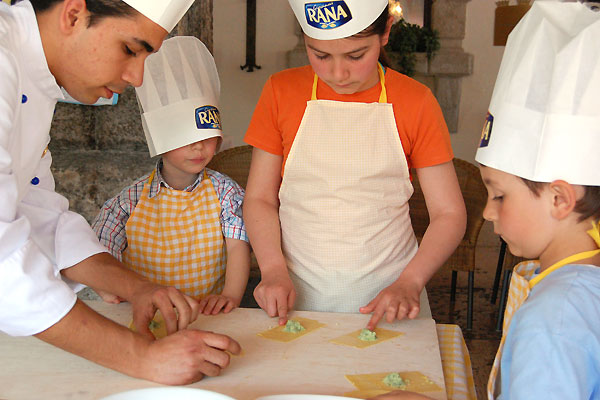
Today Verona is overrun with families: it’s a kids’ fair. Grade-schoolers in tiny numbered jerseys run a kiddie marathon…dads jogging at their sides carrying their water bottles, and countless proud little faces smiling through the exhaustion. Five-year-olds in chef hats learn to make pasta from patient teenagers. Moms give little ones coins to activate the human statues on the pedestrian mall–as kids look with wonder at the statues suddenly coming to life.

When I visited a hotel I recommend, Rosella insisted I see her wing of new rooms. Like all the others, each room had an erotic collage on the wall above a double bed with red heart-shaped pillows. I commented on the passion the rooms evoke. Rosella said her hotel is all about the union of man and woman. She makes all the art while running the hotel. While her husband steamed me an espresso, I commented on her energy. She pointed to her husband, saying, “Amato gives me energy…he’s my mezza mela–half an apple.” Apparently, when soulmates find each other in Italy, it makes the apple whole.

Here in the “land of a thousand bell towers,” people have a great love for their towns as well. As my guide walked me through the cloister of the church, she showed me the tombs of the great early scientists–local boys who made good and whose names live on in their greatest discoveries: Fallopian tubes and Eustachian tubes. Occasionally I scribble in my notebook, feigning interest so as not to disappoint my proud local guide.

Verona, so famous for love, gets countless letters addressed simply to “Juliet, Verona, Italy.” The Juliet Club (www.julietclub.com) has 10 volunteers who actually respond to these mostly lovesick people. My hunch is they live in lands where people are not so connected.

People in the Trash…

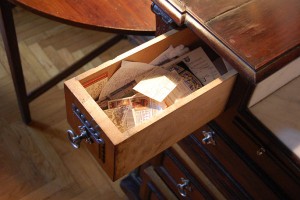
In each hotel room, I crack open a rickety old desk drawer, where I stow business cards I pick up throughout the day in my research work. This gives me a “trash can” that the maid won’t take out. I strive to keep loose papers out of my writing world, but very often I need to retrieve something I tossed.

Rummaging through my trash, reviewing the discarded cards of two days’ worth of people met, reminds me of how travel here is like a gelato social.

I met John Mica, a congressman from Florida, while dodging a horse carriage under a Donatello statue. He called himself a “knuckle-dragging conservative on economic issues who believes in funding the arts.” He and his wife sneak over here with no fanfare (so he doesn’t have to mess with security or any protocol). He was enthusiastic about a new “open skies” initiative leading to more transatlantic flights…and some funky little trattorias he wanted me to check out for my guidebook. For some reason he reminded me of salt on fresh pineapple (one of my favorite things). Meeting a likable Republican (like meeting a Catholic priest who challenges my intellect) reminds me that there’s more than one way to skin an idea.

When Congressman Mica opened his wallet to give me his card, I saw he had the card of a man I had just met and whose card I also had: David Stempler, Esq., president of the Air Travelers Association. A crusty man (and an Esq.), the government listens to him on consumer affairs dealing with the air industry. I told Stempler and Mica I thought the clamor for an “air travelers’ bill of rights” was media-stoked over-reacting to a perfect storm of airline bad luck, and that I am mightily impressed with our airline industry even if they do lose a few bags and once in a snowy blue moon a few planes are stuck on the tarmac. We agreed that the worst thing for our airline industry (and for consumers who know what’s good for them) is to saddle airlines with needless regulations and to create a business environment where they’ll cancel flights out of needless timidity.

Other cards were reminders of other encounters. For example, there was “Dr. Patricia Cantilli, Medic veterinary homeopath,” a Romanian woman on an extended computer date with a friend who once ran my favorite hotel in Florence (La Scaletta, which I deleted this year after about 20 years in my guidebooks — bad new management). Free trade, globalization…the expanded EU spills into romance, too.

“Lora Gori, president Scuola del Cuoio” runs the leather school at the Church of Santa Croce. It was actually referred to as “Citta dei Raggusi” (“Boys’ Town” in Italian) when her leatherworking family established it in collaboration with Franciscan monks during the tough years after WWII to give orphaned boys a trade. Sra. Gori still welcomes tourists as her leather workers fill former monks’ dorms with fancy belts and purses (www.leatherschool.com).

Christoph Rehli, a conductor from Switzerland with Young Frankenstein hair, was in Florence preparing for a concert. He was eating alone in one of my favorite restaurants. We had pianos in common. I told him my piano was made in the same Black Forest village as the accordion of the Gypsy man who just left the restaurant (Hohner harmonicas and accordions, and Sauter pianos — all made in Spaichingen). I told him my dad imported fine German pianos. There were three Steinway brothers, so factories ended up in New York, Hamburg, and Braunschweig. (Dad imported the Grotrian-Steinweg from Braunschweig. Back then, CBS owned the New York Steinway, was threatened by the better German Steinway, and successfully sued requiring that the name be simply Grotrian in the USA.) Christoph said he had a Hamburg Steinway that was old but good. I guessed it was a “vintage” from around 1930. He said yes. (Knowing pianos like others know wine assures me that we can all be snobs in some realm. I am forever impressed by wine-lovers who know the good years — a topic which completely baffles me.) Maestro Rehli and I had a wonderful chemistry…the kind of person I know I could be great friends with, but I’ll never see again. (A sad reality a traveler gets callous to: the best travelers say the most goodbyes.)

And another card from someone who called herself “The Tuscan Concierge” was a reminder that countless Americans and Italian entrepreneurs are still capitalizing on the “Under the Tuscan Sun” fascination we have with this part of Italy (and would love to get into my guidebook). Ristorante Medioevo (that Buca I loved in Assisi) has one of those cards so artsy you have a tough time actually deriving the name of the establishment — a growing problem, it seems, in Italy. Thankfully, Web addresses generally list the name without the over-the-top font play. Jim Fox and Barbara Miller, an American expat couple living in Florence, pass out their tandem card to people they meet. Jim said when you travel with a personal card and hand it out liberally, Europeans take you more seriously. Good tip.

Among piles of other cards penciled up with notes for the next edition of my Florence guidebook was a very clever card by Dr. Stephen Kerr, “the tourist doctor” with a clinic 100 yards from the Uffizi, open two hours a day for drop-ins. He also makes €80 “house calls” to hotels and gives student discounts.

A card from the Istituto Oblate dell’Assunzione, a welcoming convent renting rooms and tranquility, actually has an email address on it. Finally convents are getting a little business sense. The spunky sister there — Theresa — remembered me from the early 1980s when I kept my tour groups (minibus loads only back then) at a convent near the Vatican on via Andrea Doria. I didn’t remember her…but I did remember kindly sisters letting me hang my wet laundry on the rooftop with all their linen.

This little nostalgic swing through my trash drawer reminds me that good travel connects people with people. Whether I’m leading a tour group, researching a guidebook, or producing a TV show, I know that connecting my traveling Americans with Europeans is what will carbonate the experience.


Medici Fantasies Like You Can’t Imagine…

In Florence, I stay at Loggiato dei Serviti — a stately former convent, crisp with elegance and history. I consider it a splurge — but it’s far less costly than a night at the Sheraton, and it stokes Medici fantasies like you can’t imagine.

My bedroom looks out on a courtyard. The building across the way is the Accademia, housing an art school…and Michelangelo’s David. The courtyard in between is gravelly with broken columns and stones set up for students to carve. Like creative woodpeckers, all day long I hear the happy pecking and chirping of chisels gaining confidence, cutting through the stone. With this actually enjoyable soundtrack, I spent all yesterday here in my room pecking doggedly yet happily on my laptop.

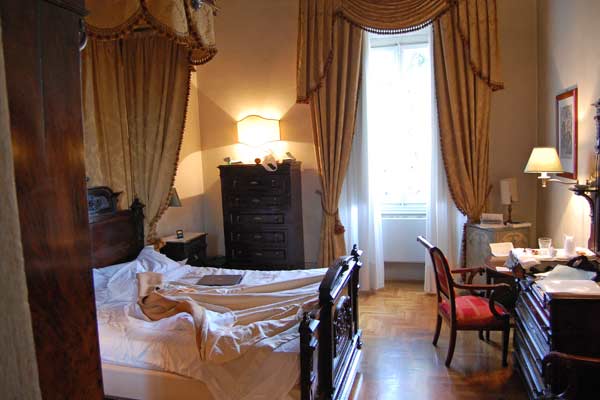
Moving into my room, I got set up: Put the TV out of view. Ask for a desk and an extra lamp for writing. Pick up and stow all the clutter that comes with a hotel room so it’s just pristine, Old World Florence. There’s a creaky freestanding armoire (I open the huge door with its skeleton key). The heavy wood beam ceiling fifteen feet overhead evokes a day when monasteries had Pentagon-like budgets. My circa-1980 phone is ruby-red, and the receiver rattles like a maraca if I get animated while talking. The mini-fridge is just big enough for my liter box of pompelmo (grapefruit juice) to sneak in with all the overpriced drinks that don’t exist in my mind. The parquet floors have extremely slip-slidey little throw rugs. I think they’re called throw rugs for what would happen to me if I carelessly stepped on one.

My hotel is on a grand old square and faces the first Renaissance building — a hospital designed by Brunelleschi. Outside, an arcade shelters the local lowlife. Enjoying a warm slice of pizza bianco while leaning against a column, I ponder the scene. While these well-worn people littering the steps used to get me down, now I realize that for 500 years, vagabonds and street people who couldn’t afford a bedroom like I’m calling home for these six days in Florence could enjoy the architecture (or at least the shade). Since the days of Michelangelo, they have set up camp free under the loggia eave of my fancy front door.

Each midnight, I open the window and untie the big sash that lets the heavy-tasseled curtain tumble straight…like princess hair. At 6 a.m., the birds chirp. I get up, look at the sleepy courtyard with its unfinished statuary, and close the windows hoping to grab another hour’s sleep. But too often I pick up this laptop and start pecking and chirping away.