Cleaning Up as I Prepare to Fly Home

Enlarge photo

Here are a few random notes from the past few weeks as I near the end of my summer travels:

My Swiss friend, Olle, takes me on my annual walk through the village of Gimmelwald. We see a rack of scythes. He demonstrates how they are sharpened not with a file, but by pounding. A sharp scythe is critical for a farmer — it cuts through hay like butter. Across the way, old boots with studs nailed on them for a grip on the steep slopes are nailed to the wall of a hut with their new use — alpine flower holder. In this case, traditional alpine culture survives…but only on show.

Traveling to the remote Czech backwater of Moravsky Krumlov to see Mucha’s Slavic Epic, it occurred to me that the Czechs keeping this grand series of canvases here is like keeping the Mona Lisain Walla Walla.

I never dreamed of wearing socks more than one day until my cameraman suggested it. After 10 minutes, you don’t notice.

Enlarge photo

Copenhagen’s streets were noisy with grads filling decorated trucks, screaming and drinking as they went from family to family for beers at a progressive graduation party hosted by their parents. They can handle the alcohol and have promising futures. Then I saw the Greenlanders. Young people from Greenland with the best prospects often travel to Copenhagen, their colonial capital, for a higher education (there’s none in Greenland). Hoping to build their young lives, they often fail — ending up unable to handle the temptations of Danish life. It’s a sad sight — wasted Greenlanders littering the square.

I didn’t realize that in central Rome, there are no buildings from after 1938. Looking for restaurants, I noticed vines climbing the buildings and it occurred to me that the places I like to recommend have roots. Places whose regulars remember when the place was their father’s favorite. Places named for the man whose faded photo is now on the wall…or who is so old he can only pretend to contribute, and shuffles around grating cheese on the pasta his grandchildren are cooking.

Ciao Venezia, Ciao, Ciao, Ciao

Venetians may be dwindling in number. But those who remain seem to be a happy lot. And when Venetians are happy, they sing. You hear it early in the morning as they wheel their souvenir carts into the tourist zone. You hear it from maids cleaning rooms. You hear it on the back lanes in the wee hours when you’re trying to sleep and voices travel twice as far.

But the gondoliers — who sing for a price — annoy me. They’re one big, wannabe rat pack who flip-flopped suave and schmaltz. Convoys of gondolas — each heavy with tourists — follow the leader who sings “Ciao Venezia, Ciao Venezia, Ciao Venezia, ciao, ciao, ciao.” And the accordionist is an enabler.

Prices in Venice have become outrageous. When I comment to hoteliers, the standard reply is, “People pay it.” As Las Vegas tries to recreate Venice, the reverse is happening as well. Demand for hotels is driving locals onto the mainland, so their vacated apartments can be made into boutique hotels. (I slept in one, under an enchanting barcode of medieval beams.) Looking for something non-touristy here is more and more like looking for a restaurant filled with locals at Disneyland.

That’s my rant. I get down as I realize that, in some cases, my ideal “back door” Europe is — in truth — wishful thinking. But I still love Venice.

A real community survives in Venice. The guy who runs the elevator at the bell tower of San Giorgio Maggiore — that wet Palladian dream floating just beyond the Doges’ Palace — told me he travels 10 kilometers (6 miles) a day up and down.

There are real energy concerns. Here, as all over Italy, restaurants are trading away a little ambience for harsh-yet-energy-efficient fluorescents. As is often the case in Europe, the government shows a kind of tough love — even if it’s bad for business and uncomfortable for citizens. Homes and hotels stop heating before they are allowed to start cooling. In the case of Venice, heat is generally turned off by mid-April and air-conditioning is only activated in mid-May. (Odd weather during that no-heat-no-air-conditioning window causes many American tourists to complain. When it comes to energy conservation, they get no sympathy from me.)

Leaving Venice for Padua the other day, I marveled at how easy it is for experienced travelers to transfer. (And the rewards awaiting the rookie who is a quick study.) Heidi, my Italy-specialist assistant, and I went from hotel to hotel in 70 minutes for €14 ($20).

At our Venice hotel — 100 yards behind the high-rent strip of hotels facing the lagoon, next to the Doges’ Palace — the guy at the desk told us we just had time to catch boat 42; it’s leaving at 6:46. We paid €6 each for tickets and hoped on the fast boat. I munched a dinner sandwich while enjoying the views and scoffing at the horrible location of the vast, new Venice Hilton Hotel.

Twenty-four minutes later, we were at the train station. In the station, we looked at the departure board — a fast train was leaving for Milan (stopping in Padua) in five minutes from track 8. Heidi (who’s better at this than me) zipped over to the now omnipresent ticket machines, typed in Padua, tapped the departure time, two people, second class, put in her credit card to pay €5 each and out popped our tickets. Two minutes later, we joined three Italian kids in a compartment on the express train. The kids packed up and left, making us feel like we had bad breath. I surveyed the photos Heidi took on today’s research swing through the Lagoon (from Igor Stravinsky’s tomb in Venice’s island cemetery to the old lady with the huge ears who still makes lace in Burano) and 25 minutes later we were in Padua. Hoping in a taxi, €6 and five minutes later we checked into our hotel.

After five days in Venice, I was a little shocked by modern buildings and all the rude cars. Recalling the story of the old women who spent her entire life in Venice and finally went to the mainland — and got run over — I reminded myself to cross streets with care.

Doctor, Doctor, You’re Still Just an A-Hole.

I’m in Padua (just half an hour from Venice, but a world away). I didn’t see a soul all day with my guidebook. (Kind of depressing after so many in Florence and Venice.) But if nobody’s here, I can’t let my coverage slide. I really like this town and I want my chapter to be worthy.

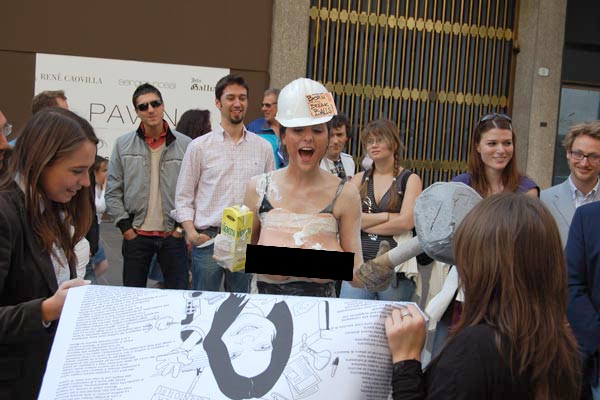
Galileo called his 18 years on the faculty in Padua the best of his life. The university seems to dominate the town and since its 60,000 students can graduate whenever they defend their thesis, I’ve never been here without little graduation parties erupting on the street all day long.

Graduates are given a green laurel wreath. Then formal group and family photos are taken. It’s a sweet, multi-generational scene with family love and pride busting out all over. Then, grandma goes home and the craziness takes over. Sober clothing is replaced by raunchy wear as gangs of friends gather around the new grad in the street in front of the university and the roast begins.

A giant butcher paper poster with a generally obscene caricature of the student and a litany of This Is Your Life photos and stories is presented to the new grad who, with various embarrassing pranks being pulled, reads the funny statement out loud. The poster is then taped to the university wall for all to see (and allowed to stay there for 24 hours).

During the roast, the friends sing the catchy but obscene local university anthem, reminding their newly esteemed friend to keep his or her feet on the ground: “Dottore, dottore, Dottore del buso del cul. Vaffancul, vaffancul.”

Very loosely translated it means: Doctor, doctor. You’re just a Doctor of the a-hole…go f-off, go f-off. (Sorry…G-rated blog.) Once I hear this song (it starts like an Olympic games fanfare and finishes like a German cartoon: oom-pah-pah, oom-pah-pah) and see all the good-natured fun, I just can’t stop singing it.

In Italy, God Is a DJ

I was in Siena the other day. To me, it’s a capital of humanism. The Sienese are so self-assured. They remember their centuries-old accomplishments as if they reflect well on them today.

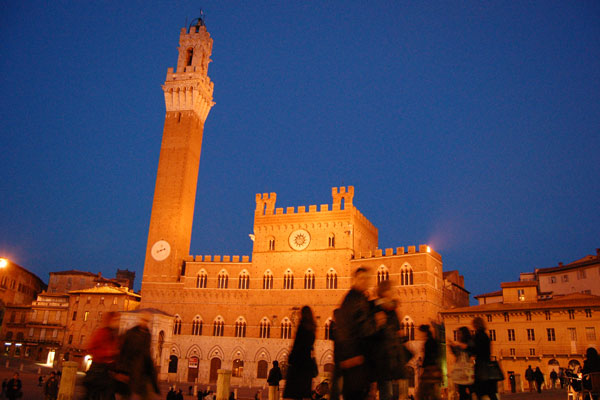
In this “land of a thousand bell towers,” they have the tallest and they seem the proudest. But my hunch is that it’s probably just an inferiority complex showing because their rival Florence is synonymous with the Renaissance, Michelangelo, and Leonardo. Say “Siena,” and you think panforte (fruitcake), a donkey race where there are no rules, and a Crayola color.

Siena does have my vote for the finest square in all of Europe. (Okay, blog-travelers, I’m curious — what’s your favorite square, and why?) Il Campo is a clamshell-shaped “square” of red brick where people hang out as if at the beach. It slopes gradually down to a grand building — not a church with a spire, but a crenellated city hall with a bell tower — the tallest in Tuscany. It stands like an exclamation point proclaiming that as a community, Siena comes together and makes life better for all.

Savoring a solitary moment here with a glass of vin santo (desert wine — borrowed from the restaurant) when the twilight sky is the same brightness as the rustic stones of Il Campo is a ritual for me.

Inside that city hall is a famous fresco called The Effects of Good Government. It’s 12.6 meters wide. Exactly 6.3 meters is devoted to the city, and 6.3 meters to the country — symbolizing how both need and help each other equally. (My hunch is that it was 14th-century propaganda to con the country folks into thinking they were respected by the urbanites who ruled them.)

If it’s true a society builds it tallest towers to its greatest gods (the architectural equivalent of “where your treasure is, there also you’ll find your heart”), then Siena worships secular effectiveness more than it trusts in God.

But Siena has a fine church, too. My guide took me in. When entering a church with me, my European friends normally sense I’m a Christian by my respect for the people and building and art. And this month, it seems every guide I’ve had (even in famously un-churched Italy) has touched the holy water and respectfully crossed themselves when we enter. On this day, though, my guide went on a little rant. She said, “We young Italians no longer go to church. We refuse to hear some old man telling us what we cannot do from that pulpit.”

Then we walked to the votives, where locals hang tokens of thanks to God for prayers answered. Next to the baby shoes, photos of healed people, and silver plaques with body parts pounded into them, was a corner that looked like a big hat rack at a race track. There, hanging obediently, were twenty bright and aerodynamic motorcycle helmets. I guess even young people who don’t like being told what they cannot do need to thank someone when they survive a motorcycle wreck.

Stepping outside, I saw a young Italian wearing a T-shirt declaring, “God is a DJ.”


It’s the Ingredients, Stupid

Italians are not patriotic about much…except their food. They tell me French cuisine is the art of making a fine sauce to cover the taste of mediocre ingredients. In Italy, they say, “La miglior cucina comincia dal mercato” — “the best cuisine starts from the market.”

It’s the ingredients, stupid. And that’s the topic of conversation (which can become an animated debate) when a chef comes out to chat with his diners. “Arugula is not yet in season. But oh, Sra. Maria has more sun in her backyard…and her chickens give her a marvelous fertilizer.”

It occurred to me that high cuisine has evolved like flowers. The most attractive get all the attention, and over time get even better. I’m in hog heaven with my Amarone wine, cheese plate, and honey. When the fancy wine glasses come out, you know it’s a particularly complex wine. At my last fine dinner, the glasses seemed designed to function like a gas mask…or drug paraphernalia, if the truth be told.

Then Corinna, who ran the enoteca I was enjoying, takes things up a notch proposing “a dish of walnuts for acidity and texture…to give things a kick. And the walnuts rake your palate.”

To go gourmet and not go broke, I like a small, classy enoteca (wine bars are trendy in Italy these days) owned and operated by hands-on food evangelists. A great wine costs €8 (about $10) a glass. Rather than bog down on an expensive entrée (or secondi), I order top-end on the antipasti and primi piatti list. That’s appetizers — the best meats and cheeses possible, and the chef’s favorite pasta dish of the day. Again…it’s the ingredients.

Strangely for me, even in the finest places, Italian waiters and waitresses don’t think coughing into their hands is a problem. (There’s been no rain here for a month. People keep telling me that’s giving everyone colds.) When I complain about this to people who run restaurants…they look at me like I’m from Mars. I guess that’s the downside of a hands-on food evangelist.