Daily Dose of Europe Will Now Include Art Masterpieces

The COVID-19 crisis can derail our travel plans…but it can’t stop our travel dreams. Since the pandemic began in mid-March, I’ve been sharing a Daily Dose of Europe: travel essays recounting my favorite memories (from my upcoming travel memoir, For the Love of Europe). Starting today, I’m going to add European art masterpieces to that lineup.

One of the great joys of travel is seeing world-class art in person—and understanding it. So, over the next two weeks, we’ll be featuring 10 of Europe’s greatest works of art (with more to come in future weeks). Especially with so many parents at home looking for enriching educational experiences for their students, we hope each of these daily masterpieces can be a delightful teaching moment. Play “tour guide” and gather your travel partners. Then lavish your attention on each photograph while reading out loud the finely crafted description. Enjoy a daily dose of Europe through its greatest art as if you’re right there.

All of these essays are excerpted from my new book, Europe’s Top 100 Masterpieces: Art for the Traveler, co-authored by Gene Openshaw. If you’d like to pick up a copy, I prefer if you support local businesses in your community — which are struggling right now — and buy it from your favorite bookshop. They could use the business…and you could use the book.

Today’s first installment features a work of art that also represents one of the most successful empires Europe has ever seen: the crown of the Holy Roman Emperor.

In a darkened, high-security room of a palace in Vienna lie the crown jewels of a lost empire. These are Europe’s oldest and most venerated royal objects — the sacred regalia used to crown the Holy Roman Emperor. These precious objects set the tone for nearly a thousand years of coronations.

The star of the collection is the Imperial Crown. Compared with more modern crowns, it’s a bit clunky — oddly shaped and crusted with uncut (not faceted) gems. But it’s more than 1,000 years old, and is a true Dark Age bright spot. It was probably made for Otto the Great, the first king to call himself Holy Roman Emperor (r. 962–973). Otto saw himself as the successor to the ancient Roman emperors, as well as King Charlemagne who revived the empire in the year 800. Like Charlemagne, Otto made sure he was crowned personally by the pope in St. Peter’s — thus legitimizing both his “Roman” birthright and his “holy” right to rule.

The Imperial Crown swirls with symbolism. The cross on top says this man is a divine monarch, ruling with Christ’s blessing. The Roman-style arch over the top recalls the feathered crests of legionnaires’ helmets. And the sheer opulence of the crown — made of 22-carat gold, elaborate filigree, and 144 precious stones — attests that this king rules over many lands: a true emperor.

After Otto, future rulers were crowned with this same crown. Many were just minor dukes who called themselves emperors. (Voltaire quipped that the Holy Roman Empire was “neither holy, nor Roman, nor an empire.”) But under the dynamic Austrian Habsburg family, it truly became an empire, covering much of Europe and the New World. The Habsburgs’ 60-acre palace in Vienna (the Hofburg) was the epicenter of European culture, and their time-worn coronation rituals became Europe’s standard.

Picture the crown along with the other royal regalia in action for a coronation. First, the emperor-to-be would don the royal mantle, a 900-year-old red-and-gold silk cloak, embroidered with exotic lions, camels, and palm trees threaded from thousands of tiny white pearls. Next, the entourage entered the church, bearing the 11th-century jeweled cross, complete with a chunk of the (supposed) actual cross of Jesus. The emperor was given a royal orb (modeled on Roman orbs), an oak-leaf scepter, and a sword said to belong to Charlemagne himself (but probably not). The emperor placed his hand on a gold-covered Bible and swore his oath. Then he knelt, the jewel-studded Imperial Crown was placed on his head, and — dut dutta dah! — you had a new Holy Roman Emperor.

By the 19th century, the Habsburg Empire was fading. “Holy Roman” rulers were forced to tone down their official title, and once-powerful emperors were reduced to hosting ribbon-cutting ceremonies and white-gloved balls. In 1914, the heir-apparent, Archduke Ferdinand, was assassinated. This kicked off World War I, Austria fell, and by 1918, the 1,000-year Holy Roman Empire was history. The crown ended up in a glass display case where its jewels still sparkle with the glory of a once-great empire.

This is an excerpt from the full-color coffee-table book Europe’s Top 100 Masterpieces by Rick Steves and Gene Openshaw. Please support local businesses in your community by picking up a copy from your favorite bookstore, or you can find it at my online Travel Store. To enhance your art experience, you can find a clip related to this artwork at Rick Steves Classroom Europe; just search for “Habsburgs”.
Daily Dose of Europe: Padua — Students, Saints, and Scarpette

The Italian university town of Padua has a special place in my heart, because I happened to be there just a few days after 9/11. During our current crisis, I’ve been thinking back on the very warm welcome the people of Pauda extended to me during that one.

Even if we’ve had to postpone trips to Europe, I believe a daily dose of travel dreaming can actually be good medicine. Here’s another one of my favorite travel memories — a reminder of what’s waiting for you in Europe at the other end of this crisis.

Nicknamed “the Brain of Veneto,” Padua is home to the prestigious university (founded in 1222) that hosted Galileo, Copernicus, Dante, and Petrarch. Pilgrims know this city for the Basilica of St. Anthony, where the faithful assemble to touch his tomb and marvel at his holy relics. It’s a great place to experience Italy: to make some new friends, get chummy with the winds of its past, and connect with the delights of its now.

I start my visit with a ramble around the old town center. It’s a colonnaded, time-travel experience through some of Italy’s most inviting squares, perfect for lingering over an aperitivo. But it’s not stodgy — this university town has 60,000 students and a youthful spirit. No wonder Galileo called his 18 years on the faculty in Padua the best of his life. I see young people — apparently without a lot of private space in their apartments — hanging out, kissing, and cuddling in public. Students are making themselves at home with their heritage, lounging literally under a medieval tomb that stands atop ornate columns.

Since the students can graduate whenever they defend their thesis, little graduation parties erupt on the streets throughout the year. Graduates are given a green laurel wreath. Then formal group photos are taken. It’s a sweet, multigenerational scene with familial love and pride busting out all over.

Then, once grandma goes home, the craziness takes over. Sober, scholarly clothing is replaced by raunchy wear as gangs of friends gather around the new grad in front of the university, and the roast begins. A giant butcher-paper poster with a caricature of the student — generally obscene — and a litany of “This Is Your Life” photos is presented to the new graduate. The happy grad reads the funny text out loud while various embarrassing pranks are pulled. The poster is then taped to the university wall for 24 hours for all to see.

During the roast, the friends sing a catchy but crude local university anthem, reminding their newly esteemed friend to keep his or her feet on the ground. Once I hear this song, I just can’t stop singing it. The melody is infectious, starting like an Olympic Games fanfare and ending with oom-pah-pahs like a German cartoon. It becomes even more endearing when a student translates the lyrics for me: “You’re a doc…tor, you’re a doc…tor, but you’re still just an asshole. You’re a doc…tor, you’re a doc…tor, but you’re still just an asshole. Oom-pah-pah, oom-oom-pah-pah.”

Eventually I stop humming this profane ditty to seek out Padua’s sacred sights: the Basilica of St. Anthony and the Scrovegni Chapel. Buried in the basilica is Friar Anthony of Padua, patron saint of travelers, amputees, donkeys, pregnant women, barren women, flight attendants, and pig farmers. Construction of this impressive Romanesque/Gothic church, with its Byzantine-style domes, started immediately after Anthony’s death in 1231. As a mark of his universal appeal and importance in the medieval Church, he was sainted within a year of his death. And for nearly 800 years, his remains and this glorious church have attracted a steady stream of pilgrims.

Going with the flow of the pilgrim groups, I enter the church. Gazing through the incense haze, I see Donatello’s glorious crucifix rising from the altar, a masterpiece appropriate for one of the most important pilgrimage sites in Christendom. Following the pilgrims into the Chapel of the Reliquaries, I stand before the basilica’s most prized relic: Anthony’s tongue. When the saint’s remains were exhumed 32 years after his death, his body had decayed to dust, but his tongue was found miraculously unspoiled, still red in color. How appropriate for the great preacher who, so full of the Spirit, couldn’t stop talking about God.

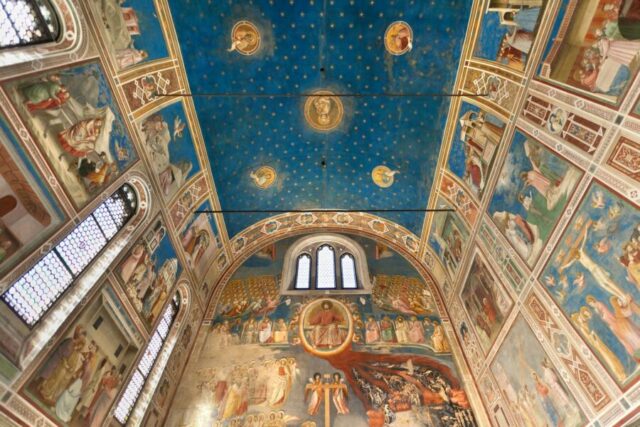
My next stop is across town at the glorious Scrovegni Chapel. It’s wallpapered with Giotto’s beautiful cycle of nearly 40 frescoes depicting the lives of Jesus and Mary. Painted by Giotto and his assistants from 1303 to 1305, it’s considered to be the first piece of “modern” (as opposed to medieval) art. This work makes it clear: Europe was breaking out of the Middle Ages and heading into the Renaissance. Giotto placed real people in real scenes, expressing real human emotions. These frescoes were radical not only for their three-dimensional effects, lively colors, and light sources, but also for their humanism.

In the early evening, after the museums and churches have closed, Padua’s squares become open-air student parties, dotted with drinks of rosy spritzes that glow with the light of the setting sun. I cap my day by joining the festivities. Reminding myself that I’m as interesting to these young Italians as they are to me, I befriend a table of college students and buy a round of drinks. Diving headlong into a vigorous political discussion, I partake in the Italian ritual of the bread and oil. I pour some fine olive oil on a dish, season it with salt and pepper, rip a long strip from our bread, dip it, and bite. A student, nodding with approval, explains that I am making the scarpette: “the little shoes.”

Soaking up the oil along with the conversation, I’m still thinking about my day, witnessing the sacred and the profane here in Padua. I realize that travelers can become human scarpette — sopping up culture — wherever we venture.

(This story is excerpted from my upcoming book, For the Love of Europe — collecting 100 of my favorite memories from a lifetime of European travel. It’s coming out in July, and available for pre-order. And you can also watch a video clip related to this story: Just visit  Rick Steves Classroom Europe  and search for Padua.)

Daily Dose of Europe: The Italian Love of Eating 

I’m using my quarantine time learning how to cook. One thing is clear: I’m nowhere near as good as the Italians. But I can dream of those “meals of a lifetime” that seem almost routine in Italy.

Even if we’ve had to postpone trips to Europe, I believe a daily dose of travel dreaming can actually be good medicine. Here’s another one of my favorite travel memories — a reminder of what’s waiting for you in Europe at the other end of this crisis.

Spending a month in Italy, the thought of eating anything other than Italian food never occurs to me. Other than France, I doubt there’s another country in Europe that could hold my palate’s interest so completely. One reason I don’t tire of going local here is that this land of a thousand bell towers is also the land of a thousand regional cuisines. And I celebrate each region’s forte.

Tuscany is proud of its beef, so I seek out a place to sink my teeth into a carnivore’s dream. My favorite steakhouse is in Montepulciano. The scene in a stony cellar, under one long, rustic vault, is powered by an open fire in the far back. Flickering in front of the flames is a gurney, upon which lays a hunk of beef the size of a small human corpse. Like a blacksmith in hell, Giulio — a lanky, George Carlin look-alike in a T-shirt — hacks at the beef, lopping off a steak every few minutes. He gets an order and then it’s whop!…leave it to cleaver.

In a kind of mouthwatering tango, he prances past boisterous tables of eaters, holding above the commotion the raw slabs of beef on butcher paper. Giulio presents the slabs to my friends and me, telling us the weight and price and getting our permission to cook it. He then dances back to the inferno and cooks the slabs: seven minutes on one side, seven on the other. There’s no asking how you’d like it done; this is the way it is done. Fifteen minutes later, we get our steaks.

In Italy, the cuisine is revered — and the quality of the ingredients is sacred. Italians like to say, “La miglior cucina comincia dal mercato.” (“The best cuisine starts from the market.”) They care deeply about what’s in season.

One night in Florence, I’m dining with my friend Cincia at her favorite trattoria when the chef comes out to chat with her. They get into an animated debate about the ingredients: “Arugula is not yet in season. But oh, Signora Maria has more sun in her backyard, and her chickens give her a marvelous fertilizer.”

Then the topic changes to the cuisine turmoil caused by erratic weather. Vignarola, the beloved stew consisting of artichokes, peas, and fava beans, is on the menu before its normal season. Cincia, seeming traumatized, says, “Vignarola, how can it be served so early? I’ve never seen it on a menu before Easter.” The chef, who only makes it for a few weeks each spring during a perfect storm of seasonality when everything is bursting with flavor, has to convince her that the season has changed and it’s on the menu because this is the new season.

Enjoying the commotion, I explain to Cincia that this is the kind of restaurant I seek out in Italy. It ticks all the boxes: It’s personality-driven — a mom-and-pop place — and run by people enthusiastic about sharing their love of good cooking. It’s a low-rent location, with lots of locals. The menu is small because they’re selling everything they’re cooking. It’s in one language, Italian, because they cater to locals rather than tourists. And it’s handwritten because it’s shaped by what’s fresh in the market today.

Cincia then takes control, telling me to put away my notepad and stop being a travel writer. She says, “Only a tourist would rush a grappa or pull the fat off the prosciutto. Tonight, we eat with no notes. We eat my way.” Reviewing the options, she says to the chef simply, “Mi faccia felice” (Make me happy).

And he does.

(This story is excerpted from my upcoming book, For the Love of Europe — collecting 100 of my favorite memories from a lifetime of European travel. It’s coming out in July, and available for pre-order. And you can also watch a video clip related to this story: Just visit  Rick Steves Classroom Europe  and search for “Italian farm culture”.)

Daily Dose of Europe: Lago di Como — Where Italians Honeymoon 

When traveling in Italy, I find Lake Como the most relaxing place to take a break. Join me there now on a mental break from self-isolation and coronavirus crisis.

Even if we’ve had to postpone trips to Europe, I believe a daily dose of travel dreaming can actually be good medicine. Here’s another one of my favorite travel memories — a reminder of what’s waiting for you in Europe at the other end of this crisis.

Stretched over two chairs atop the skinny passenger deck of a 10-car ferry as it shuttles across Lago di Como, I look south into the haze of Italy. I’m savoring the best of my favorite country with none of the chaos and intensity that’s generally part of the Italian experience. Looking north, into a crisp alpine breeze, I see snowcapped Alps.

I’m just minutes from Switzerland…but it’s clear I’m in Italy. The ferry workers are Italian, with that annoying yet endearing and playful knack for underachieving. Precision seems limited to the pasta: exactly al dente. Rather than banks and public clocks (which inundate nearby Swiss lake resorts, such as Lugano), the lanes that tumble into this lake come with lazy cafés and hole-in-the-wall shops, brimming with juicy fruits and crunchy greens.

In this romantic Lakes District in the shadow of the Alps, wistful 19th-century villas are seductively overgrown with old vines that seem to ache with stories to tell. Stunted palm trees look as if held against their will in this northern location. And vistas are made to order for poets. In fact, it was Romantic-age nature lovers who wrote and painted here that put this region on the tourism map in the 1800s.

The million-euro question: Which lake to see? Little Orta has an offbeat, less-developed charm. Maggiore has garden islands and Stresa, a popular resort town. Garda is a hit with German windsurfers. But for the best mix of scenery, old aristocratic romance, and wisteria charm, my choice is Como.

Sleepy Lago di Como, just an hour north of Milan by convenient train, is a good place to take a break from the obligatory turnstile culture of Italy. It seems half the travelers I meet have tossed their itineraries into the lake and are actually relaxing.

Today, the hazy lazy lake’s only serious industry is tourism. Many lakeside residents travel daily to nearby Lugano, in Switzerland, to find work. The area’s isolation and flat economy have left it pretty much the way those 19th-century Romantics painted it.

The self-proclaimed “Pearl of the Lake,” Bellagio is the leading Lago di Como resort, a classy combination of prim tidiness and Old World elegance. If you don’t mind feeling like a “tramp in the palace,” it’s a fine place to surround yourself with the more adventurous of the posh travelers. Arcades facing the lake are lined with shops. The heavy curtains hanging between the arches keep VIP visitors and their poodles from sweating. While the fancy ties and jewelry sell best at lake level, the locals shop up the hill.

Lago di Como is famous among Italians for its shape: like a stick figure of a man with two legs striding out. Bellagio is located where the two legs come together (which makes it the subject of funny, if crude, local rhymes you can learn when you visit). I wander from the town right on out to the crotch, following the view of the lake. At Punta Spartivento (literally “the point that divides the wind”), I find a Renoir atmosphere, perfect for a picnic while gazing north and contemplating the place where Italy is welded to the Swiss Alps.

I head to the town of Varenna (another 10-minute hop on the ferry), which is my home base. Narrow stepped lanes climb almost invisibly from the harbor to the ancient arterial road that runs parallel to the lake along the top of town. Varenna packs its 800 residents into a compact townscape — tight as 50 oysters overloading a too-small rock. Individual homes are defined only by their pastel colors.

With Varenna’s dwellings crowding the lake, the delightful passerella (boardwalk) arcs from the ferry dock to the tiny harbor past private villas guarded by wrought iron and wisteria. Two centuries ago, the harborfront was busy with coopers expertly fitting their chestnut and oak staves into barrels, stoneworkers carving and shipping prized black marble, and characteristic wooden boats heading out to catch the lake’s unique missoltino — freshwater “sardines” still proudly served by local chefs. Today, the harbor’s commerce is little more than the rental of paddleboats and a gelateria run by a guy named Eros.

Other than watch the ferries come and go, there’s wonderfully little to do in Varenna. At night, it whispers luna di miele — honeymoon. And strolling its passerella, passing by those wisteria-drenched villas where caryatid lovers are pressed silently against each other, I’m reminded of the importance of choosing the right travel partner.

(This story is excerpted from my upcoming book, For the Love of Europe — collecting 100 of my favorite memories from a lifetime of European travel. It’s coming out in July, and available for pre-order. And you can also watch a video clip related to this story: Just visit  Rick Steves Classroom Europe  and search for “Lake Como”.)

Daily Dose of Europe: Vernazza — Lorenzo’s View

I miss hiking through the vineyards up to the scenic cemeteries high above the Cinque Terre — looking down over Italy’s heavenly, traffic-free Riviera.

With so many of us stuck at home for the foreseeable future, I believe a daily dose of travel dreaming can actually be good medicine. Here’s another one of my favorite travel memories — a reminder of what’s waiting for you in Europe at the other end of this crisis.

Vernazza’s strollable breakwater creates a little harbor, rare on this rugged Riviera coastline. Grabbing a comfortable hollow in a boulder on the tip, I study the arrangement man and nature have carved out here over the last thousand years. Crumpled hills come with topographical lines: a terraced, green bouquet of cactus, grapevines, and olive trees.

With a closer look, I notice that the hills silently seethe with activity. Locals tend their vines and hikers work up a thirst for the white wine these hills produce. The single silver rail line runs perpendicular to the terraces, scaling the hillside like a rock climber’s rope. It’s autumn, and the grape pickers’ tiny train — the trenino — is busy ferrying grapes down into town from the highest terraces.

Below my rocky perch, a fisherman cleans his nets. The cool mist that follows each crashing wave reminds me how easily this breakwater is conquered during winter storms. High above the breakwater, at the base of the castle, is a restaurant called Il Castello. This pricey place was my private little splurge back when I stretched my money by choosing popsicles over gelato.

Vernazza feels populated by descendants of the pirates who plundered this coast. But Lorenzo, who ran Il Castello, was a rare Vernazzan who didn’t take advantage of tourists held captive by his town’s beauty. He’d sit me down under an umbrella with the most commanding view in town. And with the love of a small-town priest, he’d put a cookie next to my glass of cool, sweet sciacchetrà wine, and say, “Rest here. The view is nice.”

Cancer took Lorenzo quickly one winter. Now he’s king of the Vernazza mountain. He’s resting and enjoying the best view of all from a different kind of hotel, booked out by locals for years…the hilltop cemetery.

Leaving the harborfront, I climb the steep, stony staircase up to Il Castello. Monica, Lorenzo’s daughter who runs the place now with her husband Massimo, greets me warmly. Her black hair backlit by the sun, she seems to have an aura. Her penetrating eyes seem to really see me. She has Barbra Streisand lips and a bony nose. In her caring face I see Lorenzo, as if he were still standing there with a nice bottle of sciacchetrà.

I tell Monica that I’ve been thinking about her father and she suggests we visit the cemetery. Hiking through narrow back alleys that smell of damp cats, we reach the lane that leads uphill to the cemetery. After a funeral Mass, the entire village spills out of the church and trudges darkly up this same route.

At the top of the lane, a black iron gate is open. Inside, the cemetery is fragrant with fresh flowers. Quiet pathways separate marble walls of niches, stacked five high. Walking down a lane closest to the sea, Monica explains that coffins are not put into the ground but slid into a loculo. Squinting at a wall of niches, reflecting bright white in the late-afternoon sun, I review names and dates carved into the marble. Each niche is wired with a minuscule light and comes with a built-in vase. And next to each vase is an inset oval window filled with a black-and-white portrait.

Stepping around a rolling ladder — left out for loved ones with flowers for those resting on the top row — Monica arrives at her father’s loculo. She leaves me long enough to cross herself. Then, turning toward the sea, Monica sits on a flat rock just big enough for two. Patting the other half of her perch, she invites me to sit down. She doesn’t know it, but it’s as if to say, “Rest here. The view is nice.”

We ignore the red tiles, flapping laundry, and tourists lounging on the breakwater below. From here, enjoying what we call “Lorenzo’s view,” the world is peaceful green and reassuring blue, blending the sea and sky. To the left and right, I pick out each of the Cinque Terre towns along the coast. Each is alone in the world — seemingly oblivious to the march of time. I wonder what could possibly improve the setting. Then the church bells ring.

(This story is excerpted from my upcoming book, For the Love of Europe — collecting 100 of my favorite memories from a lifetime of European travel. It’s coming out in July, and available for pre-order. And you can also watch a video clip related to this story: Just visit  Rick Steves Classroom Europe  and search for “Cinque Terre.”)