Daily Dose of Europe: Bernini’s Apollo and Daphne

In a palace in Rome’s leafy Borghese Gardens stands this dramatic statue, displayed in the very room Bernini sculpted it for.

The coronavirus can derail our travel plans…but it can’t stop our travel dreams. And I believe a daily dose of travel dreaming can actually be good medicine. One of the great joys of travel is seeing art masterpieces in person. And I’m currently featuring 10 of my favorites — including this one.

When you visit the Borghese Gallery in person, the statue reveals itself exactly as Bernini intended. Starting from behind, you see only a man’s backside. But as you begin circling around the side, you realize it’s the god Apollo, running at full speed, his cloak whipping behind him. He’s chasing after a beautiful woman, the nymph Daphne. Apollo is starry-eyed, having been struck by Cupid’s arrow, making him crazy in love with Daphne. But Daphne’s running away, horrified. Apollo is catching up — he reaches out to grab her by the hip. Desperate, Daphne calls out to her father, a river god, to save her.

It’s only when you circle around to the front that Bernini reveals the story’s surprise ending. Magically, Daphne is saved from Apollo’s embrace by turning into a tree. In good Baroque fashion, Bernini captures the dramatic split second when the terrified nymph’s fingers begin to sprout leaves, her toes become roots, and Apollo is in for one rude surprise.

This striking statue by the twenty-something Bernini was a tour de force of sculpting. He was a master of marble, carving supple flesh out of hard stone: you can see Daphne’s love handles, and Apollo’s fingers press in as if it were real skin. Bernini used only the finest Carrara marble — renowned for its softness and creamy, ivory hue. Bernini chipped away to reveal the most delicate of features — the statue is almost more air than stone. Apollo’s back leg defies gravity. The exquisitely carved marble leaves at the top ring like crystal when struck.

The statue is just one of a handful of works Bernini did for the luxury-loving cardinal who owned the Villa Borghese. This palace-in-a-garden was a showcase for his fine art while wining and dining the VIPs of his age. It was a multimedia, multi-era extravaganza of great art: Baroque frescoes on the ceiling, Greek statues lining the walls, Roman mosaics on the floor…and Bernini’s statues in the center.

With his chisel, young Bernini — who virtually invented the Baroque style — was establishing some of its early features: He makes this supernatural event seem realistic. He captures the scene at its most dramatic, emotional moment. The figures move and twist in unusual poses. Apollo’s cape billows behind him. It’s not just a statue you stand and look at. It’s interactive — you have to walk around it to fully experience it. With Apollo and Daphne, Bernini turned a static sculpture into a charged scene — a piece of theater-in-the-round.

This art moment — a sampling of what we try to incorporate in our tours — is an excerpt from the full-color coffee-table book Europe’s Top 100 Masterpieces by Rick Steves and Gene Openshaw. Please support local businesses in your community by picking up a copy from your favorite bookstore, or you can find it at my online Travel Store. To enhance your art experience, you can find a clip related to this artwork at Rick Steves Classroom Europe; just search for Bernini.

Daily Dose of Europe: Raphael’s School of Athens

To solve our problems, the world needs to listen to smart people right now. When I think of our current predicament, I picture Raphael’s great painting that assembles all of the smartest people in ancient Athens in one place: The School of Athens.

The coronavirus can derail our travel plans…but it can’t stop our travel dreams. And I believe a daily dose of travel dreaming can actually be good medicine. One of the great joys of travel is seeing art masterpieces in person. And I’m currently featuring 10 of my favorites — including this one.

In 1508, the great Pope Julius II decided to redecorate his Vatican apartment. He hired a 25-year-old who came with a reputation as a one-of-a-kind prodigy: Raphael Sanzio. For the pope’s library, Raphael painted this scene highlighting secular knowledge. Raphael imagines all the great scientists and philosophers from the ancient world gathered together in a kind of rock and roll heaven.

In the center stand Plato and Aristotle. Plato points up, indicating his philosophy that mathematics and pure ideas are the source of truth. Aristotle gestures down, showing his preference for hands-on study of the material world. Their master, Socrates (midway to the left, in green), debates the meaning of it all. In the lower left, the great mathematician Pythagoras sits and ponders his famous formula: a2 + b2 = c2. In the lower right, the bald Euclid bends over to draw a geometrical figure.

There’s another way to look at this Who’s Who of great minds. You see, Raphael thought that Renaissance thinkers of his generation were as enlightened as the ancients. So he cast many of his contemporaries in the role of these enlightened people of the past. Plato, for example, with his long beard and receding hairline, is clearly Leonardo da Vinci, Raphael’s hero. And Euclid is the architect Donato Bramante. In fact, the entire scene is set amid the arches and pillars of Bramante’s work-in-progress — St. Peter’s Basilica. Raphael even photobombed his own painting. Find his self-portrait on the far right — the young man wearing a black beret and peering out.

Now take in the whole scene. Raphael balances everything symmetrically. He places a couple dozen figures to the left, a couple dozen to the right, with Plato and Aristotle dead center. Focus on the square floor tiles in the foreground. If you laid a ruler over them and extended the line upward, it would run right to the center of the picture. If you put your ruler on the tops of the columns, those lines all point down to the middle. All the lines of sight draw your attention to Plato and Aristotle, and to the small arch over their heads. It’s almost like a halo over these two secular saints who dedicated their lives to the divine pursuit of knowledge.

Finally, focus on the guy sitting right up front and center, leaning on a block of marble. He was a last-minute addition to the scene. While Raphael was working here, another painter was at work for the same pope down the hall in the Sistine Chapel. Raphael happened to get a sneak peek at that artist’s work. He was astonished. He returned to The School of Athens, scraped off a section of fresco, replastered it, and added this final figure: none other than the great painter, sculptor, and poet — Michelangelo Buonarroti.

With this fresco, Raphael’s message was clear: The enlightened ancient world had been reborn in the Renaissance.

This is an excerpt from the full-color coffee-table book Europe’s Top 100 Masterpieces by Rick Steves and Gene Openshaw. Please support local businesses in your community by picking up a copy from your favorite bookstore, or you can find it at my online Travel Store. To enhance your art experience, you can find a clip related to this artwork at Rick Steves Classroom Europe; just search for Vatican.

Daily Dose of Europe: Michelangelo’s Pietà

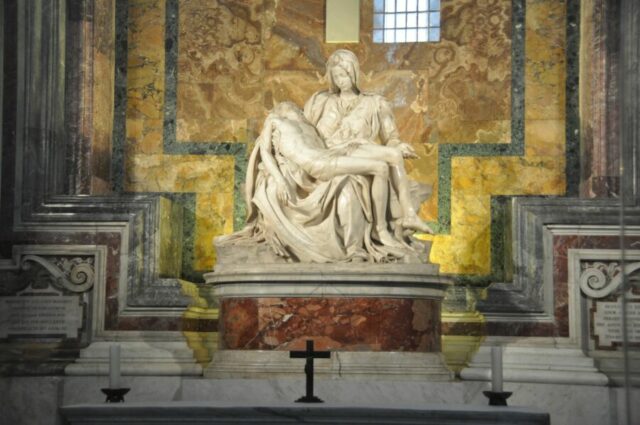
When he was just 24 years old, Michelangelo carved the statue that made him famous: His Pietà debuted in St. Peter’s in Rome for the Holy Year of 1500. Thousands of pilgrims filed by and were amazed by what appeared to be a miraculous event carved out of marble yet unfolding before their eyes.

The coronavirus can derail our travel plans…but it can’t stop our travel dreams. And I believe a daily dose of travel dreaming can actually be good medicine. One of the great joys of travel is seeing art masterpieces in person. And I’m currently featuring 10 of my favorites — including this one.

The word pietà means “pity,” and is the name of any work showing Mary tenderly mourning her dead son, Jesus.

Michelangelo, with his total mastery of the real world, captures the sadness of the moment. Mary gazes down on her crucified son. Christ’s lifeless right arm droops down, letting us know how heavy his corpse is. Christ’s bunched-up shoulder and rigor-mortis legs show that Michelangelo learned well from his studies of cadavers. The vulnerability of Christ’s smooth skin is accentuated by the rough folds in Mary’s robe. As Mary supports the body with her right hand, she turns her left hand upward, asking, “How could they do this to you?”

It’s hard to believe that this supple, polished statue is carved from one of the hardest of stones — Carrara marble. Michelangelo didn’t think of sculpting as creating a figure, but as simply freeing the God-made figure already in the marble. He’d launch himself into a project like this with an inspired passion, chipping away to find what God had put inside.

As realistic as this work is, its true power lies in the subtle “unreal” features. Life-size Christ looks childlike compared with larger-than-life Mary. Unnoticed at first, this makes a subliminal impression of Mary enfolding Jesus in her maternal love. Mary — the mother of a 33-year-old man — looks like a teenager, emphasizing how Mary was the eternally youthful “handmaiden” of the Lord, always serving him, even at this moment of supreme sacrifice. Mary always accepts God’s will, even if it means giving up her son.

Mary is a solid pyramid of maternal tenderness. Yet within this, Christ’s body tilts diagonally down to the right and Mary’s hem flows with it. Subconsciously, we feel the weight of this dead Savior sliding from her lap to the ground.

To appreciate the full impact of this scene, Michelangelo hoped you’d view his Pietà from close up, looking up at Mary’s face. Sadly, on May 23, 1972, a madman with a hammer entered St. Peter’s and began hacking away at the Pietà. The damage was repaired, but it changed forever how people interact with this object of beauty. It now sits behind a shield of bulletproof glass and is viewable only from a distance.

This is Michelangelo’s only signed work. The story goes that he overheard some pilgrims praising his Pietà, but saying it was done by a second-rate sculptor from a lesser city. Michelangelo was so enraged he grabbed his chisel and chipped an inscription in the ribbon running down Mary’s chest. It said, “This was made by Michelangelo Buonarroti of Florence.”

This is an excerpt from the full-color coffee-table book Europe’s Top 100 Masterpieces by Rick Steves and Gene Openshaw. Please support local businesses in your community by picking up a copy from your favorite bookstore, or you can find it at my online Travel Store. To enhance your art experience, you can find a clip related to this artwork at Rick Steves Classroom Europe; just search for Vatican.

Daily Dose of Europe: Botticelli’s Birth of Venus

On my next trip to Florence’s Uffizi Gallery, I can’t wait to lay my eyes on that famous “Venus on the Half-Shell” painting…one of the masterpieces of the Renaissance.

The coronavirus can derail our travel plans…but it can’t stop our travel dreams. And I believe a daily dose of travel dreaming can actually be good medicine. One of the great joys of travel is seeing art masterpieces in person. And I’m currently featuring 10 of my favorites — including this one.

This work was revolutionary: the first large-scale painting of a naked woman in a thousand years. It summed up the growing secular culture of Renaissance Florence.

Venus — the goddess of love and beauty — was born from the foam of a wave. Still only half awake, this fragile newborn, blown by the god of wind, floats ashore on a scallop shell, where her maid waits to dress her in a rich robe fit for a goddess.

Botticelli, painting innocent beauty, did everything possible to please the eye. His pastel colors make the world itself seem fresh and newly born. Botticelli (who was trained as a goldsmith) mixed real gold into the paints to highlight Venus’ radiant hair, the scallop shell, the Wind’s wings, and even the sun-sparkled grass.

The god of wind sets the scene in motion. Everything — Venus’ flowing hair, the waves on the
water, the swirling robes, even the jagged shoreline — ripples like the wind. Venus’ wavy hair mirrors the undulating line of her body. Mrs. Wind holds on tight, as their bodies, wings, and clothes intertwine. In the center of all that wavy motion stands the still, translucent form of Venus, looking like she’s etched in glass.

In good Renaissance style, Botticelli poses Venus with the same S-curve body and modestly placed hands as a classical statue. But whereas Botticelli’s Renaissance contemporaries insisted on ultra-realism, Botticelli’s anatomy is impossible. Venus’ neck is too long and she stands off-kilter. Venus’ maid seems to float above the ground. And how exactly does Mrs. Wind wrap that leg around her man?

With The Birth of Venus (a.k.a. Venus on the Half-Shell), Botticelli was creating a more ideal world, with a more ethereal beauty. It’s a perfectly lit world, where no one casts a shadow. The bodies curve, the faces are idealized, and their gestures exude grace.

Venus’ nakedness is not so much erotic as innocent. Botticelli thought that physical beauty was a way of appreciating God. Venus’ beauty could arouse and uplift the soul of the viewer, giving him a spiritual longing for heavenly things.

Gaze into the eyes of Venus. She’s deep in thought…but about what? Around her, flowers tumble in the slowest of slow motions, suspended like musical notes, caught at the peak of their brief life. Venus’ expression has a tinge of melancholy, as if knowing how quickly beauty fades and that innocence will not last forever.

This is an excerpt from the full-color coffee-table book Europe’s Top 100 Masterpieces by Rick Steves and Gene Openshaw. Please support local businesses in your community by picking up a copy from your favorite bookstore, or you can find it at my online Travel Store. To enhance your art experience, you can find a clip related to this artwork at Rick Steves Classroom Europe; just search for Uffizi.

Daily Dose of Europe: Venice’s Bronze Horses

I can’t wait to go back to Venice when this is all over. And when I do, I’ll look up at the balcony of St. Mark’s Basilica, where four bronze horses will nod their heads in greeting.

The coronavirus can derail our travel plans…but it can’t stop our travel dreams. And I believe a daily dose of travel dreaming can actually be good medicine. One of the great joys of travel is seeing art masterpieces in person. And I’m currently featuring 10 of my favorites — including this one.

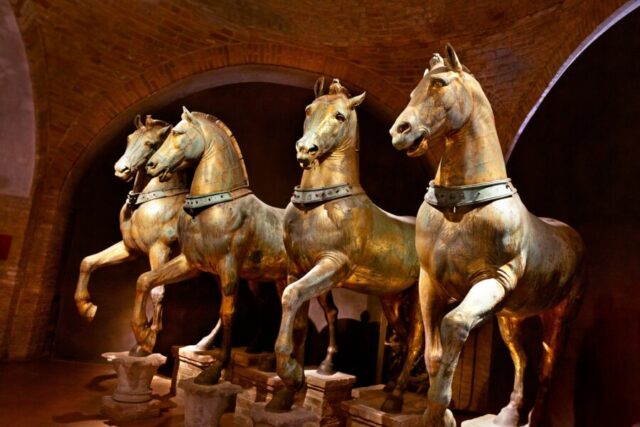
Stepping lively in pairs and with smiles on their faces, these four bronze horses exude a spirited exuberance. They long stood in the most prominent spot in the city of Venice — above the main door of St. Mark’s Basilica, overlooking St. Mark’s Square. (Replicas still stand there today.)

The horses are old — much older even than Venice. They’re likely from Greece and made in the fourth century BC. Originally they were part of a larger ensemble shown pulling a chariot, Ben-Hur style.

The realism is remarkable: the halters around their necks, the bulging veins in their faces, their chest muscles, and the creases in their necks as they rear back. With flashing eyes, flaring nostrils, erect ears, and open mouths, they’re the picture of equestrian energy.

They are clearly teammates. Each raises its hoof at the same time and same height. They cock their heads to the side, seemingly communicating with their brothers with equine ESP.

These bronze statues are rare survivors of that remarkable ancient technology known as the lost-wax method. They were not hammered into shape by metalsmiths, but cast — made by pouring molten bronze into clay molds. Each horse weighs nearly a ton. During the Dark Ages, barbarians melted most metal masterpieces down for re-use, but these survived. Originally gilded, they still have some streaks of gold leaf. Long gone are the ruby pupils that made their fiery eyes glisten in the sun.

Their expressive faces seem to say, “Oh boy, Wilbur, have we done some travelin’.” That’s because megalomaniacs through the ages have coveted these horses not only for their artistic value, but because they symbolize Apollo, the god of the sun…and symbol of power.

Legend says they were made in Greece during the time of Alexander the Great. They were then taken by Nero to Rome. Constantine brought them to his new capital in Constantinople (modern-day Istanbul) to adorn the chariot racecourse. In 1204, during the Fourth Crusade, the Venetians stole them. They placed them on the balcony of St. Mark’s Basilica from where the doge would speak to his people — the horses providing a powerful backdrop. Six centuries later, Napoleon conquered Venice and took the horses. They stood atop a triumphal arch in Paris until Napoleon fell and they were returned to their “rightful” home in Venice.

In the 1970s, the horses made their shortest and final journey. With the threat of oxidation from polluted air, they were replaced by modern copies. The originals galloped for cover inside the church, where they are displayed today.

For all their travel, this fearsome foursome still seems fresh. They’re more than just art. They stand as a testament to how each civilization conquers the previous one, assimilates the best elements from it, and builds upon it. And when visitors come to Venice today and admire these horses, they’re looking at a lot of history.

This is an excerpt from the full-color coffee-table book Europe’s Top 100 Masterpieces by Rick Steves and Gene Openshaw. Please support local businesses in your community by picking up a copy from your favorite bookstore, or you can find it at my online Travel Store. To enhance your art experience, you can find a clip related to this artwork at Rick Steves Classroom Europe; just search for “St. Mark”.