Daily Dose of Europe: Michelangelo’s David

When you look into the eyes of Michelangelo’s David, you’re looking into the eyes of Renaissance man.

As America continues to suffer crisis upon crisis, it has never been more important to broaden our perspectives and learn about the people and places that shape our world. And for me, one of the great joys of travel is seeing art masterpieces in person. Learning the stories behind great art can shed new light on our lives today. Here’s one of my favorites.
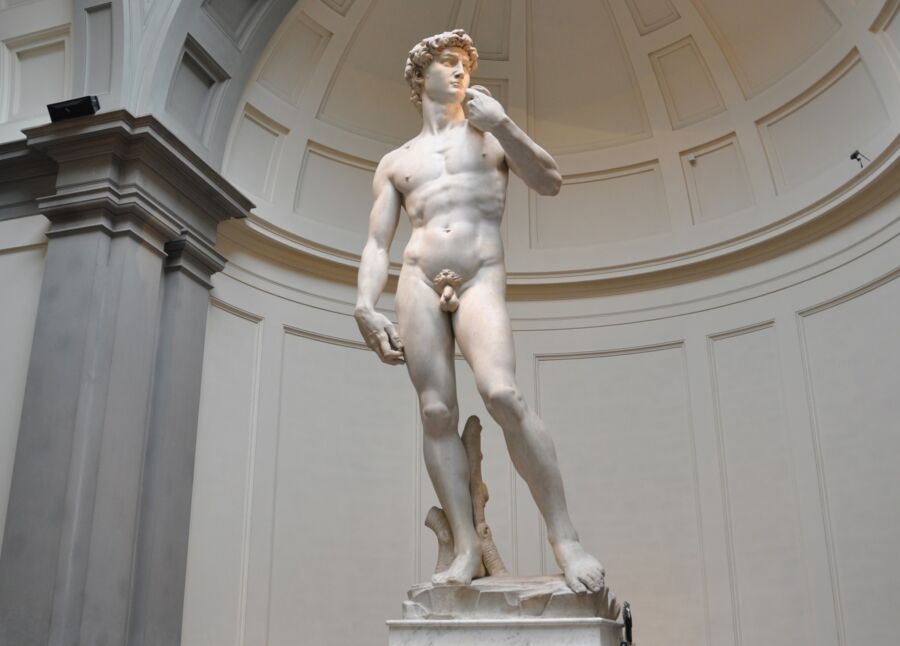
This six-ton, 17-foot-tall symbol of divine victory over evil represents a new century and a whole new Renaissance outlook. It’s the age of Columbus and Classicism, Galileo and Gutenberg, Luther and Leonardo — of Florence and the Renaissance.

In 1501, Michelangelo Buonarroti, a 26-year-old Florentine, was commissioned to carve a large-scale work for Florence’s cathedral. He was given a block of marble that other sculptors had rejected as too tall, shallow, and flawed to be of any value. But Michelangelo picked up his hammer and chisel, knocked a knot off what became David’s heart, and started to work.

He depicted a story from the Bible, where a brave young shepherd boy challenges a mighty giant named Goliath. David turns down the armor of the day. Instead, he throws his sling over his left shoulder, gathers five smooth stones in his powerful right hand, and steps onto the field of battle to face Goliath.

Michelangelo captures David as he’s sizing up his enemy. He stands relaxed but alert, leaning on one leg in the classical contrapposto pose. In his left hand, he fondles the handle of the sling, ready to fling a stone at the giant. His gaze is steady — searching with intense concentration, but also with extreme confidence. Michelangelo has caught the precise moment when David is saying to himself, “I can take this guy.”

David is a symbol of Renaissance optimism. He’s no brute. He’s a civilized, thinking individual who can grapple with and overcome problems. He needs no armor, only his God-given physical strength and wits. Look at his right hand, with the raised veins and strong, relaxed fingers — many complained that it was too big and overdeveloped. But this is the hand of a man with the strength of God on his side. No mere boy could slay the giant. But David, powered by God, could…and did.

Though the statue was intended to stand atop the cathedral, it long stood in an even more prominent spot — guarding the entrance of Town Hall. Renaissance Florentines identified with David. Like him, they considered themselves God-blessed underdogs fighting their city-state rivals. In a deeper sense, they were civilized Renaissance people slaying the ugly giant of medieval superstition, pessimism, and oppression. They were on the cusp of our modern age.

Today, David is displayed safely indoors at the Accademia, under a glorious dome at the end of a church-like nave lined with other statues by Michelangelo. You can approach as a camera-toting tourist or as a pilgrim finding inspiration in this “cathedral of humanism.” David stands as the ultimate symbol of the Renaissance — of optimism, humanism, and all that’s good in the human race.

This art moment — a sampling of how we share our love of art in our tours — is an excerpt from the new, full-color coffee-table book Europe’s Top 100 Masterpieces by Rick Steves and Gene Openshaw. Please support local businesses in your community by picking up a copy from your favorite bookstore, or you can find it at my online Travel Store.  To enhance your art experience, you can find a clip related to this artwork at Rick Steves Classroom Europe; just search for Accademia.

Daily Dose of Europe: Giotto’s Scrovegni Chapel

One thing I miss about traveling in Europe is stepping into a gorgeous space slathered with fine art. And the Scrovegni Chapel, in the Italian town of Padua, is one of my favorite lesser-known examples.

As America continues to suffer crisis upon crisis, it has never been more important to broaden our perspectives and learn about the people and places that shape our world. And for me, one of the great joys of travel is seeing art masterpieces in person. Learning the stories behind great art can shed new light on our lives today. Here’s one of my favorites.

Wallpapered with Giotto’s beautifully preserved cycle of 38 frescoes, the glorious Scrovegni Chapel depicts the life of Jesus with unprecedented realism. Painted around 1305, two full centuries before the High Renaissance, it’s considered to be the first piece of “modern” art. Europe was breaking out of the Middle Ages, and Giotto was painting real people in real scenes, expressing real human emotions.

The walls of this long, narrow chapel were Giotto’s canvas to tell the three-generation history of Jesus. Giotto’s storytelling style is straightforward, and anyone with knowledge of the episodes of Jesus’ life can read the chapel like a comic book.

It begins in the chapel’s upper corner with a heartbreaking episode that draws the viewer right in. Jesus’ grandpa, Joachim, is humiliated because he can’t produce a child. He returns dejectedly home, where miraculously, his wife gives birth to Mary, the mother of Jesus.

From this humble start, the story spirals clockwise around the chapel, from top to bottom: We see Jesus being born in a manger, baptized by John the Baptist, performing miracles, and so on. “Turning the page” to the chapel’s other wall, Giotto begins Jesus’ traumatic final days: the Last Supper, Jesus’ arrest, and the Crucifixion. The story concludes on the rear wall with a giant fresco of Jesus reigning at the Last Judgment. And all this unfolds beneath a blue, starry sky overhead on the chapel ceiling.

Jesus’ life was so eventful that Giotto had to crystalize the story into just a few evocative scenes. He captures all the drama of the Passion in the Betrayal of Christ panel — a.k.a. Il Bacio, or “The Kiss.” Amid the chaos of battling soldiers, Giotto directs your eye to the crucial action in the center. There, Judas ensnares Jesus in his yellow robe (the color symbolizing envy), establishes meaningful eye contact, and kisses him. Jesus’ stone-faced response to his supposed friend says it all.

At age 35, at the height of his powers, Giotto tackled the Scrovegni, painting the entire chapel in 200 working days.

His frescoes were groundbreaking: more realistic, 3-D, and human than anything seen in a thousand years. Giotto set his religious scenes in the everyday world of rocks, trees, and animals. So, when Joachim returns home, his faithful dog leaps up to greet him, frozen realistically in mid-air. Giotto’s people, with their voluminous, deeply creased robes, are as sturdy and massive as Greek statues. They exude stage presence. Their gestures are simple but expressive: A head tilted down says dejection, clasped hands indicate hope.

Giotto’s Scrovegni Chapel represents a turning point not only for European art, but also for a whole new way of thinking. It was Humanism — away from scenes of heaven and toward a more down-to-earth view, with man at the center.

This art moment — a sampling of how we share our love of art in our tours — is an excerpt from the new, full-color coffee-table book Europe’s Top 100 Masterpieces by Rick Steves and Gene Openshaw. Please support local businesses in your community by picking up a copy from your favorite bookstore, or you can find it at my online Travel Store. To enhance your art experience, you can find a clip related to this artwork at Rick Steves Classroom Europe; just search for Scrovegni.

Daily Dose of Europe: Caravaggio’s David with the Head of Goliath

The grotesque, in-your-face style of the painter Caravaggio feels fitting in our time of crisis. Here’s a close look at one of his most iconic works.

As America continues to suffer crisis upon crisis, it has never been more important to broaden our perspectives and learn about the people and places that shape our world. And for me, one of the great joys of travel is seeing art masterpieces in person. Learning the stories behind great art can shed new light on our lives today. Here’s one of my favorites.

In Caravaggio’s take on this familiar Bible story, David the shepherd boy has killed the giant Goliath with a rock and decapitated him with a sword. Now David holds the dripping head out at arm’s length, sticking it right in the viewer’s face.

Like David, the artist Caravaggio loved to shove startling images in the public’s face. While most artists amplified the world’s prettiness, Caravaggio painted its grittiness. Here he chronicles every gruesome detail: the dripping blood, rotting teeth, bloody wound in the forehead, and Goliath’s final expression of despair (or is it surprise?) frozen in death. David dangles the head by the hair and watches the life drain away. David’s expression is complex. He’s not gloating over his triumph, but detached, like he didn’t want to kill the poor bastard, but he had to — an executioner dispensing justice.

What exactly is David thinking? Well, Caravaggio knew. He knew exactly how it felt to have just killed someone, because he had recently murdered a man with a sword. Even as he painted this, he was running from the law.

Caravaggio’s life, like his art, was dark and dramatic. By his twenties, he was rich and famous for his startling talent and innovations. But he lived a reckless, rock-star existence — hanging out in dive bars, trashing hotel rooms, and picking fights. He used the low-life people he knew as models for his paintings, turning blue-collar workers into saints and prostitutes into Madonnas. Here, David is no heroic Renaissance man like Michelangelo’s famous statue — he looks like a teenage runaway in a dirty shirt.

Caravaggio’s specialty was stark lighting — creating a film-noir world of harsh light and deep shadows. This painting is bled of color, virtually a black-and-white crime-scene photo. Caravaggio shines the spotlight on just the details he wants to highlight: David’s skinny torso and cheek, and the giant’s horrified face.

The severed head of Goliath is none other than Caravaggio himself — an in-your-face self-portrait. That’s led scholars to see a lot of Caravaggio’s personal life in this painting. Some say David is also a portrait — of Caravaggio’s young lover, symbolizing how the young man has conquered him in love, leaving him literally smitten. Others say David is another self-portrait of Caravaggio, this time in his youth — in which case, David would be the artist’s youthful self reflecting on the ugly brute he’d become.

Caravaggio spent his final years wanted on murder charges. During that time, he forged a new direction in art. With his heightened realism, strong emotions, uncompromising details, and dramatic lighting, he set the tone for a new style: Baroque.

This painting — perhaps Caravaggio’s last — was a gift sent to the authorities along with a request that they pardon him. He portrays himself as Goliath, a message of his own self-disgust and contrition. Caravaggio was eventually pardoned, but he died shortly afterwards — appropriately, from a stab wound. Though only 38, in his short life he’d rocked the world of art — as his paintings continue to do to this day.

This art moment — a sampling of how we share our love of art in our tours — is an excerpt from the full-color coffee-table book Europe’s Top 100 Masterpieces by Rick Steves and Gene Openshaw. Please support local businesses in your community by picking up a copy from your favorite bookstore, or you can find it at my online Travel Store. To enhance your art experience, you can find a clip related to this artwork at Rick Steves Classroom Europe; just search for Caravaggio.

Rewatching The Story of Fascism in Europe

One summer evening, the American president ordered a park next to the White House to be cleared of peaceful protesters. He had just declared himself “the law and order president” and announced his intent to mobilize the US military to subdue dissent across the country. And he was about to show off with his own display of force.

The militarized police’s rubber bullets and choking gas drove back throngs of people who were in Lafayette Park lawfully, to protest police brutality. Once the smoke cleared, that president marched through the park, with an entourage of sycophants, and stood before one of the most historic churches in America. There he held up a Bible for a cynical photo op. He brandished the book (upside-down) as if he had never read it. “Is that your Bible?” a reporter asked. “It’s a Bible,” he replied with a smirk.

If I described this scene even a few years ago, you would never have believed that it was real. And yet here we are. As a Christian and a humanitarian, this scene offends me deeply. And as a privileged white man in America, the events of the last week have been a painful but important reminder that so many Americans are denied the basic rights that people like me take for granted every day. To me, “law and order” should mean that Black Lives Matter and all Americans deserve equal protection under the law.

Challenging times — like right now — call for strong leadership: a voice of unity, compassion, and mutual understanding. True leadership is nonpartisan, and in my lifetime, I’ve seen both Democrats and Republicans succeed in bringing together a fractured nation. But that’s not what we have today.

Two years ago, I produced a public television special called The Story of Fascism in Europe. I was driven by what I saw as uneasy parallels between our current political reality and the climate in 1930s Europe that gave rise to Hitler and Mussolini, and by my belief that we need to learn from that history. Today, those parallels have become impossible to deny.

The first 15 or 20 minutes of the special, as the seeds of fascism are planted in Germany and Italy, feel especially relevant in today’s America. Notice how the militarization of police and the scapegoating of “others” are textbook stepping stones in tipping a nation toward authoritarianism. Pay attention to Hitler’s “Brownshirts” and Mussolini’s “Blackshirts” — goon squads who hijacked otherwise peaceful gatherings to stoke dissent. Tune into how they called into question the legitimacy of a democratic system; how they, too, held up an unread Bible; and how they reassured supporters by offering simple solutions to complex challenges. Pay attention to how a fascist takes advantage of a crisis — or several — to consolidate power and to sow fear and chaos. And remember how Hitler and Mussolini both insisted that they, alone, had the answers for all of these problems. As they say, history may not repeat itself. But sometimes it rhymes.

One thing I learned as I researched and produced this special is that there are pivotal moments in a nation’s history when good and caring people can stand up against the rising tide of anger and fear that can lead to fascism. Or they can be complacent and wake up having lost their freedom. Our country is not too far gone…yet. But these coming weeks and months would be a good time for anyone who remembers the fate of Europe in the 1940s to organize, speak out, and vote in a way that helps keep us off that course.

For starters, be sure you and your loved ones, friends, and neighbors are registered to vote. (And during a pandemic, consider requesting an absentee ballot.) https://vote.gov/

Many ask, “What can I do?” Here’s one answer: In response to the systemic racism woven into our democracy, and to let the murder of George Floyd inspire us to bring something positive to our troubled society, this month my company is donating $50,000 to Lawyers and Collars, an initiative spearheaded by Sojourners that is working to defend voter rights in states where people of color are targeted. The goal: to support 1,000 black pastors and their allies who are ready in key states to protect the vote. In Alabama, Florida, Georgia, Michigan, North Carolina, Ohio, and Pennsylvania, they will mobilize their congregations and communities. If you’d like to join us, with even just a small donation, you can do it here: sojo.net/LCRS

Those of us who have the privilege of traveling to Europe have been blessed with an opportunity to get to know other societies — including ones that have lived through fascism — and to learn from them. Let’s bring those lessons home, and let’s do our best to provide grassroots leadership, as we find a way to heal our fractured country — with compassion, empathy, and real progress.

Watch the one-hour special: The Story of Fascism in Europe.

Daily Dose of Europe: Michelangelo’s Last Judgment in the Sistine Chapel

Even just a few months ago, travelers were complaining about the crowds in the Sistine Chapel. Today many of us wish we could be in that crowded room (safely) again. But for now, this virtual visit will have to do.

The coronavirus can derail our travel plans…but it can’t stop our travel dreams. And I believe a daily dose of travel dreaming can actually be good medicine. One of the great joys of travel is seeing art masterpieces in person. Here’s one of my favorites.

Twenty-three years after doing the Sistine ceiling, the pope asked Michelangelo to return to the Sistine to paint the wall behind the altar. He had painted the story of creation on the ceiling. Now, he set out to complete his Christian history of the world by painting the world’s final event — the end of time.

The mood of Europe was completely different from when Michelangelo had last painted here. Conflict between Catholics and Protestant Reformers was raging across Europe, and the Renaissance spirit of optimism was fading. Michelangelo himself — once the champion of humanism — was questioning the innate goodness of mankind.

It’s Judgment Day, and Christ has come down to find out who’s been naughty and who’s been nice. Christ is a powerful figure in the center, raising his arm to smite the wicked. Beneath him, a band of angels blows its trumpets Dizzy Gillespie-style, giving a wake-up call to the sleeping dead. The dead — in the lower left — leave their graves and prepare to be judged. The righteous ones, on Christ’s right hand, are carried up to the glories of heaven. The wicked, on the other hand, are hurled down to hell, where demons await to torture them.

It’s a grim picture. No one is smiling, not even the saved souls in heaven. Meanwhile, over in hell, the wicked are tortured by gleeful demons. One of the damned (the crouched-down guy to the right of the trumpeting angels) has an utterly lost expression, like, “Why did I cheat on my wife?!” Two demons grab him around the ankles to pull him down to the bowels of hell, condemned to an eternity of constipation.

Overseeing it all is the terrifying figure of Christ dominating the scene. This is not your “love-thy-neighbor” Jesus anymore. He’s come for justice. His raised arm sends a ripple of fear through everyone. Even his own mom, Mary, crouched beneath his arm, turns away. When The Last Judgment was unveiled in 1541, the pope is said to have dropped to his knees and cried, “Lord, charge me not with my sins!”

This fresco changed the course of art. The complex composition, with more than 300 figures swirling around Christ, was far beyond traditional Renaissance balance. The tumbling bodies made it a masterpiece of 3-D illusion. And the sheer over-the-top drama of the scene was unheard of for the time. Michelangelo had “Baroque-en” all the rules of the Renaissance, signaling a new era of emotional art.

The Last Judgment also marks the end of Renaissance optimism. In the Sistine ceiling’s Creation of Adam, he was the wakening man-child of a fatherly God. Here, in The Last Judgment, man cowers in fear and unworthiness before a terrifying, wrathful deity.

Michelangelo himself must have wondered how he’d be judged — had he used his God-given talents wisely? Look at St. Bartholomew, the bald, bearded guy at Christ’s foot. Bartholomew holds a flayed skin. In the flayed skin you can see a barely recognizable face — the twisted self-portrait of a self-questioning Michelangelo.

This art moment — a sampling of what we try to incorporate in our tours — is an excerpt from the full-color coffee-table book Europe’s Top 100 Masterpieces by Rick Steves and Gene Openshaw. Please support local businesses in your community by picking up a copy from your favorite bookstore, or you can find it at my online Travel Store.  To enhance your art experience, you can find a clip related to this artwork at Rick Steves Classroom Europe; just search for Sistine.