Daily Dose of Europe: Roman Pantheon

The Pantheon gives you a feel for the magnificence and enlightened spirit of ancient Rome better than any other monument.

As America continues to suffer crisis upon crisis, it has never been more important to broaden our perspectives and learn about the people and places that shape our world. And for me, one of the great joys of travel is seeing art masterpieces in person. Learning the stories behind great art can shed new light on our lives today. Here’s one of my favorites.

The Pantheon was a Roman temple dedicated to all (pan) of the gods (theos). It was a one-stop-worship place for ancient pagans who could come here to honor Jupiter, Venus, Mars, or any of the thousands of other Roman gods — the god of bread-making, of fruit trees, even the god of manure.

The temple was built by the Emperor Hadrian around AD 120. Hadrian was a voracious traveler, sophisticated scholar, and amateur architect, and he may have personally helped design it. Hadrian loved Greece, and gave the Pantheon the distinct look of a Greek temple — columns, crossbeams, and pediment.

The facade’s enormous columns — 40 feet tall, 15 feet around, and 55 tons — are each made of a single piece of red-and-gray granite. They were quarried in faraway Egypt, shipped across the Mediterranean, then carried overland to this spot, where they were lifted into place using only ropes, pulleys, and lots of sweaty slaves. It’s little wonder that the Romans — so organized and rational — could dominate their barbarian neighbors.

But what makes the building so unique is what’s on the inside — a soaring interior dome. Stepping inside, your eye is drawn upward, where the dome completely fills your field of vision. The dome was the ancient world’s largest, a testament to Roman engineering. It’s exactly as high as it is wide — 142 feet from floor to rooftop, 142 feet from side to side. You can put it into an imaginary box that’s a perfect cube. Even if you’re not a mathematician, the perfection and symmetry of the building makes a strong subconscious impression. Modern engineers still admire how the Romans built such a mathematically precise structure without computers, fossil fuels, or electricity.

The dome is made from concrete, a Roman invention. The dome gets lighter and thinner as it rises to the top — from 20-foot-thick walls at the bottom to five feet thick at the top, made with light volcanic stone. The square indentations, or coffers, reduce the weight as well. At the top of the dome is an opening 30 feet across. This sunroof is the building’s only light source. So what happened when it rained? They got wet.

With perhaps the most influential dome in art history, the Pantheon was the model for Brunelleschi’s dome in Florence, Michelangelo’s at St. Peter’s, and even the Capitol Building in Washington, DC.

As ancient Rome crumbled, the Pantheon was spared. This pagan temple to “all the gods” was converted to a Christian church to “all the martyrs.” Over the centuries, it became a revered burial spot for “secular saints” like the artist Raphael and Italy’s first modern king.

The Pantheon is the only ancient building in Rome continuously used since its construction. Visitors from around the world pack the place to remember the greatness of classical Rome. And the Pantheon contains the world’s greatest Roman column: the pillar of light, shining through the sunroof, spanning the entire 142 feet, connecting heaven and earth.

This art moment — a sampling of how we share our love of art in our tours — is an excerpt from the new full-color coffee-table book, “Europe’s Top 100 Masterpieces,” by Rick Steves and Gene Openshaw. Please support local businesses in your community by picking up a copy from your favorite bookstore, or you can find it at our online Travel Store. You can also view bonus content online with short clips that give context and dimension to the art at Rick Steves Classroom Europe; just search for Pantheon.

Daily Dose of Europe: Venice’s Cicchetti Crawl

Venice may be empty of tourists this summer. But in normal times, the city entertains millions of visitors each year. On a recent trip, a Venetian friend told me that almost every restaurant caters to the tourists. Then, with a sly smile, he added, “But there are still the cicchetti bars.”

Even though we’re not visiting Europe right now, I believe a daily dose of travel dreaming can be good medicine. I just published a collection of my favorite stories from a lifetime of European travels. My new book is called “For the Love of Europe” — and this story is just one of its 100 travel tales.

Cicchetti (pronounced chi-KET-tee) are the local appetizers that line the counters of little pubs all over Venice at the end of each workday. My favorite meal is what I call “The Stand-Up Progressive Venetian Pub-Crawl Dinner.” In a town with canals and no cars, pub-crawling is easy and safe — perhaps safer if you know how to swim. Tonight I’ll visit a series of these characteristic hole-in-the-wall pubs, eating ugly-looking morsels on toothpicks, and washing it all down with little glasses of wine. I look forward to the local characters I’ll meet along the way. Cicchetti bars have a social standup zone with a cozy gaggle of tables. In some of the more popular places, the crowds spill happily into the street.

Venetians call this pub crawl the giro d’ombra. Giro means “stroll,” and ombra — slang for a glass of wine — means “shade.” It dates back to the old days, when a portable wine bar scooted with the shadow of the Campanile bell tower across St. Mark’s Square. That wine bar is long gone, but the cicchetti bars remain, tucked away in the perpetual shade of the back streets.

While Venice is, it seems, sinking in tourist crowds, I’d bet 90 percent of those tourists gather along the glitzy shopping streets between the Rialto Bridge and St. Mark’s Square. To find a characteristic cicchetti bar, you have to wander. I don’t worry about getting lost — in fact, I get as lost as I can. I remind myself, “I’m on an island and I can’t get off.” Even though there generally aren’t street names, when I want to find my way, I simply look for small signs on the corners directing me to the nearest landmark (e.g., “per Rialto”).

The cicchetti selection is best early, so I start my evening at 6 p.m. It’s in the far reaches of Venice that I bump into the thriving little bacari (as the local pubs are called). I ask for “un piatto classico di cicchetti misti da otto euro” and get a classic plate of assorted appetizers for €8. I sample deep-fried mozzarella cheese, gorgonzola, calamari, and artichoke hearts. Crostini (small pieces of toasted bread with a topping) are also a favorite, as are marinated seafood, olives, and prosciutto with melon. Meat and fish (pesce) munchies can be expensive, but veggies (verdure) are cheap. Bread sticks (grissini) are free for the asking.

Part of the attraction is the funky decor. There are photos of neighborhood friends here for a family party; St. Mark’s Square the morning after a wild Pink Floyd concert; Carnevale masks evoking a more mysterious past; and of old-time Venice, proving that people may change but the buildings remain essentially the same.

Venetians kick off the experience with an aperitivo, a before-dinner drink. Know your options. A blackboard usually lists several fine wines that are uncorked and available by the glass. Most nights, I get a small glass of house red or white wine (ombra rosso or ombra bianco). Tonight, I’m in the mood for an Aperol spritz — it makes me feel more local.

A man asks me, “Le dispiace se mi siedo qui?” (Do you mind if I sit here?) before sitting down next to me. It occurs to me that’s a handy, polite phrase for making new friends. He orders a drink and food. When his plate of fish arrives, he picks up one of the tiny fish, delicately tied in a loop. Holding it by the toothpick that harpoons it, he looks at it lovingly, says, “Sei il mio piu bel ricordo” (“You are my most beautiful souvenir”), and pops it happily into his mouth. Pushing over his plate, he offers one of the fish to me.

Connecting with people makes a pub crawl more fun: You can meet an Italian, learn some Italian, eat better…and collect your own beautiful souvenirs.

This story appears in my newest book, For the Love of Europe — collecting 100 of my favorite memories from a lifetime of European travel. Please support local businesses in your community by picking up a copy from your favorite bookstore, or you can purchase it at my online Travel Store. You can also find a clip related to this story at Rick Steves Classroom Europe; just search for Cicchetti.

Daily Dose of Europe: The Cinque Terre — Italy’s Riviera

When I’m hanging out on the Vernazza breakwater with a glass of sciacchetrà, the buzz I’m savoring is not from the wine — but from enjoying this world of ancient terraced vineyards, little pastel ports, rustic cuisine, and twinkling vistas. (OK, it’s also from the wine.)

Even though we’re not visiting Europe right now, I believe a daily dose of travel dreaming can be good medicine. I just published a collection of my favorite stories from a lifetime of European travels. My new book is called “For the Love of Europe” — and this story is just one of its 100 travel tales.

It’s midnight and the Mediterranean is darker than the sky. From the town breakwater, I scan the horizon for the bobbing lanterns of old-school fishermen seducing anchovies into their nets. But I see none.

During 40 years of visits, I’ve nursed a drink on this breakwater and seen the number of bobbing lanterns dwindle. The lanterns are gone now, as are many of the traditions… lost to the rising tide of modernity. But the weekly street markets still roll in, with the wives of fishermen selling their catch. And, after all these years, I’m thankful for this fragile yet surviving bit of the old Riviera and the community that keeps it vital.

Resting between Genoa and Pisa, the Cinque Terre is the most dream-worthy stretch of Italy’s Riviera. Leaving the nearest big city, La Spezia, the train lumbers into a mountain. Ten minutes later, bursting into the sunlight, it arrives at the first of the five towns. Rolling from town to town, the train nips in and out of the hills, teasing you with a series of Mediterranean views. Each moment is grander than the last: azure blue tinseled in sunbeams, frothy waves hitting desolate rocks… interrupted only by the occasional topless sunbather camped out like a lone limpet.

The Cinque Terre (pronounced CHINK-weh TAY-reh) means “five lands.” This quintet of pint-sized port towns clings to this most inaccessible stretch of coastline. Each is a well-whittled pastel jumble of homes filling a gully like crusty sea creatures in a tide pool.

These rugged ports, founded by Dark Age locals hiding out from marauding pirates, were cut off from the modern world until the arrival of the train. Today, the once foreboding castles protect only glorious views and the train brings hordes of hikers. To preserve this land, the government has declared the Cinque Terre a national park, collecting a small fee from each visitor. (The fees are intended to protect the flora and fauna and maintain the trails, but I’ve seen little evidence of that.)

Beyond the towns, vineyards with their many terraces blanket the mountainside. Someone — probably after too much local wine — calculated that the roughly 3,000 miles of terrace walls have the same amount of stonework as the Great Wall of China. Wine production is down nowadays, as younger residents choose less physical work. But many locals still maintain their tiny family plots and proudly serve their grandfather’s wine.

The government, recognizing how wonderfully preserved these towns are, has long prohibited anyone from constructing any new buildings. That’s why the region has no big, modern resort hotels — something I appreciate. The lack of comfortable accommodations leaves the towns to the more rugged travelers — those content to rent a room in a private home or simple pensione — and we enjoy a land where the villagers still go about their business as if this was the very edge of the Earth.

I always eat well in the Cinque Terre. This is the home of pesto. Basil, which loves the region’s temperate climate, is mixed with cheese (half parmigiano cow cheese and half pecorino sheep cheese), garlic, olive oil, and pine nuts, then poured over pasta. And the vino delle Cinque Terre flows cheap and easy. The sweet, sherry-like sciacchetrà wine is served with a cookie. While 10 kilos of grapes yield 7 liters of wine, 10 kilos of grapes make only 2 liters of sciacchetrà, which is made from near-raisins. Sciacchetrà is much stronger than regular wine, something to keep in mind if your room is up a lot of steps.

Of the five towns, Vernazza, overseen by a ruined castle and with the closest thing to a natural harbor, is the jewel. The occasional train popping in and out of the mountain tunnels is the only reminder that the modern world is still out there somewhere. It’s a tough community long living off the sea…and, in the last generation, living off travelers who love the sea. The church bells dictate a relaxed tempo. Yellow webs of fishing nets, tables bedecked with umbrellas, kids with plastic shovels, and a flotilla of gritty little boats tethered to buoys provide splashes of color. And accompanying the scene is the mesmerizing white noise of children at play, happy diners, and the washboard rhythm of the waves.

Vernazza’s one street connects the harbor with the train station before melting into the vineyards. Like veins on a grape leaf, paths and stairways reach from the main street up into this watercolor huddle of houses that eventually dissolve into the vines high above. A rainbow of laundry flaps as if to keep the flies off the fat grandmothers who clog ancient doorways.
At the top end of town, Vernazza’s scrawny access road hits a post. No cars enter this community of 600 people. Like the breakwater holds off the waves at the bottom of town, the post holds back the modern storm at the top. But the town’s ruined castle no longer says, “Keep out.” The breakwater is a broad, inviting sidewalk edged with boulders — reaching out into the sea like a finger beckoning the distant excursion boats.

While Vernazza’s fishing fleet is down to just a couple of boats, locals are still more likely to own a boat than a car. Boats are tethered to buoys, except in winter or when the red storm flag indicates bad seas. In that case they’re pulled up onto the little harborfront square, usually reserved for restaurant tables.

The humble town gathers around its pebbled cove, where well-worn locals enjoy some shade on benches and tourists sunbathe on the rocks. From end to end, everything’s painted in one of the “Ligurian pastels,” as regulated by a commissioner of good taste in the regional government. High above, the castle — now just a tower, some broken stone walls, and a grassy park — served as the town’s lookout back in pirate days. Below the castle, an interior arcade connected houses — ideal for fleeing attacks. In front of the church, a mini piazza decorated with a river rock mosaic is a popular hangout. It’s where the town’s old ladies soak up the day’s last bit of sun and kids enjoy a rare patch of level ball field.

My evenings in Vernazza are spent sitting on a bench and people-watching, either with gelato or a glass of local white wine (I usually borrow the glass from a bar; they don’t mind). During the passeggiata (evening stroll), locals meander lazily up and down the main street doing their vasche (laps). Sometimes I join in, becoming part of the slow-motion parade. Gelato in hand, I gaze up at the people looking out the windows of the faded pastel buildings like a gallery of portraits hanging on ancient walls.

Traditions ring through the Cinque Terre as persistently as its beloved church bells — which remind residents of the days before tourism. The fishermen out at sea could hear the bells; the workers in the vineyards high on the mountain could hear them, too. In one town, the hoteliers tried to stop the bells for the tourists who couldn’t sleep. But the community nearly revolted, and the bells ring on.

This story appears in my newest book, For the Love of Europe — collecting 100 of my favorite memories from a lifetime of European travel. Please support local businesses in your community by picking up a copy from your favorite bookstore, or you can purchase it at my online Travel Store. You can also find a clip related to this story at Rick Steves Classroom Europe; just search for Cinque Terre.

Daily Dose of Europe: Florence — City of Art

On a recent visit to Florence, I remember thinking, “I’ve seen more great art in a few hours than many people see in a lifetime.” If I could drop into any city in Europe right now for a day of museum-hopping…it might just be Florence.

Even though we’re not visiting Europe right now, I believe a daily dose of travel dreaming can be good medicine. I just published a collection of my favorite stories from a lifetime of European travels. My new book is called “For the Love of Europe” — and this story is just one of its 100 travel tales.

Geographically small but culturally rich, Florence is home to some of the finest art and architecture in the world. In that single day, I looked Michelangelo’s David in the eyes, fell under the seductive sway of Botticelli’s Birth of Venus, and climbed the first great dome of the Renaissance, which gracefully dominates the city’s skyline today as it did 500 years ago.

After Rome fell in AD 476, Europe wallowed in centuries of relative darkness, with little learning, commerce, or travel. Then, around 1400, there was a Renaissance: a rebirth of the culture of ancient Greece and Rome. Starting in Florence, it swept across Europe. Wealthy merchant and banking families — like the Medici, who ruled Florence for generations — showed their civic pride by commissioning great art.

With the Renaissance, artists rediscovered the beauty of nature and the human body, expressing the optimism of this new age. The ultimate representation of this: Michelangelo’s David. Poised confidently in the Accademia Gallery, David represents humankind stepping out of medieval darkness — the birth of our modern, humanist outlook. Standing boldly, David sizes up the giant, as if to say, “I can take him.” The statue was an apt symbol, inspiring Florentines to tackle their Goliaths.

Until 1873, David stood not in the Accademia, but outside Palazzo Vecchio, the former Medici palace and now Florence’s City Hall. A replica David marks the spot where the original once stood. With goony eyes and a pigeon-dropping wig, this David seems dumbfounded, as tourists picnic at his feet and policemen clip-clop by on horseback.

Next door to the palace were the Medicis’ offices, or uffizi. Now the Uffizi Gallery holds the finest collection of Italian paintings anywhere, sweeping through art history from the 12th through 17th centuries, with works by Botticelli, Raphael, Giotto, Titian, Leonardo, and Michelangelo. In the long, arcaded courtyard, a permanent line of tourists (who ignored my guidebook’s advice to book reservations online in advance) waits to buy tickets.

For me, a highlight of the Uffizi is Venus de’ Medici. Revered as the epitome of beauty, Venus is a Roman copy of a 2,000-year-old Greek statue that went missing. In the 18th and 19th centuries, wealthy children of Europe’s aristocrats made the pilgrimage to the Uffizi to complete their classical education. They stood before the cold beauty of this goddess of love and swooned in ecstasy.

Classical statues like this clearly inspired Sandro Botticelli, my favorite Florentine painter. His greatest paintings, including the Birth of Venus, hang in this gallery. According to myth, Venus was born from the foam of a wave. This fragile Venus, a newborn beauty with flyaway hair, floats ashore on a clam shell while flowers tumble in slow motion. For me, Botticelli’s Birth of Venus represents the purest expression of Renaissance beauty.

In Florence, art treasures are everywhere you turn. The small, uncrowded Bargello Museum features the best collection of Florentine sculpture anywhere, including works by Michelangelo, Donatello, and Ghiberti. And hiding out at the underrated Duomo Museum, you’ll see one of Michelangelo’s Pietàs (which he designed as the centerpiece for his own tomb) and Ghiberti’s Gates of Paradise panels. Revolutionary in their realism and three-dimensionality, these panels were created in response to a citywide competition in 1401 to build new doors for the Baptistery, an event that kicked off the Renaissance.

Across the street from the Duomo Museum towers Florence’s famous cathedral. Boasting the first great dome built in Europe in more than a thousand years, the Duomo marked the start of the architectural Renaissance (later inspiring domes ranging from the Vatican’s St. Peter’s Basilica to the US Capitol). Designed by Filippo Brunelleschi, the immense dome is taller than a football field on end.

As if inspired by the centuries-old, greatest art of our civilization, Florence’s artistic and artisan community lives on today. To find it, I simply walk across the fabled bridge, Ponte Vecchio, and explore the Oltrarno neighborhood, home to small shops with handmade furniture, jewelry, leather items, shoes, and pottery. Craftsmen bind books and make marbled paper. Antique pieces are refurbished by people who’ve become curators of the dying techniques of gilding, engraving, etching, enameling, mosaics, and repoussé metalwork.

After a day filled with so much great art, I retreat to a stately former monastery and unwind in a Renaissance-era cell. It’s my favorite Florentine hotel, Loggiato dei Serviti, and that cell is my bedroom.

Directly across from my window is the Accademia, filled with tourists clamoring to meet David. The peaceful courtyard in between is gravelly with broken columns and stones that students are carving like creative woodpeckers. I hear the happy chipping and chirping of their chisels gaining confidence, cutting through the stone. Five centuries later, it’s comforting to know that the spirit of the Renaissance remains alive and well in Florence.

(This story appears in my newest book, For the Love of Europe — collecting 100 of my favorite memories from a lifetime of European travel. It’s available now in our online Travel Store  and in bookstores across the US. Pick up a copy and enjoy 400 pages of happy travels. You can also find clips related to this story at Rick Steves Classroom Europe; just search for Florence.)

Daily Dose of Europe: Siena’s Palio — 90 Seconds of Sheer Medieval Madness

For the first time in 30 years, I’m home for the Fourth of July — and there are no big parades or fireworks. That’s disappointing. But I remind myself that Siena’s world-famous horse race, the Palio — a tradition that goes back centuries — is also cancelled. And that is absolutely tragic.

The Palio is a very big deal in Siena. My Sienese friend Roberto describes it this way: “For the Sienese life story: You’re born…there’s the Palio…and then you die.”

The Palio di Siena takes place twice every summer — except this year — on July 2 and August 16. While Siena is quiet today, I have very fond memories of the time I watched the Palio in person when it was anything but quiet.

Even though we’re not visiting Europe right now, I believe a daily dose of travel dreaming can be good medicine. I’m about to publish a collection of my favorite stories from a lifetime of European travels. My new book is called “For the Love of Europe” — and this story is just one of its 100 travel tales.

Siena is divided into 17 neighborhoods, or contrade, of which 10 are selected by a drawing to vie for the coveted Palio banner — and all-important bragging rights. Each competing contrada’s horse is chosen randomly by lottery. The neighborhood then adopts it, showering it with love, washing and grooming it, and keeping it in a five-star stable. The contrade — each with its own parish church, fountain, and square — are staunch rivals. Each contrada is represented by a mascot (porcupine, unicorn, she-wolf, and so on) and a distinctive flag. Its colors are worn and flown all year long, but omnipresent as the race nears.

While the race itself lasts just 90 seconds, it’s preceded by days of festivities. As the big day approaches, processions break out across the city, including one in which the famed and treasured Palio banner — featuring the Virgin Mary, to whom the race is dedicated — is held high as it’s paraded to the cathedral. Locals belt out passionate good-luck choruses. With the waving flags and pounding drums, it all harkens back to medieval times, when these rituals boosted morale before battle.

The day before the race, I joined a crowd in the main square, Il Campo, to see the jockeys — mostly hired hands from out of town — get to know their horses in a practice run called the “charge of the carabinieri.” At midnight, the streets were filled with eating, drinking, singing, and camaraderie, as neighborhoods gathered to pump themselves up.

On race day, bets are placed on which contrada will win…and lose. Despite the shady behind-the-scenes dealing, the horses are taken into their contrada’s church to be blessed. “Go and return victorious,” says the priest. It’s considered a sign of luck if a horse leaves droppings in the church.

Meanwhile, Il Campo has been converted into a racetrack. Clay is brought in and packed down to create the surface while mattresses pad the walls of surrounding buildings. The most treacherous spots are the sharp corners, where many a rider has bitten the dust.

The entire city of Siena packs into Il Campo. Bleacher and balcony seats are expensive, but it’s free to join the masses in the square. The well-connected get to watch from the comfort of an apartment window. Roberto’s friend, Franco, shares his apartment overlooking the racecourse…and we enjoy the best seats in town. From this vantage point, we watch as the square fills, with pageantry unfolding, flags waving, and excitement building.

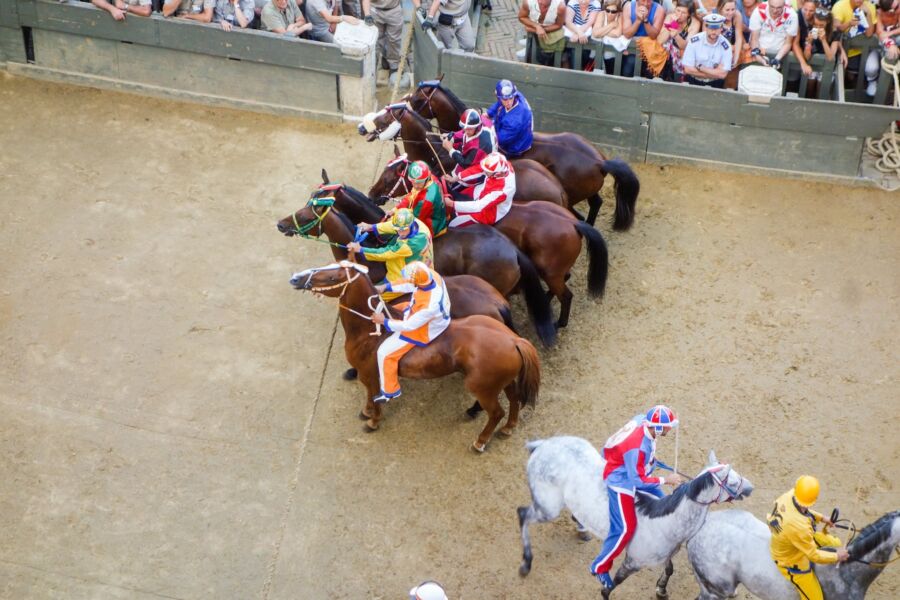
Finally, it’s time. A cart pulled by oxen carries the Palio banner into the arena. The crowd goes wild. As the starting places are announced, 10 snorting horses and their nervous riders line up to await the start. Silence takes over. And then…

They’re off! Once the rope drops, there’s one basic rule: There are no rules. The jockeys ride bareback while spectators go berserk. Life stops for these frantic three laps. Up in the apartment, Roberto and Franco hold their breath…

And then, it’s over. The winner: Lupa, the she-wolf district! We zip out into the street to join the ecstatic mobs coursing toward the cathedral. The happy “Lupa-Lupa-Lupa!” horde thunders through town, weeping with joy. At the cathedral, the crowd packs in, and the winning contrada receives the beloved banner. They are champions…until the next race.

Seeing euphoria overcome members of the winning contrada — it’s Lupa’s first win in 27 years — reminds me that it’s impossible for a tourist to really understand what this ritual race means to the people of Siena.

Carrying their coveted Palio banner high and hoisting their jockey to their shoulders, the Lupa contingent tumbles out of the cathedral and back into the streets, where the celebration continues into the wee hours — 500 years of proud tradition, still going strong.

(This story appears in my newest book, For the Love of Europe — collecting 100 of my favorite memories from a lifetime of European travel. Please support local businesses in your community by picking up a copy from your favorite bookstore on Tuesday, July 7th. Or you can pre-order For the Love of Europe online. You can also find a clip related to this story at Rick Steves Classroom Europe; just search for Palio.)