Daily Dose of Europe: My Dinner with Franklin

I’m thinking of my friends in northern Italy, including Franklin — a local gourmand who loves to take me to dinner while I’m in Verona. Join Franklin and me for two Italian specialties: a memorable feast…and great conversation.

Europe is effectively off-limits to American travelers for the time being. But travel dreams are immune to any virus. And, while many of us are stuck at home, I believe a daily dose of travel dreaming can actually be good medicine. Here’s another one of my favorite travel memories — a reminder of what’s waiting for you in Europe at the other end of this crisis.

I love the way Italians enjoy their food. I’m sitting down for a meal with Franklin at one of my favorite restaurants, Enoteca Can Grande in Verona. Eating in a little restaurant like this one, you have contact with the chef. We were here a year ago and chef Giuliano remembers us. Once we’re comfortably seated, he consults with us. As is our tradition, we encourage him to bring us whatever he’s most excited about today. Pleased with the freedom to dazzle us, he goes to work.

Franklin is a local. He knows the cuisine and gushes about the food incessantly. As the courses come and we eat, he shares his thoughts, which are sometimes impolite, but always come from the heart (perhaps with a side trip through the stomach).

With the first of many small plates, Franklin is delighted. “Raw Piedmont beef, carne cruda. It is like seeing the smile of a beautiful woman. Even after 10 years, you never forget her.”

Our wine is Amarone della Valpolicella. Enjoying a sip, I ask, “Sublime is an Italian word, no?”

He says, “Yes, soo-blee-may…this is sublime.”

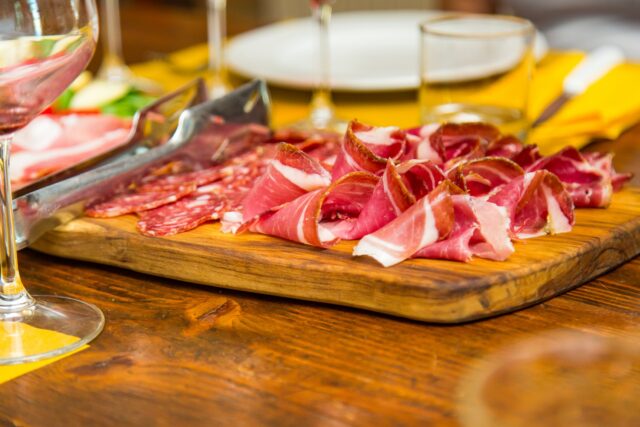
Giuliano brings a plate of various cold cuts, glistening in a way that shows they’re nothing but the best. We ponder, if you had to choose between salami and cheese in life, which would you choose? Giuliano and Franklin both agree that it would be a terrible choice…but they would have to go with the cheese. Then we nibble the mortadella with truffle, complicating that decision. Mortadella is the local baloney — not a high-end meat. But with the black truffle, it is exquisite. Imagine calling spam exquisite…just add truffle.

Franklin says, “I used to smoke, and I compared white wine and red like cigarettes and a good Cuban cigar. I enjoy my red wine like I enjoy my Cuban cigars.” Then he gets distracted by the herb decorating the next little mozzarella dish. After tasting a sprig, he says, “Yes, fresh. It’s normally served dried. The chef is a genius…fresh, brilliant with mozzarella.”

Franklin’s phone rings. It’s his wife, who says, “Don’t eat too much cheese or dessert.” Franklin, who’s not thin, surveys our table and sadly contemplates enjoying the enticing parade of food that has just begun with anything less than complete abandon. Then he sighs and tells me, “Many people live their entire lives and they do not have this experience.”

I say, “That is a pity.”

“Yes. It’s like a man being born and being surrounded by beautiful women and never making love.”

As we eat and drink, Franklin opens up about his passion for good eating. He says, “In Italy, you don’t need to be high class to appreciate high culture, opera, cuisine. It’s the only culture I know like this. Here in my country, a heart surgeon talks with a carpenter about cuisine. This is just how we are.”

Next comes the polenta, the best I’ve ever tasted. This cornbread, typical of the Veneto region, comes in varieties, like bread ranges from whole grain to white. This is the darker polenta integrale, using all of the corn. And it comes with anchovies. “A good marriage,” Franklin says. It’s the simple things — the anchovies, the olive oil, the polenta integrale, and the proper matching of flavors — that bring the most joy to the table.

Noticing how Franklin polishes every plate, I say, “You even eat the crumbs.”

He says, “Yes, I would feel like a sinner not to.” Sipping his wine, he adds, “And to not finish the Amarone…Dante would have to create a new place in hell. Mortal sin.”

As guides tend to do, especially after a little wine, Franklin mixes culture, history, and politics in with his commentary on cuisine. I find myself scribbling notes on the paper tablecloth.

Franklin is frustrated with how Italy’s north subsidizes the south. He complains that the south is “corrupt, inefficient, lazy, no organization.”

I remind him, “They say that here in the north — in regions like Veneto and Lombardi — you are like the Germans of Italy.”

He says, “Even today, the south still has its organized crime. When fascism came to Italy, the Camorra went to the USA. Mussolini had zero tolerance. And he got things done. That’s one reason why he was popular. And one reason why Mussolini is still popular. Then, after World War II, rather than tolerate communism, the government allowed the Camorra to reestablish itself in Italy.”

I ask him if he enjoyed The Godfather.

“I watched The Godfather with a certain pride because of the importance of food in that movie. Especially the scenes with tomatoes. Marlon Brando watched tomatoes ripen. When he said something like, ‘Become red, you bastards,’ to the yellow tomatoes, that took me back to Sicily and the home of my father.”

Our conversation drifts to how modern societies mirror their ancient predecessors…or don’t. Comparing the historic continuity between the ancient and modern civilizations of Rome, Greece, and Egypt, we agree that the biggest difference is in Egypt, a relatively ramshackle society today that feels a far cry from the grandiosity of the pharaohs and pyramids. Greece, which wrote the ancient book on aesthetics, developed an unfortunate appetite in modern times for poorly planned concrete sprawl. But Rome has the most continuity. Today’s Romans, like their ancient ancestors, are still passionate about wine, food, and the conviviality offered by the public square. The piazza and good eating — in Italy those go back to Caesar.

Next comes the pumpkin ravioli. I hold the warm and happy tire of my full tummy and say, “Basta.”

Giuliano comes by, sees my empty glass, and realizes we need another bottle. He warns us, “Next I bring you a small cheese course.”

Contemplating the cheese platter, Franklin says, “I’m not so religious, but for this cheese, with Amarone…I fall on my knees.”

I agree. “In cheese we trust.”

He compliments my economy of words and repeats, “Yes, in cheese we trust.”

“This cheese plate takes dessert to new heights.”

Franklin, playing with the voluptuous little slices, says, “Even if we do not talk, with these cheeses we have a good conversation.”

I support my heavy yet happy head with my hand as Franklin fills our glasses from the second bottle and we move on to the parmesan and the gorgonzola. Sipping the wine, Franklin says, “If this was my only wine, I could be monogamous.”

When Giuliano stops by again, I compliment him. He recalls that on our last visit, we sat at the same table. He serves thousands of people. I’m always impressed by people who care enough to remember their clients. It’s the same in hotels. I don’t remember which room I slept in last time, but often the proprietor greets me saying, “I put you in your room…number 510.”

On my visit to Milan three years ago, I got a haircut. I remember really enjoying my barber. I needed a haircut on this trip, too, so when I was in Milan, I walked vaguely in the direction where I thought his shop was. Not sure whether I’d found the right place, I popped in on a barber. It seemed like the one, but I really didn’t know. Ten minutes into my haircut, the barber — having gotten to know my hair — realized he remembered it and asked me if I hadn’t been there before. He had a tactile memory not of me as a person…but as a head of hair he had cut that happened to be mine.

Giuliano asks if I’d like anything else.

I ask, “Dov’è il letto?”  (“Where is a bed?”)

Franklin agrees and says, “Yes, a good restaurant should come with a bed.” It occurs to me that we must have tasted 30 different ingredients — all of them top quality and in harmonious combinations. Franklin again marvels at how Giuliano is creative and unpredictable without using garish combinations — no gorgonzola ice cream.

I have a feeling Giuliano will remember my table the next time I drop in. And I’ll remember to invite my friend Franklin. Year after year, the experience is reliably indimenticabale. That’s an Italian word I’m thankful is well-used in my tiny vocabulary: unforgettable.

(These daily stories are excerpted from my upcoming book,  For the Love of Europe — collecting  100  of my favorite memories from a lifetime of European travel, coming out in July.  It’s available for pre-order. And you can also watch a video clip related to this story: Just visit Rick Steves Classroom Europe and search for Verona.)
Daily Dose of Europe: Piero’s Venice

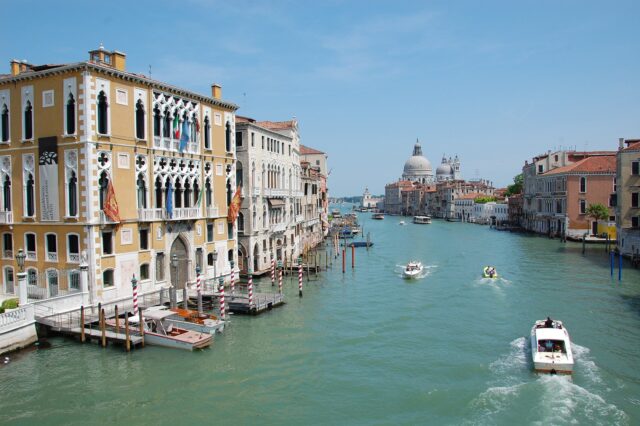
Until a few weeks ago, Venice was inundated with tourists. But my local friend Piero has a knack for explaining the real Venice. (Here’s hoping that very soon, Venice will once again be crowded.)

Europe is effectively off-limits to American travelers for the time being. But travel dreams are immune to any virus. And, while many of us are stuck at home, I believe a daily dose of travel dreaming can actually be good medicine. Here’s another one of my favorite travel memories — a reminder of what’s waiting for you in Europe at the other end of this crisis.

Descending the Rialto Bridge, I shuffle slowly, spinning my wheels in a human traffic jam congesting one of the biggest shopping streets in Venice. Finally breaking free, I turn down a dank and empty lane, reach the big black door of my hotel, and push a bronze lion’s nose. This security buzzer brings Piero to the second-floor window. He welcomes me with a “Ciao, Reek!” and buzzes the door open. I climb the steps, eager to settle in.

Piero, who runs the Venetian hotel I call home, shaved his head five years ago. His girlfriend wanted him to look like Michael Jordan. With his operatic voice, he reminds me more of Yul Brynner. He often says, “My voice is guilty of my love for opera.”

Proud of the improvements in his place since my last visit, Piero shows me around. While remodeling the hotel, he discovered 17th-century frescoes on the walls of several rooms. The place was a convent back then. An antique wooden prayer kneeler, found in the attic and unused for generations, decorates a corner of my room. The whitewash is partially peeled away, revealing peaceful aqua, ochre, and lavender floral patterns. In Venice, behind the old, the really old peeks through.

The breakfast room is decorated with traditional Venetian knickknacks — green and red decorative glass, prints of canal scenes, and sequined masks reminiscent of Carnival indiscretions. The room is strewn with antiques. Everything is old. “It’s kitsch,” Piero admits, “but only the best kitsch.” I sit down. As Piero brings me red orange juice — made from blood oranges — he reports on his work and the latest Venice news. While the sounds of Don Giovanni fill the air, guests prepare for their day.

Piero’s cell phone rings and he apologizes with operatic eyes. “In Italy, this is success.” He answers it and talks as if overwhelmed with work: “Si, si, si, va bene (“that’s fine”), va bene, va bene… certo (“exactly”), certo… bello, bello, bello (“beautiful,” in descending pitch)… OK, ciao, ciao, ciao.” He hangs up and explains, “That was the night manager. Always problems. I call him my nightmare manager.”

In my early travels, hotel night managers were a sorry lot. Generally speaking only the local language, they worked at night when the most complicated guest problems hit. When a tourist in a bind came to them, communication was impossible, so things just got worse. On a good night, they’d spend their time carefully ripping the paper napkins neatly in two so they’d go twice as far at the breakfast table.

Opera continues to fill the air as Piero dashes to help some French guests heading out for the day. He pours coffee for both of us, then sits back down and says, “In hotels all the people are different. The French don’t use the shower. Young Americans are most messy but use the shower very much. I don’t understand this. Americans ask, ‘What is this bidet for?’ I cannot tell them. It is for washing more than the feet. In it we wash the parts…that rub together when you walk.”

“The tourists have taken over your city,” I say sadly.

Walking me to the window and tossing open the decrepit blind, Piero answers, “But Venice survives.”

As my gaze moves from the red-tiled roofs to the marketplace commotion filling the street below, I see his point. Tourists cannot take over Venice.

“Venice is a little city,” he says. “Only a village, really. About 55,000 people live on this island. Not Italian — we are just one century Italian. I am Venetian in my blood. I cannot work in another town. Venice is boring for young people — no disco, no nightlife. It is only beautiful. Venetian people are travelers. Remember Marco Polo? He was Venetian. But when we come home we know this place is the most beautiful. Venice. It is a philosophy to live here…the philosophy of beauty.

“The life here is with no cars…only boats. To live properly in Venice, you must have a boat. With a boat you live in Venice in another dimension — with no tourists. You cruise under bridges and see the tourists walking in their dimension but you are in the Venice of no tourists. The boat is my alternative Venice.”

(These daily stories are excerpted from my upcoming book, For the Love of Europe — collecting 100 of my favorite memories from a lifetime of European travel, coming out in July. It’s available for pre-order. And you can also watch a video clip related to this story: Just visit Rick Steves Classroom Europe and search for Venice.)

Daily Dose of Europe: Tuscany — “Here Begins Prosciutto” 

I keep thinking of all my Tuscan friends, hunkered down in their farmhouses while waiting out the coronavirus. At least they’re well-fed.

Because of the coronavirus, Europe is effectively off-limits to American travelers for the next few weeks (and likely longer). But travel dreams are immune to any virus. During these challenging times, I believe a daily dose of travel dreaming can actually be good medicine. Here’s another one of my very favorite travel dreams-come-true…a reminder of what’s waiting for you in Europe on the other end of this crisis.

I checked into the farmhouse inn on the Gori family estate. This is Tuscany in the rough: a working farm, not a resort…no TV, no swimming pool, lots of real culture. My host, Signora Gori, is both old-money elegant and farmhouse tough. After I settle in, she takes me on a welcome stroll.

Our first stop is a sty dominated by a giant pig. “We call him Pastanetto — the little pastry,” Signora Gori says. While the scene through my camera’s viewfinder is pristine and tranquil, the soundtrack is not. After a horrendous chorus of squeals, she says, “That is our little Beirut.”

Hiking to the rustic slaughterhouse, we enter a room dominated by a stainless-steel table piled with red sides of pork.

“Here begins prosciutto,” Signora Gori says. Burly men in aprons squeeze the blood out of hunks of meat the size of dance partners. Then they cake the ham hocks in salt to begin the curing process, which takes months. While the salt help cure the meat, a coating of pepper seals it.

In another room are towering racks of aging ham hocks. A man in a white coat tests each ham by sticking it with a bone needle and giving it a sniff. It smells heavenly.

Back outside, Signora Gori takes me into the next barn, where fluffy white lambs jump to attention, kicking up a sweet-smelling golden dust from beds of hay. Backlit by stray sunbeams, it’s a dreamy, almost biblical scene. Picking up a baby lamb and giving it an Eskimo kiss, she explains, “We use unpasteurized milk in making the pecorino cheese. This is allowed, but with strict health safeguards. I must really know my sheep.”

This close-to-the-land-and-animals food production is part of Italy’s Slow Food movement. Believing there’s more to life than increasing profits and speeding up production people like the Gori family have committed to making and serving food in the time-honored way. It may be more labor-intensive and more expensive, but it’s tastier. Because Italian foodies are happy to pay higher prices for higher quality, it’s also good business.

Tuscany is trendy. Enticed by books like Under the Tuscan Sun, a persistent parade of visitors are hell-bent on sampling the Tuscan good life — and its prosciutto. The nearby town of Greve is happy to oblige. It’s a facade of Tuscan clichés, with enough parking and toilets to handle all the tour buses, as well as a vast prosciutto emporium, with boastful newspaper clippings on its door and samples kept under glass. My stroll on the Gori farm reminds me how, especially here, it’s critical to venture off the tourist track.

Walking down another lane, we observe the family’s team of vintners. Signora Gori’s brother empties a bucketful of purple grapes from a dump truck into a grinder, which munches through the bunches, spit- ting stems one way and juice with mangled grapes the other. Following pipes of this juice into a cellar, Signor Gori explains that winemaking is labor-intensive, “but right now, the grapes are doing most of the work.”

As the new grapes ferment, we taste the finished product. A key word from my Tuscan travels is corposo — full-bodied. Lifting the elegant glass to my lips, I sip the wine while enjoying the pride in the eyes of those who made it. Satisfied, I say, “Corposo.”

“Si, bello,” they reply.

That night at dinner, we’re joined by the rest of the Gori family. The two sons dress and act like princes home on break from some Italian Oxford. We sit down to a classic Tuscan table, focused on simplicity, a sense of harmony, and the natural passage of time necessary for a good meal…each of us with a glass of good red wine. Dipping my bread in extra-virgin olive oil and savoring each slice of prosciutto, it’s clear: Great wine goes best with simple food. I nod to my hosts, appreciating that I’m experiencing the true art of Tuscan cuisine.

Full and content, we sip port and enjoy a game of backgammon on a board that has provided after-dinner fun for 200 years in this very room. Surrounded by musty portraits that put faces on this family’s long lineage, alongside a few guns used in Italy’s 19th-century fight for independence, I realize this evening — so special for me — is just another night on the farm for the Gori family.

Corposo. That’s how I like my wine…and my Tuscan travels.

This story is excerpted from my upcoming book, For the Love of Europe — collecting some of my favorite memories from a lifetime of European travel, coming out in July. Click here to preorder. )

(This story is excerpted from my upcoming book, For the Love of Europe — collecting 100 of my favorite memories from a lifetime of European travel, coming out in July. It’s available for pre-order.)

Daily Dose of Europe: A Romantic Breeze in Rome

Let’s go for a nice dinner in Rome. On the menu is filetti di baccalà…Roman-style fish sticks.

Because of the coronavirus, Europe is effectively off-limits to American travelers for 30 days — starting today: Friday, March 13. But travel dreams are immune to any virus. Through this crisis, join me for a quick, daily escape from the headlines as we count down the days until we can head back to Europe.

Anxiety is something I like to sweep away when guiding a tour. And anxiety is not welcome at home either — especially when dealing with a crisis characterized by uncertainty. As we work through these challenging days, I believe a daily dose of travel dreaming can actually be good medicine.

I’ve collected 30 of my very favorite travel dreams-come-true to share as a daily dose of embrace-the-world during a time when we’re unable to physically do that. Share this with your friends. Let each daily travel dream be a small dose of the wonder of our world that you can inhale, swirl around, and really enjoy.

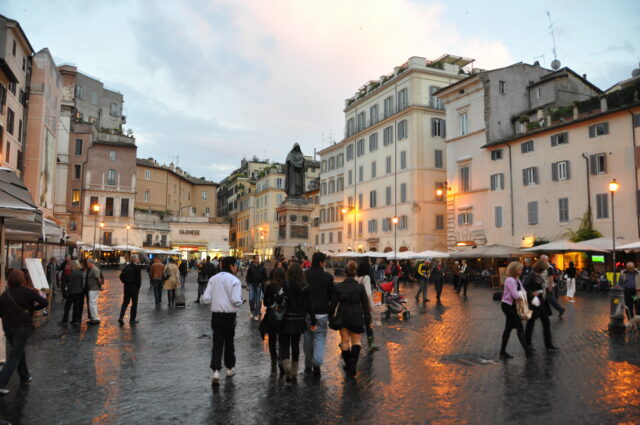
A statue of Giordano Bruno marks the center of Campo de’ Fiori— my favorite square in Rome. Five centuries ago, Bruno challenged the Roman Church and was burned at the stake right here. With each visit, I make a quiet little pilgrimage, staring into the eyes of brooding Bruno, pondering the courage of those early heretics.

When in Rome, I use Bruno as a meeting point. (I like to say, “I’ll be sitting under Bruno.”) Tonight, I’m waiting for Stefano and Paola, who run one of my favorite hotels in Rome. With each visit, they take me on a quest for restaurants to recommend in my guidebook. They’ve promised to take me to a little restaurant they deem perfect. When they arrive, I say Ciao to Bruno and we walk down a tiny cobbled lane to a classic, crumpled little piazza filled with scooters. A stately but tiny Neoclassical white church is crammed into the corner. On the far side, a single eatery is all lit up. The sign above the door says “Filetti di Baccalà.”

“Stefano, you’re right. This is perfect.” I walk ahead, navigating the gridlock of abandoned scooters to get into the restaurant. A long line of tables, covered with white-paper tablecloths and crowded with locals, stretches to a neon-lit kitchen in the back. And there, two grease- splattered cooks are busy cranking out filetti di baccalà…Rome’s answer to fish sticks.

There’s one table open near the back, past an old man in a black suit playing the violin. We limbo by the violinist and grab it. Above our table a weathered sign reads Specialità Filetti di Baccalà 60 lire. The price has been revised over the years in response to the whims of the economy, peaking at 4,000 lire. Today, it’s €5. The harried waiter drops off a simple menu, listing a humble selection of appetizers and salads, but only one main course (filetti di baccalà) and, with his thumb hitch- hiking into his mouth, asks, “Da bere?” (“To drink?”).

Our fillet of cod is about what you’d expect at a top-notch London fish-and-chips joint. We enjoy it along with some breaded and fried zucchini, a salad of greens I’d never before encountered, and a carafe of white wine. Some people might think the meal is nothing special. But buried deep in the medieval center of the city, in a tarnished and varnished eatery without a tourist in sight, the ambience is intoxicating.

The violinist plays Sinatra’s “My Way” to an appreciative crowd. Eventually he makes his way to our table, standing just beyond Paola’s radiant face. It’s a classic Roman moment. Her dark eyes, framed by little black glasses, are locked on Stefano’s. Tiny rings of pearls set in gold swing from her ears. A gold necklace is the perfect complement to her smooth, olive complexion.

Like a hungry camera, my eyes compose the scene: carafe of golden white wine shimmering in the foreground, Paola’s face looking lovingly at her husband in the middle, and the violinist — jaw tight on his instrument but still smiling — in the back. The happy chatter of dinner conversation rounds out the scene.

As if only for Paola, the musician plays a Roman anthem to the night. Paola whispers to me, “This is Ponentino…a special wind, a sweet… ” brushing her hand gently along her cheek in search of the word, “…caressing Roman wind.”

Then she and Stefano face the music, and with the entire room, sing the song:

Rome, don’t be foolish tonight.

Give me the sweet wind to let her say yes.

Turn on all the stars that you have…the brightest ones.

Give me a small flash of the moon, only for us.

Let her feel that springtime is arriving.

Give me your very best crickets to sing to her.

Give me the Ponentino.

Be a partner with me.

Paola translates the rest of the song to me. In verse two, the woman answers: “Rome, give me a helping hand to tell him no,” and so on. But, in the final verse, of course, they get together, creating the love triangle: a man, a woman…and Rome.

With the room still singing, the elegant older couple at the next table look over at us. Seeming pleased that the three of us — a generation behind hers — are enjoying this traditional Roman moment, the woman says, “Bella.”

(This story is excerpted from my upcoming book, For the Love of Europe — collecting 100 of my favorite memories from a lifetime of European travel, coming out in July. It’s available for pre-order.)

Is Europe Becoming “Anti-Tourist”?

These days, I’ve noticed that Americans have become very “follow the crowd” in their travels. Our appetite for bucket-list, crowdsourced, Instagrammable travels is funneling countless tourists into the same few places. Consequently, popular cities are feeling crushed by mass tourism, and popular sights are congested to the point where many find them not only less enjoyable… but actually dangerous.

Citizens of over-touristed cities like Barcelona, Amsterdam, and Venice are getting grumpy about mass tourism. And “must-see” sights like the Anne Frank House in Amsterdam, the Gaudí buildings in Barcelona, and Michelangelo’s David in Florence come with discouraging lines.

What to do? The “bad tourism” that residents of overcrowded cities complain about is mostly a result of blitz travelers — those who day-trip in (from cruise ships and in big buses), congesting streets and squares and leaving more litter than money. I find that travelers who stick around to have dinner and spend the night are still appreciated by locals (and valued as part of the economy).

As for the overwhelmed sights: Whenever possible, make a reservation in advance online. Then you won’t be frustrated with crazy lines at ticket offices that close for the day as soon as they sell out. I was just at the church in Milan that holds Leonardo da Vinci’s Last Supper. It would be a chaotic mob, if not for their very smart program of reservations: Only 25 people are allowed inside every 15 minutes. When I arrived, there was total peace and sanity, as about 800 people a day come in at a steady and organized pace. The trick: Book in advance. Be thankful when that is required!

Another tip: Realize for every Anne Frank House, there’s usually a Dutch Resistance Museum a few blocks away — less trendy, never crowded, and often actually offering a richer travel experience. Remember, ninety percent of Europe has no crowd problems.

Finally, we tourists can be a little more considerate in the way we travel. Here’s a video created by an organization in Venice that offers a good reminder for people traveling anywhere to be more thoughtful guests. In fact, that’s a great practical tip: If you want to be warmly welcomed, be deserving of a warm welcome.