To Celebrate Our Pocket Guides, I’m Sharing Some Tips on Rome, Paris, and London

My publisher tells us that our new Pocket Guides to London, Paris, and Rome are doing great–not cannibalizing sales of our full-size guidebooks to those cities but getting in on the thriving market for smaller, more colorful, and more portable “best of” and “top ten” guidebooks. To celebrate their success, here’s a fun Q&A for people anticipating trips to my three favorite big cities in Europe:

Best photo op in each city?
Rome: The old ladies on their folding chairs as they hang out in the Jewish Quarter; rays of sunlight cutting through St. Peter’s Basilica; the scene on Via del Corso in the early evening when it’s closed to traffic, and the community is out for the passeggiata.
Paris: The city from top of Montparnasse Tower (you don’t have to look at the Montparnasse Tower); the neighborhood action on a street like rue Montorgueil; the honey-colored tones of freshly baked bread and pastries at just about any corner bakery.
London: Different angles on the Millennium Bridge; the pageantry during the Changing of the Guard at Buckingham Palace; Big Ben and the Houses of Parliament from the top of the London Eye.

Best free yet enriching experience in each town?
Rome: Going to a late Mass at St. Peter’s Basilica (most days at 5 p.m.); being all alone in the Pantheon very early or very late; exploring the back streets of Trastevere.
Paris: Being in the organ loft at St. Sulpice Church as Daniel Roth plays a short concert between Masses on Sunday; sitting on the steps of Sacré-Cœur in Montmartre as darkness settles on the City of Light.
London: Enjoying the many wonderful and free galleries and museums–especially the British Museum and the British Library; taking in Speakers’ Corner at Hyde Park on Sunday; viewing the legal action in the Old Bailey courtrooms.

Favorite single museum and why in each town?
Rome: The Borghese Gallery–It must be the most sumptuous palace in Italy even without its many Bernini masterpieces, including my favorite statue anywhere, Apollo and Daphne.
Paris: The Louvre–It shows off the greatest collection of art in Europe in what was its biggest palace.
London: The British Museum–It’s the chronicle of our Western civilization.

What guilty pleasure do you indulge in each city?
Rome: Staying in the decadent Hotel Nazionale and dining at my favorite restaurant, Il Gabriello.
Paris: Pigging out on macarons at Ladurée on the Champs-Elysees.
London: Riding in the big black taxis just to talk with the cabbies; wandering through the parks, browsing from obscure monument to obscure monument, while people watching.

Biggest mistake time-strapped travelers make in each city, and how to avoid it?
Rome: Going to sights like St. Peter’s and the Colosseum when there is a long line. Rather than waiting an hour to get in, you can be all alone at the greatest church in Christendom if you simply go early or late. And the line for the Colosseum is actually a line to buy a ticket, which is a combo-ticket that includes the neighboring Palatine Hill. Simply pick up your ticket at the Palatine Hill entrance a short walk away, and stroll right past the long line waiting for tickets at the Colosseum.
Paris: Waiting in long lines for the Louvre, Orsay Museum, Sainte-Chapelle, and Versailles. All can be avoided simply by purchasing the Paris Museum Pass (sold at any city museum).
London: Going to a play when you’re suffering from jet lag–that’s one expensive nap. That’s why, if I’m touring England, I go from the airport directly to Bath (a relaxing, smaller town) to get over jet lag. I finish my tour in London when I’m fully adjusted to local time. And that way, nothing will be anticlimactic since I end up in exciting London. It’s the best finale for a trip around Britain.

A Rainbow of Art in Vernazza

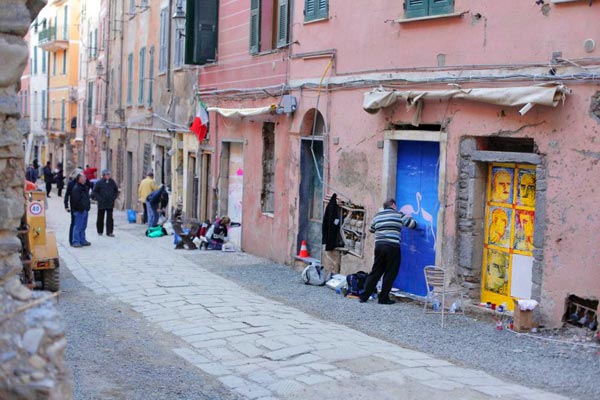
On the morning of January 6th, more than 50 artists descended on the damaged Cinque Terre town of Vernazza, armed with a vivid message of hope.

Organized by painter Antonio Barrani, their mission was called “Un Arcobaleno di Solidarietà per Vernazza” — A Rainbow of Solidarity for Vernazza. Each painter took a lifeless, boarded-up doorway along Via Roma…and transformed it into a work of art.

More than just decorating the Via Roma, this avenue of art is designed to inspire all who love Vernazza to play a role in her recovery.

As you page through these images, we’ll use the captions to bring you up to date on Vernazza’s recovery from the October 25th disaster — and what you can do to help one of our favorite villages in Italy spring back to life.

Visit Vernazza this  summer! It’s the best contribution a traveler can make. Can’t swing it?  Then imagine what you might spend on a day-trip to Vernazza.

Donate that amount to Save Vernazza or Per Vernazza Futura.

Either way, you’ll be a hero.

000_Vernazza
A Rainbow of Art in Vernazza - Photo: Mario Bertocchi.

001 Vernazza
More than 50 artists assembled in Vernazza on a chilly Friday morning. Photo: Bea Newton
002 Vernazza
Via Roma — recently freed from a grave of mud and rubble 13 feet deep — was lovingly decorated. Photo: Mario Bertocchi


003 Vernazza
Each artist had something personal to express... Photo: Mario Bertocchi

004 Vernazza
Vernazza may be down, but she's not out. - Photo: Mario Bertocchi

005 Vernazza
Passion, creativity and generosity will bring Vernazza back. - Photo: Mario Bertocchi

006 Vernazza
This village will be reborn, stronger than before. - Photo: Mario Bertocchi

008 Vernazza
Vernazza's water, electricity, gas and telephone lines are being repaired. Photo: Bea Newton

009 Vernazza
Her residents, evacuated since the end of October, are beginning to return. Photo: Michele Sherman

010 Vernazza
Her residents, evacuated since the end of October, are beginning to return. Photo: Michele Sherman

011 Vernazza
Vernazzans look forward to welcoming travelers back in late spring. Photos: Mario Bertocchi; Michele Sherman

012 Vernazza
The government and volunteers can only do so much. Photo: Bea Newton

013 Vernazza
Vernazza needs private donations to get the work done on time. Photos: Michele Sherman; Bea Newton

014 Vernazza
Vernazza also needs travelers to return this summer. Photos: Michele Sherman

015 Vernazza
You can play a role in Vernazza's rebirth. Photos: Michele Sherman

016 Vernazza
Pick one way to help, and you'll make marvelous things happen. Photos: Michele Sherman

017 Vernazza
Visit Vernazza this summer! It’s the best contribution a traveler can make. Photo: Mario Bertocchi

A Late-Night Walk Through Vernazza…Before the Flood

I was in Vernazza last May, updating my Italy guidebook. At 10 p.m. one night, after a long day of research, I enjoyed wandering through this magical town, playing with my iPhone video camera. I never could have imagined that the street I was walking on would, just a few months later, be under 6 to 12 feet of mud and rocks. At the end of my stroll, Chef Claudio at Gambero Rosso joins me in marveling at how Vernazza is indeed “molto bella.” Then he says ciao and grazie…sending his best wishes to all the Americans who keep this town employed. As the rubble from last week’s heartbreaking disaster is being cleared away, we look forward to doing that again. Learn more at www.ricksteves.com/news.

If you can’t see the video below, watch it on YouTube.

A Violent Rain Buries an Italian Friend

Thirty two years ago, I met two American college girls while hitchhiking in Switzerland. They were studying in Florence, and I asked them their favorite place in Italy. They surprised me by naming a place I had never heard of before: Cinque Terre. Curious, I headed south and discovered a humble string of five villages along Italy’s Riviera coast with almost no tourism…and, it seemed, almost no contact with the modern world.

After falling in love with what I consider the most endearing stretch of the Mediterranean coastline anywhere, I’ve gone back almost every year since. Of the five towns, spindly, pastel Vernazza has always been my favorite. Over three decades, I’ve grown up with the people of Vernazza, watched a young generation carry on with their traditions — and seen the town go through years of hard work to develop into a thriving haven for travelers looking for that pristine stretch of Italian coastline. Once rugged and magical, it became…comfortable and magical.

Then, on Tuesday afternoon, a torrent of rain came down and a flash flood thundered through the town, gutting nearly every business, and filling the ground floors with mud.

To learn more about what has happened, to view pictures of the aftermath, and to read message-board comments from people who were there, see my online November Travel News.

I spent four nights here last May, updating our guidebook chapter to the Cinque Terre. At the end of my stay, as I got on the train for Rome, I found myself actually thinking of Vernazza as a person…and as a friend. Of all the towns I know in Europe, this is the one that is, for me, a human puzzle in which I’ve figured out nearly all the pieces. I believe I know more people in Vernazza than in all of Spain. This week, as I read emails from Vernazzan friends and look at the horrifying photos and videos of the disaster, I feel I’ve lost a friend. In fact, looking at the photos — store fronts ripped off and fishing boats crumbled on rocks — I get this ghastly feeling that these are photos of a crime scene…and that nature has murdered my friend.

A routine I’ve long enjoyed with each visit has been to walk slowly from the top of town to the bottom, just before midnight. I’d savor the rhythm of the pastel colors and imagine the town back when a stream rushed down its middle. At some point, generations ago, the stream was put under the pavement. But it still flowed, draining water from the terraced vineyards that surround the town on three sides. I’d always stop at one point along the street where I could actually hear the soft sounds of that water still flowing beneath the road, from vineyards to the sea.

And this week, with a freakishly intense rainstorm — like a misplaced monsoon — torrents of water funneled from the surrounding mountains into the town carrying rampaging tons of mud and debris. That narrow street became a riverbed again, and Vernazza met a fate almost similar to Pompeii: the entire ground-floor of the town was buried.

Today, many of its people are evacuated, there’s no water or power, no communication, and the town is cut off from the rest of the world as roads and train lines are still being dug out. Businesses that Vernazzans had worked all their lives to build are washed away. Its church now houses only a mucky lagoon.

One of the joys of my work is sending travelers to Vernazza. And today I read an email from one Vernazzan who fears they may not rebuild and it could become a ghost town. But I think people are determined to dig out and bring life back to both Vernazza and its neighbor Monterosso. (The other three towns of the region — Riomaggiore, Manarola and Corniglia — because of their luckier topography, got through the storm essentially unscathed.)

I had planned to visit the town next April to film an updated version of my TV show on the region. Then I realized, there may be nothing to show. I was thinking I’d have to put the TV shoot on hold. But then I thought: no, I need to take the crew to the Cinque Terre and show the world the resilience of its people, the natural beauty of the region, and how its communities will carry on.

How can we help? Those who care about the region can donate money. (I don’t feel comfortable with collecting money, and it’s too early to clearly see which relief organizations will be involved.) 

I think, most importantly, the best thing we can do is keep Vernazza and Monterosso in our travel dreams and incorporate them into your next trip. Tourism is the life blood of these towns and, while they need and will get government aid along with charity from friends in the short term, they will need to rekindle their thriving economy in the long term. That involves you and me.

Along with not abandoning the towns of the Cinque Terre, we need to keep in mind that violent weather devastates many more “ugly sister” towns on our planet, where few people notice or rush to their aid. This happens in wealthy corners of our world — like Europe and the USA — and it happens in corners of our world where desperation is the grinding, day-to-day norm. And while many in America feel that acknowledging and addressing climate change is just too expensive for their bottom line, climate change is a reality. And its violent weather packs an even bigger punch, with more devastating consequences, in the developing world.

What will I do? I can keep singing praises for the Cinque Terre. I can dedicate the same promotional energy to it in the coming years that I have in the past decades — even if there will be a hard and ugly time of healing. And I will work to help explain to climate change deniers in our society that it is not “just a theory,” and its victims are real people.

Piazza Navona Entertains

Nearly all Mediterranean cruises start and finish in these ports: Barcelona, Rome (Civitavecchia), Venice, or Istanbul. So cruise travelers will generally have a little extra time in these great cities.  We just finished one cruise (West Mediterranean) and have a day free in Rome before catching our second cruise (covering the East). Beware: There’s a lot of experience among cruise travelers, and it is shared generously. One lady I met on the ship was a veteran of a dozen or so Mediterranean cruises. She said, “The key in Rome is to leave the crowds and eat with the locals, so I dine on Navona Square.” To me Piazza Navona is about as touristy as Rome gets. But as a night spot, it has a centuries-old magic.

If you can’t see the video below, watch it on YouTube.