Vernazza was pummeled almost to death by a violent flood that followed a freak rainstorm on October 25, 2011. While the bottom of town is springing back to life, the top of the town is still pretty desolate. A stroll among the ruins gives a sense of the power of that terrifying deluge.
If you can’t see the video below, watch it on YouTube.
For me, walking through Vernazza, six months to the day after its flood, was like seeing an old friend who had changed dramatically. But the magic is still there, and the promise of a town put back together is strong. Viva Vernazza…Vernazza lives.
If you can’t see the video below, watch it on YouTube.
In Italy, “the land of a thousand bell towers,” rustic towns love the sound of their own church bells. They each have their own dialect, favorite saints, and folklore. The folklore of Vernazza and Monterosso will be enlivened with tales of the flood of 2011.
In Monterosso, beloved statues in the church survive — while a mud-line halfway up the wall in the nave is a reminder that the townspeople heroically came to their rescue, taking them through raging waters to higher points. Later, when there was enough help in the streets, excess volunteers came into the church and lovingly polished the candlesticks, just to keep caring for their town. To this day, shops have flood-damaged items on sale — you can buy a “flood umbrella” cheap. A big tent, set up by the National Guard, functioned through the winter as the town piazza — used for staging emergency deliveries, community meals, Christmas Eve Mass, and the New Year’s Eve disco. Old ladies who couldn’t help dig, helped cook. People worried that Laura, whose bakery — loved for her secret recipes — was destroyed, and wouldn’t reopen. But she rebuilt, and that beautiful aroma of her sweet cakes still helps locals greet the new day. Diego’s motorbike, the bike of his dreams, which he had bought just 10 days before the flood, was buried. He excavated it, cleaned it up, and — to the cheers of his friends — it started.
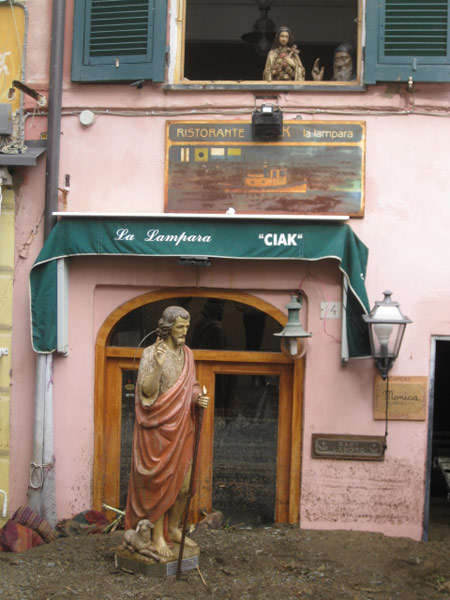
Precious statues, rescued amid all the chaos, wait patiently for their church to be dug out and cleaned.
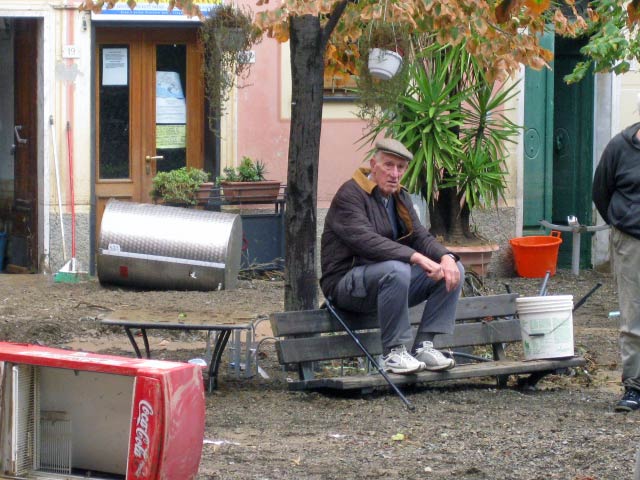
Even after the flood, this man had to sit on the bench he had warmed for decades.
The local civil protection unit is now named for Sandro Usai — Monterosso’s one death from the flood. Sandro was last seen heroically trying to open up a grate to increase canal drainage when he was swept out to sea. When his body washed ashore a week later, his funeral was the first time the community stopped working and was silent together. Sandro Usai received the highest civilian award the Italian government gives.
Little Vernazza lost three residents: Pino, the gelato man; Sauro, a shopkeeper; and 80-year-old Pina. Pina refused to leave her apartment. Sauro also refused to leave. He was last seen hanging on to the awning of his building in a muddy torrent. Their bodies washed up together — three weeks later — on the beaches of St. Tropez, France.
Psychologically, the trauma and aftermath of the flood is toughest on the local seniors. Many have barely ventured beyond the Cinque Terre. They know nothing else. Every day, for many decades, they’ve warmed the same bench with the same friends. One old man, who had long spent his afternoons on a bench that was covered up to the seat in mud, still came in the days after the flood, with his cane to steady himself, sitting on the top of the seat back of his buried bench, hanging on to a little normalcy.
For 30 years I’ve strolled the main drag of Vernazza as if walking through a poem. Walking down that street now — gutted of nearly all its businesses, the dreams and labors of love of its residents swept so violently away — is an emotional roller coaster. Tonino is painting a new door where his boat, Gustina, was once kept. On the wall behind him, a photo of his boat comes with a painted-on caption: “Tonino loved me and the flood kidnapped me.” Tonino said it was lucky he had been stranded across the street when Gustina was swept away, or he likely would have been swept out to sea with her.
Nostalgic, I had lunch in Piva’s restaurant, where I first ate when visiting as a student in the 1970s. Piva, who cooked an amazing seafood risotto then as now, is also the town troubadour. Many nights, when the cooking’s done, he pulls out his guitar and leads his happy diners in song. After showing me the new post-flood ovens and stoves in his kitchen, he pulled out his well-worn guitar — a trace of mud still caked on its neck — and said, “In this restaurant only my guitar survived the flood.”
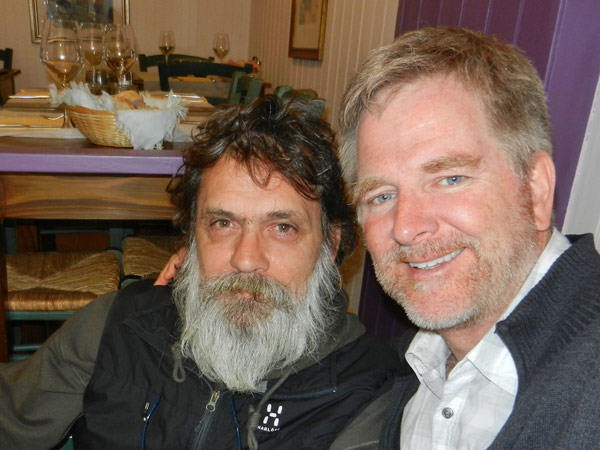
What had long been the best nightspot in town, the Blue Marlin Bar, is an empty concrete shell. The only piano in town is gone, along with all the shipwreck decor (and a dozen years of family Christmas cards I’d sent, which he’d collected on his bulletin board). Massimo, looking tired and sporting a scraggily white beard, is barely recognizable. Having not shaved since October 25, he says he’ll shave when the Blue Marlin reopens next month. Even though the space is newly plastered and quiet, there’s a hole left in the wall that will always come with a horrific story. Forty locals and tourists were trapped in the bar with the water rising and no way out. Massimo knew which bit of wall was thin, and, fortunately, a hammer had been left out nearby. With his bartender, Jeff (the only American man living in Vernazza), they broke through the wall and heroically helped all 40 trapped inside to escape through the hole into a staircase leading to safety. In the chaos, one Vernazza woman recalls kissing her little girl, passing her through the hole while thinking she might never see her again.
Massimo, who broke a wall to rescue 40 trapped people, will shave when his Blue Marlin Bar reopens.
On October 25th, one of our tour groups was in Vernazza. At the height of the flood, they were stranded in a restaurant, literally standing on tables as the water rose. Throughout town, people had taken refuge, as people do in a sudden downpour, in shops and restaurants, to wait for it to pass. But this storm wasn’t passing. The downpour persisted and the water just kept rising. I heard many stories. And all noted how, amazingly, the water receded for a moment before rising again to its ultimate height. This gave people (my tour group included) a window of time to scamper out and up nearby staircases to safety. While many thank the town’s patron saint, the Madonna of Reggio, others figure a bus lodged in the narrowest part of the main street, causing a backup that let the flooding below it recede — just momentarily.
Knowing that every car in the lot above the town was swept into the sea, I walked to the top of Vernazza to inspect the scene. There’s a stillness there, as nothing here has reopened yet. Stone walls laid by medieval Vernazzans stand ripped apart, delicate bridges that arced over the ravine to favorite B&Bs are long gone. My favorite, the place I slept in last year, is boarded up. And the resident ducks — a favorite for locals and tourists alike for ages — are long gone.
Standing on what was the town’s playground, looking over the raw, open wound of an enlarged ravine and desolate buildings, I had to spill some tears. It was like I was visiting a dear relative in the hospital — someone who had been very sick and was still weak…but was out of the woods and recovery was assured. It was here that an idea struck me: I would put as a subtitle on the cover of the next edition of my Cinque Terre guidebook “Viva Vernazza”: Vernazza lives.
Life is returning to Vernazza's harbor square…piano, piano.
I woke to the sound of miniature cement trucks and jackhammers. These were happy sounds to me, as physically, Monterosso and Vernazza are being put back together after the recent devastating flood. Socially, too, it’s been a time of reconstruction for both communities. Being small towns, they were rife with cliques and ancient grudges. With the challenge presented by the flood and recovery period, locals marvel at how everyone came together. Today, many locals enjoy better relations with old enemies, but there is a new divide: between people who joined in the community-wide effort, and those who only took care of their own business needs (or even left town during the chaos). In both towns, while a large percent of the businesses were essentially destroyed, lots of people and hotels that were on higher or luckier ground came through unscathed, losing only their water and electricity for a while. Some of them ignored their business needs and became heroically involved. And, as it goes in small towns, those who didn’t will long be remembered for turning their backs on neighbors in need.
People commented on how, having experienced this tragedy, they have a new empathy for distant people dealing with similar natural disasters. Others commented on how, now, every time there’s a big rain, anxiety sweeps through the community.
The tourist business in 2011 was very strong. October 25 was at the end of the season, when locals were ready for a much-needed winter break. While the flood hit at the perfect time from a business point of view, locals, already exhausted after a very busy season, had to immediately plunge into a nonstop rebuilding period, pushing to be ready for the 2012 season.
Vernazza's beach is swollen by mud from surrounding hills. Soon the hard-working tractor will be replaced by lazy sunbathers.
For travelers wondering if it’s OK to travel to the Cinque Terre, here’s my take: Three of the towns were unaffected (Riomaggiore, Manarola, and Corniglia). They have plenty of tourism and don’t need your business as much. I’d choose between the two flood-ravaged communities. Monterosso is completely ready. Vernazza, with a few hotels and restaurants already open, expects to be ready for prime time by June. Crews have worked tirelessly to get the trails put back together and the best hikes are wide open. This is a great time to visit, to both stoke and celebrate the recovery, and to be one of the first to enjoy the charms of either town, post-flood. There’s a camaraderie in the air and an appreciation of tourists that is palpable. Even in late April, over the course of several days, I saw countless travelers enjoying their visits as they would if there had been no flood.
Monterosso: Overloaded drainage canals and ancient streams swollen under the streets caused pavement to burst upward.
Monterosso's six under-street channels stand ready to allow future floods to flow unimpeded through town and into the sea without taking businesses and dreams with it.
The people of the Cinque Terre are being taught a tough lesson. It’s their beautiful land that brings the tourists. With the affluence brought by tourists, locals abandoned their land — leaving the vineyards unplanted and the centuries-old dry-stone terracing to crumble — for less physically demanding, more profitable work in tourism. (Grapevines are lighter on the land and have far-reaching root systems to combat erosion. Traditional vintners keep the stone terraces in good order.) But after a generation of neglect and abandonment (while the Cinque Terre enjoyed and profited from tourism), the land was washed by violent weather into the towns. It’s like nature was speaking: There will be no tourism to harvest without proper stewardship of the land. The question that remains: Will the lesson be learned, remembered, and heeded? (Tomorrow: the last in this three-part flood series.)
Groups of expat American women (who fell in love both with the towns and their men) are helping organize relief and communications in the aftermath of this disaster Rebuild Monterosso and Save Vernazza. For all the latest in both towns, see these websites or reach them through our Cinque Terre News page.
On October 25, 2011, after a very dry summer, a freak rainstorm hit the Cinque Terre, an idyllic string of five Italian Riviera towns. Within four hours, the region got 22 inches of rain — a third of an average year’s total. Because of the topography and the ability of the flash flooding to drain, three of the towns (Riomaggiore, Manarola, and Corniglia) were undamaged, and two were devastated. Much of Monterosso and Vernazza were buried under three meters of mud and left without water, electricity, or phone connections. It was a day residents will talk about for the rest of their lives.
I visited on the six-month anniversary of the flood (April 25). In the next week, I’ll share my Cinque Terre experience here on my blog.
The day after the flood was hot and dry and everyone came together, starting a winter of digging out and rebuilding. In Monterosso six canals run under six streets to the sea. Debris from landslides filled these up, clogging things so the deluge went over ground. Trees, furniture, cars, buses, and tons of mud and rocks plowed through the city. Water pressure from drain pipes below caused streets to explode upward. Medieval wells in basements became geysers. Rivers of raging mud rampaged down the streets, stranding people, and ultimately leaving shops and restaurants on the main streets of old Monterosso and Vernazza buried.
The mud that buried Vernazza on October 25 destroyed every business on its main street.
Vernazza's mayor, Vincenzo Resasco, artfully and tirelessly kept the rebuilding of his town on track and people working together. Six months to the day after the flood, he proudly showed me the town's impressive progress.
With that first post-flood sunrise, tourists were evacuated, emergency workers came in, and locals rolled up their sleeves and began shoveling. Through the winter there were no weekends as they set out to rebuild in time for the next tourist season.
While April 25th, the six-month anniversary of the tragedy, was also was Italy’s Independence Day, and holidays here are normally sacrosanct, everyone was still hard at work.
The destruction occurred mostly along former ravines, where, historically, streams ran through the towns. In the last century, the ravines were covered with roads, and the water drained through canals under the pavement that, over time, were not properly maintained. Like congested arteries (made even worse with all the debris that washed into town), the drainage canals couldn’t handle the raging flow. Monterosso’s streets are now repaired. Big new grates allowing ready access to the canals and the sound of rushing water assure townsfolk that the streams are flowing unimpeded below.
Vernazza is built around one street (built over the stream in its ravine), with the surrounding hills like a funnel directing flash-flood waters right through the middle of town. After six months, the upper half of town still feels like a war zone, with no businesses open and many apartments and homes still unoccupied. But the harborfront has come back to life. Alpine engineers have been imported from Switzerland to analyze the drainage challenges and put nets above the town to protect it from more landslides. Thankfully, the structural integrity of the buildings is generally fine.
While both towns incurred about the same amount of destruction, Vernazza is smaller and more isolated, so a bigger percent was devastated. It was still rebuilding with most of its businesses yet to open. Monterosso, a bigger town with better access to the outside world, was essentially back up and running. Restaurants and businesses at street level in affected areas were gutted and today have replaced everything: tables, chairs, plates, walls lined with bottles of wine, stoves, and so on.
Chef Gino, of Monterosso's Ristorante al Pozzo, shoveled mud through the winter with his family. Now Gino cooks again. While many of his best bottles of wine survived — but with labels obliterated.
Nearly every business in Vernazza — mostly humble mom-and-pop shops — spent their winter literally digging out.
A week or so ago, the president of Italy came to Vernazza in a show of support. The town’s most venerable restaurant, which had just reopened, cooked him the region’s signature dish: pasta with pesto. The president enjoyed it so much, he’s flying the chef to Rome to cook and serve it at the presidential palace.
Talking with locals, a phrase I hear over and over is “piano, piano” (little by little). Little by little, they are rebuilding. I was told, “The reality of a tragedy like this is: Eventually the government aid dries up, the sympathy fades, and it’s just you and a shovel.” (Tomorrow, part two.)