Guest Post: Pasta-Making Night at the Agriturismo

As I like to do every couple of weeks, today I’m sharing a post from Cameron Hewitt (co-author of many of my Europe guidebooks). If you like this tasty slice of Tuscany, be sure to “like” Cameron on Facebook.

In this post, Cameron captures both the sweet life of rural and traditional Tuscany as well as how American travelers can actually experience it. While in practice this entry includes a recipe for a special pasta, it’s also (and more importantly) a recipe for good living in disguise. Once again, Cameron, you inspire me to not just travel…but to travel well. Enjoy!

At Agriturismo Cretaiole, Thursday night is pasta night. Guests return from a busy day of tooling around Tuscan hill towns and wineries to make pasta — specifically, the local hand-rolled noodles, called pici.
cameron-italy-tuscany-cooking-class-cretaiole-009

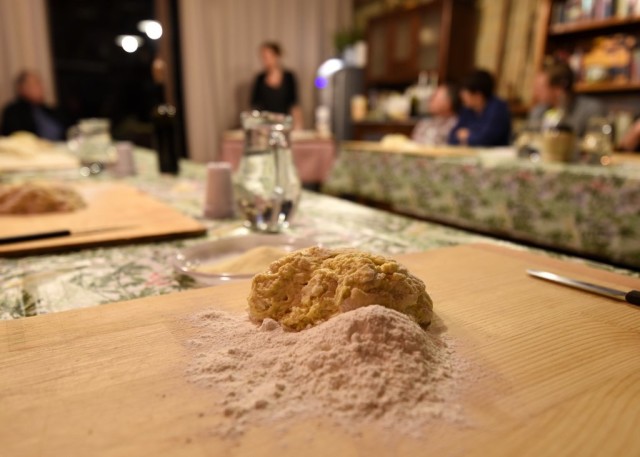
After a lively week of group bonding, all of the guests pack into the glassed-in veranda. They squeeze behind rustic tables with a hubbub of anticipation. In front of each small group is an oversized, rough-wood board with just the right texture for rolling noodles.

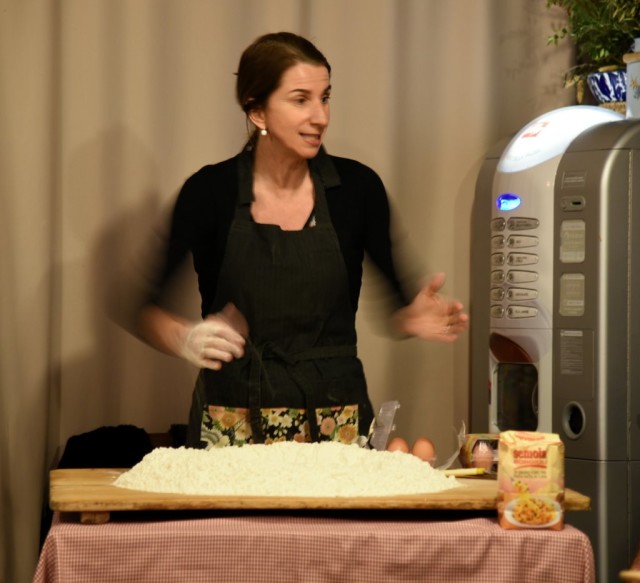
In one corner of the room, our agriturismo host, Isabella, stands at a small table and addresses the group. The board in front of her is piled high with a 10-pound mountain of flour. She explains — with the seasoned confidence of someone who’s taught hundreds, maybe thousands, of travelers how to make perfect pasta — the precise procedure.
cameron-italy-tuscany-cooking-class-cretaiole-003

First, she dredges out a crater in the top of her flour mountain, turning it into a volcano. Into this precarious container she cracks eight eggs. She gingerly beats the eggs with a fork, gradually sprinkling in water — a few drops at time — as she pulls in more and more flour from the lip of the crater. With each stir, the sea of eggy goo threatens to breach the fragile walls. But gradually, liquid turns to solid. And with one last vigorous stir, it becomes a mound of sticky dough.
cameron-italy-tuscany-cooking-class-cretaiole-006

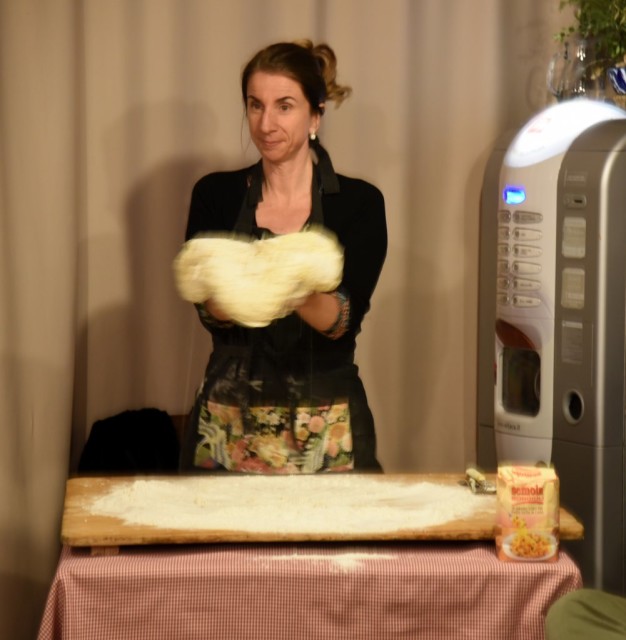
It’s time to knead. Isabella carefully explains the importance of keeping the “cut” — or, in more pleasant terms, the “smile” — facing you at all times. After each knead, you rotate the dough a quarter-turn, then repeat. It’s a steady rhythmic, motion — like waves crashing on a beach: Pull, push, push, rotate. Pull, push, push, rotate.

Each family huddles around their communal wad, taking turns. Isabella circulates through the room, gently correcting our awkward technique. “Done?” someone asks her. She sticks an accusing finger deep into the center of the seemingly finished ball of dough, and withdraws a sticky fingertip. “Not done yet,” she says. “Keep going.”

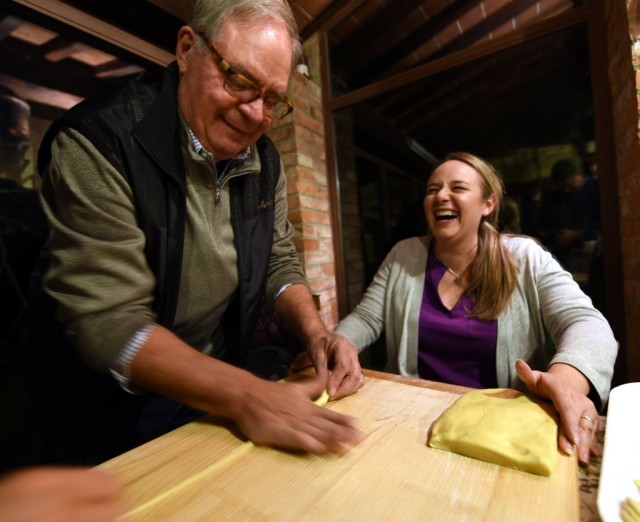
Finally, the dough is ready, and it’s time to make the pasta. Pici (pronounced “pee-chee”) are peasant noodles. Pici are hand-rolled — not neatly extruded from a metal tube. But it’s deceptively tricky to master.
cameron-italy-tuscany-cooking-class-cretaiole-041

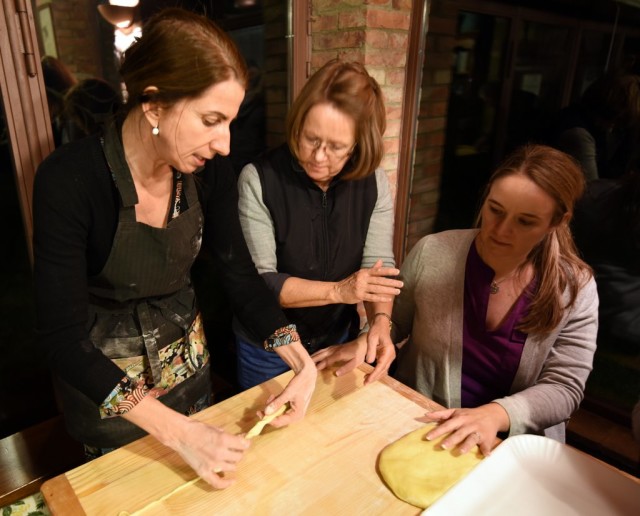
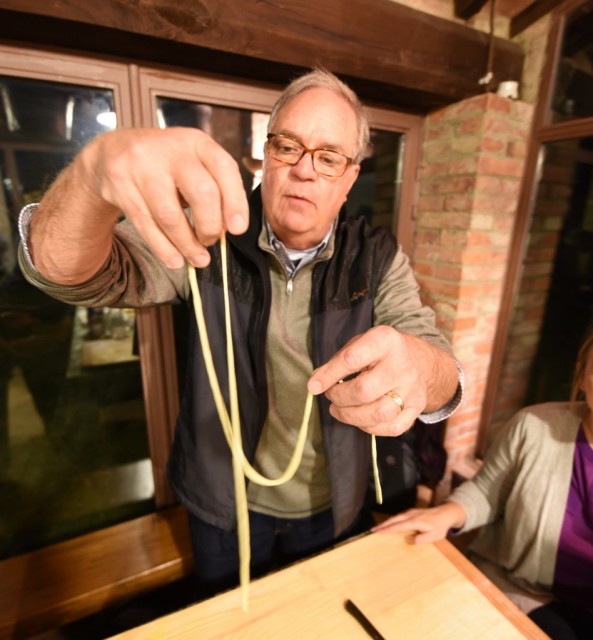
Here’s the technique: Cut off a hunk of dough, hold it in your left hand, and roll it with your right.  Continually massage the dough with the heel of your hand against the cutting board, always gently tugging on the dough clump to tease out a strand. It’s harder than it sounds. Too little pressure, and you get thick, inedible ropes. Too much pressure, and it breaks into bits. But if you do it right, you get pasta shaped like a four-foot-long earthworm. This is where those special boards come in: They offer just enough texture to provide friction for rolling the pici, but not so much that it sticks.
cameron-italy-tuscany-cooking-class-cretaiole-029

Families take turns rolling their pici, offering each other tips and encouragement. Some people go fast. Others go slow. Some pick up the technique immediately, churning out long strands of perfectly uniform noodle. Others can’t quite get the hang of it, and spend most of their time pinching together broken strands…while nervously eyeing Isabella across the room, hoping she doesn’t notice.
cameron-italy-tuscany-cooking-class-cretaiole-036

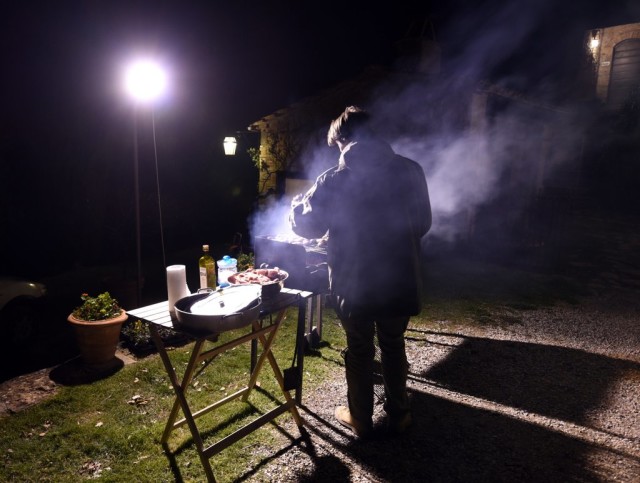
I take a break to head outside, where I find Isabella’s husband Carlo at the grill. His roaring fire has died down, and he’s repositioning his glowing coals. Carlo gently nestles his pork sausage and ribs onto the hissing grill.
cameron-italy-tuscany-cooking-class-cretaiole-057

In the little garden shed nearby, Isabella has brought a 20-gallon pot of water to a rolling boil. To season the noodles, Isabella pours three generous handfuls of coarse salt into the water. It tastes as salty as soup. Then she drops in the handfuls of pici, which squirm around the bubbles like miniature eels.

In just five minutes — when the water starts to foam up — it’s done. Isabella tosses the pici with some meat ragù she’s been simmering all day long, then takes the giant, overflowing, stainless-steel bowl back to the veranda.

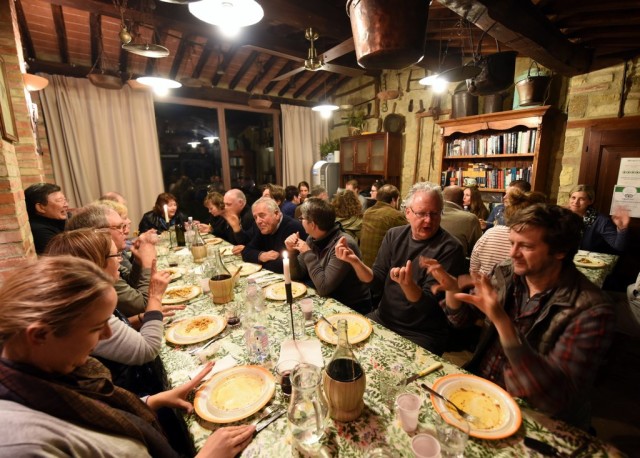
At Cretaiole, pasta night is also potluck night. Each guest brings down a salad, side dish, or dessert they’ve prepared in their apartment. Some use it as an opportunity to try out recipes they’ve picked up at cooking classes this week: a radicchio salad with pecorino and fennel, or a lightly sweetened, simple ricortta. Others import favorites from back home — my mother-in-law’s apple crisp (made with Tuscan apples) is a hit.
cameron-italy-tuscany-cooking-class-cretaiole-058

Settling in to a delicious (and hard-earned) dinner, the Cretaiole guests chatter and drink and eat and laugh. Old Man Luciano shows up, clutching bottles of Vin Santo and grappa that he’ll be sharing later in the evening. Once-strangers, now-friends animatedly discuss all they’ve experienced this week. That great art museum in Siena. That stunning scenery from the drive to Monticchiello. Adorable Milli, our canine companion who sniffed out truffles during our hike through a wooded valley. People swap the Italian words they’ve learned and the Italian gestures they’ve mastered.

Digging into my pici, I screw my index finger deep into my cheek, then wave my hand alongside my head: Delizioso! The noodles we made are firm but tender. Each noodle clings to just the right amount of flavorful ragù, exactly as it was designed to do. As time stands still around this convivial dinner table — so far from home, yet so familiar — it’s clear why here in Tuscany, the traditional ways are still the very best ways.
Cooking with Chef Roberto: New Olive Oil and Old Wine

As I like to do every couple of weeks, today I’m sharing a post from Cameron Hewitt (co-author of many of my Europe guidebooks). If you like this tasty slice of Tuscany, be sure to “like” Cameron on Facebook.

But let me warn you: if you love fine Italian cooking (as I do), stay away from this post. Cameron cruelly takes us into a Michelin chef’s kitchen in a tiny hilltop village just south of Siena. He walks us deliciously through many courses, each illustrated vividly with mouth-watering photos, knowing full well that this will just make us want to drop everything and fly straight to Italy on empty stomachs filled with anticipation. Damn you, Hewitt!

Cooking in Mamma Laura’s kitchen was a fantastic culinary experience. But for a more refined take on Italian cooking, we joined Chef Roberto behind the scenes at his restaurant. Our agriturismo arranged this experience as “sort of a cooking class,” but it turned out to be so much more: We were flies on the wall of a brilliant chef’s working kitchen — a graduate-level seminar on Advanced Italian Flavors.

Chef Roberto Rossi owns a Michelin star and a fine restaurant in his humble home village of Pescina, stranded high on the slopes of Mount Amiata. To reach Ristorante Il Silene, we corkscrew up and up — on choppy gravel roads — into the mountains overlooking the Val d’Orcia. As we gain altitude, fat raindrops become fat snowflakes. Finally, we crest a summit and enter a remote village where we park, scurry across the street in the slush, and step into the cozy-classy world of Il Silene.

Chef Roberto greets us at the door, takes our dripping coats, and offers us a glass of wine. The fireplace in the corner warms both us, and the two slender rabbits that are spending a few hours on a rotisserie. (We’ll see them again later.)

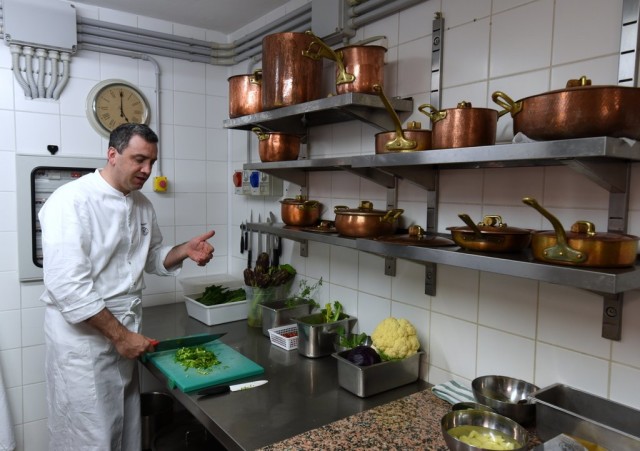
At 4:30, Roberto invites us back into the kitchen. With playful eyes under curly black hair, and a constant wry smirk, Chef Roberto seems relaxed. He leans against the counter and chats with us, while his staff scurries around the kitchen: Lella, the Sicilian sous chef who’s been his right hand since he entered the restaurant business; a few eager Italian chefs-in-training; and a pair of timid young Japanese culinary interns, who study the master intently.cameron-italy-tuscany-cooking-class-il-silene-001

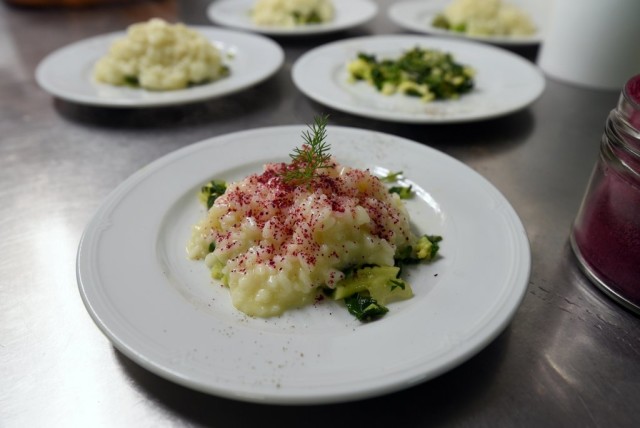
“So,” Roberto finally says, rubbing his hands together. “What do you feel like eating? How about risotto?” He walks casually to the stovetop, pulls out a pan, and ladles in some vegetable stock from a simmering pot. He sprinkles in some rice and gives the pot a few stirs, then hands the spoon to Lella, who dutifully stirs and stirs and stirs for the next 20 minutes. The result: a luxuriously creamy risotto. On top, Roberto grates precious, aged parmigiano reggiano cheese — each crumbly little flake instantly melting into the steaming rice. And finally, he sprinkles the dish with his own invention: a pinkish-purple powder made from dried and finely grated beets. Both the cheese and the beets give the dish an earthy umami kick. A little sprig of fennel perches on top, like a Christmas tree on a snowy mountain.

cameron-italy-tuscany-cooking-class-il-silene-005

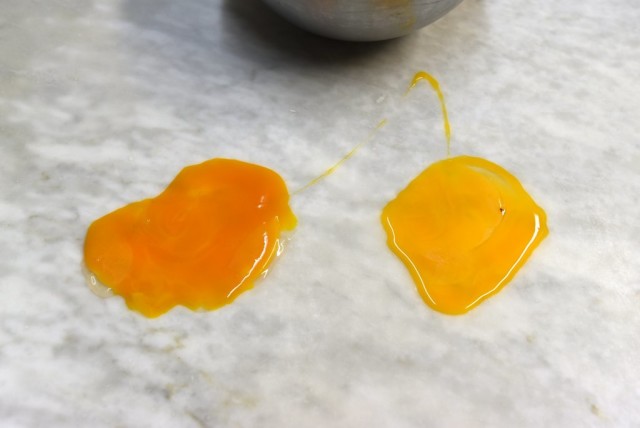
Satisfied with our first course, Roberto invites us back to his pasta-making room. We huddle around the rickety old table with a smooth marble top. Sipping his wine, Roberto — whose father owns a farm just up the street — explains the critical difference between farm-fresh and store-bought eggs (even “organic” and “free range” ones). To demonstrate, he cracks one of each on the white marble. Can you guess which is which? (The rich, orangey tones of the farm-fresh egg are a dead giveaway.)

cameron-italy-tuscany-cooking-class-il-silene-011

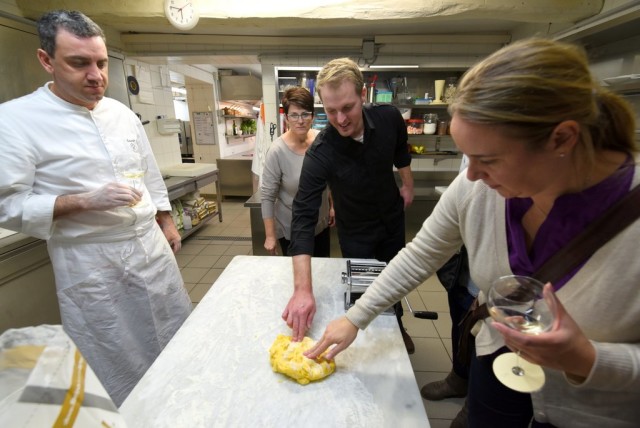
Point made, Roberto scrapes the eggs into a bowl, throws in some flour and a duck egg yolk (for elasticity), runs it through a mixer, then hand-kneads the small knot of yellow dough with mechanical precision. The moment it reaches the perfect texture, he invites us to prod it.

cameron-italy-tuscany-roberto-dough

Roberto rolls out the dough, then starts running strips through his pasta maker. “Italy has so many kinds of pasta,” he explains. “Hundreds and hundreds. Each one is designed to show off the other ingredients: local produce, meat sauces, cheeses, and so on. But they all start with basically the same dough.”

cameron-italy-tuscany-cooking-class-il-silene-031

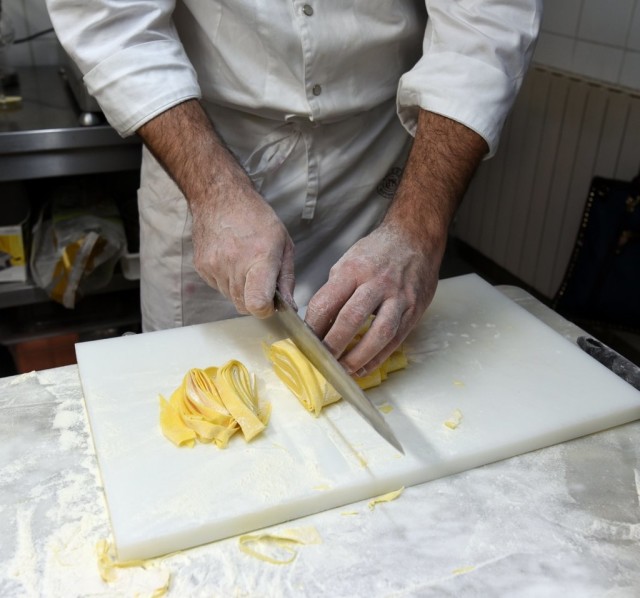
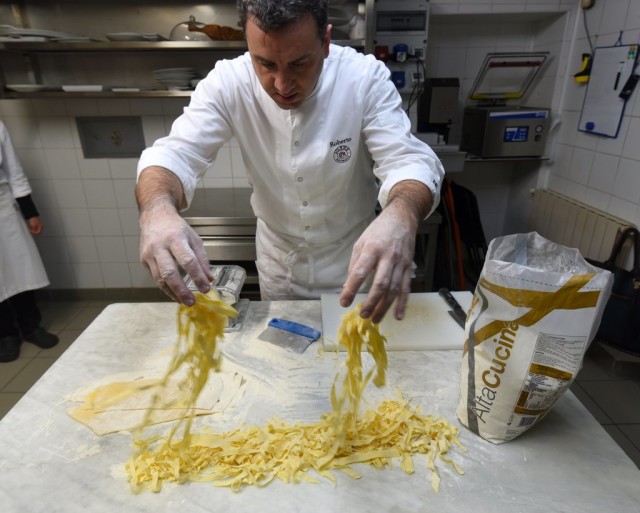
As he pulls each long, skinny, translucent sheets of dough from the roller, he folds it over on itself several times. Then he attacks each little bundle with his knife, eyeballing textbook-perfect examples of different pastas.

cameron-italy-tuscany-cooking-class-il-silene-029

Papardelle,” he says, chopping thick ribbons.

cameron-italy-tuscany-cooking-class-il-silene-028

Tagliatelle.” This one is thinner. His hands work fast and furious — almost too fast to track.

cameron-italy-tuscany-cooking-class-il-silene-035

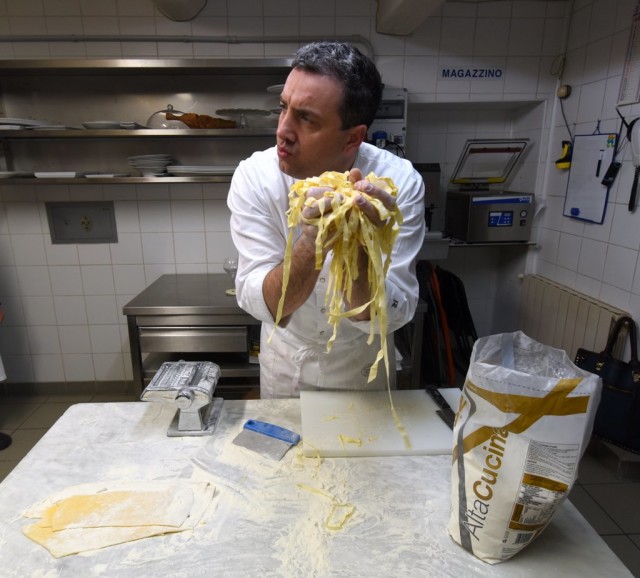
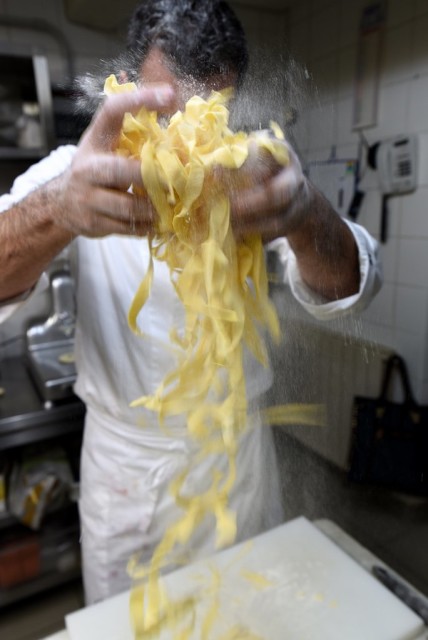
Capellini.” Thinner still. With each batch, he grabs the wad of new noodles and tosses them gently in the air.

cameron-italy-tuscany-cooking-class-il-silene-049

“You cut the capellini in small pieces, like for a soup, and you get fideo pasta.”

cameron-italy-tuscany-cooking-class-il-silene-042

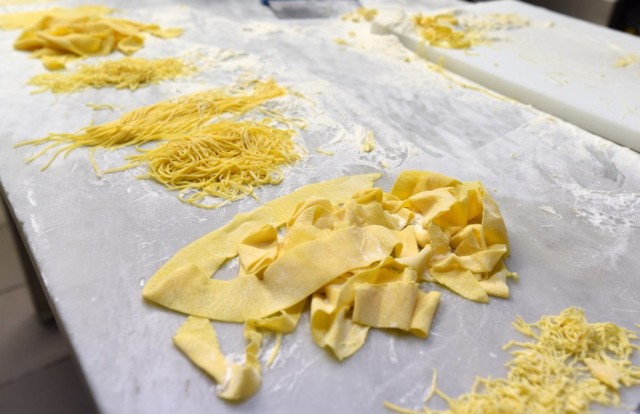
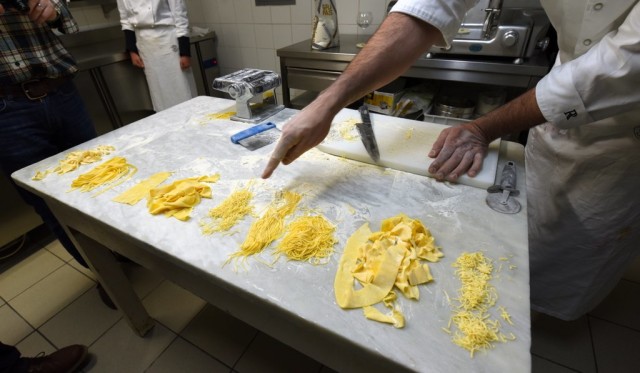
Stepping away from the table triumphantly and sipping his wine, he beams at his creation. With nine different types of pastas lined up along the flour-scattered marble, it looks like the cover of a foodie magazine…all done in a just few minutes, by one man and his knife.

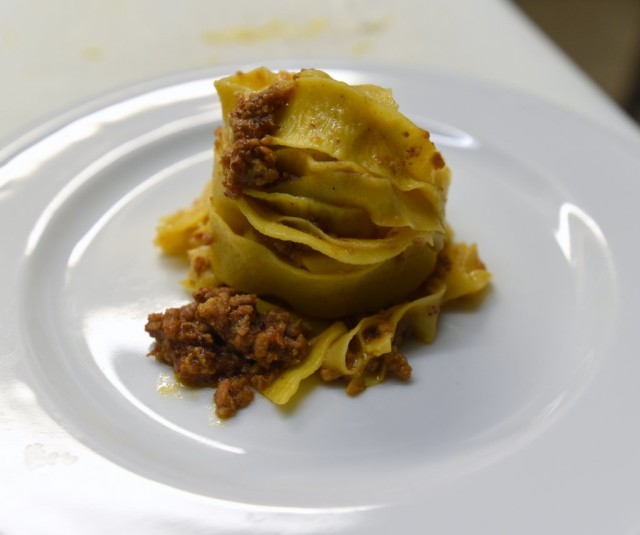
Roberto sends one of his assistants to heat up our pasta (so fresh it needs only a brief, boiling bath) and mix it up with some turkey ragù. Delicious.

cameron-italy-tuscany-roberto-pasta

Next comes a lesson in olive oil. Roberto holds up two squirt bottles. “The blue one is last year’s. Still good, but just for cooking. The green one is this year’s. For finishing.” Only a few days before, Roberto was at the olive mill down in the valley, where he personally watched the precious golden-green oil pressed out of his olives. We taste each one, and the difference is remarkable: Last year’s, still decent, has subdued, muted flavors. You can’t quite taste the olives. But this year’s? Explosively piquant.

For an even better taste of top-quality oil, Roberto thin-slices a baguette and toasts the slices. Holding a bottle high in the air, he rains down a shimmering stream of golden-green oil, then tosses them with his hands. Crunching into the crusty, coated little discs, the pungent, acidic, tingly taste of fresh olive oil blankets our palates.

cameron-italy-tuscany-cooking-class-il-silene-056

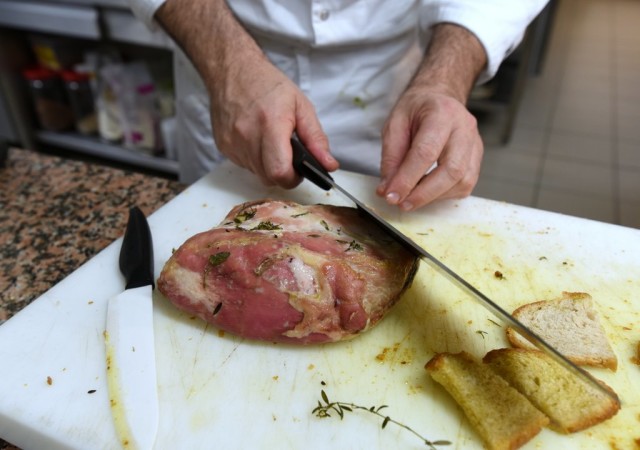
Seeking another topping for his little crostini, Robert disappears out back and returns with a breast of turkey that he’s been slow-roasting for hours. “I don’t usually cook turkey,” he says. “But I know it’s Thanksgiving in America, so I decided to try. If you understand the principles of how to cook meat — salt, herbs, aromatics, slow-roasting at a low temperature — you can cook anything well.” He slices off some thin tastes. It is, without a doubt, the best turkey I’ve ever eaten.

cameron-italy-tuscany-roberto-turkey

For another topping, Roberto makes a batch of his signature salsa verde: a vibrant-green sauce made with a generous bunch of Italian parsley, ample olive oil, a couple of medium-boiled egg yolks, capers, top-quality anchovies, and some salt. When we taste it, our questions of “What do you put it on?” are instantly answered: Anything. This outrageously flavorful, catch-all condiment tastes faintly of each of its ingredients, but is far greater than the sum of its parts.

As we munch, Roberto explains his passion for wine. Not a rare quality in Italy — especially in Italian restaurants. But more specifically, Roberto has an affinity for very old wines. “Later on,” he says, “I’m going to open for you a very special bottle. From the Südtirol — the very northern part of Italy, in the Alps, touching Austria. It’s a white wine, aged several decades.” It’s the paradox of a great chef: He insists on only the freshest and most local ingredients, yet prefers extremely old wines from distant lands.

Roberto explains that he recently returned from a trip to Spain. Near Barcelona, he visited the restaurant of a celebrity chef who owns a second Michelin star. Roberto enjoyed his meal, of course, but couldn’t help but stoke a little rivalry with his colleague. (He shows us the little sample of olive oil they sent home with him — in a gaudily labeled plastic bottle, which, as every oil aficionado knows, spoils the taste.) He tells us that this famous chef, who appears virtually every day on television, seemed very tired. “Well, I am not,” Roberto says defiantly, standing up straight and smiling wide. “I live here, in Pescina.”  If we were wondering why such a talented chef chose to live so far off the grid…we have our answer.

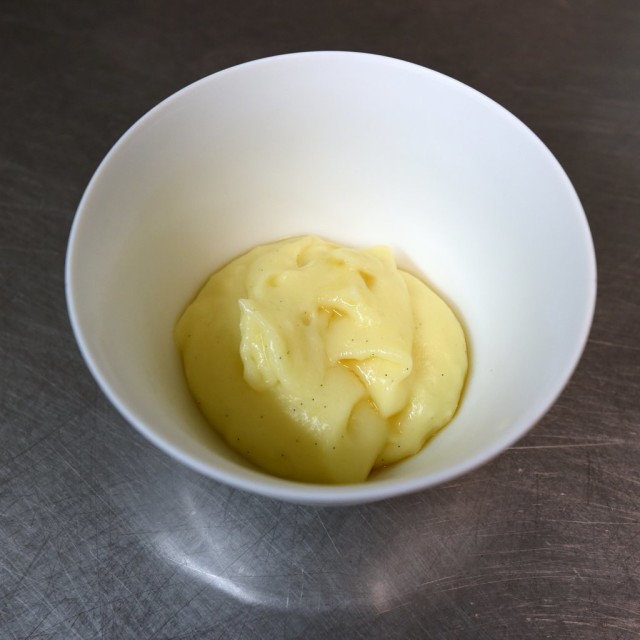
To wrap up our kitchen visit, Roberto whips up a batch of pastry cream: Heat up a pot of milk with lemon peel and vanilla seeds. Then, at the point of boiling, introduce a mixture of eggs, sugar, and flour…and stir vigorously, whipping it into a custard-like consistency. As a special treat, he drizzles in a dram of 1860 marsala wine. It’s not much to look at, but like everything else he creates, it’s sensational. Digging into this simple yet heavenly confection, we ask, “When do you serve this?” Roberto thinks it over, then says, “When I have a guest who doesn’t know what they want — or who doesn’t like anything at all — this is what I give them. Everyone likes this.”

cameron-italy-tuscany-roberto-cream

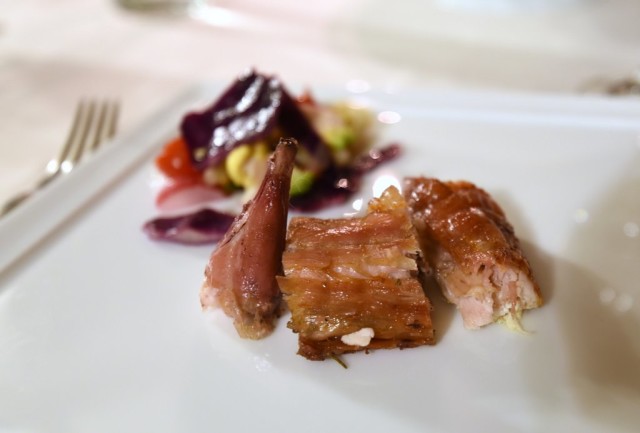
After a couple of hours of shadowing Roberto in his kitchen, we’re stuffed: Risotto. Pasta ragù. Bruschetta with olive oil, and slow-roasted turkey, and salsa verde. And now pastry cream.  So imagine our surprise when Roberto glances up at us, with a twinkle in his eye, and says, “OK! Now it’s time for dinner.” Despite our protests, he leads us out into the elegant dining room, seats us at a grand table, and proceeds to serve us a fantastic four-course dinner: handmade pasta, of course; those slow-roasted fireplace rabbits; and that bottle of antique Dolomite wine. Everything is fantastic, and the portions are mercifully modest. (He must have taken pity on us.)

cameron-italy-tuscany-roberto-rabbit

Our evening in Robert’s kitchen might seem like an unrealistic goal for the casual tourist. But, like the cooking class in Mama Laura’s home, these sorts of experiences are perfectly accessible to anyone who’s willing to do a little homework and make the arrangements. Hanging out for a couple of hours with Roberto, then dining in his restaurant, probably cost us just a few euros more than dining in the restaurant alone. And we came home with a renewed appreciation for how a top-end kitchen — and a top-end chef — masters the art of pleasing diners.

Waiting for Luciano’s Knock

As I like to do every couple of weeks, I’m sharing a post from Cameron Hewitt (co-author of many of my Europe guidebooks) today. If you like this intimate slice of Tuscany, be sure to “like” Cameron’s Facebook page. There’s a world of good travel there. In this piece, Cameron inspires us to take some time to slow down, step away from the famous cities and must-see museums, and really connect with salt-of-the-earth Tuscany. Enjoy!

Every night at around 9:30 or 10:00, there’s a knock on the guest room doors at Agriturismo Cretaiole. It’s Luciano — the 75-year-old farmer who owns the place — inviting people down to the veranda for a nightcap. There’s no point fighting it. Yes, you’re tired from your busy vacation. But Luciano has been working the fields all day, and he’s ready to party. You have no excuse.

Trading your pajama bottoms for blue jeans, you make your way to the glass-enclosed patio. Luciano has laid out his little plastic cups, and bottles of his three homemade spirits: grappa (grape brandy), limoncello (grappa infused with lemon rinds), and Vin Santo — the prized “holy wine” that’s made with concentrated grapes, fortified with grappa, then aged lovingly in special casks.

Luciano pours everyone their slug of choice, then puts on his Sinatra records. As the sprits flow and Frank croons the classics, Luciano nudges his guests to the dance floor. Emboldened by the Vin Santo — and by the general aura of Tuscan romance — couples who haven’t slow-danced in eons grip each other and sway to the music. Occasionally Luciano cuts in for a dance of his own.

The old man loves to talk, even though he speaks no English. Despite his guests’ protests that they don’t speak Italian, Luciano just keeps chattering away — making himself understood (more or less) with meaningful eye contact and by speaking slowly.

Recently Luciano discovered the Google Translate app. So now, when he wants to convey a more complex point, he borrows someone’s smartphone. He speaks into it with a measured, gentle ease — his velvety voice submerging the phone in Italian charisma. After a pause, the phone spits out a rough translation in Siri-speak. It’s a jarring juxtaposition. But — like the traditional-meets-modern mix of the agriturismo itself — it just works.

cameron-italy-tuscany-luciano-farm

The old man is stubbornly old-fashioned. One of his relatives joked, “Luciano’s idea of progress is getting two new sheep for the farm.” Luciano may be the paterfamilias, but his daughter-in-law, Isabella, is the business brains of the operation. By converting his farm into an agriturismo, she created a bridge between Luciano’s rustic ways and a steady stream of visitors from faraway lands. Now that he’s gotten used to it, Luciano has a newfound purpose in life: connecting with tourists, and proudly sharing his traditions. This old dog is learning some new tricks…and loving it. Well, most of the time.

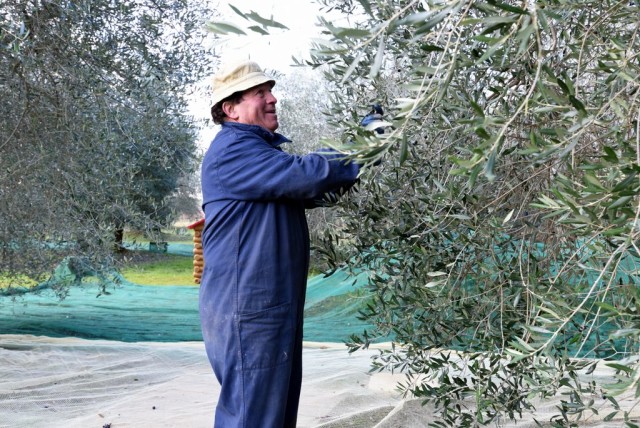
One day, Luciano invited his agriturismo guests to participate in the olive harvest. A few hardy and curious souls showed up, and put in a couple of hours’ work: spreading out tarps, gently raking plump olives off of spindly branches, then stooping over to gather them up.

cameron-italy-tuscany-cretaiole-045

At the day’s end, as the sky became a deep purple, Luciano built a roaring campfire deep in the grove. He pulled out a straw-wrapped bottle of his homemade wine, and began to cut slices of bread to toast on the open fire. He rubbed each crispy slice with garlic, drenched it in a generous dollop of his bright-green, fresh-pressed olive oil, and handed it around. “Bruschetta,” he said. “This is the real peasant cuisine.”

cameron-italy-tuscany-luciano-fire

Luciano’s exhausted work crew of tourists huddled around the fire and crunched into our reward for a hard day’s work. But Luciano wasn’t quite as impressed with us as we were with ourselves. “Here’s the thing about this agriturismo business,” he muttered to me with a wink. “It’s an awful lot of turismo and not much agri.”

While people come to Cretaiole for the food, wine, scenery, and cultural activities, I think that when all is said and done, some of their most prized memories come from their time with Luciano. Yes, things would be easier if Luciano learned some English. But I sure hope he never does.