The Sea of Galilee

After a busy day of filming the major Christian sites along the Sea of Galilee, I enjoyed this view from my hotel window in Tiberias.

If you can’t see the video below, watch it on YouTube.


We worked a long day, and it went very well. Here are the eight sequences we covered in the script today:

A short drive up Israel’s coastline, and then into the interior, takes us down — 700 feet below sea level — to the Sea of Galilee. Israel’s top source of water is fed and drained by the Jordan River. This area has long been popular with Israeli vacationers and pilgrims. For Christians, Galilee is famous as the place where Jesus did his three years of ministry and where so many Bible stories are set.

In the Jordan River, the faithful believe John the Baptist baptized Jesus. And today, Christians from all over the world come here in droves to affirm their own baptism with a dip into that same fabled river.

Long before tourism, and even long before Christ, the economy around the Sea of Galilee was fishing. At the Kibbutz Ginosar, a museum contains a boat that dates from the time of Jesus. Recently discovered and excavated, it’s likely the same kind that those first disciples fished from. This busy north end of Galilee is where Jesus walked on water, calmed the storm, and talked fishermen into changing careers.

In the Bible, Matthew writes, “As Jesus was walking beside the Sea of Galilee, he saw two brothers, Peter and Andrew. They were casting a net into the lake, for they were fishermen. ‘Come follow me,’ Jesus said, ‘and I will make you fishers of men.’”

Pilgrims and the faithful come here to worship and be inspired.   In this church, a rock marks Mensa Christi — the place were Christ, resurrected after his Crucifixion, ate with his disciples and said to Peter, “Feed my sheep.” For Roman Catholics, this is a very important site, as it established the importance of Peter — the first pope — among the disciples.

Tour buses shuttle the crowds from one sight to the next. Another church is built upon the place where, according to the Bible, the five thousand who gathered to hear Jesus preach were miraculously fed by a few fish and loaves of bread. This mosaic is from the original church that stood here in the fifth century.

And this church, perched high above Galilee on Mount Beatitude, marks the place where Jesus gave the Sermon on the Mount. Beatitude is Latin for “blessing.” The faithful from every corner of Christendom come here to remember how Jesus said, “Blessed are the meek, for they shall inherit the earth. Blessed are the peacemakers, for they will be called the children of God. And blessed are the merciful, for they shall receive mercy.”

Keeping the High Ground

I wanted to give our viewers empathy for Israel’s unenviable position: surrounded by threatening Arab states. That’s why we filmed at the Gadot Lookout, on the Golan Heights, a former Syrian pillbox looking down on the Sea of Galilee (Israel’s primary source of water — critical in the days before desalination).

Our guide Benny explained that after Israel was created in 1948, its neighbors generally held the high ground around its borders. Then, with a bold victory in the Six-Day War in 1967, Israel surprised all of its enemies (essentially destroying Egypt’s air force on the ground in minutes) and quadrupled its size. To the north, they could have waltzed right into Damascus. But Israel just wanted buffer territory — and to hold the high ground. Today, Israel seems to have a passion for being on the tops of hills, whether with military bases or with residential settlements.
Standing atop a former Syrian pillbox, we look down into Israel. From the script: "For a generation, Arabs could lob shells into the towns, kibbutzim, and farms of Israel below. This is an example of why the high ground matters. Today, Israel — determined never again to live under its enemies — controls this and all the high ground around its borders."
Standing atop a former Syrian pillbox, we look down into Israel. From the script: “For a generation, Arabs could lob shells into the towns, kibbutzim, and farms of Israel below. This is an example of why the high ground matters. Today, Israel — determined never again to live under its enemies — controls this and all the high ground around its borders.”
Looking out from this pillbox over the Sea of Galilee, as Syrian soldiers did for a generation, I could understand why Israel felt the need to take the Golan Heights for its own security.

My Holy Land Shoot Finally Arrives

For the last year, my usual laser focus on Europe has been diverted with preparation for our Holy Land shoot. With our regular TV production in Europe, I do the scouting, rough up the script, and line up local contacts as I research my guidebooks. With our Iran special in 2009,  we wrote the script pretty much on the fly as we were filming. But for the Holy Land, I dedicated a special trip this spring just to sort through the options and come up with a plan. While this project has distracted me from my normal work, I have great hopes to help my American audience understand (as much as a travel writer/TV producer can) the context of the problems in this notoriously troubled part of the world. And now, I’m thrilled at the opportunity to take our crew to the Holy Land.

For our shoot, we have a week in Israel followed by about a week in Palestine. El Al Airlines flew us from LA to Tel Aviv (non-stop in 15 hours, amazingly efficient and comfortable), where my producer Simon Griffith (middle) and I were met by our Israeli guide, Benny Dagan (left). Benny — a former press relations officer in the Israeli army and a very experienced guide — was my guide in April, and he was my first choice to be with us in the countryside of Israel. Considering his life experience, I can’t imagine a better person to share the Israeli narrative.
The port city of Jaffa is the Ellis Island for Zionism — the place where many Jews joyfully first set foot in the homeland of their ancestors after the creation of the modern state of Israel in 1948. Overlooking the dazzling skyline of Tel Aviv (a city created from sand dunes by Israelis in the last century), I huddle with my crew — cameraman Karel Bauer, producer Simon Griffith, and guide Benny Dagan — to finalize the writing of an "on-camera" bit I’m about to do. (By the way, many of the photos you'll see here were artfully taken by one of our cameramen, Dean Cannon, who has generously let me use them. Thanks, Dean!)
The port city of Jaffa is the Ellis Island for Zionism — the place where many Jews joyfully first set foot in the homeland of their ancestors after the creation of the modern state of Israel in 1948. Overlooking the dazzling skyline of Tel Aviv (a city created from sand dunes by Israelis in the last century), I huddle with my crew — cameraman Karel Bauer, producer Simon Griffith, and guide Benny Dagan — to finalize the writing of an “on-camera” bit I’m about to do. (By the way, many of the photos you’ll see here were artfully taken by one of our cameramen, Dean Cannon, who has generously let me use them. Thanks, Dean!)
The Mediterranean coast of Israel is densely populated, and perhaps its most beautiful city is Haifa — famous as a place where modern Jewish Israelis and Arab Israelis (about a quarter of the population) can work and play together without the baggage of the religious and political tensions. The gorgeous foreground is the Baha'i shrine gardens. The center of the Baha'i faith is in Israel, but there’s so much to jam into a 30-minute show, it didn’t make the cut.
The Mediterranean coast of Israel is densely populated, and perhaps its most beautiful city is Haifa — famous as a place where modern Jewish Israelis and Arab Israelis (about a quarter of the population) can work and play together without the baggage of the religious and political tensions. The gorgeous foreground is the Baha’i shrine gardens. The center of the Baha’i faith is in Israel, but there’s so much to jam into a 30-minute show, it didn’t make the cut.

Exploring Israel and Palestine — In Search of Understanding (and Some Great TV)

Earlier this month, my crew and I flew to Tel Aviv to film three new public television shows on the Holy Land: individual half-hour episodes on Israel and Palestine (part of our new eighth season of Rick Steves’ Europe, premiering in October of 2014); and an hour-long special on the Holy Land as a whole, designed to give context to the challenges of that region, and to help viewers better understand and empathize with the people sharing it (scheduled to air in mid-2014).  Over the next month or so, I’ll be posting every day right here about my experiences filming these new shows.

Hearing about my travel plans, several people have asked me whether I really want to wade into the quagmire of Israel and Palestine, where it seems like anyone who probes for the truth will anger people on one side or the other. Believing that the vast majority of Americans are not partisan on the issues here — and emboldened by the burgeoning movement among Palestinians and Israelis to find an enduring solution that gives dignity and security to people on both sides of the divide — I think this is an exciting and timely project. And, frankly, I’m tired of extremists exploiting social media to exaggerate their numbers, creating the illusion that a vocal fringe of our society is more legitimate than it actually is. With these new shows, my only agenda is to appeal to open-minded people who simply want to do some armchair travel, hear a variety of perspectives, and be given the opportunity to form their own opinions.

I was in the Holy Land this spring scouting for these new shows. Now I’m excited to head back and start shooting with our crew: my producer, Simon Griffith; two cameramen, Karel Bauer and Dean Cannon; and a cadre of both Israeli and Palestinian local guides, drivers, and helpers. We’ll be working in Jerusalem (bursting with history and culture); Tel Aviv and Haifa (so joyful and full of modern life); and Masada and Yad Vashem (which give poignancy to the Jewish struggle, from Roman times to the Diaspora to our own generation). Then, heading into the West Bank, we’ll be curious sightseers in Bethlehem, Hebron, Jericho, Nablus, and Ramallah — experiencing “reality travel” in places almost completely unknown to most Americans. We’ll walk in the sandal-steps of Jesus with Christian pilgrims at the Sea of Galilee, taking Bible stories to a new level. And we’ll learn about the Separation Wall and the settlements that vex the desire for peace.

With the help of local Israeli and Palestinian guides, we’ll make a point to listen to local voices on both sides of the issues. In Israel, I’ll be wearing my yarmulke and eager to learn. And in Palestine, I won’t be wearing my keffiyeh — but I’ll be equally ready to learn.

After several weeks of traveling throughout the Holy Land this year, it’s my hunch that the majority of both Israelis and Palestinians have come to the conclusion that violence is not the answer. And I believe that, while any sane person wants peace, a wise person understands there can be no real peace without justice. Like the destinations themselves, these themes will prove to be a fascinating area to delve into.

The Holy Land — which is “holy” to about a third of humanity — is a richly rewarding place to travel. Join me right here over the next month, as I’ll be posting every day about my explorations of this fascinating land. And share a link with your friends who might be interested in traveling along. Together, we’ll strive to overcome fear with understanding.

Happy travels!

DSC01693

Final Thoughts on My Week in Palestine

During my week in Palestine, I was in the care of three great guides: Husam Jubran (hjubranus@yahoo.com), Kamal Mukarker (kamal_mukarker@hotmail.com), and Iyad Shrydeh (iyadsh_2004@yahoo.com). Each is a proud Palestinian who works routinely with American tourists. They are all licensed guides (charging $300 a day, possibly with a car) who work like any guide in Europe. The big difference is that most of their clients are religious or political tourists. Frankly, I can’t imagine enjoying a trip here without the help of professional guides like these. With Kamal, Iyad, and Husam, I felt safe and got the absolute most learning out of each day.

With a guide in Palestine, you’re likely to find yourself invited into a family’s home for dinner. I had a great evening with Kamal (seated next to his mother). His mother is also a guide.

Traveling through the Holy Land, my heart is a shuttlecock, swinging from sympathy with Israel to solidarity with Palestine. I’m saddened by the people — like some who post on this blog and on Facebook — who are so hardened on one side or the other that they cannot allow themselves to find empathy with the society they consider the enemy. Even if one side is the enemy, it’s not the entire society but just its powerful or just its extremists. And the young generation on each side is simply living with the history it inherited. As is so often the case in tough situations like this, most people would be willing to find a way to coexist peacefully but extremists can only get traction by blasting out the middle and making things more radical.

Travelers entering Israel get a visa  — but it’s a separate sheet of paper clipped into your passport so that after your trip there’s no evidence that you’ve been in Israel (which is nice if you’re visiting some extreme Islamic countries). Palestine uses the same coins and currency as Israel and, strictly from a passport point of view, is like being in the same country. While crossing the border is complicated for Palestinians, for a Western tourist it's easy. Phones and ATMs work in Palestine as if you’re in Israel. There is plenty of good guidebook information for independent travelers in Palestine — either as part of Israel guidebooks or as books solely on Palestine. (Please note that I did not go to Gaza which is a much less tourist-friendly situation.)
Travelers entering Israel get a visa — but it’s a separate sheet of paper clipped into your passport so that after your trip there’s no evidence that you’ve been in Israel (which is nice if you’re visiting some extreme Islamic countries). Palestine uses the same coins and currency as Israel and, strictly from a passport point of view, is like being in the same country. While crossing the border is complicated for Palestinians, for a Western tourist it’s easy. Phones and ATMs work in Palestine as if you’re in Israel. There is plenty of good guidebook information for independent travelers in Palestine — either as part of Israel guidebooks or as books solely on Palestine. (Please note that I did not go to Gaza which is a much less tourist-friendly situation.)

When I consider the challenges facing the Holy Land, I think of the importance of Israelis and Palestinians having ways to connect. I’m haunted by the devastation the people of France and Germany suffered in World War I, and I’m equally haunted by the fact that few Germans and French on the front lines had ever met someone from the other country in 1914. I believe if they had met, studied, drank, and danced together, they would have found a way to avoid the slaughter.

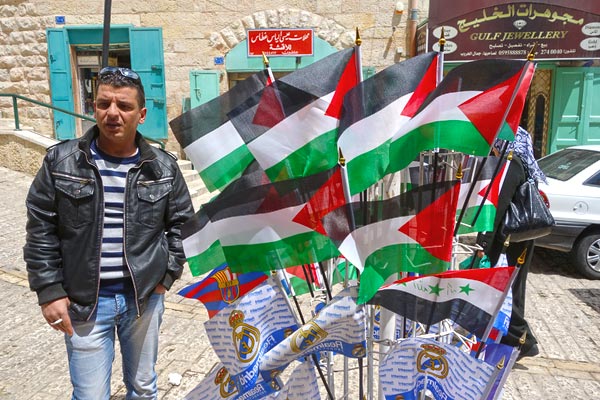
Whichever side of the separation wall your heart resides on, you should be concerned that — as a result of the wall — people on both sides will not get to know each other. They will not understand that they all root for the same soccer teams. Israelis and Palestinians who are soccer fans, curiously, root for the Madrid and Barcelona teams — but they don’t even know the other side does the same thing. There’s no way mutual fans of Real Madrid could be mutual enemies.

In addition to Palestinian flags, this vendor is selling flags for FC Barcelona and Real Madrid — soccer teams that are extremely popular in Israel. I've also heard Muslim Palestinians and Israeli Jews refer to each other as cousins. While these days that might be a bit optimistic, both clans have the great patriarch Abraham in common.
In addition to Palestinian flags, this vendor is selling flags for FC Barcelona and Real Madrid — soccer teams that are extremely popular in Israel. I’ve also heard Muslim Palestinians and Israeli Jews refer to each other as cousins. While these days that might be a bit optimistic, both clans have the great patriarch Abraham in common.

There’s a place on the Palestine side of the wall where passengers can conveniently change from a Palestinian car to an Israeli one. When I left Palestine, my Israeli driver waited there for my Palestinian driver to drop me off. I’ll never forget their handshake — in the shadow of an ominous Israeli watchtower painted black by the flames of burning tires and with angry Palestinian art on the wall. These men were each beautiful, caring people, caught in a problem much bigger than either of them. The exchange was little more than a suitcase shuttling from one back seat to the other. I watched as they quietly shook hands, looked into each other’s eyes, and said a solemn and heartfelt “Shalom.” After my week in Palestine, driving 300 yards through that security gate into Israel was like driving from Guatemala to San Diego. And I thought, “With all these good people, on both sides, there has got to be a solution — and a big part of it will be grassroots, people-to-people connections.”

As always, by traveling to a country that seems hard to get your brain around, you realize it’s filled with people just like you and me (but who really know how to wear a scarf). Consider a trip to the Holy Land. And when you do, visit both Israel and Palestine. Do it for peace.