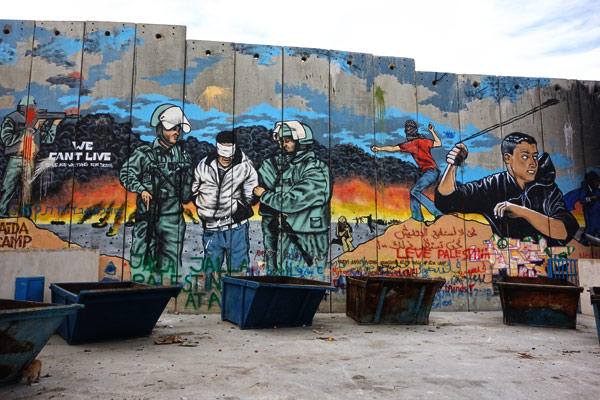
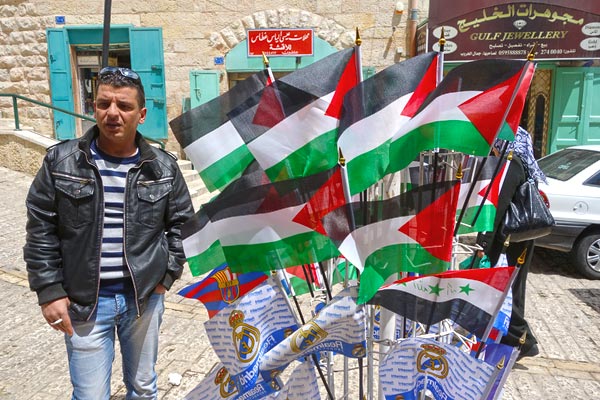
In the last decade Israel built a wall separating it from the Palestinian Territories in order to stop Palestinian terrorists from getting into Israel, and most people in Israel attribute the dramatic drop in violence since then to this barrier. Since the wall’s been erected, terrorism within Israel has gone down about 90 percent. While it has angered people around the world who care about the plight of the Palestinians, many Israelis would say, “Sorry about the inconvenience, but what’s a matter of convenience for Palestinians is a matter of survival for us.” While the wall is generally nicely finished on the Israeli side, on the Palestinian side it’s rough concrete punctuated by fortified towers. The concrete provides a big and inviting canvas for angry Arab artists and fascinating viewing for any visitor.
When Israel celebrates its Independence Day each spring, the same event is mourned as “The Day of Catastrophe” on the other side of this wall. While Israelis celebrate their independence by setting off fireworks and having big family BBQs, charred towers like this one are a reminder that, on the other side of the barrier, the anniversary is remembered differently — for example, it’s an excuse for angry Palestinian teenagers to stack tires against these symbols of occupation and set them on fire.Much of the art along the wall has a David and Goliath theme, with slingshot-wielding boys tormenting well-armed troops.There’s a big culture of hero- and martyr worship in Palestine. This woman, Leila Khaled, won notoriety by hijacking a TWA plane flying from Rome to Tel Aviv in 1969. Is she a terrorist or a freedom fighter? It really depends on who you ask.In this mural the imprisoned Fatah leader Marwan Barghouti is lionized. I was told that there’s a very good likelihood that the extreme Hamas party could beat the more moderate Fatah party in the next Palestinian election, which could in turn radicalize the West Bank as Hamas has radicalized Gaza. Moderates claim that if Israel would let Barghouti — the only Fatah leader with any charisma — free, Barghouti could help things stay on a moderate course. Many wonder why, if Barghouti could help moderation and Hamas would bring more extremism, Israel refuses to release Barghouti.
Israel has granted a certain amount of autonomy to the Palestinians, but with significant restrictions. The West Bank of the Jordan River, is divided into pockets of land classified into three zones: Areas A, B, and C. The land in Area A, while a relatively small percentage of the geographic area, contains most of the Palestinian cities and towns, and is free — it’s entirely controlled by the Palestinian Authority. The parts designated as Area B are mostly filled with infrastructure surrounding and connecting the islands of autonomy which combine to make Area A. Area B is under Palestine civil authority but is largely off-limits to Palestinian security forces. It’s mostly controlled by the Israeli military and seems to be designed so that if there’s trouble in any island of Area A — for example a terrorist attack emanating from that community — that community can be locked down and isolated in a snap by Israeli troops shutting down Area B. By shutting down Area B, the vast majority of the Palestinian population is bottled up in isolated urban islands throughout the West Bank. Area C, holding most of the West Bank’s uninhabited land, is under complete Israeli authority. While Area C is kind of a part of Palestine, there can be no Palestinian building in Area C without a permit from the Israeli Civil Administration — and that’s usually difficult to get. A problem with Area B is that, since Palestinian security forces can’t really work there and Israel doesn’t care to enforce Palestinian laws, it tends to be a more lawless place…and also serves as a convenient garbage dump.
Frustrating as the restrictions are, it is important to remember what an historic accomplishment it is that that the land in Area A is free and self-ruled, and has been since 1994.
I was told that the First Intifada led to the Oslo Accords, which established Areas A, B, and C as a transitional arrangement scheduled to be phased out in five years. When the deadlines were ignored, that lead to the Second Intifada (more violent than the first). And all that bloodshed meant the zone system became permanent, and the wall-and-settlement program was implemented.
Area C also includes Israeli infrastructure — like this fine highway — which cuts through the West Bank connecting Jewish settlements in Palestine with Israel proper. Palestinian license plates are green and Israeli plates are yellow. When times are good all cars are allowed. In troubled times, traffic is yellow plates only.
For Palestinians, living within the strict confines imposed by Israel after the Second Intifada can be frustrating. Both established and “flying” (temporary) checkpoints can make traveling from one Area A community to another very difficult. (Although during my visit, checkpoints seemed unmanned, and traffic was passing through without stopping.) For security reasons, Israel doesn’t allow Google to map the area. There is no reliable mail service between the West Bank and the rest of the world (many Palestinians keep an address with a friend in Jerusalem to work around this — but forget about getting any Amazon.com purchases delivered within Palestine).
Many hilltops in the West Bank are now covered with new, planned Israeli communities called “settlements.” They are connected to Israel by secure, well-built roads.
While most young people and professionals have smartphones here, there’s no 3G allowed in Palestine. As smartphones need an Internet connection to fully function, nearly every restaurant and café provides free Wi-Fi. Israeli settlements buried deep within the West Bank have 3G, so some Palestinians mooch off of this by getting an Israeli SIM card.
A big bold red sign marks the point where any road in Area B passes into Area A. It declares that passing this point is dangerous and that it is illegal for any Israeli citizen to do so. My hunch is that Israel’s concerned its citizens may be kidnapped by Palestinian extremists and then held for ransom in an attempt to negotiate the release of Palestinians detained in Israeli prisons. With this clear warning, Israel can, in good conscience, have a policy of not negotiating for hostages. Many believe a sad by-product of this policy is that it keeps people fearful and separated, and makes people-to-people connections more difficult between the two sides. I get the sense that the majority of people on both sides would like better relations. Walls and checkpoints are hurdles for this.
Israel feels as affluent as the USA. There is the ever-present security dimension of the country, which is hard to escape but after a while becomes routine. Flying in and crossing borders comes with lots of questions and amazing security (although I could leave my shoes on and take my water bottle through airport security). I felt very safe. There is no language barrier. And the infrastructure for travel and tourism is about like what you’d find in Europe. Distances are short, taxis are plentiful, Wi-Fi is everywhere. It felt about as expensive as one of the cheaper European countries. The weather was great this time of year (what you’d expect in California in the spring) and there were almost no tourist crowds — except at popular pilgrimage sights, which could be mobbed.
Now I’ll cross Israel’s “Security Fence” and enter a land where that fence is called “The Wall” — Palestine. I had great guides in Israel who gave me that country’s perspective. I’ll have three different guides for about a week of travel in Palestine to give me its peoples’ viewpoints. It promises to be quite a powerful experience. Please share my invitation to any friends curious about this part of the world — ask them to like me here on Facebook and travel along. Shalom.
Patriotic parades with plenty of Israeli flags circled Jerusalem’s old town as Israel celebrated 65 years of independence.
The second Jewish Diaspora began in A.D. 70. That’s when the Roman Empire defeated the Jewish rebels at Masada, then destroyed the main Jewish temple and exported the defeated Jews as slaves. Jewish civilization was scattered for centuries until finally, in 1948, they had an official homeland to return to. During my visit, Israel celebrated 65 years of independence.
It is national policy to welcome all Jews into Israel. Its “law of return” welcomes immigrants with grants and loans, subsidized housing, and classes to facilitate their assimilation. No matter how poor, foreign, and rough the returning Jew may be, the program expects to create well-educated, Hebrew-speaking Israelis out of his family within two generations. Israel claims to have successfully absorbed at least a million penniless refugees this way.
I was told that when President Obama visited last month, every Israeli girl fell in love. (“How nice, how charming he was.”) Many considered him naïve in his first term and now more mature. My guide said, “His advisors had him very well prepared. He pushed all the right buttons.” His charisma charmed the Israeli media.
The tradition each Independence Day in Israel is for friends and families to have big barbecue feasts.We made new friends who invited us home for a family Independence Day party. It’s easy to find yourself welcomed into an Israeli home on this festive day.Our friend’s daughter was newly married and shared photos of her amazing, over-the-top wedding. With many Israeli families newly immigrated from a wide array of countries, a wedding — designed to please all involved — invariably includes a mix of old country traditions.
I am embarking on the challenge of making two TV shows: one on Israel and one on Palestine. My challenge is to do it in a way that partisans in the vitriolic debate realize that there’s nothing wrong with understanding better the perspective of the side they oppose. In fact, I believe that if peace is ever to be found, it will come when empathy goes both ways.
I’m impressed by the harshness of many comments here as I’ve simply shared, so far, what I learned from Israelis in the country they consider their homeland. I’ll be in Palestine next week and sharing that perspective. I know what it’s like to be committed to a political viewpoint to the degree that I shut down any attempt to help me better understand what I oppose. Guns, drug policy, economic justice issues, abortion: These are all issues on which good people can be diametrically opposed. And so, certainly, is the issue of Jews and Palestinians.
As long as I’ve been politically active (since the American invasion of Grenada), I’ve been impressed by how land issues are so fundamental to peace with justice. And I’ve believed that peace without justice is not peace at all. It seems to me, land is what the struggles in the Holy Land are all about.
Israeli settlements generally take the high ground in Palestinian territory.
After the tumult of the past 65 years, a political border divides Israel and Palestine. It is drawn in a way that favors Israel but gives Palestinians enough land to build an independent state. Israel has steadily encroached upon Palestinian territory by building hilltop settlements in the West Bank. It has built enough settlements there to make the option of creating two states (a Jewish Israel with a viable and potentially satisfied Palestine) nearly impossible. When the two-state option is no longer possible, the only option will be the one-state option, and with that Israel has a choice: one pluralistic state or one Jewish state. If Israel insists on one Jewish state (rather than a secular Jewish/Muslim state or two separate states, allowing for the creation of a truly independent Palestine), I believe Israel will have forced itself into an ugly and undesirable corner. Israel will ultimately have no option but to become what Jewish Israelis don’t want to be in order to simply be. Here’s what I learned about the settlements from the Israeli perspective.
Ancient Jewish rebels hid what came to be known as the Dead Sea Scrolls in about A.D. 70 while en route to their dramatic last stand against the Romans, which ended in the Jews’ mass suicide and the beginning of the second Diaspora. The Jewish people scattered through the world and the Diaspora lasted nearly 2,000 years — until 1947 when (in the wake of the horrific Holocaust) the United Nations adopted a plan for the creation of a Jewish state. Those sacred scrolls, which were discovered that same year, 1947, had remained hidden for the entire Diaspora. Notably, most of the scrolls were found in the West Bank, and so legally the Palestinians have a claim to them — which just further underscores the complexity of this region.
There are Jews who don’t concern themselves about Israel at all. There are Jews who think the state of Israel is a terrible, even un-Jewish idea. And there are Jews who believe that their people should live together in a single homeland. These Jews are Zionists. Zionists built Israel.
Imagine a people, maintaining their culture and traditions for 2,000 years without a homeland. Imagine them remembering the holy temple destroyed by the Roman Empire and that epic last stand ending in mass suicide on the fortified hilltop of Masada. Imagine a generation of people whose parents were killed in the Holocaust and who, with a love of their heritage, found themselves in the position to retake what they believed to be their homeland. A phrase among these Zionists is “Masada shall never fall again.” That shows a determination to never come to such a point of despair as that faced by the Jews who died there in A.D. 70.
From 1947 until 1967, when Israel routed its Arab neighbors in the Six-Day War, Israel lived with the military installations of its enemies on the high ground all around. They were able and willing to rain rockets down on the Israelis at will. In the spirit of “Masada shall never fall again,” Israel is hell-bent on retaking the high ground and establishing itself there in an irreversible way.
The settlements Israel has built over the past years are huge, well-funded, government-subsidized, fortified hilltop cities that creep into the Palestinian Territories — and certainly establish the high ground. Israel justifies many of its land grabs as creating a needed buffer zone (an action they can defend by simply referring to their recent history). They say that according to international law, if land is used to attack a nation, that nation has the legal right to both occupy and settle that land for its own defense. And they’re doing that now with a vengeance.
Israeli settlements are like planned and gated Jewish communities. The growth of settlements in East Jerusalem and the West Bank has embittered Palestinians as much as terrorism embittered Israelis. With Israeli government subsidies, it’s easier for many Israeli families to live beyond the country’s border than within it.
There are hundreds of thousands of settlers. My guide, Benjamin, lived for two years in a settlement. While not convenient for him, he moved to it after a settler was killed there by a Palestinian, in order to show solidarity with that community. Other settlers are attracted by fine new housing and government subsidies, which make raising their families much easier. Some like the serenity — being away from the big-city rat race. And most appreciate the comfort of knowing their children will be raised with other friends and families who have similar Jewish values. Israel claims that the settlements are not in the valleys but on the hilltops — which they say are unused by the Palestinians anyway. In regard to its policy on settlements, it seems Israel doesn’t ask permission or wait for anyone’s approval. They’ve got a mission and they make it happen.
There are legal settlements organized and built by the Israeli government. And there are illegal settlements built against the government’s public wishes — but that ultimately become accepted and rarely stopped by the government. Hilltop settlements are built within certain boundaries in an attempt to minimize trouble with Palestinians. But they invariably grow in size, which is justified by a belief that it’s only natural for these communities to grow organically.
A more extreme position held by many conservative Jews as well as conservative Christians is that the presence of Palestinians in the West Bank impedes God’s will. Therefore, the settlements are God’s will and opposing them is the work of the devil.
By the way, as a travel writer, there is the interesting issue of what to call the land of the Palestinians. Mainstream guidebooks, for instance, barely acknowledge the distinction between Israel and the occupied territories. More independent, non-corporate guidebooks will actually refer to the area as Palestine. I find an interesting spectrum of political correctness when it comes to the name: On the far right the disputed land is Judea and Samaria (land promised to the Jews in the sacred texts). Less conservative but still politically correct from an Israeli perspective is “Occupied Territories.” I find “West Bank” and “Palestinian Territories” reasonably middle ground for both sides, and the most progressive name would be to call the area Palestine — which implies the ultimate legitimacy of an independent Palestinian state. Based on the United Nations decision last November to recognize Palestine as a “non-member observer state,” Google has decided to go with the term Palestine, and I will too.
Israel is determined to fight what it considers terror in the streets. I was told, “Sometimes we know who the next suicide bomber is before even he does.” From 2000 to 2005, the Second Intifada brought a rash of bloody terrorist attacks in Israel. In response, Israel began building a nearly 500-mile-long wall — which it calls the “Security Barrier,” “Anti-Terrorism Barrier,” or “Security Fence” — in the West Bank. They justify this by saying that in the decade before it was built, over a thousand Israelis were killed by terrorists. Since its construction, there have been almost no deaths due to terrorist attacks. While it’s called a wall, over 90 percent of it is a fence. The actual walled part is generally limited to highly populated areas like Palestinian towns and cities. I noticed that the Israeli side of the wall was nicely designed with landscaping and fine rockery work, but the side facing Palestinian communities was rough concrete — now decorated with gritty political art. While insulting and humiliating to Palestinians, Israelis believe the wall, along with the many police checkpoints associated with it, has thwarted thousands of terrorist acts.
Crossing from the Israeli to Palestinian side, you’ll find the wall decorated with political art.