This April I’m dividing my time between Egypt, Israel, the Palestinian Territories, and Turkey. To many, Israel represents a beacon of democracy, stability, and prosperity in the middle of a bunch of very troubled states. (Having just come from Egypt, I can certainly understand that.) Of course it’s the Holy Land–three great religions share some of Israel’s most sacred spots. And that means it’s the center of a complex political puzzle, and full of great travel experiences. I’m spending about a week here to scout for an upcoming TV episode and I’m in the hands of fine local guides provided by the very supportive Israel Ministry of Tourism. For the next week I’ll be sharing a couple of posts a day. Please share this with your friends who may be interested. I hope you enjoy my reporting.
The Israeli coast from Tel Aviv to the border of Lebanon is dotted with interesting sights. The thriving city of Haifa is home to the main temple of the Baha’i Faith. Its founder, Baha’u’llah, is buried in Israel. Sightseers must come away from a visit to any Baha’i sight thinking: These people are the ultimate in let’s all just get along, live together in peace, and tend gorgeous gardens.
Signs in four languages are commonplace in Israel: Hebrew (for its Jewish population), Arabic (for the Israeli Arabs–about a quarter of the country), Russian (as many locals are recent Jewish arrivals from the former Soviet Union, and Russian tourism is booming), and English (for everyone else).
Signs that are only in Hebrew present me with more than a language barrier: I literally can’t tell which end is up.
Visitors to Israel come away impressed by the country’s many layers of history. That includes lots of Roman ruins. The ancient city of Beit She’an–the best Roman ruins in Israel–marked the eastern end of the empire at its peak. In A.D. 749, the impressive city was leveled by what must have been a mighty earthquake.
Thanks for traveling with me through Egypt. I’ll be reporting from Israel starting tomorrow. For a little break from the Middle East–and for something far more serious–here’s a fascinating interview produced by Seattle public television station KCTS. Just before flying to Cairo a couple of weeks ago, I had the honor and privilege of sitting down for a candid, one-on-one interview with the famous travel writer, Rick Steves. Check this out.
As you can tell by the flurry of posts, my 10 days in Egypt have inspired me to write. I’ve had an amazing experience here. My open letter to President Morsi actually earned me a reply from his assistant, who ensures me they are trying and that they appreciate the caring candor of this series on their country. I leave Egypt both exhilarated and exhausted from all that I’ve learned.
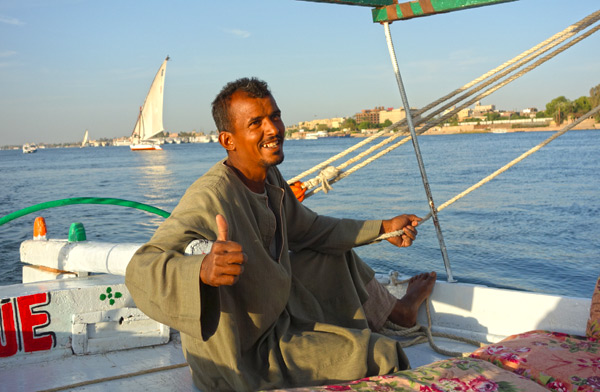
While travel to Egypt comes with plenty of uncertainty, one thing is sure: If you travel thoughtfully, you’ll be charmed by a warm welcome from beautiful people.
I have no plans to write a guidebook or lead tours to Egypt. Others do that far better than we could with our Europe focus. But I’m excited about returning in the next season to produce two, possibly three, episodes for public television. While I set out to scout for two shows, it’ll be very tough to show what I want in two 3,400-word scripts. But making a logical structure for three different shows will be a challenge. Perhaps Ancient Egypt (light on Cairo with Abu Simbel), Cairo (light on ancient sites), and Highlights of the Nile (Alexandria, Cairo, Luxor, and the cruise to Aswan). But a tighter two-show plan–Ancient Egypt and Highlights of the Nile–would be stronger.
While traveling in Europe, I enjoy meeting countless Americans and fans of my TV series and guidebooks. While the political craziness has dented tourism across the board here in Egypt, there are plenty of visitors…but almost no Americans. In 10 days in Egypt I met exactly one person who recognized me (and was a public television supporter)–a Sufi Muslim from Toronto.
By the way, I purchased a Sony RX100 camera just before leaving (at $650, it’s about the most expensive of the little pocket cameras). It slides like an armadillo into my pocket when not in use. I generally just shot on automatic but found the shutter-priority mode handy, too. It has incredible light sensitivity (I rarely used a flash and shot a lot at night). And its brain is mind-blowing. I like it a lot. My partner, Trish (a better photographer than me–you can see her art from this trip at The Travelphile, uses one, too.
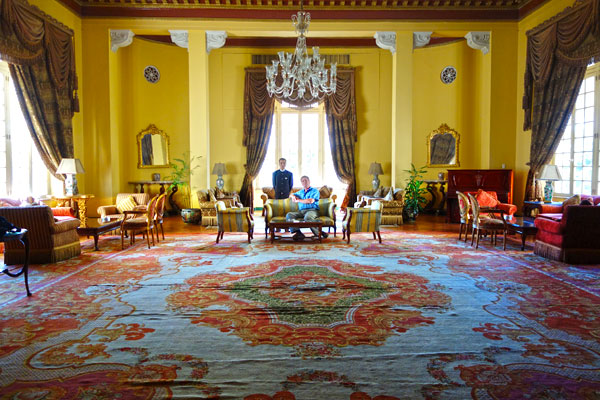
Staying at the Winter Palace in Luxor (for the price of a basic hotel in London) you live like a king. I was even assigned my own butler.
I have to admit, I was pretty pampered on this trip. To both stay safe and get the absolute most value out of my time, I hired Tarek Mousa, who runs Egypt and Beyond Travel (http://egyptandbeyondtravel.com/) to set up this trip. We brainstormed possible itineraries for the 10 days. He met me at the airport in Cairo and had hotels, a car, and local guides working with me each day. I went out a lot on my own and felt comfortable. But from a sheer efficiency point of view, with the language barrier and the complexities of post-revolutionary life in Egypt and real issues of safety, I was glad I worked with Tarek to create what was essentially my own private tour.
Tarek Mousa, of Egypt and Beyond Travel, made sure I enjoyed maximum travel thrills for every mile, minute, and dollar while I was in Egypt.
Now, after getting used to a world where I routinely find tiny pieces of stone in my food and am hob-knobbing with people with foreheads bruised from the intensity of their prayers, I fly to the Holy Land for 10 days split evenly between Israel and the West Bank, Palestinian Territories, or Palestine–depending on your politics. This promises to be an equally stimulating and rewarding travel experience. I hope you’ll stay tuned as I report on what I learn there, here on my blog.
While Egypt has many of the world’s greatest ancient archeological sites, its museums are generally dreary. The Egyptian Museum in Cairo, while old school, is world class simply by the brute magnificence of the treasures it displays. The Luxor Museum, made possible and designed by the people who brought us the Louvre in Paris, is the finest museum in the country. While it’s a fraction of the size of the big museum in Cairo, it offers more than enough ancient art and artifacts–all wonderfully displayed.
The Luxor Museum is the only museum in Egypt that’s as slick as the great museums of Europe. And it’s filled with art that’s both B.C. and B.U.
Good as it is, I was thankful for the expert tour given by our guide, Fateen. As is almost always the case when it comes to interiors in Egypt, photos were strictly forbidden. I busily took notes for our TV work.
Looking at the fine statues of the god Amun and the pharaoh Amenhotep III, I remembered the coin collectors’ term from my distant childhood for a coin that was never in circulation: BU, or brilliantly uncirculated. These statues were B.U. because they were part of the famous “cachet” of statues found filling a chamber in perfect condition in the late 1980s.
Names of ancient Egyptians are written in ovals called a cartouche. Pharaohs have two cartouches, side-by-side, because every pharaoh has two names: birth name and royal name, like kings and popes. Elegant and pedicured toes show a life of pampered luxury. Gods hold the ankh–the key of life–and a symbol of eternal life.
If you know what to look at you can see the back and forth of a religious war (around 1340 B.C.) as Amenhotep III’s son, the monotheistic Akhenaten, scribbled out his father’s polytheistic cartouche “Amenhotep.” For a while there was a battle of the gods between Amun–the Zeus of polytheistic ancient Egypt, and Aten–a proto Allah. Amun eventually won out and Aten was thoroughly ground into oblivion by the forces that felt threatened by the economic and political fallout of having only one god. (This is similar to how the Apostle Paul was run out of town when he tried to replace Artemis and company in Ephesus with one God who didn’t need all the statue worship–which indirectly kept a lot of people employed and therefore not inclined to trade many pagan gods for a single Christian one.)
Pharaohs had images posted everywhere because, somehow, that increased the likelihood that their souls would survive the journey to the goal line for eternal life. If you’ll meet any pharaoh in heaven, I bet it’ll be Ramses II. He’s guilty of a dirty trick that, to me, reflects very poorly on his character. Just in case his soul could read, Ramses usurped the images of a previous pharaoh, Amenhotep III, by carving out Amenhotep’s name and carving his name into Amenhotep’s belt buckles and bases.
As I kicked back on a well-worn horse carriage at the end of the day, with a cool breeze coming at me off the Nile and colors rich with the setting sun, another jingle-jangle carriage passed me on the right. Just as it did, two rambunctious boys with filthy hands and feet, jalopy smiles, and shining eyes hopped onto the rear axle of the passing carriage–secretly hitching a ride and laughing so happily they brightened an already very sunny day.
That was one of the enduring images for me from my last visit to Luxor (in 1999). As a TV producer, the challenge of catching these fleeting moments on video is endlessly frustrating. But I’m determined to get this magic moment in our next show, even if I have to set it up.
To start our second Luxor day, our guide, Tarek, arranged for a horse-drawn carriage to clip-clop us out of Luxor, through the fields, and into a village. Sitting tall, riding shotgun next to our driver, I was baking in the sun and marveling at how the horses maneuver through the crazy car traffic–while hanging onto whatever I could so as not to tumble off. I was thinking, this may be romantic in some tourists’ books, but wouldn’t a taxi have been more practical? Then, we got into the fields and rutted dirt lanes of a village and it became clear: Horse carriage was the way to go.
For me, part of the allure of a place like Egypt is to go back in time by visiting a village. And I really need a good village experience to balance out the silent ancient stones and chaotic concrete urban scenes for the new TV shows. But in the last decade since I’ve visited Egypt, there’s been a big change: Modernity has sloshed inelegantly into even the remote villages. Rather than reeds, mud brick, and rough-hewn timbers, the villagescape now consists mostly of modern brick, concrete, and rebar structures…with no hint of any building code. Still, if you take your time and know where to look and give your wanderlust a little slack, you can fine vivid village life along the Nile, even in 2013.
Leaving the traffic and commotion of Luxor, our horse cut across a field. Suddenly the traffic was alfalfa-powered rather than gas-powered. Here we saw a stratum of society that was self-sufficient and close to nature. The lush fields of sugar cane, alfalfa, and wheat were well-watered, thanks to Egyptian irrigation cleverness that goes back to the days of the pharaohs.
Filling my notepad, I jot a reminder to film in the morning when there’s more action in the streets. I record random observations that might be good for the camera: balconies come with privacy curtains so women can enjoy the evening breeze in their casual, immodest domestic mode (still technically in private). Homes look unfinished with their rebar Mohawks, but that’s just an alternative to a bank account as villagers sink their extra cash into an upper story for their children. They build little by little as the cash becomes available. Equity in a bigger home is considered more stable than socking money away in a bank account. Rustic wooden cages hold fluffy ducklings for sale. A mosque is under construction with progress stalled until they can gather more donations. Butchers, bakers, and spicy falafel makers add to the commerce on the street. The finest building in any town is its government-built school. Built with a uniform design, they look the same in each village.
The door to a fence is decorated with hand prints, as you might see in a grade school art project–but with more meaning. The five fingers symbolize the five pillars of Islam (to profess there is only one God and Mohammad is his messenger, to pray five times a day, to take care of the poor, to fast 30 days through Ramadan, and (if you can afford it) to go on a pilgrimage to Mecca once in your lifetime. Those who have made the trip to Mecca, the Haj as it’s called, are sure to paint a proud declaration above their door–with a drawing of the Kaaba and ornate Arabic script describing the holy adventure. When you’ve made the trip people can refer to you with a kind-of “sir” title. If I was Muslim and went to Mecca on a pilgrimage, I’d be Haj Rick.
Throughout the Middle East, exposed rebar is a reminder that parents build equity and provide for their children’s security by continuously adding to their homes as they gather a little extra cash.
Hoping to get a peek into a house, we stopped at what looked like the home of a large, traditional family. When you’re a curious American on the street of an Egyptian village that sees no tourists, it’s easy to get invited in. The father of the clan proudly led us on a little tour as other members of the family emerged from barn-like quarters to see who had ventured into their world.
The ground was a blanket of hay. An older girl was waving flies from the bread dough rising on rounds of wood in the hot sun before being popped into the oven. Three camels were necking in the corner–villagers believe their milk has a medicinal value for frail people and produce it as charity for the poor. Exploring, we found cows for milk, birds for company, and the backyard defined by a mud-brick fence–fringed with decorative palm fronds as yards have been here along the Nile since 2700 B.C. We left just as the milkman dropped by. The mother brought jugs of fresh milk to pour into the bigger jugs hanging from his donkey–just another way to boost the family’s humble income.
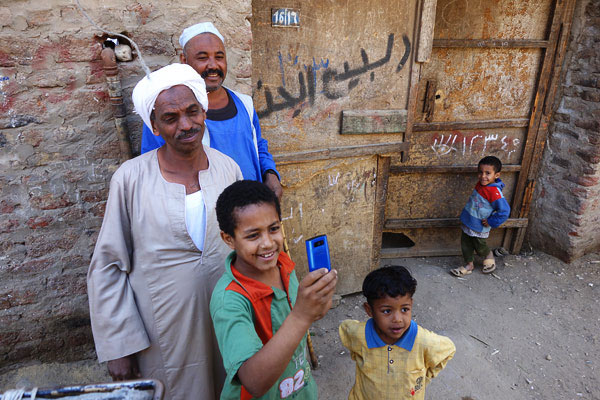
Visiting a village, curiosity goes both ways as we take their photos and new village friends take ours.
As we clip-clopped out of the village, I noticed the main street was lined with tiny new trees, each fortified by a little 3-foot-tall mud-brick castle. Small trees would never grow in this rough-and-tumble environment without a little protection…just enough to let them get to a critical sturdiness when the bricks can be cleared out and a hardy tree–too big for a goat to nibble or a careening cart to topple–will bring shade and color to that hot and dusty village world. Jostling atop our carriage back into the chaos of modern Luxor city, I thought the little trees and their temporary brick fortresses were a metaphor for democracy in Egypt and the army. Egyptians want democracy but many are beginning to believe the army may be necessary to keep it from dying in its infancy.
There’s plenty for a travel writer to take note of when you venture into a village along the Nile.