Andy Steves and an Extremely Green St. Patrick’s Day in Dublin

DSC00570
My son, Andy Steves, continues to build his Weekend Student Adventures tour program, offering American students in Europe three-day weekend tours of the top cities for about $250. (I got to be an assistant tour guide supporting Andy with one of his groups in Barcelona, and I can personally attest that his tours have to be about the best deal going for students looking to have a fun and well-organized weekend.) His bestselling trips each year are the famous festival weekends: Carnevale in Venice, Easter in Rome, Queen’s Day in Amsterdam, and St. Patrick’s Day in Dublin. These are the times when lifelong memories are created.

Andy’s St. Patrick’s Day weekend is almost sold out, as about a hundred students will join him and his Irish guides on the only day when anyone can be an honorary Irishman. Here’s Andy’s take on the celebration:

Historically, the first St. Paddy’s Day parades started popping up about 250 years ago in NYC and Boston; Irish soldiers would march through the streets on this day to reconnect with their roots. While at some point today’s celebration morphed into one that has little to do with the man it’s named after, I believe the day still presents an opportunity for millions around the world to reconnect with their Irish identity. With 37 million Americans claiming Irish ancestry (8 times the current population of Ireland itself), it makes sense that the biggest parades happen in the States: NYC, Boston, Chicago, and Savannah. But Ireland isn’t far behind. And what better and more authentic way to celebrate being Irish than on the streets of Ireland itself? Last year I was there as over 600,0000 revelers come in to Ireland’s capital to celebrate the weekend, wearing green and kissing lots of Irish maidens.

It took Ireland until the year 2000 for the Irish Department of Tourism to recognize this opportunity, but now they’re embracing the festive event as a way to pump up their economy. They’ve titled the weekend of celebrations “The World’s Friendliest Day,” and this year for the first time, they are inviting the general public to participate in the parade along with 17 bands and hundreds of performers from around the world.

While the parade and festivities are quite mainstream by now, my favorite place to be is off the beaten path next to a toasty wood oven in a little Irish pub near O’Connell Street, listening to an impromptu “trad” session. I love being around a group of locals singing the songs they’ve sung their entire lives. The musicians playing aren’t there for any reason besides the love of their musical repertoire and the convivial atmosphere. It doesn’t hurt that the local audience knows every single word of every single song they play. Old and young alike gather in pubs like these all across Ireland to create an atmosphere that I find absolutely unique to this country. This spirit is the reason I love coming back again and again.

Wherever you find yourself this St. Patrick’s Day weekend, my merry band of student travelers and I will be raising one of the 12 million pints of Guinness to be consumed around the world to you and all that is green. Slainte!

If you know any students studying in Europe, Andy has a great program worth checking out. Click on over to WSAEurope.com to see what he’s offering.

DSC005372 DSC00624

Dingle

Enlarge photo

To commemorate the Smithsonian Presents Travels with Rick Steves magazine — now on sale online, and at newsstands nationwide — Rick is blogging about the 20 top destinations featured in that issue. One of those destinations is Dingle, Ireland.

Kathleen was old and frail, but picked up her step as she led me to the small-town cinema. She declared, “Tom Cruise is a wee little guy.” Everyone was all abuzz about where he and Nicole Kidman had slept.

I was in the town of Dingle, on the west coast of Ireland. And tonight, in Dingle’s homey theater, it seemed the entire town had gathered to watch the premiere of Far and Away — a movie that was partly filmed right here in Dingle. As the movie played, each time a bit player from the village appeared on screen, a rowdy uproar erupted. Knowing where to look in the movie, you could see telephone poles decorated like trees.

The movie depicted tough times — the 1890s, when impoverished people from villages like Dingle flocked to the New World in pursuit of a better life. These days, of course, Dingle is riding high on Ireland’s economic resurgence. But all it takes is a pensive stroll through the fields to remember the earlier pain and struggle of this land. Picking up a clod of earth, my friend Tim, Dingle’s retired police chief, explained how even the dirt had to be made by struggling peasants — sand and seaweed carried here by human beasts of burden from the distant shore.

Dingle’s a humble town. Each day, it feels like the main business is rolling out the empty kegs and rolling in the full ones. They claim to have more pubs per capita than any town in Ireland. And each evening, I walk around the block like a guy choosing a dance partner, considering where I’ll enjoy a pint.

Dingle’s town mascot has long been a dolphin named Fungie. This playful dolphin is thoroughly milked to stoke tourism. But to me, it seems that Fungie just brings people to town for the wrong reason. You don’t come to Dingle to see a freak dolphin; you come to experience a Gaeltacht town.

A Gaeltacht (a place where Gaelic — the traditional Irish language — is spoken) is a kind of national park for the traditional culture. As a Gaeltacht, Dingle gets special subsidies from the government. A precondition of this financial support is that towns use their Irish (Gaelic) name. But Dingle (or An Daingean in Irish) has voted down this dictate from Dublin. I think changing it back to An Daingean would be true in principle to the Gaelic movement, but just plain bad marketing. (It’s fun to say Dingle, but An Daingean — pronounced “on DANG-un” — is hard to say and to spell.) As a compromise, signposts spell it both ways.

The tip of the Dingle Peninsula is marked by a chalky statue of a crucifix. It faces the sea, but it seems like about half the time, it’s actually facing a cloud with zero visibility being whipped by sheets of rain. I imagine cows here have thicker eyelids, evolved over centuries of sideways rain. The Gallarus Oratory, a 1,300-year-old church made only of stone, is famously watertight — unless the rain is hosing in sideways. I’ve been splattered inside. I’ve crept over the Conor Pass with zero visibility, ragamuffin sheep nonchalantly appearing like ghosts in the milky cloud. I’ve huddled in farmhouses abandoned in the great famine of 1848, awaiting a chance to step out. Yes, the weather is a force on the west coast of Ireland. But when the sun comes out, everything rejoices.

Euro Experiences from NW to SE — Part I

Enlarge photo

Let me stoke your travel dreams for 2009 by sharing some of my favorite European experiences, roughly from northwest to southeast. Maximizing the experience is a dimension of smart budget travel that’s just as important in challenging times as saving money. Imagine these…

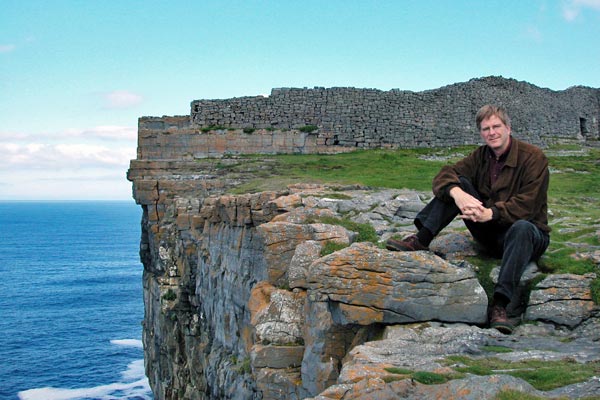
On Ireland’s Aran Island, feel like the westernmost person in Europe as you lie on a rock with your head hanging over the cliff-edge, high above the crashing Atlantic at the Iron Age fortress of Dún Aenghus.

In Dublin, be the only tourist among 50,000 cheering fans in a stadium for a hurling match—that uniquely Irish game that’s as rough and tumble as airborne hockey, with no injury timeouts.

Belly up to the bar in a neighborhood pub in Edinburgh and drink not beer, but whisky. Ask a local what they like best and why—you’ll find that whisky is as refined as wine, and suddenly you feel like an expert taster.

Hike the best-surviving stretch of Hadrians’ Wall, and picture being posted there back in ancient Roman times to keep out the scary Scots.

Sit in the choir for an evensong service in the York Minster—surrounded by men and boys singing their hearts out for the glory of God today, in a church built for the glory of God hundreds of years ago.

Immersed in the wild and pristine vastness of England’s Dartmoor, trek from the hamlet of Gidleigh through a foggy world of scrub brush and scraggy-haired goats to find your own private Stonehenge. Arriving at a humble stone circle, sit and observe blackbirds and wild horses, and feel the echoes of druids worshipping and then partying right there thousands of years ago.

Tetrapods to Lindberg with the Gift of Gab

Here in the land so famous for the gift of gab, there seems to be a passion for communication much deeper than just good craic in the pubs. I’m trying to get my mind around this:

Many paleontologists (at least many Irish paleontologists) believe the first fish slithered out of the water on four stubby legs 385 million years ago onto what would become the isle of Saints and Scholars. (I actually hiked down to see their “tracks.”) Over time those tetrapods evolved into bipods…like the Irish scribes who–living in remote outposts like the Skellig Islands just off Ireland’s southwest coast– kept literate life alive in Europe through the darkest depths of the so-called “dark ages.” In fact, around the year 800, Charlemagne imported monks from this part of Ireland to be his scribes.

Evolution, literacy, communication. Just over a thousand years later, in the mid-19th century, Reuters–who provided a financial news service in Europe–couldn’t get his pigeons to fly across the Atlantic. So he relied on ships coming from America to drop a news capsule overboard as they rounded this southwest corner of Ireland. His boys would wait in their little boats with nets to “get the scoop.” They say Europe learned of Lincoln’s assassination (1865) from a capsule tossed over a boat here.

The first cables were laid across the Atlantic from this same desolate corner of Ireland to Newfoundland giving the two hemispheres telegraphic communication. Queen Victoria got to be the first to send a message–greeting an American president in 1866. Marconi achieved the first wireless transatlantic communication from this same place to America in 1901. And in 1927, when Charles Lindberg ushered in the age of trans-Atlantic flight, this was the first bit of land he saw.

Today, driving under the 21st century cell phone and satellite tower crowning a Ring of Kerry hilltop on the far southwest tip of the Emerald Isle while gazing out at the Skellig Islands, you just have to ponder the evolution of communication through the ages and the part this remote corner of Ireland played.

Beans for breakfast…it’s Ireland

I just spent a week in Dublin. It was our annual family vacation. Anne and Jackie flew in from Seattle. Andy wrapped up his 70 days in Europe here. And I took a break from researching. I had a hunch Dublin would be great for a week of family fun…and it was brilliant.

The city is safe, thriving, easy, and extremely accessible. Each night we enjoyed fun and affordable entertainment. Andy drank enough beer to tarnish its allure. Both kids connected with their Irish heritage. (In a week Andy will be back as school–Notre Dame…trying out for the “Irish Guard”–the big intimidating guys who precede the marching band at fighting Irish football events.) We were all pretty wide eyed at the thriving late night scene in Temple Bar. In Dublin the girls are wrapped up like party favors. The guys look like they’re on the way home from a hurling match.

And Ireland’s becoming a melting pot. It seemed everywhere we went young Polish people were serving us: bringing breakfast, cleaning our hotel rooms, taking our tickets. Ireland’s a land long famous for exporting its labor, but today the economy is booming and they’re experiencing a population boom–of immigrants. Of the 10% of Ireland’s population that is not Irish, most are Polish (Catholic, kept down by a bully neighbor…they can relate).

Poles are famously hard working here. My friend who runs a youth hostel employs a Pole who unnerves him by almost shouting “I can do dat” every time he’s given a task. It’s disorienting to hear rough Irish types (historically the under-class at home as well as abroad) talking about their Polish housecleaners like a great latest accessory. “I’ve got a wonderful new Pole…very low maintenance…don’t know how I managed without.”

Except for the beans at breakfast…forget “eating Irish” in Dublin. Going local here is going ethnic. I was at a multi-national food court and it was confusing: Chinese were cooking Mexican, Poles were running the Old Time American diner, a Spaniard was serving sushi, and Irish were running the Thai. Save your craving for pub grub for the small towns.

Yesterday, I was at Croke Park with 50,000 Irish football fans (like soccer but you can run with the ball as long as you bounce or kick it every three steps). Each fan paid €30 ($40) for a ticket. I get talking to my friend, telling him I went to the Abbey Theater the night before to see a play by Oscar Wilde. He asked me the cost. I said €30. He said to his wife, “imagine paying €30 to see a play?” I reminded him that, to a playgoer, spending €30 to see the game we were at would be just as strange.

Ireland’s charming rough edge is surviving its new affluence…but it’s becoming a little less rough. We spent €30 outside the stadium so everyone in my family would have a scarf or hat or flag with the correct colors (gold and green–we were rooting for Donegal). I remember twenty years ago–when the “colors” were cheap dye on crepe paper hats for a buck. I was in the humble stadium on this same spot (where Europe’s thunderous third biggest stadium stands today). The rain was causing my colors to run from my hat down my face–gold and green…still for Donegal even back then. I put the hat atop the umbrella next to me…not thinking it would run in eight small rivlets…coloring those around me. Luckily, they were Donegal fans too. Colors hold fast today. With affluence, the Irish no longer bleed on each other.

During that game twenty years ago I’ll never forget the creative cursing. My vocabulary grew like never before. The Irish–even in polite company–have always been loose with the “F word.” The Irish rock star Bono got in trouble on American TV for saying it, but the station avoided the FCC fine–apparently on a technicality: because, in common Irish usage, it’s considered an adjective rather than a verb.

On this current trip I’ve noticed the Irish don’t say the F-word so much. A decade ago it was f-in’ this and f-in’ that. And the air’s cleaner of smoke too. There’s no smoke indoors anywhere. Pubs come with fresh air and a few blokes smoking outside the front door.

Today, I had breakfast with Noel Dempsey, the Irish minister of communication–who, cabbies I interviewed in the last few days figure, is in line to be Ireland’s next prime minister.

(I made friends with Noel in Seattle when I was the Grand Marshal for St. Patrick’s Day and he was the visiting dignitary. Noel explained that each St. Patrick’s day the demand for Irish dignitaries empties their country of politicians as they fan out to St. Paddy’s Day festivals around the world. They post a listing of all the requests each winter and if you don’t choose one, you’ll get assigned a destination. He liked Seattle.)

Noel said Ireland is very pleased with the performance of their economy. In 1987 their per capita income was 65 percent of the European average. Today it’s 130 percent.