The Book of Kells — Christ Enthroned

“Christ Enthroned,” from the Book of Kells.

For me, one of the great joys of travel is having in-person encounters with great art — which I’ve collected in a book called Europe’s Top 100 Masterpieces. Here’s one of my favorites:

Jesus Christ sits on a throne and solemnly cradles something very important — a book, the holy word of God. He has a lush head of curly flaxen hair and a thoughtful expression. Seated under an arch, he’s surrounded by a labyrinth of colorful, intricately woven designs.

This illustration from an old Bible tells the story of Jesus. This particular drawing came right at the point in the story (Matthew 1:18) where this heavenly Jesus was about to be born as a humble mortal on earth.

It’s just one page of the remarkable 1,200-year-old gospels known as the Book of Kells. Perhaps the finest piece of art from the so-called Dark Ages, this book is a rare artifact from that troubled time.

It’s the year 800. The Roman empire has crumbled, leaving Europe in chaos. Vikings were raping and pillaging. The Christian faith — officially embraced during the last years of the empire — was now faltering, as Europe was reverting to its pagan and illiterate ways. Amid the turmoil, on the remote fringes of Europe, lived a band of scholarly Irish monks dedicated to tending the embers of civilization.

These monks toiled to preserve the word of God in the Book of Kells. They slaughtered 185 calves and dried the skins to make 680 cream-colored pages called vellum. Then the tonsured monks picked up their swan-quill pens and went to work. They meticulously wrote out the words in Latin, ornamented the letters with elaborate curlicues, and interspersed the text with full-page illustrations — creating this “illuminated” manuscript. The project was interrupted in 806 when Vikings savagely pillaged the monastery and killed 68 monks. But the survivors fled to the Abbey of Kells (near Dublin) and finished their precious Bible.

Christ Enthroned is just one page — 1/680th — of this wondrous book. On closer inspection, the page’s incredible detail-work comes alive. To either side of Christ are two mysterious men holding robes, and two grotesque-looking angels, with their wings folded in front. Flanking Christ’s head are peacocks (symbols of Christ’s resurrection), with their feet tangled in vines (symbols of his Israelite roots). Admittedly, Christ is not terribly realistic: He poses stiffly, like a Byzantine icon, with almond eyes, weirdly placed ears, and E.T. fingers.

The true beauty lies in the intricate designs. It’s a jungle of spirals, swirls, and intertwined snakes — yes, those are snakes, with their little heads emerging here and there. The monks mixed Christian symbols (the cross, peacock, vines) with pagan Celtic motifs of the world around them (circles, spirals, and interwoven patterns). It’s all done in vivid colors — blue, purple, red, green, yellow, and black — meticulously etched with a quill pen. Of the book’s 680 pages, only two have no decoration.

As Christianity regained its footing in Europe, monasteries everywhere began creating similar monk-uscripts — though few as sumptuous as the Book of Kells. In 1455, Johann Gutenberg invented the printing press, books became mass-produced…and thousands of monks were freed from being the scribes of civilization.
Daily Dose of Europe: Ireland’s Dingle Peninsula — The Next Parish Over Is Boston 

Spending St. Patrick’s Day stuck in my house makes me very nostalgic for many wonderful visits to Ireland. And one of my favorite corners of the Emerald Isle is the dreamy Dingle Peninsula.

Because of the coronavirus, Europe is effectively off-limits to American travelers for the next few weeks (and likely longer). But travel dreams are immune to any virus. During these challenging times, I believe a daily dose of travel dreaming can actually be good medicine. Here’s another one of my very favorite travel dreams-come-true…a reminder of what’s waiting for you in Europe on the other end of this crisis.

I once met an elfish, black-clad old man in the little town of Ventry, on Ireland’s Dingle Peninsula. When I asked if he was born here, he paused, breathed deeply, and said, “No, ’twas about five miles down the road.”

I asked him if he had lived here all his life.

He answered, “Not yet.”

When I told him where I was from, a faraway smile filled his eyes as he looked out to sea and muttered, “Aye, the shores of Americay.”

Dingle Peninsula gives the traveler Ireland in the extreme. It feels so traditionally Irish because it’s part of a Gaeltacht, a region where the government subsidizes the survival of the Irish language and culture. While English is everywhere, the signs, songs, and chitchat are in Gaelic. This sparse but lush peninsula marks the westernmost point in Ireland. Residents are fond of gazing out at the Atlantic and saying with a sigh, “Ahh, the next parish over is Boston.”

Fishing once dominated Dingle, but tourists and moviemakers are well onto the region now. Several films feature the peninsula, including Ryan’s Daughter and Far and Away. Its offshore islands were the hideout of an aging Luke Skywalker in the most recent Star Wars trilogy. What had been a trickle of visitors has surged into a flood as word of Dingle’s musical, historical, gastronomical, and scenic charms spread.

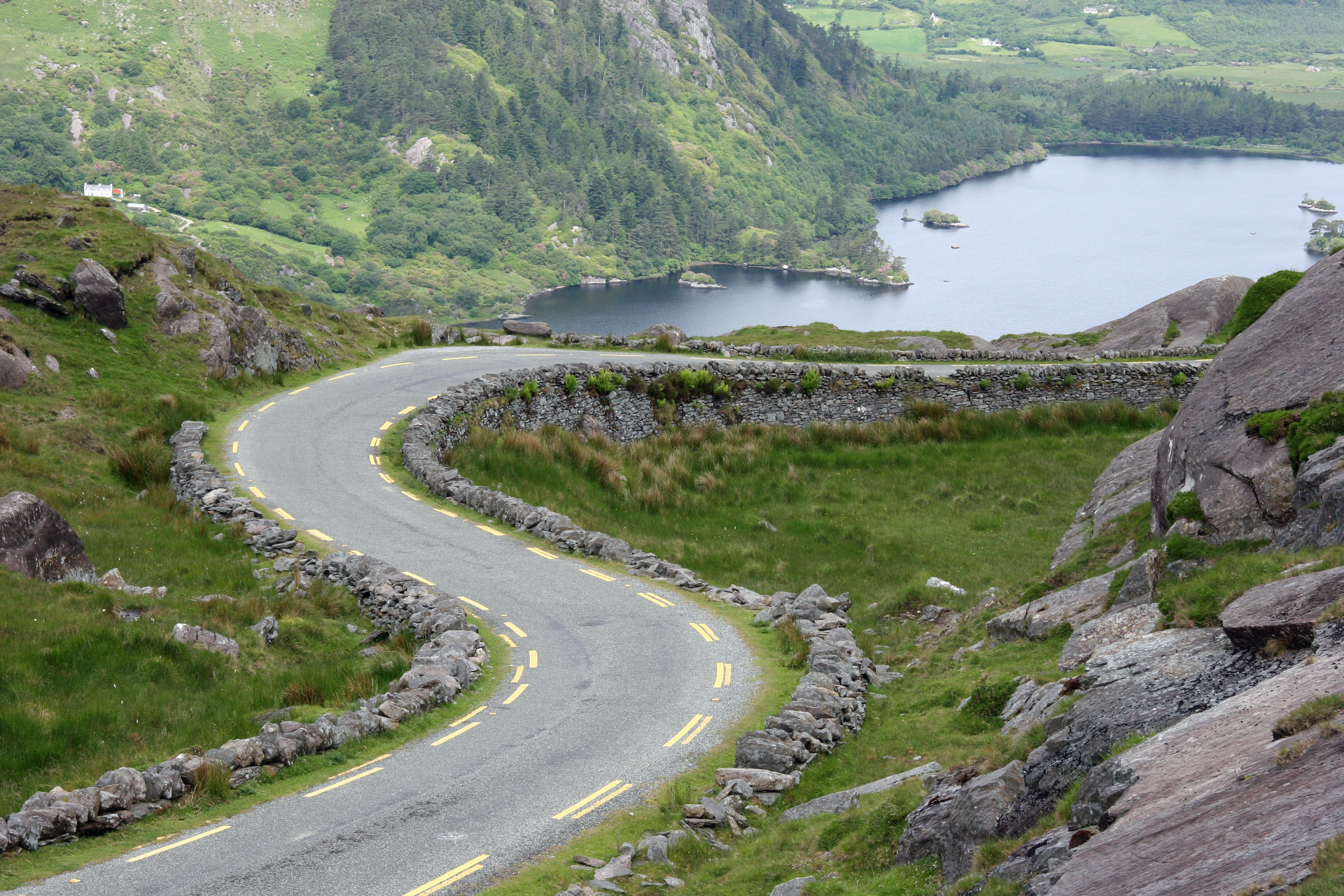
About 30 miles around, the peninsula is just the right size for a daylong driving or cycling tour. Hopping on a bike, I assess the gathering storm clouds and zip up my parka. In Ireland, good and bad weather blow by in a steady meteorological parade. A little rain will just add to the experience. Circling these roads is like a trip through an open-air museum. The landscape is littered with a half-million sheep and dozens of monuments left behind by Bronze Age settlers, Dark Age monks, English landlords, and even Hollywood directors.

In the darkest depths of the Dark Ages, when literate life almost died in Europe, peace-loving, scholarly monks fled the chaos of the Continent and its barbarian raids. Sailing to this drizzly fringe of the known world, they lived out their monastic lives in lonely stone igloos or “beehive huts” that I pass on my ride.

Rounding Slea Head, the point in Europe closest to America, the rugged coastline offers smashing views of deadly black-rock cliffs. The crashing surf races in like white stallions.

I ponder the highest fields, untouched since the planting of 1845, when the potatoes rotted in the ground. The vertical ridges of those bleak potato beds are still visible — a barren and godforsaken place. That year’s Great Potato Famine eventually, through starvation or emigration, cut Ireland’s population by a quarter.

I stop to explore the Gallarus Oratory, a stone chapel dating from AD 700 that’s one of Ireland’s best-preserved early Christian monuments. Its shape is reminiscent of an upturned boat. Finding shelter inside as a furious wind hurls rain against its walls, I imagine 13 centuries of travelers and pilgrims standing where I am, also thankful for these watertight dry-stone walls.

When the squall blows over, I continue up the rugged one-lane road from the oratory to the crest of the hill, then coast back into Dingle town — hungry, thirsty, and ready for a pub crawl.

Of the peninsula’s 10,000 residents, 1,500 live in Dingle town. Its few streets, lined with ramshackle but gaily painted shops and pubs, run up from a rain-stung harbor. During the day, teenagers — already working on ruddy beer-glow cheeks — roll kegs up the streets and into the pubs in preparation for another tin-whistle music night. “Pub” is short for “public house.” A convivial mix of good craic (that’s the art of conversation, pronounced “crack”) and local beer on tap complements the music. People are there to have a good time and visitors from far away are considered a plus.

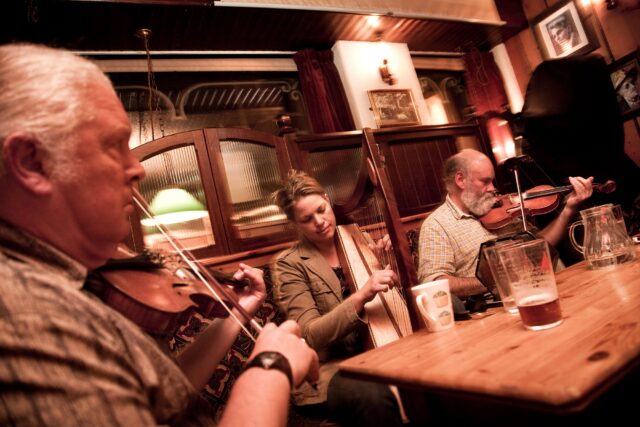
In Dingle, there’s live music most nights in half a dozen pubs. There’s never a cover charge. Just buy a beer and make yourself at home. The Small Bridge Bar and O’Flaherty’s are the most famous for their atmosphere and devotion to traditional Irish music. But tonight — and most nights — I make a point to wander the town and follow my ears. Traditional music is alive and popular in Ireland. A “session” is when musical friends (and strangers who become friends) gather and jam. There’s generally a fiddle, flute or tin whistle, guitar, bodhrán (goat-skin drum), and maybe an accordion.

I follow the music into a pub and order a pint. The music churns intensely, the group joyfully raising each other up one at a time with solos. Sipping from their mugs, they skillfully maintain a faint but steady buzz. The drummer dodges the fiddler’s playful bow. The floor on the musicians’ platform is stomped paint-free and barmaids scurry through the commotion, gathering towers of empty, cream-crusted glasses. With knees up and heads down, the music goes round and round. Making myself right at home, I “play the boot” (tap my foot) under the table in time with the music. When the chemistry is right, live music in a pub is one of the great Irish experiences.

The Irish like to say that in a pub, you’re a guest on your first night; after that, you’re a regular. That’s certainly true in Dingle…the next parish over from Boston.

(This story is excerpted from my upcoming book, For the Love of Europe — collecting 100 of my favorite memories from a lifetime of European travel, coming out in July. It’s available for pre-order.)

My Favorite Writers? Other Travelers


Who are my favorite writers? Other travelers. Just regular people who become great writers by traveling well and sharing their feelings and discoveries thoughtfully.

I’m home for a week before continuing my 2019 travels, and I’ve been catching up on my mail. I’ve been inspired by many of the emails I’ve read, such as this one from Don, who shared how — even when he found himself in a tourist trap — he was able to dig deep and connect with the locals. Thanks for the trip report, Don. Keep on travelin’.

Hiya Rick, wherever you are. I am ten days and many pints in on a 30-day tour of Ireland, with no car (never learned to drive) and nothing but your guidebook to lead me. So far it’s been great following your advice…Dublin, Kilkenny, Cashel, Kinsale, (all surprisingly easy to connect without a car). But now I find myself spending a night in Killarney–for which your book offers the sorry traveler who lands there no tips and only pity. Believe me, it was out of necessity. And as I looked for a pub this evening I thought, “Oh, I see what Rick means”. Even though Kinsale was totally overrun with Yanks, it was nothing like this. If Disneyland had an Ireland, it would be modelled on Killarney. Okay…what to do? I’ve been to John Cleere’s Pub in Kilkenny and I’m headed for Dingel next, so I don’t need live music. I veer off to the side streets in search of somwhere real and decided to trade music for sports. First pub I find that fits the bill is called Dan Linehan’s. Sure enough, here’s where the locals are. You know you’re in the right place when there are betting slips on the bar, next to the beer mats. Kids next to me say hi and before you know it one tells the tender, “Another for us, please. And whatever the American is drinking”. After they leave I wander some more and across the road from the chippie they recommended (great chips), I sniff out another place–The Luane. It’s not packed with Americans…in fact there’s not even one. I order a pint and actually get mistaken for a local. This guy was surprised when I said, “Me? A local? I just got here this morning.”. So, my point is…even in Killarney, it’s possible for guys like us to have a good time. Just gotta find the back door.

God bless,
Don

A Visit to St. George’s Market, Belfast

It was a rainy day on the Emerald Isle, and I was somewhere I had never been before: St. George’s Market. Join me and my guide Jackie there now in this little clip.

Here’s how I wrote this place up for our Rick Steves Ireland guidebook:

St. George’s Market was the largest covered Victorian produce market in Ireland. Today, the farmers are gone and everyone else, it seems, has moved in. Three days a week (Friday, Saturday, and Sunday, about 9:00-15:00), St. George’s Market becomes a thriving artisan, crafts and flea market with a few fish and produce stalls to round things out. With a diverse array of street food and homemade goodies added to the mix, it’s a fun place for lunch (5 blocks east of City Hall, at the corner of Oxford and East Bridge streets, tel. 028/9043-5704).

A Memorial Garden in Belfast

I have always believed that no trip to the Emerald Isle is complete without a visit to Northern Ireland. And I recently spent a few days there, after a stop in Dublin, researching the next edition of our Rick Steves Ireland guidebook.

In Belfast, I spent a fascinating 90 minutes with Tucker, a guide from Cab Tours Belfast — a taxi tour company that is made up of both Catholic and Protestant driver guides who are committed to giving unbiased, dual-narrative tours. On Bombay Street, we stopped at the Clonard Martyrs Memorial Garden. Join us there now.