Hitler systematically silenced the free press, intellectuals, and universities. He called complicated modern art “degenerate,” and he banned all books that questioned his agenda — as well as the writings of psychologists, left-wing thinkers, and Jewish authors.
This clip is excerpted from my new one-hour special “Rick Steves’ The Story of Fascism in Europe.” Check your local listings for air times — and if you don’t see it, please ask your public television station to add it to their schedule.
Just being out and about on the road, you stumble onto scenes that give insight into different worlds. On my latest swing through Central Europe — Berlin, Prague, Vienna — I enjoyed being a “cultural lint brush.” Here are some slice-of-local-life insights I picked up.
Berlin’s late-night convenience stores — like bodegas in New York City — are nicknamed “Spatis” (meaning roughly “late-ies”). And when there’s a big soccer game on TV, they’ll set up a TV on the sidewalk, put out some milk crates for customers to sit on, and host a party. For the cost of a grocery-store beer, the neighborhood gathers and enjoys sharing the event together. My Berlin friends — who say “this would never be allowed in Munich” — love these examples of Berlin community.
In the last couple of years, a new fake tradition has been born in Prague: stands selling chimney cakes, or trdelník. You’ll see these stands on virtually every corner, with saucy medieval maidens hard at work baking rotisserie pastries…all conspiring to be seen as a local custom. But chimney cakes have nothing to do with Czech culture or traditions (they’re originally from two countries away, in Hungary). They’re just another clever way to make money off tourists.
In Prague, ATMs not attached to real banks offer famously bad rates. Every local knows to avoid these rip-off ATMs.
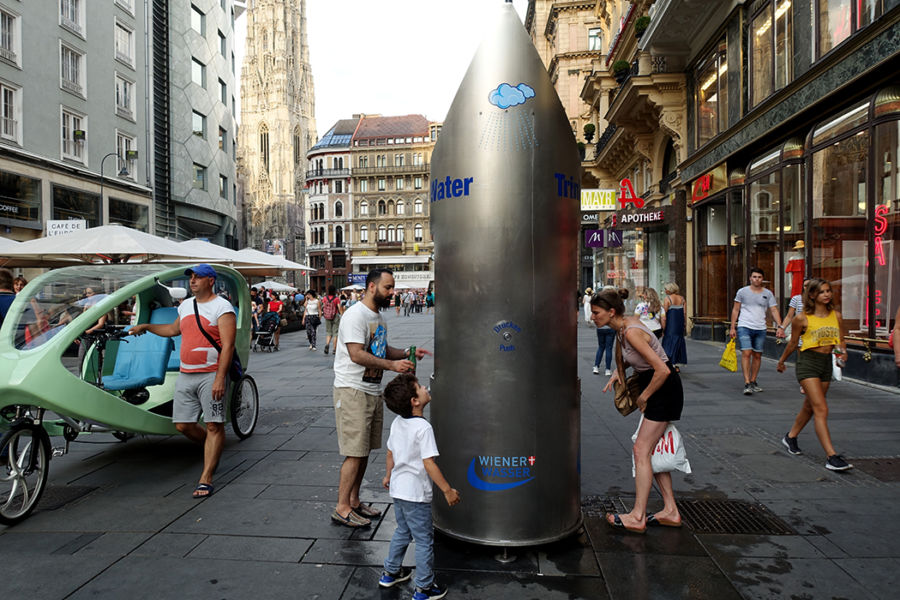
In Vienna, the city government — knowing both locals and tourists are dealing with hotter days than ever, thanks to climate change — have put out big cold-water stations with reminders to stay hydrated.
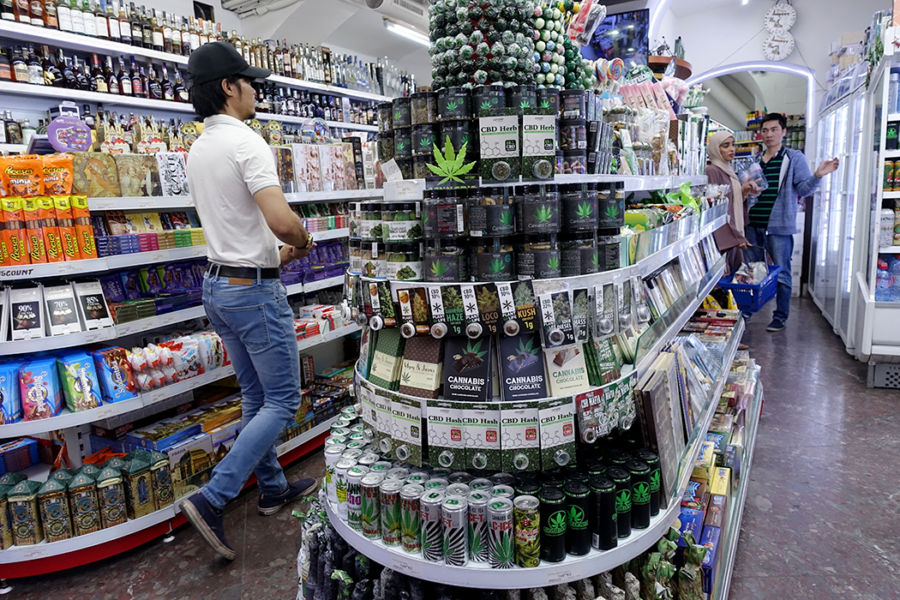
You see a lot of marijuana leaves and green packaging throughout Europe these days, and you might think, “Wow, I didn’t know pot was legal here.” But this is CBD cannabis — legal only if it contains less than one percent THC. CBD makes you calm and is considered a medicine. THC pot — the stuff that makes you giggle — is not yet legal here. Don’t worry (that’s OK)…be happy (not yet).
—
Join our traveling community — connect with me on Facebook and Twitter.
I’ve long wanted to better understand Berlin’s Kreuzberg neighborhood — traditionally the home of many Turkish immigrants, and today gentrifying fast. Just like many Mexicans are guest laborers in the USA (doing the scut work that middle-class Americans and their kids don’t want to do), Turks have long served that “Gastarbeiter” role in the much wealthier Germany. As usual, the guest workers get the worst neighborhoods. And, in the case of the Turks here in postwar Berlin, it was “up against the Wall”…the Berlin Wall. Then, suddenly, in 1989, the Wall’s gone and Kreuzberg is free to blossom. I enjoyed a delightful afternoon with Hashim Anik, a Turkish German guide who grew up right here and has seen a lot of positive change. Join us for a little walk. I’d love to hear about any Kreuzberg experiences you’ve enjoyed.
—
Join our traveling community — connect with me on Facebook and Twitter.
Walking down the streets of a great city like Berlin, you don’t really know what lies behind the fancy facades. Often, the front of a building hides courtyard after courtyard of a graffiti-laced world where people live in simple apartments that date back to the 19th century, built to house the workers needed to power Berlin’s Industrial Age boom. Until recently, these apartment flats were “squats,” where people with little money camped out after the fall of communism. Today they are slowly gentrifying. Their very existence invigorates my favorite Berlin neighborhood, Prenzlauer Berg, with a trendy nonconformity and creative energy.
—
Join our traveling community — connect with me on Facebook and Twitter.
I was just all alone in a secret KGB prison outside of Berlin with ghosts of people once held there. If someone is held in a KGB prison, it’s probably because they are a good person, not a bad person. Alone in that prison, I couldn’t help but think of two presidents, Putin and Trump, talking privately for two hours about their power and how to wield it.
In the 1980s, a young Vladimir Putin was a rising star in the KGB, working right there in Germany when this prison was full of unjustly incarcerated people. Now, he’s Mr. Make Russia Great Again. He’s leading his country — with a cunning ruthlessness that impresses both his people and our president — back to a position of global strength after its fall with the implosion of the USSR.
Pondering photos of people broken here, solitary confinement cells, and what it takes to rule a people who are not really free, I wondered what motivates our president to admire autocrats across the globe. Fighting for democracy and civil liberties is messy and frustrating I’m sure. Perhaps brutal measures by autocrats who have unbridled power are more rewarding. People don’t get in your way. You see results strong and fast.
Putin helped run and organize a system of prisons like this back then and he runs his country with a similar heartlessness today. The cost is real lives. Broken lives. This prison is silent today, but its ghosts spoke to me. Its inmates were silenced by isolation. They could do nothing.
But we are not isolated. We can make a difference. Silence on our part, as our president cozies up to autocracy, is a choice.
If ever you’re in Berlin, and you need a little such inspiration, here’s my entry for this sight from my Berlin guidebook:
KGB Prison Memorial at Leistikowstrasse, Potsdam
Standing in stark contrast to all of Potsdam’s pretty palaces and Hohenzollern bombast, this crumbling concrete prison has been turned into a memorial and documentation center to the Cold War victims of USSR “counterintelligence” (free, Tue-Sun 14:00-18:00, closed Mon).
On the nondescript Leistikowstrasse, a few steps from the lakeside park, the KGB established a base in August 1945 (mere days after the Potsdam Conference), which remained active until the fall of the USSR in 1991. The centerpiece of their “secret city” was this transit prison in which enemies of the Soviet regime were held and punished in horrible conditions before entering the USSR “justice” system — to be tried, executed, or shipped off to the notorious gulag labor camps. While most prisoners were Russian citizens, until 1955 the prison also held Germans who were essentially kidnapped by the USSR in retribution for their wartime activities.
From the blocky modern reception building, you’ll enter the complex. In the yard find the model illustrating how this was just the inner core of a walled secret city which until 1991 was technically Soviet territory and run by the KGB. Then head inside the prison, where the hallways and cells are an eerie world of peeling paint, faded linoleum, and rusted hinges. The two floors host a well-presented exhibit in English, explaining the history of the building and profiling many of the individuals who were held here.