Daily Dose of Europe: Ghosts in Berlin

In Berlin, it’s clear that history is not contained in a book — it envelops the entire city. Today’s Berlin is vibrant with youthful energy, and it’s changing fast. But for anyone fascinated by 20th-century tumult, the city is hog heaven.

Even though we’re not visiting Europe right now, I believe a daily dose of travel dreaming can be good medicine. I recently published a collection of my favorite stories from a lifetime of European travels. My new book is called “For the Love of Europe” — and this is just one of its 100 travel tales.

I have a powerful image stuck in my mind of Hitler and his architect and right-hand man, Albert Speer, poring over plans for postwar Berlin…a metropolis super-sized in a way that makes Paris look quaint. Of course, by 1945, Berlin was in ruins, Hitler’s charred corpse could be identified only by his dental records, and Speer was in jail writing his memoirs, “Inside the Third Reich” (which provided me with my most vivid impressions of the Nazi era).

Over my last few visits to the city, I can see the irony that in some ways, Speer’s vision of a dynamic new Berlin dominating Europe could be coming true. For example, the massive Hauptbahnhof — the only train station in Europe with major lines merging at right angles — has a scale and grandeur that Hitler might have appreciated. Toss in 80 stores and local subway lines, and it’s a city in itself.

But freedom, not Hitler, won. And the other strong feeling I get in Berlin is that it’s a victory celebration for capitalism and its defeat of communism. Like ancient Romans keeping a few vanquished barbarians in cages for locals to spit at, capitalism and the West flaunt victory in Berlin. Slices of the Berlin Wall hang like scalps at the gate to the Sony Center, the audacious office park at Potsdamer Platz.

A sleek Radisson hotel now stands on the place where the old leading hotel of East Berlin once stood. I remember staying there during the Cold War, when a West German five-Mark coin changed on the black market would get me and my friends drinks all night. Now five euros barely buys me a beer, and the lobby of the Radisson hosts an exotic fish tank the size of a grain silo with an elevator right in the middle, zipping scenically up eight floors. Next door, the DDR Museum is filled mostly with East German tourists rummaging through the nostalgia on display from their parents’ dreary lives under communism.

Across the street, statues of Marx and Lenin (nicknamed “the Pensioners” by locals) look wistfully at the huge TV tower East Berlin built under communism. It had a fancy bar on top, but the best thing East Berliners could say about it back then was, “It’s so tall that if it falls, we’ll have an elevator to freedom.”

The victory party rages on at Checkpoint Charlie. With every visit, I remember my spooky first time there in 1971, when tour buses returning to the West were emptied at the border so mirrors could be rolled under the bus to see if anyone was trying to escape with us.

Now, a generation later, Checkpoint Charlie is a capitalist sideshow. Lowlife characters sell fake bits of the wall, WWII-vintage gas masks, and DDR medals. Two actors dressed as American soldiers stand between big American flags and among sandbags at the rebuilt checkpoint, making their living posing for tourists. Across the street at “Snack Point Charlie,” someone sipping a Coke says to me, “When serious becomes kitsch, you know it’s over.”

Standing at the historic Brandenburg Gate, I face Berlin’s fashionable new heart: Pariser Platz. Within about 100 yards of this square — once a vacant lot along the Berlin Wall, and now a festive gathering place that seems designed to celebrate freedom — is a poignant collection of sights.

There are many memorials, including one to the six million murdered Jews of Europe and another to the first victims of Hitler: 96 men, the German equivalent of congressmen, who spoke out in the name of democracy against his rule in the early 1930s. They were sent to concentration camps where they were eventually killed. Nearby is the American Embassy, famous for taking security concerns to new heights. Across from a very busy Starbucks is one of the “ghost” subway stations that went unused through the Cold War and now feels like a 1930s time warp. Above that is the hotel balcony where Michael Jackson famously dangled his baby (according to local guides, it’s the sight of greatest interest for most American tourists). And the glass dome capping the bombed-out Reichstag is where, on the rooftop on May Day 1945, Russian troops quelled a furious Nazi last stand. The nearby hills were created entirely with the rubble of a city bombed nearly flat about 70 years ago. Considering all this, the clash of history and today’s vibrant city is almost overwhelming.

Tucked away nearby is the Kennedys Museum, filled with JFK lore, including the handwritten note with the phonetics for his famous Berlin speech. Reading it, I can hear his voice: “eesh been ein Bear-lee-ner” (“I am a Berliner”).

The amazing story of Berlin swirls through my head: Speer’s vision, Hitler’s burning body, the last stand on the rooftop…the communists, the heroic American airlift, when the Communists attempted to starve a free Berlin into submission…Kennedy’s speech, followed 24 years later by Reagan’s demand to “tear down this wall”…the euphoria-turned-challenge of Germany’s reunification, and the gleaming city visitors marvel at today.

I wave down a cab and hop in. I use the opportunity to get a local’s perspective and ask the driver if he is a Berliner. When he turns to me, I realize he’s Turkish, which makes me feel a little foolish. Then, making me feel foolish for feeling foolish, he says, “I’ve lived here 31 years. If Kennedy, after one day, could say ‘Ich bin ein Berliner,’ then I guess I can say I am a Berliner, too.”

This story appears in my newest book, For the Love of Europe — collecting 100 of my favorite memories from a lifetime of European travel. Please support local businesses in your community by picking up a copy from your favorite bookstore, or you can purchase it at my online Travel Store. You can also find clips related to this story at Rick Steves Classroom Europe; just search for Berlin.
Daily Dose of Europe: Berlin’s Reichstag — Teary-Eyed Germans and a Big Glass Dome

Years ago, when I got my history degree, I said to myself, “I’d better get a business degree, too, so I have something useful.” But I’ve learned over the years that if more people knew more about history, our world would be a better place.

Even if we’ve had to postpone trips to Europe, I believe a daily dose of travel dreaming can actually be good medicine. Here’s another one of my favorite travel memories — a reminder of what’s waiting for you in Europe at the other end of this crisis.

History is constantly speaking to us. Travelers enjoy a privileged way to hear it — and sometimes an up-close chance to witness history in the making.

Whenever I see the restored Reichstag building in Berlin, I’m reminded of my visit in 1999, when it reopened to the public. For tourists unaware of history, it was just a new dome to climb, offering another vantage point on the city. But a knowledge of its past gives it far deeper meaning. It was in this building that the German Republic was proclaimed in 1918. In 1933, this symbol of democracy nearly burned down. While the Nazis blamed a communist plot, some believe that Hitler himself planned the fire. Whatever the case, he used the fire as a convenient excuse to frame the communists and grab total power.

After 1945, this historic home of the German parliament — which saw some of the last fighting of World War II on its rooftop — stood as an abandoned and bombed-out hulk overlooking the no-man’s-land between East and West Berlin. After reunification, Germany’s government returned from Bonn to Berlin. And, in good European fashion, the Germans didn’t bulldoze their parliament building. They respected the building’s cultural roots and renovated it.

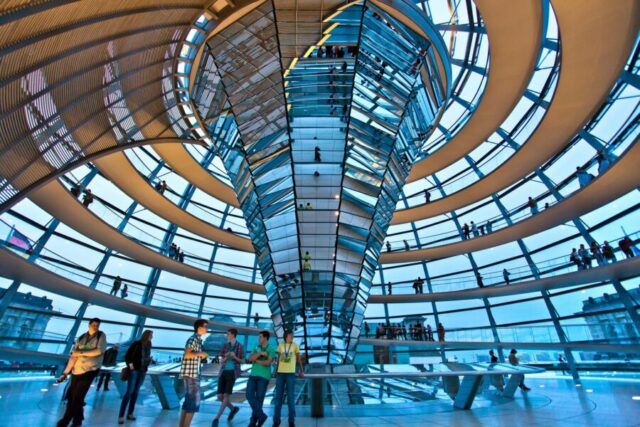
They capped it with a glorious glass dome, incorporating modern architectural design into a late-19th-century icon, and opened it up to the people. The dome rises 50 yards above the ground. Inside, a cone of 360 mirrors reflects natural light into the legislative chamber below. Lit from inside at night, it gives Berlin a kind of lantern celebrating good governance.

The Reichstag dome is a powerful architectural symbol. German citizens climb its long spiral ramp to the very top and look down, literally over the shoulders of their legislators, to see what’s on their desks. Jerked around too much by their politicians in the past century, Germans are determined to keep a closer eye on them from now on. And this dome is designed to let them do exactly that.

When the Reichstag first reopened, I climbed to the top of the dome and found myself surrounded by teary-eyed Germans. Anytime you’re surrounded by teary-eyed Germans, something exceptional is going on. It occurred to me that most of these people were old enough to remember the difficult times after World War II, when their city lay in rubble. What an exciting moment for them: the opening of this grand building was the symbolic closing of a difficult chapter in the history of a great nation. No more division. No more communism. No more fascism. They had a united government entering a new century with a new capitol building, looking into a promising future.

It was a thrill to be there. I was caught up in it. As I looked around at the other tourists, it occurred to me that most of them didn’t have a clue about what was going on. They were so preoccupied with trivialities — camera batteries, their Cokes, the air-conditioning — that they missed a once-in-a-lifetime opportunity to celebrate this great moment with the German people. I thought, “I’m living in a dumbed-down society.” And it saddened me. I don’t want to live in a dumbed-down society.

Powerful forces find it convenient when we’re dumbed down. As a society, we become easier to manipulate…easier to make money from. I vowed right there, in my work as a travel writer, that I would expect my readers to be engaged…and made smarter by their travels.

In mainstream tourism, we’re often encouraged to be lighthearted and avoid the serious. Sure, fun in the sun, duty-free shopping, and bingo can be a big part of your vacation. I enjoy it, too. But all this can distract us from a more important reason to travel. Travel can broaden our perspective, enabling us to rise above the advertiser-driven info­tainment we call the news to see things as citizens of the world. By plugging directly into the present and getting the world’s take on things firsthand, a traveler goes beyond traditional sightseeing. (And shortly after that inspirational Berlin visit, I wrote an entirely new kind of book that develops that notion, called Travel as a Political Act.)

When we travel, we have the opportunity to see history as it’s unfolding. With knowledge of the past, we can better appreciate the significance of what’s happening today. That’s something a lot of travelers don’t take advantage of…and it’s never been more important.

(This story is excerpted from my upcoming book, For the Love of Europe — collecting 100 of my favorite memories from a lifetime of European travel. It’s coming out in July, and available for pre-order. And you can also watch a video clip related to this story: Just visit  Rick Steves Classroom Europe  and search for Reichstag.)

The Story of Fascism: Lessons and Legacy

The story of fascism in 20th-century Europe teaches us that strong and charismatic leaders can capitalize on fear to lead a society astray. Democracy is fragile. It requires a vigilant and engaged populace. And if you take freedom for granted, you can lose it.

This clip is excerpted from my new one-hour special “Rick Steves’ The Story of Fascism in Europe.” Check your local listings for air times — and if you don’t see it, please ask your public television station to add it to their schedule.


The Story of Fascism: “Never Again”

Memorials across Europe remind us of the unthinkable horrors of 20th-century fascism — and compel us to never let it happen again.

https://www.facebook.com/ricksteves/videos/474532753061336/


This clip is excerpted from my new one-hour special “Rick Steves’ The Story of Fascism in Europe.” Check your local listings for air times — and if you don’t see it, please ask your public television station to add it to their schedule.

The Story of Fascism: The Allies Defeat Fascist Germany

Defeating Hitler and Mussolini took total war — a massive and heroic effort led by Britain, the USA, and the Soviet Union.

https://www.facebook.com/ricksteves/videos/671799606527554/


This clip is excerpted from my new one-hour special “Rick Steves’ The Story of Fascism in Europe.” Check your local listings for air times — and if you don’t see it, please ask your public television station to add it to their schedule.