 For the past few nights in the Loire Valley, I’ve been reminded that an evening meal here can be much more than a meal. When you spend $60 for dinner here (instead of just “filling the tank” for $20) don’t count on getting any extra nutrition. You’re buying a three-hour joy ride for the senses — as rich as visiting an art gallery and as stimulating as a good massage.
In Amboise, after a full day of researching the next edition of our France book, Steve Smith and I go to Restaurant L’Epicerie. Steve orders a basic menu and I go top end. As usual, we share. I bring along my little black notebook in an attempt to capture how — when you choose a good restaurant, relax about the prices, and let yourself really tune into the experience — splurging on dinner is a travel thrill in itself. And that can make it a great value.
Getting a full dozen escargot rather than the typical six snails doubles the joy. Eating six you’re aware that supply is very limited. Eating twelve, it seems for the first eight like there’s no end to your snail fun. The taste is so striking that I find myself requesting silence at the table. It’s just my mouth and the garlic-drenched snails, all alone on the dance floor of my palette. Add good Chinon wine and you’ve got a full orchestra accompaniment. Like a slow motion love scene, I pry another snail gently out of its shell and pop it into my mouth. The swirly spiral on the empty shells visually syncs with each swish of wine.
Like a mermaid’s tail in a tide pool, my crust of bread laps up the homemade garlic-and-herb sauce. I ask Aurore, our waitress, how it can be so good. With a sassy chuckle and smile she says, “Other restaurateurs come here to figure that out, too.” Then she adds, “It’s done with love.” While I’ve heard that line many times, here it seems believable.
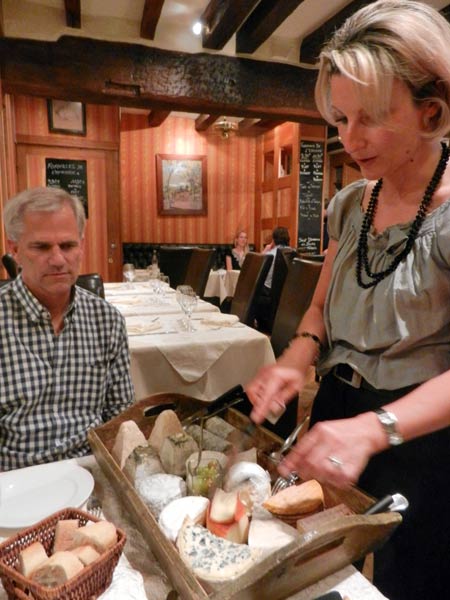
The restaurant itself adds to the experience. Under rough timber beams hang frameless portraits of long forgotten city fathers. Opposite hangs an aging painting of a traditional boat full sail blowing up the Loire. Glasses fill the room like crystal flowers. Gazing at the quiet lane outside my window, with the floodlit Amboise château sparkling high above, I think French kings and Leonardo strolled along this very spot.
Then my main course arrives: tender beef with beans wrapped in bacon. Slicing through a pack of beans in their quiver of bacon, I let the fat do its dirty deed. A sip of wine, after a bite of beef, seems like an incoming tide washing the flavor farther ashore.
My crust of bread, a veteran from the escargot course, is called into action for a swipe of sauce. Italians brag about all the ingredients they use. But France is proudly the land of sauces. Thanks to the bread, I enjoy one last encore of the meat and vegetables I’d just savored.
If it’s not this afternoon’s bread, it’s not a good restaurant. I hold up my petite wicker basket and, with a quick and crusty chop, chop, chop, it comes back in moments filled. If the sauce is the medicine, the bread is the syringe. I take some more.
Lighting in a restaurant is a mystery to me. When it works, the food, the glasses, your dining partner all twinkle. The red in the beef, the diamonds in the wine, the smile in the tomato, everything seems more appetizing. And then, Aurore asks in French, “What would give you pleasure?”
Shifting my chair to stretch out my legs, I prepare for the next course. Aurore brings on her cheese platter. It’s a festival of mold on a rustic board with its vibrant yet mellow colors promising a vibrant array of tastes. She explains the line-up with patience and care as I film her presentation with my iPhone. With the cheese there’s a special extra: raisins soaked in Armagnac brandy. Her sweet French voice makes me want to respond, “Oui!” The lovingly sliced collection of cheeses arriving on my plate makes me want to sing (out of consideration for Steve, I don’t).
As cheese needs wine, I check my wine bottle like I would my gas tank before driving home. Noticing the restaurant crowd thinning, I remind myself there is no rush. I appreciate hearing the quiet murmurs of other diners, as eating among others enjoying their experience as much as I am enjoying mine is part of the sensual experience. It makes me wish restaurants back home were also hushed.
As I lean back to stifle a burp, Steve says, “And here comes dessert.”
Mine is a tender crêpe papoose of baked cinnamon apple with butterscotch ice cream garnished with a tender slice of kiwi. That doesn’t keep me from reaching over for a snip of Steves’ lemon tart with raspberry sauce and shaved almonds.
The meal ends with an offer of coffee, but I decline, preferring to remain in my dazed state.
The bill arrives: €34 for my four courses, €22 for Steve’s simpler menu, and €30 for the wine. The entire meal costs us €86, or about $60 each. You could call it $20 for nourishment and $40 for three hours of bliss. I can’t imagine a richer Loire experience, one that brought together an unforgettable ensemble of local ingredients, culture, pride and people.
Aurore bids us good night with the same twinkle of joy that accompanied each course. Stepping out into that lane, looking up to the floodlit château, I know it won’t be the last time.