Cornwall Highlights

I’ve been traveling for nearly a week in southwest England and have not seen an American. There are plenty of tourists — Europeans and Brits — but not a Yank in sight. This is Cornwall, where the last native speaker of the Cornish language probably died in the late 1700s. But there still is local pride. The welcome sign on the motorway at the county border is in that old Celtic language people used to speak around here, as well as English. And, locals claim, had the Scots said yes to their recent referendum for independence, there would have been rumbling for greater autonomy here in this proud corner of Britain. Here are six photos that, for me, capture highlights of Cornwall.

Mousehole port

The cute little fishing port of Mousehole is actually named for the tiny, mouse hole-like entry into its tough little harbor. The village was crushed by Spanish cannon balls in 1595 and rebuilt in the 17th century. There’s an 8-meter tide here and the boats lie beached in the harbor at each low tide.

Victorian Rock Pool

The arrival of the train made this distant part of England accessible to Victorian holiday-goers in the 19th century. I love noting the little niceties built for the Victorian aristocrats — like this rock pool. Each day the tide strands a world of fun little creatures for visitors to discover.

Minack Theater

The dramatically situated Minack Theater is the labor of love of Rowena Cade (1893-1983), who dedicated her life to carving out this amazing place. Every night during theater season about 700 people enjoy live drama with a vast sea-view backdrop.

Lunch with Tim neqr Minack Theatre

I enjoyed the expert guiding of Tim Uff during a busy day of touring the Penwith Peninsula. For lunch, Tim grabbed us a Cornish pasty and bottles of local elderflower presse to enjoy as we watched birds and dolphins from our Minack Theatre perch. Seeing gannets dive for lunch, Tim explained that they hit the water at about 60 mph. When baby gannets try this too soon, they’re often found washed up on shore with broken necks.
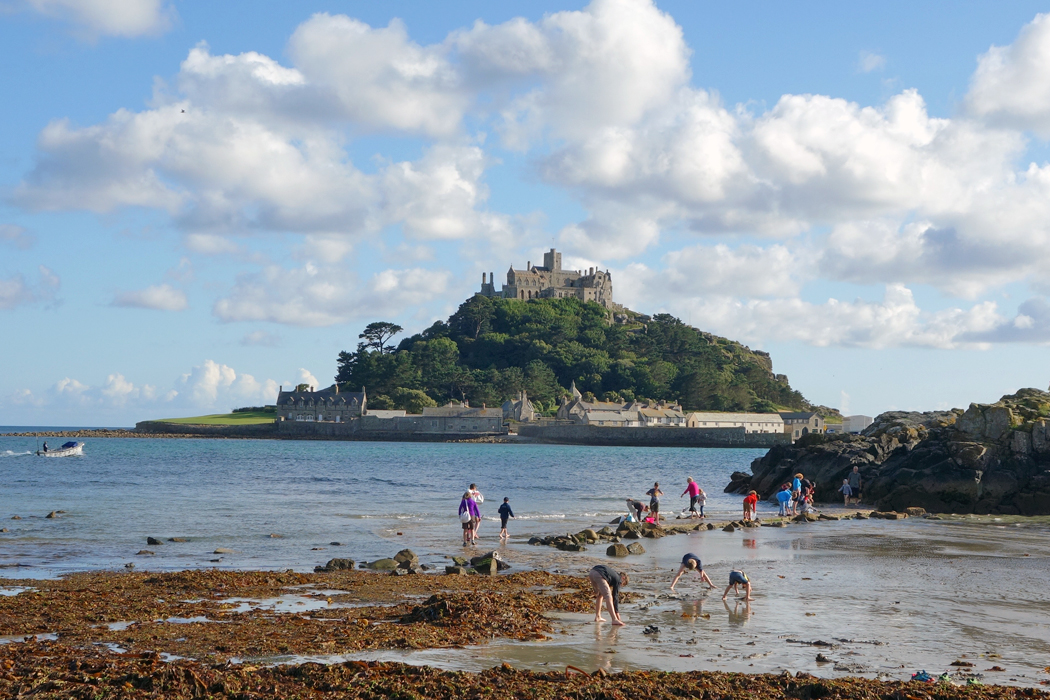
St. Michael's Mount

Mont St-Michel in France has a little brother — directly across the English Channel. It’s St. Michael’s Mount here in Cornwall. Inhabited for about 1,500 years and originally a Benedictine monastery, today it’s a fun excursion for Cornwall tourists.

Land's End tourists

One of the most touristy places in all of Britain is at its far southwest tip, cleverly called Land’s End. Every tour bus stops here so people can pay £10 to line up to have their photo taken at the famous milepost. Tacky as this place is, there’s something exciting about being at the “land’s end” of anything. (Tomorrow, I’ll get you away from the crowds.)

I Have a Romantic Thing About Pilchards

Pilchards are big, oily sardines. Their oil once lit the lamps of Victorian London. And, packs of salted pilchards kept the people of Cornwall alive through harsh winters in an age when putting food on the table to simply survive was a challenge. Here’s a peek at a secret harbor my guide, Tim Uff, shared with me. Don’t tell anyone, but it’s Penberth Cove (just a mile from the famous theater in the rock, Minack Theatre). It’s a rugged bit of Cornwall (sorry about the wind noise in this clip). From here you can imagine a hilltop watchman spotting a school of pilchards (“where the water turned purple”) and blowing his trumpet. All the fishermen would jump into their boats and charge out to encircle the fish with their nets. A good catch would have fisherwomen trudging from village to village with bushels of salted pilchards for sale on their backs, and the people of Cornwall would be kept in protein through the winter.

Cornwall’s Ancient Hedgerows

An icon of Cornwall — rightly nicknamed “The Garden of England” — is its fearsome hedgerows. For a thousand years, the hardy Cornish people have been picking the rocks off their rugged fields and stacking them along their lanes. Consisting of a stone framework filled in with earth and made vibrant with a tangle of vegetation, hedgerows also function as wildlife corridors. And, if you rip them out (as developers might be inclined to do), you get erosion. These hedgerows are part of the ancient fabric of Cornwall, where man and Mother Nature are dance partners (and man understands who is best qualified to lead).

I’m thankful I have a good local guide. Tim Uff expertly motored me through the wonders of the Penwith Peninsula here on the “land’s end” of southwest England. An expert guide with a car costs about £200 ($300, www.tourcornwall.com). For a group of four, that’s a great value. For a hardworking guidebook writer, having the help of a guide like Tim is a godsend!

Tropical England

While updating my Rick Steves England guidebook, I’ve endured some pretty dreary weather. So dropping into the Eden Project in Cornwall was a delightful chance to enjoy the tropics in England, and to explore the biggest rain forest in captivity. Here’s the description from the guidebook:

Set in an abandoned china clay pit, the Eden Project is an ambitious and futuristic work-in-progress – a theme park of global gardening with an environmental conscience. Exotic plants from all over the world are showcased in two giant biomes, reputedly the largest greenhouses in the world. The displays focus on sustainable farming and eco-conscious planting. If you’re looking for a quaint English cottage garden, this isn’t it. Rather than a flowery look at England’s past, this “global garden” gives you a sense of how the shrinking world will affect us in the future (www.edenproject.com). I haven’t experienced anything quite like this in my travels. Have you?

Details Paint a Bigger Picture of a Little Cotswold Church

Buried in the Cotswold region of west England is the pristine village of Stanton, with what appears to be just another little medieval church. But, by knowing what to look at, you’ll see deeper. Follow me on an exercise that includes psychoanalyzing the patron saint (St. Michael, a giveaway that the church was built upon a pagan holy ground) to feeling the grooves worn into pews by sheepdog leashes centuries ago.