Daily Dose of Europe: The Queen’s English

Oscar Wilde famously said that the English “have really everything in common with America nowadays — except, of course, language.” It’s still true. A trip to Britain comes with plenty of linguistic surprises.

Even though we’re not visiting Europe right now, I believe a daily dose of travel dreaming can be good medicine. I recently published a collection of my favorite stories from a lifetime of European travels. My new book is called “For the Love of Europe” — and this is just one of its 100 travel tales.

I’ll never forget checking into a small-town B&B as a teenager on my first solo European adventure. The landlady cheerily asked me, “And what time would you like to be knocked up in the morning?”

I looked over at her husband, who winked, “Would a fry at half-eight be suitable?” The next morning I got a rap on the door at 8 a.m. and a huge British breakfast a half-hour later.

Britain can be an adventure in accents and idioms…

Every day you’ll see babies in prams and pushchairs, sucking dummies as mothers change wet nappies. Soon the kids can trade in their nappies for smalls and spend a penny on their own. “Spend a penny” is British for a visit to the loo (bathroom). Older British kids enjoy candy floss (cotton candy), naughts and crosses (tic-tac-toe), big dippers (roller coasters), and iced lollies (popsicles). Kids are constantly in need of an Elastoplast or sticking plaster (Band-Aid), which their parents buy at the chemist’s (pharmacy).

In a stationery store, you can get sticky tape or Sellotape (adhesive tape), rubbers (erasers), and scribbling blocks (scratch pads). At garden shops, those with green fingers (a green thumb) might pick up some courgette (zucchini), swede (rutabaga), or aubergine (eggplant) seeds. If you need a torch (flashlight), visit the ironmonger’s (hardware store).

In Britain, fries are chips and potato chips are crisps. A beefburger, made with mince (hamburger meat), comes on a toasted bap (bun). For pudding (dessert), have some sponge (cake).

The British have a great way with names. You’ll find towns with names like Upper and Lower Slaughter, Once Brewed, and Itching Field. This cute coziness comes through in their language as well. You’ll visit “brilliant” (wonderful) sights that’ll give you “goose pimples” (goose bumps). Your car will have a bonnet and a boot rather than a hood and trunk. You’ll drive on motorways, and when the freeway divides, it becomes a dual carriageway. Never go anticlockwise (counterclockwise) in a roundabout. Gas is petrol, a truck is a lorry, and when you hit a tailback (traffic jam), don’t get your knickers in a twist (make a fuss) — just be patient and queue up (line up).

The British never say they have a two-week vacation, but many locals holiday for a fortnight, often in a homely (homey) rural cottage or possibly on the Continent (continental Europe). They might pack a face flannel (washcloth) and hair grips (bobby pins) in their bum bag (never a “fanny” pack — which refers to the most private part of a woman’s anatomy). If it’s rainy, they wear a mackintosh (raincoat) or an anorak (parka) with press studs (snaps).

If you get settled into a flat (apartment), you can post letters in the pillar box or give your mum a trunk (long-distance) call. If that’s too dear (expensive), she’ll say you’re tight as a fish’s bum. If she witters on (gabs and gabs), tell her you’re knackered (exhausted) and it’s been donkey’s years (ages) since you’ve slept. After washing up (doing the dishes) and hoovering (vacuuming), you can have a plate of biscuits (cookies) and, if you’re so inclined, a neat (straight) whisky. Too much of that whisky will get you sloshed, paralytic, bevvied, wellied, ratted, popped up, or even pissed as a newt.

Then there is the question of accents. In the olden days, a British person’s accent indicated his or her social standing. As Eliza Doolittle discovered in “My Fair Lady,” elocution could make or break you. Wealthier families would send their kids to fancy private schools to learn elocution. But these days, in a sort of reverse snobbery that has gripped the nation, accents are back. Politicians, newscasters, and movie stars have been favoring deep accents over the Queen’s English. It’s hard for American ears to pick out all of the variations and some accents are so thick they sound like a foreign language, but most Brits can determine what region a person is from based on his or her accent.

All across the British Isles, you’ll encounter new words, crazy humor, and colorful accents. Pubs are colloquial treasure chests. Church services, sporting events, and local comedy shows are linguistic classrooms. The streets of Liverpool, the docks of London, and children’s parks throughout the UK are playgrounds for the American ear. One of the beauties of touring Great Britain is the illusion of hearing a foreign language and actually understanding it…most of the time.

This story appears in my newest book, “For the Love of Europe” — collecting 100 of my favorite memories from a lifetime of European travel. Please support local businesses in your community by picking up a copy from your favorite bookstore, or you can purchase it at my online Travel Store. You can also find a clip related to this story at Rick Steves Classroom Europe; just search for England.

Daily Dose of Europe: Bayeux Tapestry

This skinny, 70-yard-long strip of cloth depicts a crucial historical event that helped shape the Europe we know.

As America continues to suffer crisis upon crisis, it has never been more important to broaden our perspectives and learn about the people and places that shape our world. And for me, one of the great joys of travel is seeing art masterpieces in person. Learning the stories behind great art can shed new light on our lives today. Here’s one of my favorites.

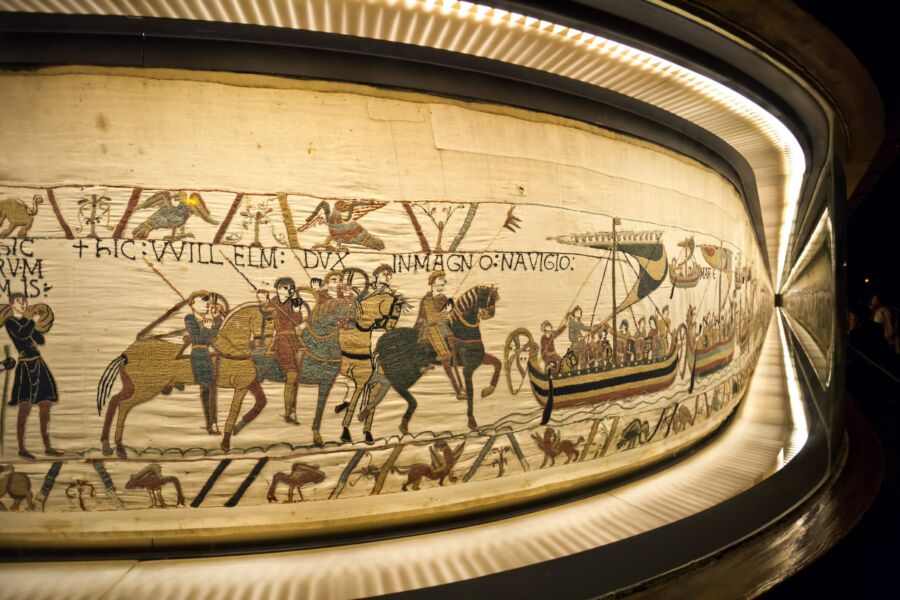
Like a graphic novel, the Bayeux Tapestry tells the mesmerizing story of how William the Conqueror and Harold of England competed for the English crown. The tale culminates in one of the most pivotal battles in history: The Battle of Hastings in 1066.

The story begins in London. In the opening scene — the first of about 60 in the tapestry — the reigning King of England, Edward, is presiding on the throne in his palace. He orders his brother-in-law Duke Harold to ride off to France. At that time, Normandy (northern France) was under English rule. Harold was to announce to all the subjects that Edward had decided who his successor as king would be — a seemingly illegitimate duke called “William the Bastard,” known today as “William the Conqueror.”

The tapestry is realistic enough that even an illiterate peasant could understand what’s happening. The Latin titles reinforce the main characters and key events. Down-to-earth details keep you “reading.” The narrative is framed by a border (top and bottom) with more eye candy — some related to the story, some mere decoration.

The climax of the whole tapestry is the Battle of Hastings, which pitted the invading Normans of France, led by William, against the Anglo-Saxons of England, led by Harold. It was a fierce, 14-hour battle. Knights on horseback charge, swordsmen clash, and archers launch arrows, leaving the battlefield strewn with mangled corpses. According to historical accounts, Harold fell from his horse. He lifts his visor to shout to his men, when suddenly — shoop! — Harold gets hit with an arrow, right in the eye. Finally, an enemy horseman bends down to finish Harold off with a sword. The title above says it all: “Here King Harold is slain.”

The Battle was won by William. The Normans now ruled England. This illegitimate child, until then known as “William the Bastard,” could now call himself “William the Conqueror.” Unfortunately, that’s where the Bayeux tapestry ends, because the final scene is missing, lost to history.

But we know the rest of the story. William marched to London, claimed his throne, and (though he spoke no English) became king of England. This set in motion 400 years of conflict between England and France — not to be resolved until the 15th century. However, on the plus side, the Norman conquest of England brought that country into the European mainstream. Because of the events depicted on the Bayeux tapestry, England got a stable government, contact with the rest of Europe, and a chance to eventually grow into a great European power.

And today, historians and tourists alike can stand in the presence of this precious document, stroll slowly along, and see those momentous events from nearly a thousand years ago unfold before their eyes.

This art moment — a sampling of how we share our love of art in our tours — is an excerpt from the new, full-color coffee-table book, “Europe’s Top 100 Masterpieces,” by Rick Steves and Gene Openshaw. Please support local businesses in your community by picking up a copy from your favorite bookstore, or you can find it at my online Travel Store. To enhance your art experience, you can find clips related to this artwork at Rick Steves Classroom Europe; just search for Bayeux.

Daily Dose of Europe: York — Vikings, Bygone Days, and England’s Top Church

Historians run around the English city of York like kids in a candy shop. And with a knowledgeable guide bringing things to life, even non-historians find themselves exploring the past with a childlike wonder.

Even though we’re not visiting Europe right now, I believe a daily dose of travel dreaming can be good medicine. I just published a collection of my favorite stories from a lifetime of European travels. My new book is called “For the Love of Europe” — and this story is just one of its 100 travel tales.

I’m in York, following Edwin, a wry and spry retired schoolteacher, into an overgrown turret in the city’s ancient wall. Edwin stays active leading town walks and giving private tours. Today, he’s taking me to his favorite places.

Fingering a red brick, Edwin explains that just as a scout counts the rings in a tree, we can count the ages of York by the layers of bricks in the city wall: Roman on the bottom, then Danish and Norman, and finally topped off with the “new” addition — from the 14th century.

Strolling into the half-timbered town center, we stop at the medieval butchers’ street called The Shambles. As if sharing a secret, Edwin nudges me under an eave and points out the rusty old hooks and says, “Six hundred years ago, bloody hunks of meat hung here, dripping and then draining into the gutter that still marks the middle of the lane. This slaughterhouse of commercial activity gave our language a new word. This was the original ‘shambles.’”

I find English guides likeably chatty and opinionated. As Edwin and I explore York, I learn several ghost stories, what architectural “monstrosity” the “insensitive” city planners are about to inflict on the townsfolk, a bit of the local politics, and the latest gossip.

York is the most interesting town between London and Edinburgh. Edwin is ready with an explanation: In the Victorian Age, most big cities embraced the Industrial Revolution, tearing down their walls and inviting the train tracks to run right through their center. But the people of York kept their walls and required the train station to be built just outside the center. While less efficient at the time, this left the city a historic treasure cradled entirely within the surviving walls. Those York Victorians not only saved their wall, but they amped up its historic charm with a remodel, giving it fanciful crenellations and arrow slits.

Edwin and I head over to the York Castle Museum, where English memorabilia from the 18th, 19th, and early 20th centuries is cleverly displayed in a huge collection of craft shops, old stores, and bygone living rooms. Charles Dickens would feel right at home here. As towns were being modernized in the 1930s, the museum’s founder, Dr. Kirk, recognized a threat to their heritage and collected entire shops and reassembled them here. In Kirkgate, the museum’s most popular section, we wander down a century-old Lincolnshire street, popping in to see the butcher, baker, coppersmith, and barber.

The shops are actually stocked with the merchandise of the day. In the confectionery, we eavesdrop on English grannies giggling and reminiscing their way through the mouthwatering world of “spice pigs,” “togo bullets,” “hum bugs,” and “conversation lozenges.” The general store is loaded with groceries, the toy shop has old-time games, and the sports shop has everything you’d need for a game of 19th-century archery, cricket, or skittles. Anyone for ping-pong? Those Victorians loved their “whiff-whaff.”

In the period rooms, three centuries of Yorkshire living rooms and clothing fashions paint a cozy picture of life centered around the hearth. A peat fire warms a huge brass kettle while the aroma of freshly baked bread fills a room under heavy, open-beamed ceilings. After walking through the evolution of romantic valentines and unromantic billy clubs, we trace the development of early home lighting from simple waxy sticks to the age of electricity. An early electric heater has a small plaque that explains, “How to light an electric fire: Switch it on!”

Dr. Kirk’s “memorable collection of bygones” is the closest thing in Britain to a time-tunnel experience, except perhaps for our next destination, the Jorvik Viking Centre just down the street.

A thousand years ago, York was a thriving Viking settlement called Jorvik (YOR-vik). While only traces are left of most Viking settlements, Jorvik is an archaeologist’s bonanza, the best-preserved Viking city ever excavated. Sail Disney’s “Pirates of the Caribbean” north a thousand miles and back a thousand years, and you get Jorvik. More a ride than a museum, this exhibit drapes the abundant harvest of this dig in theme park cleverness. We ride a kid-pleasing people-mover for 12 minutes through the re-created Viking street of Coppergate. It’s the year 975 and we’re in the village of Jorvik. Everything — sights, sounds, even smells — has been carefully re-created. Next, our time-traveling train rolls through the actual excavation site, past the remains that inspired the reconstructed village. Stubs of buildings, piles of charred wood, and broken pottery are the time-crushed remains of a once-bustling town. Everything is true to the original dig. Even the face of one of the mannequins was computer-modeled from a skull dug up right here.

Our next stop is the thunderous National Railway Museum, which showcases 200 illustrious years of British railroad history. Fanning out from a grand roundhouse is an array of historic cars and engines, including Queen Victoria’s lavish royal car and the very first “stage-coaches on rails.” Exhibits on dining cars, post cars, Pullman cars, and vintage train posters creatively humanize the dawn of an exciting new age.

Edwin and I walk over the river toward the towering York Minster, stopping first at the romantic ruins of St. Mary’s Abbey. A fragile arcade of pointed Gothic arches seems to hang from the branches of the trees that tower above. I remark to Edwin that it’s striking how magnificently the Minster survives while only a single wall of this abbey church still stands. Edwin explains that Henry VIII, so threatened by the power of the pope, destroyed nearly everything that was Catholic — except the great York Minster. Thankfully, Henry needed a northern capital for his Anglican Church. Edwin then explains the Dissolution of the Monasteries. “Henry wanted more than a divorce. He wanted to be free from the power of the abbots and the monasteries and the pope in Rome. It was our first Brexit — and we got it in 1534.”

Then, playfully describing three bombastic leaders at the same time, he says, “It was spearheaded by a much-married, arrogant, overweight egomaniac.” Edwin is playing with me, alluding to my president, but he is also describing the pompous, pro-Brexit prime minister, Boris Johnson, along with Henry VIII. While 500 years apart, they both wanted to “be free” from Europe (from the pope and from the EU), which also meant sending no more money to Europe (in tithes to the Roman Catholic Church back then or taxes to Brussels today). And they both wanted no more intrusions from Europe into their realm. In the 16th century under Henry and in the 21st century under Boris, for Britain, “leaving means leaving.”

With that, we step into York’s Minster, the pride of the city. It’s one of the most magnificent churches in Britain and the largest Gothic church north of the Alps. Splashed with stained glass and graced with soaring ceilings, this dazzling church brilliantly shows that the High Middle Ages may have been dank, but they were far from dark.

The Minster is famous for its 15th-century stained glass, especially its Great East Window, which is the size of a tennis court. The window’s fine details — far too tiny to see from the floor — were originally in-tended “for God’s eyes only.”

But Edwin has opera glasses. He pulls them from his satchel so I can study the window as he guides me: A sweeping story is told in more than 300 panels of painted and stained glass, climaxing with the Apocalypse. It’s a medieval disaster movie — a blockbuster back in 1408 — showing the end of world in fire and flood and pestilence…vivid scenes from the Book of Revelations. Angels trumpet disaster against blood-red skies. And there it is, the fifth panel up on the far left side…the devil giving power to the “Beast of the Apocalypse,” a seven-headed, ten-crowned lion, just as it was written in the Bible. This must have terrified worshippers. This British masterpiece was unprecedented in its epic scale, created a hundred years before Michelangelo frescoed the story of the beginning and end of time at the Sistine Chapel in Rome. One of the great art treasures of the Middle Ages, it’s the work of one man: John Thornton of Coventry (who, I think, deserves a little of Michelangelo’s fame).

The church also holds a full carillon of 35 bells, so church-bell enthusiasts can enjoy a little ding-dong ecstasy during the weekly bell concerts. Edwin has another guiding appointment. But before leaving, he introduces me to a deacon, who delights in showing off this pride of the Minster. He leads me upstairs a few flights and into the bell tower to show off the biggest bell. We come to a stony room — vacant except for a fat, lifeless rope dangling from the ceiling. With childlike enthusiasm, the suddenly animated deacon begins pulling the rope. He reaches and reaches, pulling ever higher and ever lower, and I ready my ears for a thunderous sound. Suddenly the deacon clenches the rope and becomes airborne, soaring high above me as ear-shattering clanging rings throughout the town. Eventually landing back on the medieval wooden floor, he winks at me and says, “In York, our bell is so big it rings the ringer.”

He invites me to attend the evensong service, reminding me that it’s a good way to fully experience the York Minster. Later that evening I return, arriving early to get a prime seat. It’s a spiritual Oz, with 40 boys singing psalms: a red-and-white-robed pillow of praise, raised up by the powerful pipe organ.

As the boys sing and the organ plays, I ponder the towering Gothic arches — stone stacked by locals 700 years ago, still soaring like hands folded in prayer. I whisper, “Thank God for York. Amen.”

This story appears in my newest book, For the Love of Europe — collecting 100 of my favorite memories from a lifetime of European travel. Please support local businesses in your community by picking up a copy from your favorite bookstore, or you can purchase it at my online Travel Store. You can also find a clip related to this story at Rick Steves Classroom Europe; just search for York.
Daily Dose of Europe: Westminster Abbey — The National Soul of England

It’s beautiful to think of how much history Westminster Abbey has seen — both good times and bad. And through it all, Britain’s top church offers solace to its people.

Even if we’ve had to postpone trips to Europe, I believe a daily dose of travel dreaming can actually be good medicine. Here’s another one of my favorite travel memories — a reminder of what’s waiting for you in Europe at the other end of this crisis.

Wearing a red robe and a warm smile, Eddie works as a verger at London’s Westminster Abbey. As a church official, he keeps order in this space — which is both very touristy and very sacred.

I tell him I’m working on a Rick Steves guidebook, and he says, “I’d like a word with that Rick Steves. He implies in his guidebook that you can pop in to worship or pay respects to the Unknown Soldier in order to get a free visit to the abbey.”

Showing him my photo on the back cover, I say, “Well, I am Rick Steves.”

I’m really charmed by Eddie, who explains that it’s his responsibility to sort out believers (who get in free to pray), tourists (who must pay the entrance fee), and scammers who fold their hands reverently, hoping to avoid paying. Together, we agree on a new tactic: Rather than promote deception for the sake of free entry, I’ll encourage my readers to attend a free worship service. The musical evensong service is a glorious experience that occurs several times a week. Everyone is welcome, free of charge.

Proving it helps to have friends in holy places, Eddie takes me into a room where no tourist goes: the Jerusalem Chamber, where scholars met from 1604 to 1611 to oversee the translation of the Bible from ancient Greek and Hebrew into English, creating the King James Version.

Appreciating the danger of translating the word of God from dead ancient languages into the people’s language and the importance of these heroic efforts in the 16th and 17th centuries, I get goose bumps. When visiting Germany’s Wartburg Castle, I felt goose bumps when stepping into the room where Martin Luther translated the Bible for the German-speaking world. And I enjoyed a little goose-bump déjà vu here when Eddie let me slip into the Jerusalem Chamber.

Eddie then escorts me to the abbey and I quickly become immersed in the history that permeates it. This is where every English coronation since 1066 has taken place. At a coronation, the Archbishop of Canterbury stands at the high altar. The coronation chair is placed before the altar on the round, brown pavement stone, which represents the Earth. After a church service, the new king or queen sits in the chair, is anointed with holy oil, and then receives a ceremonial sword, ring, and cup. The royal scepter is placed in the new ruler’s hands, and — dut-dutta-dah — the archbishop lowers the crown onto the royal head.

As I walk, I listen to the audio tour narrated by actor Jeremy Irons. With his soothing voice in my ear, I enjoy some private time with remarkable artifacts. The marble effigy of Queen Elizabeth I was made from her death mask in 1603 and is considered her most realistic likeness. The graves of literary greats of England are gathered, as if for a post­humous storytelling session, around the tomb of Geoffrey Chaucer (Mr. Canterbury Tales). Poppies line the tomb of Britain’s Unknown Soldier, with the US Medal of Honor (presented by General John J. Pershing in 1921) hanging from a neighboring column. More recently, the statue of Martin Luther King, Jr. has been added as an honorary member of this heavenly English host.

My favorite stained-glass window features saints in robes and halos mingling with pilots in parachutes and bomber jackets. It’s in the Royal Air Force Chapel, a tribute to WWII flyers who “earned their angel wings” in the 1940 Battle of Britain. Hitler’s air force seemed to rule the skies in the early days of the war, bombing at will and threatening to snuff Britain out. While determined Londoners hunkered down, British pilots in their Spitfires and Hurricanes took advantage of newly invented radar systems to get the jump on the more powerful Luftwaffe. These were the fighters about whom Churchill said, “Never…was so much owed by so many to so few.” The book of remembrances lists the names of each of the 1,497 pilots and crew members who died.

Grabbing a pew to ponder this grand space, I look down the long and narrow center aisle of the church. It’s lined with Gothic arches, providing a parade of praying hands and glowing with colored light from the windows. It’s clear that this is more than a museum. With saints in stained glass overhead, heroes in carved stone all around, and the bodies of England’s greatest citizens under the floor, Westminster Abbey is more than the religious heart of England — it’s the national soul as well.

(This story is excerpted from my upcoming book, For the Love of Europe — collecting 100 of my favorite memories from a lifetime of European travel. It’s coming out in July, and available for pre-order. And you can also watch a video clip related to this story: Just visit  Rick Steves Classroom Europe  and search for Westminster.)

Daily Dose of Europe: Mysterious Britain 

On my next trip to Britain, I’ll linger a bit longer at its many mysterious sights.

Even if we’ve had to postpone trips to Europe, I believe a daily dose of travel dreaming can actually be good medicine. Here’s another one of my favorite travel memories — a reminder of what’s waiting for you in Europe at the other end of this crisis.

On my first trip to Dartmoor National Park, back when I was a student, word of the wonders lurking just a bit deeper into the moors tempted me away from my hostel in Gidleigh. I was told of an especially rewarding hike that would lead me to the mysterious Scorhill Stone Circle. Climbing over a hill, surrounded by ominous towers of craggy granite, I was swallowed up by powerful, mystical moorland. Hills followed hills followed hills…green growing gray in the murk.

Where was that 4,000-year-old circle of stone? I wandered in a scrub-brush world of greenery, white rocks, eerie winds, and birds singing unseen. Then the stones appeared. It seemed they had waited for centuries, still and silent, for me to visit.

I sat on a fallen stone and my imagination ran wild, pondering the people who roamed England so long before written history documented their stories. I took out my journal, wanting to capture the moment… the moor, the distant town, the chill, this circle of stones. I dipped my pen into the cry of the birds and wrote.

That experience, 40 years ago, kicked off decades of my fascination with mysterious Britain. Dartmoor, Stonehenge, the Holy Grail, Avalon…there’s an endlessly intriguing side of Britain steeped in lies, legends, and at least a little truth. Haunted ghost walks and Loch Ness Monster stories are profitable tourist gimmicks, but the cultural soil that gave us Beowulf, King Arthur, and Macbeth is fertilized with a murky story that goes back over 5,000 years — older, even, than Egypt’s pyramids. With a little background, even skeptics can appreciate Britain’s historic aura.

There are countless stone circles, forgotten tombs, man-made hills, and figures carved into hillsides whose stories will never be fully understood. Britain is crisscrossed by lines, called ley lines, connecting these ancient sites. Prehistoric tribes may have transported these stones along a network of ley lines, which some think may have functioned together as a cosmic relay or circuit.

Two hours west of London, Glastonbury is located on England’s most powerful ley line. It gurgles with a thought-provoking mix of history and mystery. For the views, hike up the 500-foot-tall Glastonbury Tor (a grassy, conical clay hill capped with an old church tower), and you’ll notice the remains of the labyrinth that made climbing the hill a challenge some 5,000 years ago.

In AD 37, Joseph of Arimathea, Jesus’ wealthy tin-merchant uncle, supposedly brought a vessel containing the blood of Christ to Glastonbury, and with it, Christianity to England. (Joseph’s visit is plausible because back then, merchants from the Levant came here to trade with the local miners.)

While that story is supported by fourth-century writings and accepted by the Church, the King Arthur and Holy Grail legends it inspired are not. Those medieval tales were cooked up when England needed a morale-boosting folk hero to inspire its people during a war with France. They pointed to the ancient Celtic sanctuary at Glastonbury as proof of the greatness of the fifth-century warlord, Arthur. In 1911, his supposed remains, along with those of Queen Guinevere, were dug up here, and Glastonbury was woven into the Arthurian legends. The Camelot couple was reburied in the abbey choir and their gravesite is a kind of shrine today. Many believe the Grail trail ends at the bottom of the Chalice Well, a natural spring at the base of the tor.

In the 16th century, Henry VIII, on a rampage against the power of the monasteries, destroyed Glastonbury Abbey. For emphasis, he hung and quartered the abbot, sending his body on four national tours… at the same time. Two centuries later Glastonbury rebounded. In an 18th-century tourism campaign, thousands signed affidavits stating that water from the Chalice Well healed them, putting Glastonbury on the tourist map.

Today, Glastonbury is a center for searchers. It’s too out there for the mainstream church, but just right for those looking for a place to recharge their crystals. Since the society that built that labyrinth worshipped a mother goddess, the hill, or tor, is seen by many today as a symbol of the Sacred Feminine.

Along with its history, the geology contributes to the mystery of this land. Southern England’s shoreline is lined by famed white chalk cliffs. And that same white chalk is just below a thin layer of topsoil all across the region. Eons ago, all it took was a shovel and a little hard work to peel away the soil and transform rolling hillsides into works of art — or messages.

Travelers to this day are entertained by giant white figures popping out of these grassy green slopes. Many are creations of 18th- and 19th-century Romantics acting out against the coldness of the Industrial Age, but a few of these figures have, as far as history is concerned, always been there. One figure is particularly eye-catching: The Cerne Abbas Giant, armed with a big club and an erection, is hard to ignore. For centuries, people fighting infertility would sleep on Cerne Abbas. As my English friend explained, “Maidens can still be seen leaping over his willy.”

And fixed like posts into that same chalk subsoil are stone circles, more souvenirs of England’s misty, distant past. The most famous stone circle, Stonehenge, is an hour’s drive from Glastonbury. Built in phases between 3000 and 1000 BC with huge stones brought all the way from Wales, it still functions as a remarkably accurate celestial calendar.

A study of more than 300 similar circles in Britain found that each was designed to calculate the movement of the sun, moon, and stars, and even predict eclipses. These prehistoric timekeepers helped early societies know when to plant, when to harvest, and when to party. Even in modern times, when the summer solstice sun sets in just the right slot at Stonehenge, pagans boogie.

Curiously, some of the particular “blue stones” used in Stonehenge were found only in distant Wales. Why didn’t the prehistoric builders use what seem like perfectly adequate stones nearby? Consider those ley lines. Perhaps a particular kind of stone was essential for maximum energy transmission. How might these massive stones have been transported in a pre-industrial age? Various practical explanations have been suggested, but there’s no consensus among experts. Imagine instead congregations gathering here 5,000 years ago, raising thought levels and creating a powerful life force transmitted along the ley lines. Maybe the stones were levitated in Wales and rocketed a hundred miles to this spot. Maybe psychics really do create powerful vibes. Maybe not. It sounds unbelievable, but at one time, so did electricity.

Not far away, the stone circle at Avebury is 16 times the size of Stonehenge and about one-sixteenth as touristy. Visitors are free to wander among 100 stones, ditches, and mounds, and ponder these curious patterns from the past. Near Avebury is the 130-foot-high pyramid-shaped Silbury Hill. More than 4,000 years old, this man-made mound of chalk is a reminder that you’ve only scratched the surface of Britain’s fascinating prehistoric and religious landscape.

More Neolithic wonders lurk in England’s moors. While they inspire exploration, beware: you can get lost in these stark, time-passed commons. Directions are difficult to keep. It’s cold and gloomy, as nature rises like a slow tide against anything human-built. A crumpled castle loses itself in lush overgrowth. A church grows shorter as tall weeds eat at the stone crosses and tilted tombstones. Over the centuries, the moors have changed as little as the longhaired sheep that still seem to gnaw on moss in their sleep.

One of England’s wildest and most remote regions is in the southwest corner of the country. It’s Dartmoor — that wonderland of powerfully quiet rolling hills that inspired me long ago. Near the Cornwall Peninsula in the county of Devon, it’s crossed by only three main roads. Most of this area is either unused or shared by its 34,000 villagers as a common grazing land — a tradition that goes back to feudal days. Ordnance Survey maps show that Dartmoor is peppered with bits of England’s mysterious past, including more Bronze Age stone circles and enigmatic megaliths than any other chunk of England. It’s perfect for those who dream of enjoying their own private Stonehenge without barbed wire, police officers, parking lots, tourists, or port-a-loos.

Returning to Dartmoor on my last trip, I sat peaceful and alone on the same mossy stone I warmed the day I first experienced Scorhill Stone Circle in 1978. I recalled that day, at the age of 23, when I realized how many wonders in Europe were still undiscovered…hidden and unheralded. I remembered how, hiking home that evening, I decided that my calling was to find these places and to share them. That was the day I became a travel writer.

(This story is excerpted from my upcoming book, For the Love of Europe — collecting 100 of my favorite memories from a lifetime of European travel. It’s coming out in July, and available for pre-order. And you can also watch a video clip related to this story: Just visit  Rick Steves Classroom Europe  and search for “mysterious Britain”.)