Czech Tales of Communism

Prague is a beautiful, historic, and delightful-to-visit city. And if you, like me, are forever fascinated by slice-of-life stories from people who had to live through the Cold War in the Warsaw Pact, it’s even more engaging. Throughout Eastern Europe, guides like my friends who lead me around Prague know how to weave their personal memories of communism into their time with you.

One of my guides talked of the generation gap in the Czech Republic. When she traveled recently to the Grand Canyon National Park in the USA, her older friends asked her excitedly, “What did you bring home?” In the old days, people just fantasized about being able to leave the country to bring home a boom box or a Western camera. To travel just for the experience didn’t make any sense to them…and, in some cases, still doesn’t.

Another guide reminisced about 1989 and how, with the arrival of freedom and the fall of the Iron Curtain, Russian language teachers suddenly had to teach English. There were no textbooks, and Russian teachers took cram courses in English so they could teach their students sentences like “Deez eez my bruder” (“This is my brother”). The fun thing for schoolkids those first few years was that they knew more English from watching Rambo movies than their teachers did from taking the cram courses.

Another guide talked of how, in her youth, she could only dream of drinking a nice cold Coca-Cola. She said, “We couldn’t drink Coke, but we could collect the cans tourists threw away. I had five cans. My friend had ten.”

One of our most popular and impactful tours in our Best of Eastern Europe tour. And many of our Eastern Europe guides — like Honza and Katka, shown here — come from Prague and are beloved by our groups. Honza Vihan is the co-author of my Prague guidebook, and I’m thankful to collaborate with him. With Honza’s on-the-ground, local insights, I’m confident that our book is the best available on the Czech capital.

Prague Castle Orchestra

Any time I visit Prague, a highlight for me is to drop by the castle’s front door and see Josef and his Prague Castle Orchestra playing — and, hopefully, hear Smetana’s Die Moldau (as we have in this clip). If I were the mayor of Prague, I’d book them for the rest of their musical days to bring joy to city’s many visitors, as they do here, at the gateway to its most visited sight. Josef is one of those creative people who has clearly found his niche.

If you can’t see the video below, watch it on YouTube.

Prague: Jumbled with History

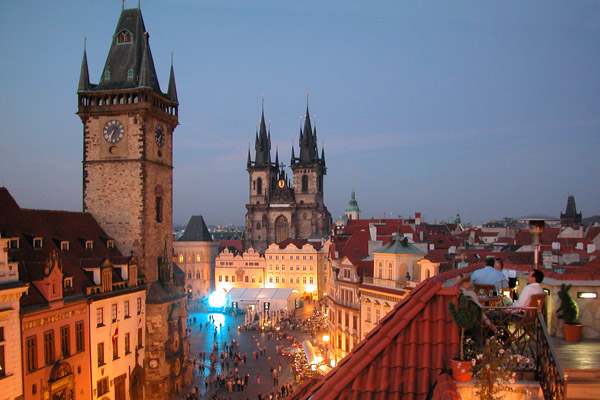
Prague is a traveler’s dream city: exotic but easy, affordable, boasting arguably Europe’s best beer, and an architectural time warp with plenty of great sightseeing. It’s crowded and touristy — precisely because it’s so much fun. Here are a few of my favorite memories from my latest trip.

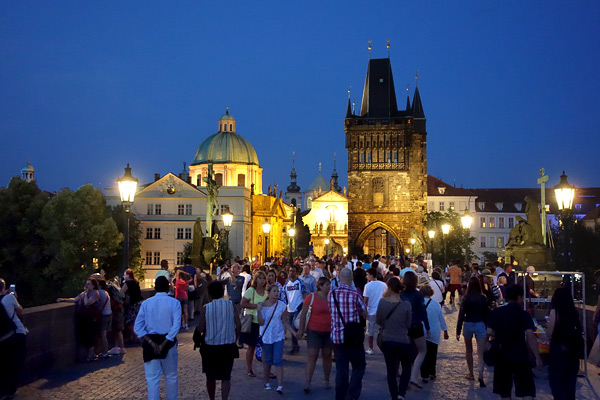
Charles Bridge is a 500-yard stroll over the Vltava River, connecting what many consider Europe’s largest castle with a thriving Old Town. Any time of day or night, the stroll comes with fun street music and great people-watching.
The great Czech painter Alfons Mucha’s magnum opus, the Slav Epic, is finally settled in Prague, where it should be. Its 20 massive canvases connect the Czech people with their Slavic soul. It's one of the most powerful artistic experiences in Europe — don’t miss it.
The great Czech painter Alfons Mucha’s magnum opus, the Slav Epic, is finally settled in Prague, where it should be. Its 20 massive canvases connect the Czech people with their Slavic soul. It’s one of the most powerful artistic experiences in Europe — don’t miss it.
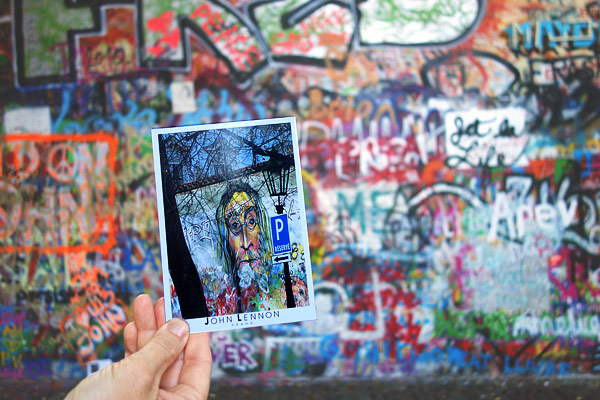
Prague’s Lennon Wall spontaneously appeared back in Cold War times, when the Czech people were birds locked in a cage and needed a place to vent. They'd paint murals of John Lennon each night, only to have them whitewashed over by the authorities the next day. Today the poignancy of the wall is long gone, but it’s still a colorful and nostalgic place to visit.
Prague’s Lennon Wall spontaneously appeared back in Cold War times, when the Czech people were birds locked in a cage and needed a place to vent. They’d paint murals of John Lennon each night, only to have them whitewashed over by the authorities the next day. Today the poignancy of the wall is long gone, but it’s still a colorful and nostalgic place to visit.
Prague is one city where, more than just about anywhere else, I recommend hiring a private guide — like Sarka, whom I’ve recommended in my Prague book since its first edition nearly a decade ago. For about $30 an hour, you get a guide and companion who is expert at making your wandering meaningful.
One of my favorite things lately is meeting families on the road whose parents are making the travel experience fun and enlightening for the kids. This mom is a super guide — she’s with her kids in what could be just another old church...but look at the enthusiasm in her little travelers’ faces. (I like to think the guidebook they’re toting helps, too.)
One of my favorite things lately is meeting families on the road whose parents are making the travel experience fun and enlightening for the kids. This mom is a super guide — she’s with her kids in what could be just another old church…but look at the enthusiasm in her little travelers’ faces. (I like to think the guidebook they’re toting helps, too.)

Prague Trumps Rothenburg

Enlarge photo

To commemorate the Smithsonian Presents Travels with Rick Steves magazine — now on sale online, and at newsstands nationwide — Rick is blogging about the 20 top destinations featured in that issue. One of those destinations is Prague, Czech Republic.

I’m currently on a Central European swing, updating my guidebooks: Budapest, Prague, Vienna, Munich. Being back in Prague reminds me of how that city first broke down the Iron Curtain in my guidebooks many years ago.

On a research trip back in the 1990s, I was on a train heading to Rothenburg to update the ultimate medieval town in Germany, as I did nearly every year. For a decade, I’d been diligently visiting to check the woodcarvings, walk the old wall, visit the toy museum and the medieval crime-and-punishment museum, and check in with old friends who run the hotels and restaurants that serve the town’s hordes of tourists. The work was almost mechanical. Socially, it was a happy homecoming. The ramparts and cute lanes were filled with my readers, who cheered me on. I loved going to Rothenburg.

This was just a couple of years after the end of the Cold War. The obvious new frontier of European tourism was the mysterious East. The former Warsaw Pact countries were now wide open and eager to welcome Western travelers. I knew that sooner or later, I’d tackle the region and expand my guidebook coverage there. But it was overwhelming, and, psychologically, it was easy to just keep redoing the Rothenburgs of Western Europe. I was daunted by the job — a bit lazy…dreading the unavoidable truth that if I was to cover Europe, I would now need to stretch east.

I was rattling down the tracks in the direction of Rothenburg, when I realized the very train I was on would end its run in Prague. I started comparing the value of spending the next three days in Rothenburg versus doing a groundbreaking research stint in Prague. I stayed on that train and didn’t get off until the Golden City of a Hundred Spires. I jumbled my itinerary a bit to accommodate the new job, and what followed was one of the most exciting and rewarding weeks of research I can remember. I left with Prague now in the realm of what we covered.

That first Prague chapter needed a home, and the only home we had for it was splicing it into our existing Germany, Austria & Switzerland guidebook. What was called “GAS” in my office would now be “GASP.” (Over the years, GASP became GAS, then GA…until finally there were separate guidebooks for each of the four destinations, including Prague.)

With the beautiful co-author partnership of Honza Vihan (our good friend and super guide from Prague), Prague joined the elite league of cities that merited their own Rick Steves guidebook (along with London, Paris, Venice, Florence, and Rome). Cameron Hewitt took this Czech nucleus and expanded into another five countries (which I termed the “Louisiana Purchase” of Europe) — Poland, Slovakia, Hungary, Croatia, and Slovenia — co-authoring my Eastern Europe guidebook, and then two others (on Croatia & Slovenia and Budapest). Today Eastern Europe is fully integrated into our Europe-wide program, with four different guidebooks and six different bus tour itineraries.

And it all started in that year when Rothenburg went unresearched and a seed was planted in Prague.

Cream and Dream in Prague

Enlarge photo

Just between you and me, 25 years as a tour guide got me burned out on gelato. I remember as a kid swooning over “Italian Ice Cream” in Germany. And then I oversaw two decades of “it’s to die for” gelato appreciation. Now, as I’m rustling through Europe for four months out of five, I rarely succumb to the temptation to eat ice cream. (It’s a key element to my extremely simple weight-loss program over here.) Yesterday, I was just finishing up my visit to Prague Castle, which brags it’s the biggest anywhere. If exhausting is a measure of big, I’ll buy that claim. You go through the castle like a pinball — it’s all downhill, and everyone funnels out the lower gate.

An incredibly charming schoolboy was hawking Prague’s favorite ice cream. It’s called “Cream and Dream,” which almost makes me blush. Anyway, he lured me in for a taste. Banana was his favorite, so I tried it. I purchased a cone. It almost lived up to its name.

Across the way, I had to update the Barbie Doll Museum. It’s one of those museums that sounds silly, yet is actually great — a vast collection of all things Barbie, dating back to 1959, with social commentary. Looking at the buxom first edition, you can understand why these sirens of capitalist discontent that objectified women’s bodies weren’t allowed here until 1989. (I can’t resist a Nicaragua tangent: Like or loathe their economics, one of the great things about the Sandinistas was that they outlawed using women’s bodies as advertising tools.) I had to tour the Barbie Museum fast because they didn’t let in ice cream. I parked my guide at the stairwell, licking hers and protecting mine.

Barbie in the can and ice cream gone, our next stop was just across the castle lane — the Lobkowicz Palace. I’ve been 10 days now in Hungary and the Czech Republic. They both have a passion for charging admission to dreary palaces stripped bare by the communists and today offering little more than new stucco on high vaulted ceilings as a rack upon which to hang boring stories of local nobles from centuries past.

Just an hour earlier, I had hated the Rosenberg Palace, which is now included in the Prague Castle combo-ticket to make up for the fact that the Golden Lane is closed. I have never understood the appeal of the Golden Lane (even though it’s one of the “Thousand Places to See Before You Die”), and hoped this would be a net plus. It wasn’t.

The Lobkowicz Palace is a new addition to our guidebook; it just opened a couple of years ago, and I’d yet to visit it. As it was late and I was running out of steam fast, I was going to wimp out and just check the details at the ticket booth, but a banner outside claimed it was “Prague’s Best Palace to Visit.” Those kinds of claims generally make me want to disprove them — as they are generally misleading come-ons. So I rallied and got a ticket. It included an audioguide narrated by the count of the palace himself, William Lobkowicz. Audioguides like this one — in which noble heirs of palaces actually walk you through their grand halls and introduce you to great-great-grandpapa in musty old family portraits — are often wonderfully quirky and intimate.

The Lobkowicz audioguide was fabulous. I’m into these lately, with the work we’re doing on our own audio tours, and this one was lovingly designed and produced…and Mr. Lobkowicz had a perfect voice for the project. (Being a count has been outlawed now in the Czech Republic, so I need to bring him down to earth — “Mister” rather than “Count.”)

I was happy to be turned on by the Lobkowicz Palace. I appreciate that they include the audioguide in the visit, and that it brings the place to life and lets you get to know the family — which lost all their possession to the Nazis, got them back for three years after World War II, and then lost them all again to the communists. Now they are embracing the challenge of sharing their noble heritage with their country, and it’s a great gift to locals and foreign visitors alike.

Turning in the audioguide and ready to leave, I gave the clerk my card and told her to thank the count. She asked me if I’d like to meet him. Turns out he, his wife Sandra (a Romanian American he met at Boston College while in exile during the Cold War), and their key curator knew my work and were thrilled to be in the book. Like nobility all over 21st-century Europe, they are working hard to make their vast palaces economically viable as cultural attractions, and need the publicity guidebooks provide.

William and Sandra took me through the palace for a more intimate peek at things. We talked about post-Nazi restitution challenges and triumphs, and the fact that many nobles get a bad rap since the French Revolution. (“We’re just real people who own lots of big palaces.”)

Sitting down to coffee with the best view possible of Prague from their noble loggia, we brainstormed ways to get the palace more recognition. Suddenly a cute schoolboy joined the conversation. It was William junior… done selling ice cream for the day.