Learn More About Cuba Before Your Trip

My trip to Cuba was a fascinating and memorable way to kick off 2016. And sharing it with you (and reading so many insightful comments) has been a joy. I hope you enjoyed traveling with me during the last 30 or so posts. If you missed any posts along the way, you can find them all right here on my blog.

Rick Steves and Cuban man with cigars

To put the many questions to rest: While I enjoyed the experience and highly recommend travel there, I have no plans to lead tours, write a guidebook, or film a TV show on the island.

If you live in the Seattle area and want to learn more, I will be giving my 90-minute Cuba talk on March 28 at Town Hall Seattle ($5); and on April 2 at the Edmonds Center for the Arts (free). A filmed version of this talk may also be available later online. Stay tuned.

It’s my hope that this Cuba series has inspired you to consider traveling there yourself. For a complete and practical listing of the B&Bs we slept in, the restaurants that we’d recommend, and our sources of information — as well as more posts about our Cuba trip — visit Trish Feaster’s blog, The Travelphile.

Thanks again for adventuring with me…and happy travels!

Wrapping Up Cuba

The American visiting Cuba gains an appreciation for the resilient joy and spirit of its people, and takes home memories of a time warp free of the strip-mall banality of the rich world. Venturing here offers a chance to befriend a poor and struggling island society that is, in its own way, an inspiration…and headed for breathtaking change. And as the wheels of my Aeroméxico plane left the Havana airport tarmac, I hoped to someday soon return to find a society that has kept the good in its heritage while gracefully and gently joining the family of nations in an aggressive global economy.

Fidel Castro

Fidel Castro, the human embodiment of Cuba’s Revolution, survives…but just barely. People I met didn’t know exactly where he was and figured he’s alive, but no longer coherent. Even so, it seems that Cuba’s Revolution survives because of the stature of Castro. We asked many times, “What happens here after Fidel and Raúl Castro are gone?” The answer: “Nobody knows what will happen.”

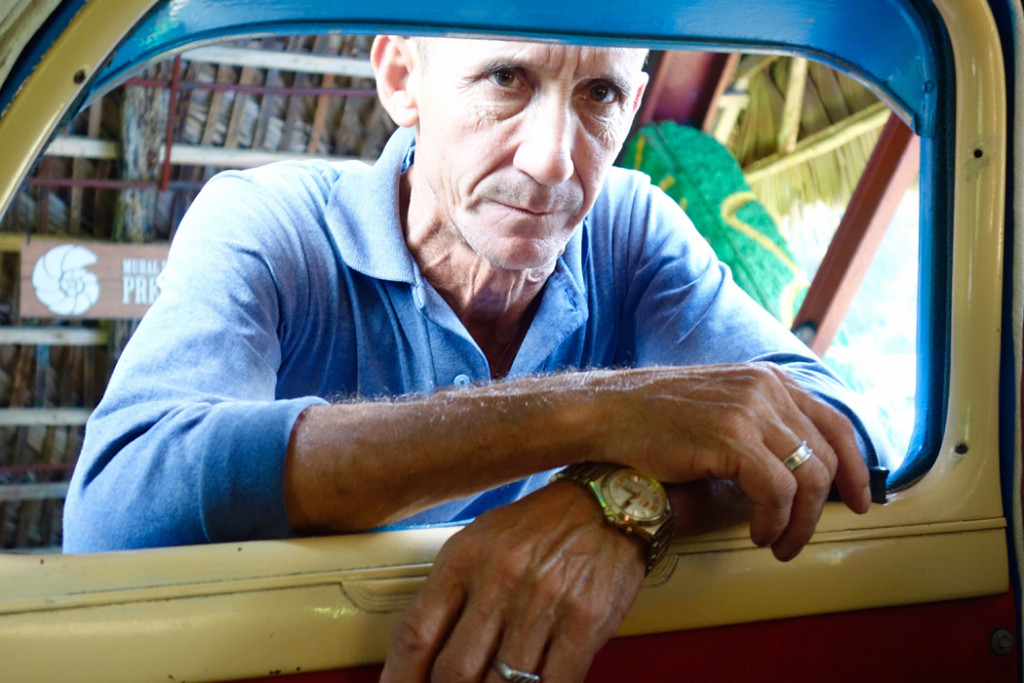
Cuban man

Photo: The Travelphile

Sure, the Cubans are poor in material terms. But they are no poorer than other Latin Americans. And they have a strength of character, national pride, and human dignity that is unique in this region.

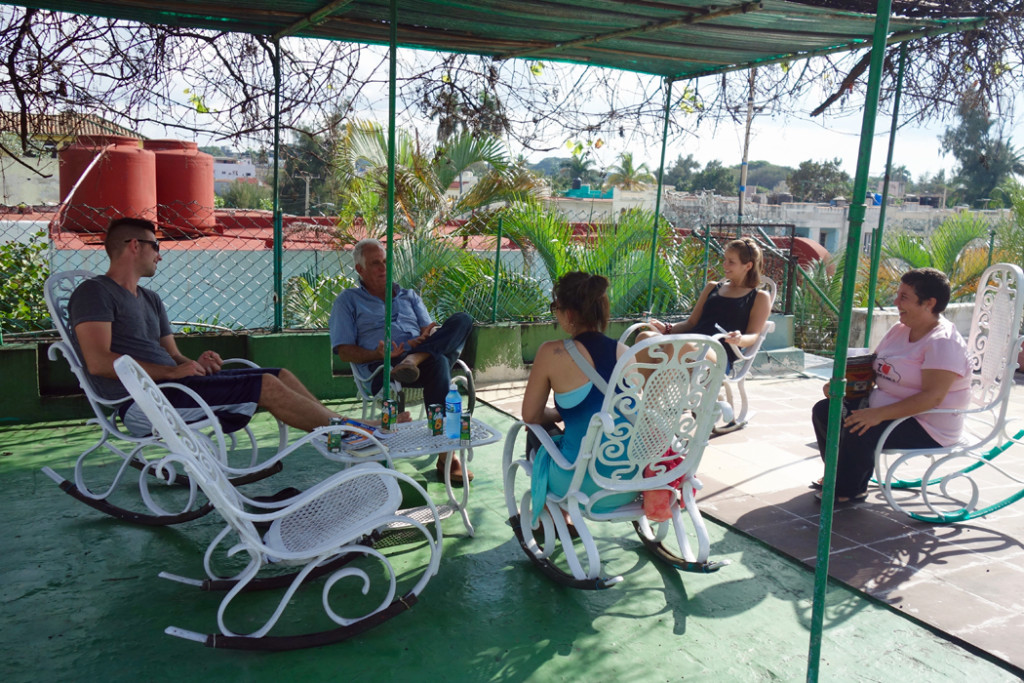
Family on rooftop

Photo: The Travelphile

Cubans are free to talk politics, and they love doing just that. We spent hours on the rooftop of our B&B talking with our hosts. The conversations were wide-ranging and full of memorable quotes: “Cubans are great athletes. We earn more Olympic gold medals, per capita, than any other country.” “When you give people things for free, they don’t value it.” “We don’t throw away anything. We just repair it and repair it and repair it.” “Resistance and dissident movements get no traction in Cuba, because people here assume they are funded by the CIA to destabilize our country.”

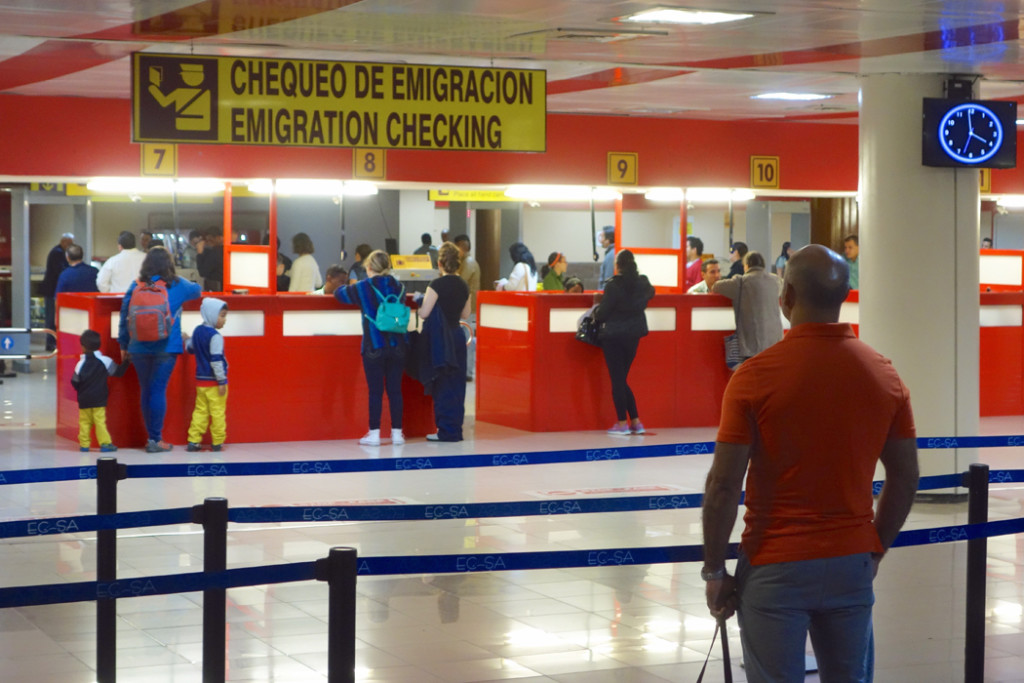
Airport customs

I traveled to Cuba completely legally, but through Mexico. My government knew exactly what I was doing, because whenever I prearranged or paid for something (even via London or Canada), a form popped up making me declare that I had a general license to travel in Cuba. (Of the 12 acceptable categories, I simply had to declare that I was on “professional research.”) Returning home, we flew from Havana to Mexico City (departing at about 6:00 am, no departure taxes, very straightforward…like any flight). Then we flew from Mexico City to Houston. At Houston, US Customs hardly looked at me. I pleaded, “But I’ve been in Cuba. I bought souvenirs, too.” The man in the uniform just said, “Welcome home.”

Rick Steves with passport

Photo: The Travelphile

(It’s my hope that this Cuba series has inspired you to consider traveling there yourself. For a complete and practical listing of the B&Bs we slept in, the restaurants we found that we’d recommend, and our sources of information — as well as more posts about our Cuba trip — visit Trish Feaster’s blog, The Travelphile.)

A Wild New Year’s Eve Party in the Havana Barrio

A highlight of our Cuba trip was ad-libbing our New Year’s Eve party. It worked out perfectly — we made friends, got invited into a private apartment, drank rum, and learned how to dance with a huge and friendly family. To make it even better, we ended up crashing an expensive rooftop hotel party for rich world elites…which was pretty bleak. That affirmed that the fun is best with the locals. Happy New Year!

(It’s my hope that this Cuba series has inspired you to consider traveling there yourself. For a complete and practical listing of the B&Bs we slept in, the restaurants we found that we’d recommend, and our sources of information — as well as more posts about our Cuba trip — visit Trish Feaster’s blog, The Travelphile.)

Happy New Year’s Eve in Havana

Anticipating a Cuban New Year’s bash, tourists gather in Havana’s old town. The cathedral square is filled with tables, as servants scamper to keep the breeze from destroying their handiwork with the napkins. Leaving the touristic center, we walk three blocks into a barrio — with buildings aging like melted sugar cubes and people who, it seems, view the world from their ramshackle doorsteps. I made a friend and was invited into a party I’ll never forget.

Rick Steves and Cuban party host

Peeking into a once-grand entryway, now draped in poverty, I saw masses of creative wiring creating a confused black web above broken building material coated with grime. A ramshackle spiral staircase led into what seemed like a dark attic — but I knew was many floors of apartments, each with a family primed to enter the New Year. Given the political quaking in Cuban-American relations, I suspect that 2016 could be a year to remember.

Marveling at the play of light — rays streaming through cracks, highlighting random corners of the otherwise dark space — I realized it was perfectly monochrome. As I steadied my camera against the door to compensate for the low light, a man suddenly stepped into the space.

Wearing a blue-and-black-striped shirt, with crucifix bling dangling from his neck, he looked like a young, miniature Arsenio Hall. The bright-blue stripes along with his toothy smile popped in all that black and gray.

He said, “Me llamo José.” We talked and shared our feliz año nuevo wishes. Americans are still an oddity here, so that stoked the conversation. José was heading up that haunted-house spiral staircase to his family’s party, and invited us along. Knowing that this is the kind of opportunity you travel for, we accepted.

Rocking chairs spilled out onto the third-floor landing, providing an alternative space for the old boys to gather. Drawn to the bright light of the family room — a big space for cooking, eating, and lounging — we were welcomed into a four-generation scene. (Generations pile up quickly, as girls have kids early. José was 39 and already a grandfather. He didn’t like that his 13-year-old daughter had a child…but what can you do?)

Rick Steves family with Cubans

Photo: The Travelphile

I’ve enjoyed many situations with very poor people partying. But this scene seemed different. I sense the ratio of education to per capita income here is the highest among the poor of any place I’ve ever traveled. These people spoke English and eagerly taught us to rhumba. With the conversation raging, the brother showed me his smartphone with quotes from Abraham Lincoln in Spanish. He translated one roughly: “The best form of justice is not always the best politics.” Cuba has plenty of poor, but regardless of any family’s ability to pay, they’ve all been to school.

The only thing being served was straight rum in tiny glasses. A boom box played while all danced. Little kids were busy learning dance moves from the older ones. A ten-year-old Michael Jackson wannabe was happy to teach the visiting tourists the steps. The patriarch proudly snapped photos. (My next post is a video of all the fun.)
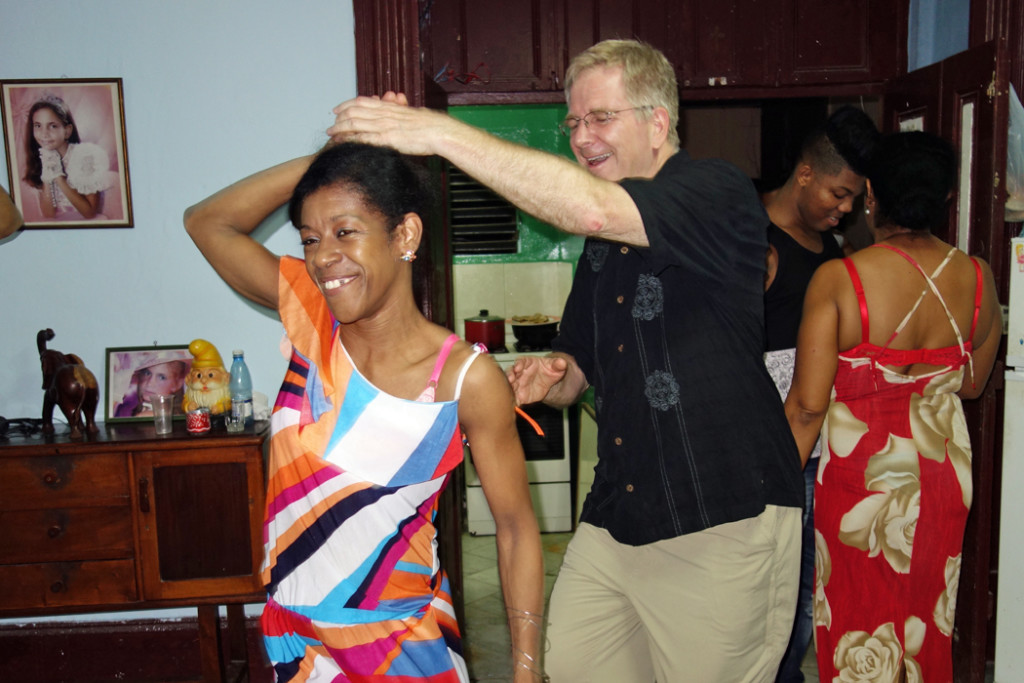
Rick Steves dancing with Cuban woman

Photo: The Travelphile

Getting some quiet, I stepped out onto the balcony. From that corner perch, the grimy city stretched in four directions. Nearly all the action seemed to be families gathered in homes — certainly more affordable than going out.

When midnight struck, everyone crowded onto that balcony to enjoy the local tradition of pelting anyone clueless enough to be out and about with garbage and water.
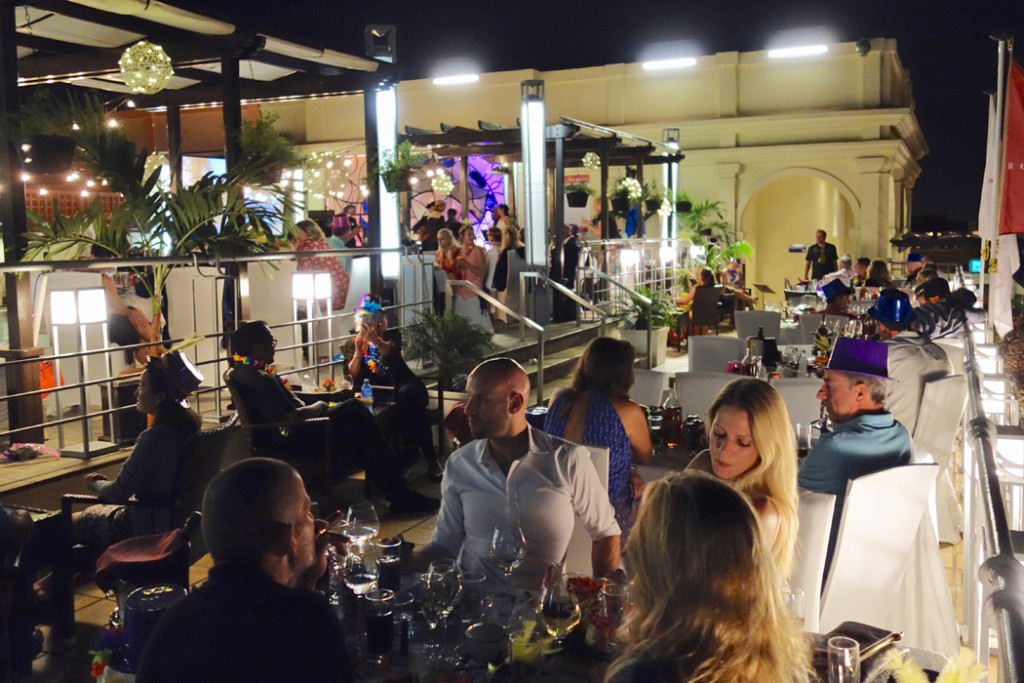
Havana hotel

Photo: The Travelphile

Later, we walked six blocks back to Cuba’s towering capitol building (a knockoff of ours in Washington DC — but, they boast, “one meter taller”). Across the street, we climbed to the rooftop of a hotel and crashed a classy $50-a-plate dinner with a band playing poolside. The patrons seemed dreadfully bored, and the contrast between this scene (with over-the-top food and party favors for about a month’s local wages) and the humble apartment where we had enjoyed our New Year’s was thought-provoking.

Out after midnight in a Havana barrio, we felt perfectly safe, except for potholes and passing bici (bicycle taxis) in the dark streets. Jumping into a taxi, I said, “Miramar” (the neighborhood of our B&B). He said, “Twenty CUC” — that’s about $20. I said, “Ten.” He said, “No, this is a 1956 Pontiac…fifteen.” I said, “OK.” He said “Feliz año nuevo,” and we rumbled home…capping a New Year’s Eve I’ll long remember.
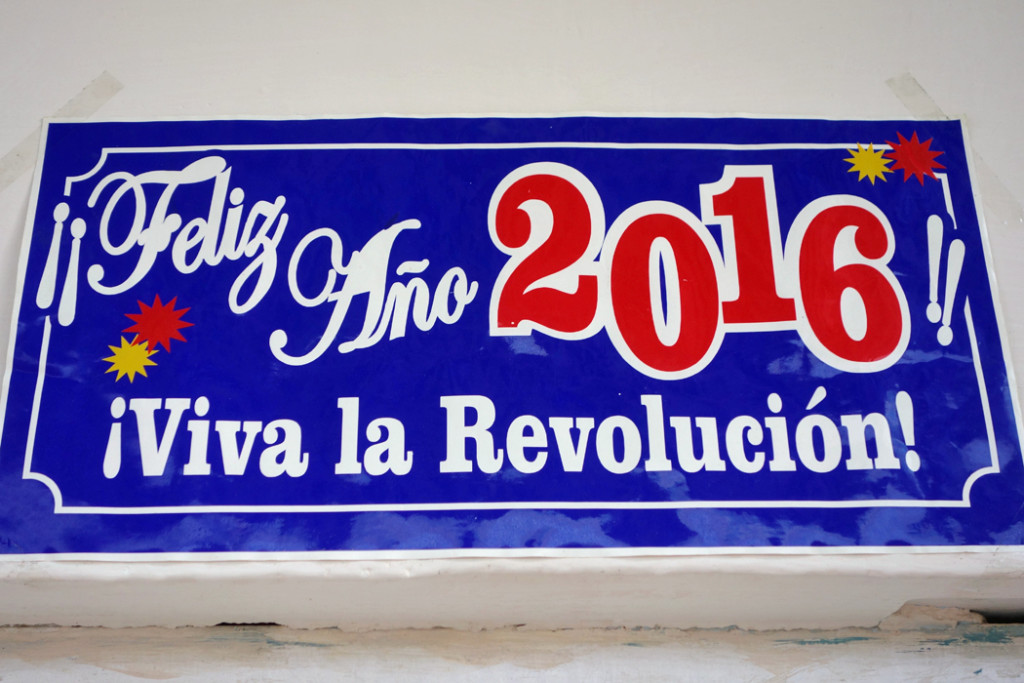
New Year Banner