Here you can browse through my blog posts prior to February 2022. Currently I'm sharing my travel experiences, candid opinions, and what's on my mind solely on my Facebook page. — Rick

Video: Glasgow’s Tenement House

It’s day 82 of my 100-day trip to Europe, and I’m in Glasgow, revisiting a great, if offbeat, museum. Something I love about my work: I get the joy of reviewing lots of sights and choosing which ones make it into the guidebook and TV show. While heavily advertised commercial gimmicks like wax museums, torture dungeons, and brewery tours attract hordes of tourists, other sights that take you back in time and connect you intimately with a bygone lifestyle get only a few thoughtful travelers. Some of my highly recommended sights — like the Tenement House in Glasgow (see my description below, excerpted from my Scotland guidebook) — may make people say “Huh!?” But they’re the sights that might just make your day.

I also love the similar museums in Copenhagen (the National Museum’s Victorian Apartment), in England’s Cotswolds (the Earl of Wemyss’ Stanway House), and in Paris (Jacquemart-André Museum).

Which lesser-known sights in Europe have given you that fun, intimate, time-warp experience?

Tenement House

Here’s a chance to drop into a perfectly preserved 1930s-era middle-class residence. The National Trust for Scotland bought this otherwise ordinary row home, located in a residential neighborhood, because of the peculiar tendencies of Miss Agnes Toward (1886-1975). For five decades, she kept her home essentially unchanged. The kitchen calendar is still set to 1935, and canisters of licorice powder (a laxative) still sit on the bathroom shelf. It’s a time-warp experience, where Glaswegian old-timers enjoy coming to reminisce about how they grew up.

Ring the doorbell to be let in. Explore the four little rooms. Imagine a world without electricity (Miss Toward was a late adapter, making the leap to electricity only in 1960). Ask about the utility of the iron stove. Ponder the importance of that drawer full of coal and how that stove heated her entire world. Ask why the bed is in the kitchen. As you look through the rooms laced with Victorian trinkets — such as the ceramic dogs on the living room’s fireplace mantle — consider how different they are from Mackintosh’s stark, minimalist designs from the same period

Cost and Hours: £6.50, April-Oct daily 13:00-17:00, July-Aug from 11:00, closed Nov-March.


Join our traveling community — connect with me on Facebook and Twitter.

200 Posts by One of My Favorite Travel Writers, Cameron Hewitt

rick steves and cameron hewitt with lenin statue
Me, Vladimir, Cameron

When people ask me about my favorite travel writers, I don’t need to look far. When I read the words of my most prolific co-author, Cameron Hewitt, I’m inspired to dig deeper into complex cultures, to experience the ups and downs of travel more intimately, and to share that essence of good travel more vividly.

Over the last few years, I’ve really been enjoying Cameron’s travel blog. Of course, I’m biased — since he works for me. Cameron is a great traveler and one of my favorite collaborators for big projects, from writing new guidebooks on Scotland, Berlin, or Iceland, to producing TV shows, to creating other travel content. I see Cameron as the “next generation” of my style of travel. And, while I enjoy taking credit for a lot of what Cameron does, his blog is the place where his own personality can really shine through.

Cameron’s blog is an entertaining, informative, often funny behind-the-scenes look at what it’s like to be a travel writer. He shares his infectious love of travel, mixed with savvy insights on how to do it better. If you love good travel writing and haven’t started reading Cameron’s blog yet, start now…I never miss it.

Cameron is celebrating his 200th blog post this week with a roundup of his favorite posts — from his tips for finding Italy’s best gelato or saving money in Iceland, to stories from his family Thanksgiving at a Tuscan agriturismo, to the time he took two Sound of Music tours in Salzburg, back to back, even though he’s not a fan of the movie. Cameron’s also looking back at his “origin story” — one of those wonderful just-out-of-college backpacker trips with long night-train journeys in crowded compartments and scary border crossings in the wee hours.

What’s your travel origin story? (You share yours here…and then I’ll share mine.)

Video: The “Scottish” Band Welcomes All the Tribes

Glasgow’s West End is the place to go for live music. And the Ben Nevis Pub was thriving as we spent the evening enjoying the scene with our camera rolling. (I’m feeling the beer, so excuse the swoopy camera moves.)

My agenda for our new public television show was to feature strictly Scottish traditional music. But as the session got going, I learned we had the entire UK in the band: musicians from Ireland, Wales, England, and Scotland — and they were drinking Guinness! At first, I was disappointed. My producer and I even talked about finding a bar with a solid Scottish band. Then our Glaswegian guide, Colin Mairs, pointed out that this is the reality…and it’s a fun one: The tribes are all making music together. And that (as a microcosm of our world in general — or, at least, its potential) is a beautiful thing. When it comes to good travel, being open-minded is as important as packing light.

By the way, this is a great example of a highlight for any visit to Britain: Reach out for info, find out which pubs have music, and make memories. What musical memories have you sparked in Britain’s pubs?


Join our traveling community — connect with me on Facebook and Twitter.

Video: Charles Rennie Mackintosh’s Art Nouveau Tea Rooms in Glasgow

I just joined my TV crew and our local guide, Colin Mairs, for our Scotland shoot. We’ll be here 18 days, filming three new shows for public television. Our first episode features Glasgow. And for architects, a big draw here is the Art Nouveau work of Charles Rennie Mackintosh. Here’s a look at a tea house he designed that makes for some tasty sightseeing. To give it context, here’s the “on camera” we filmed for our show:

These tearooms, opened in 1903, are an Art Nouveau masterpiece by Charles Rennie Mackintosh. Glasgow’s famous hometown architect gave this a spritely modern feel. Tearooms like the Mackintosh at the Willow were hugely popular during the industrial boom of the late 19th century.

During this age of Victorian morals, the temperance movement was trying to discourage the consumption of alcohol. Tearooms like this were designed with an agenda: to be an appealing alternative to eating in pubs.

In addition to giving office workers an alternative to pubs, these tearooms provided a place where women could gather while unescorted — in a time when being out alone could give a woman a less-than-desirable reputation.


Join our traveling community — connect with me on Facebook and Twitter.


Spatis, Trdelník, CBD — The Things You Learn in Central Europe

Just being out and about on the road, you stumble onto scenes that give insight into different worlds. On my latest swing through Central Europe — Berlin, Prague, Vienna — I enjoyed being a “cultural lint brush.” Here are some slice-of-local-life insights I picked up.

Berlin’s late-night convenience stores — like bodegas in New York City — are nicknamed “Spatis” (meaning roughly “late-ies”). And when there’s a big soccer game on TV, they’ll set up a TV on the sidewalk, put out some milk crates for customers to sit on, and host a party. For the cost of a grocery-store beer, the neighborhood gathers and enjoys sharing the event together. My Berlin friends — who say “this would never be allowed in Munich” — love these examples of Berlin community.


people sitting on crates outside a storefront in front of a small TV showing a soccer game


In the last couple of years, a new fake tradition has been born in Prague: stands selling chimney cakes, or trdelník. You’ll see these stands on virtually every corner, with saucy medieval maidens hard at work baking rotisserie pastries…all conspiring to be seen as a local custom. But chimney cakes have nothing to do with Czech culture or traditions (they’re originally from two countries away, in Hungary). They’re just another clever way to make money off tourists.


a stand in prague selling a snack


In Prague, ATMs not attached to real banks offer famously bad rates. Every local knows to avoid these rip-off ATMs.


guide holding an "x" in front of her face to mean "bad" next to ATM


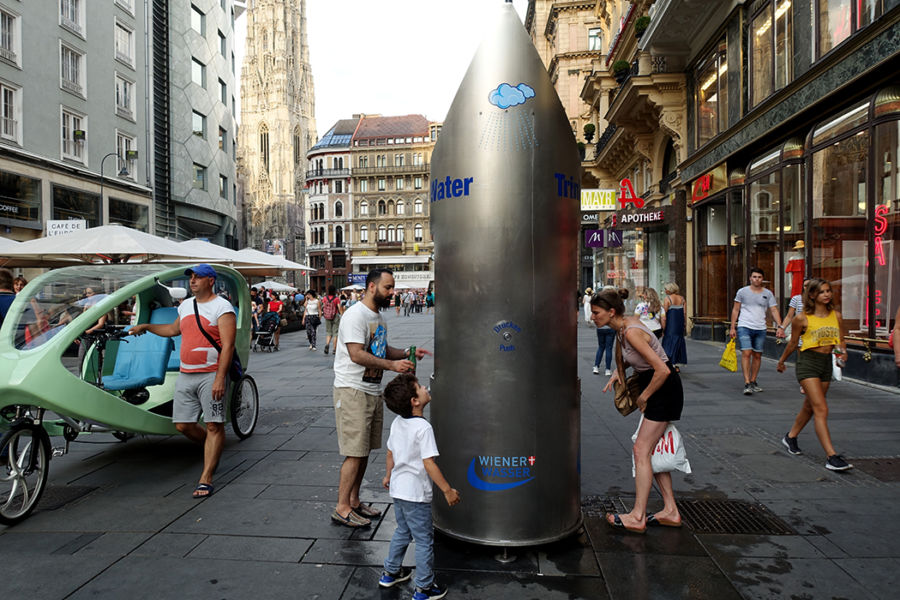
In Vienna, the city government — knowing both locals and tourists are dealing with hotter days than ever, thanks to climate change — have put out big cold-water stations with reminders to stay hydrated.


a large fountain shaped like a water bottle in vienna with people drinking from it


You see a lot of marijuana leaves and green packaging throughout Europe these days, and you might think, “Wow, I didn’t know pot was legal here.” But this is CBD cannabis — legal only if it contains less than one percent THC. CBD makes you calm and is considered a medicine. THC pot — the stuff that makes you giggle — is not yet legal here. Don’t worry (that’s OK)…be happy (not yet).


shelf of cbd products in a store


Join our traveling community — connect with me on Facebook and Twitter.