Here you can browse through my blog posts prior to February 2022. Currently I'm sharing my travel experiences, candid opinions, and what's on my mind solely on my Facebook page. — Rick

Roman Guidebook Jetsam

My previous entry featured some of the new items that will be added to the next editions of my Rome and Italy guidebooks. But a few things always wind up on the cutting-room floor. The following tidbits won’t appear in print, but I can’t resist sharing them here:

My Roman friend got lost with me around the Spanish Steps. She said that’s because this is an area with a grid plan of streets, and the logic of right angles confuses them.

At St. Peter’s Basilica, the altar under Raphael’s Transfiguration has been removed. Speculation is that, as he moves closer to sainthood, Pope John Paul II will be moved to a higher-profile resting place – from the basement crypt up into the actual basilica.

Local non-Catholic guides in Rome complain that “official Vatican guides” are getting more and more privileges when it comes to guiding in the Vatican. (For example, they are reportedly the only guides allowed to escape directly from the Sistine Chapel through the much-loved little door into St. Peter’s Basilica, saving their tour members lots of hiking.) And to be an “official Vatican guide,” you must prove your Catholic faith with a letter from your priest.

Eating in Italy can be hazardous to your shirt. My Roman friend told me last time he took a stained shirt into the dry cleaner, the lady there exclaimed, in gratitude, “Oh, my dear olive oil. How could I stay in business without you?”

In Rome, the classic pasta is Amatriciana – with spicy tomato sauce. Enjoying a plate, I splattered a bit of it on my shirt. When I showed my waiter, he said, “Ahh, the tax of the Amatriciana,” and gave me a shaker of talcum powder. (Good restaurants always have a can of stain spray or talcum powder for such incidents – ask as soon as possible for help.)

Fishing in Rome and Sharing My Catch

I’m just finishing up in Rome. The city is remarkably stable and organized. If you dropped in for your first time, you’d likely think the opposite. But my first 20 years of traveling in Rome (in the 1970s and 1980s) left me with an indelible impression of chaos that I am only now realizing is very dated. The city enthralls and seduces me like never before. I thought the attraction had something to do with the persistent chaos, but the charm is strong as ever as the chaos ebbs. Two of the few Italian phrases I know (and use all the time) are appropriate for Rome: Complimenti (My compliments) and Buon Lavoro (Enjoy your work).

Here is a rough and candid sampling of the kinds of things I’m finding for the new editions of our Rome and Italy guidebooks:

Via dei Fori Imperiali: On Sunday afternoons, Via dei Fori Imperiali is closed to traffic from Piazza Venezia to the Colosseum, and a delight to stroll.

Discounts: While discounts are technically only for EU residents, American seniors who ask will often get the same deal.

Orvieto: Let’s remind people to consider Orvieto for day trip from Rome. It’s just 90 minutes away by train.

Palazzo del Quirinale: The presidential palace and former home of popes feels like a combination White House and Versailles. It’s open Sunday mornings (free, 8:30-12:00). Wandering through here, you enjoy a lavish and living extra dimension to Rome.

Gesù Church: A 17:30 ceremony lights up the tomb and altarpiece of St. Ignatius of Loyola, with music and ritual. I’ve been told that this is a very moving 20 minutes well spent.

MAXXI: Rome’s “National Museum of Art of the 21st Century” is the big news on the museum scene here – as you can imagine, after ten years and 150 million euros spent. This complex, “Italy’s first national museum dedicated to contemporary creativity,” is a playful concrete-and-steel structure filled with bizarre installations, and located inconveniently away from the center. It comes off as a second-rate Pompidou Center. While many contemporary art museums are notable more for their architecture than for their art, this scores with neither. It felt to me like Rome trying to be more than what it is – and judging by the lack of energy here, I’m not alone (€11, Tue-Sun 11:00-19:00, Thu until 22:00, closed Mon, two exhibits per year, preview at www.fondazionemaxxi.it, tram #2 from Piazza Popolo to Piazza Apollo Doro, Via Guido Reni 4a, tel. 06-322-5178).

Fausto delle Chiaie: “Fausto of the Beach” is a self-appointed part of the Arch of Peace. This eccentric (yet likely more sane then the rest of us) takes you to a different dimension with his good street art. While next to the local academy of art, he stresses there is relation. Fausto’s installation art (in English and Italian) is usually strewn along the curb that runs between the Ara Pacis and the Mausoleum of Augustus. Charming Fausto speaks English and reminds you that his “plastic secretary” (a tip box) is at the end of the curb if you are inspired. For me, he’s the MINNI – and is more entertaining than the MAXXI.

Passeggiata at Piazza del Popolo and along Via del Corso: Of course, all over the Mediterranean world, people are out strolling in the early evening. Rome’s passeggiata is both more elegant (with chic people enjoying fancy window-shopping in the grid of streets around the Spanish Steps and along Via Margutta) and a bit more rough (at Piazza del Popolo and along the Via del Corso). This is where working-class suburban youth called coatto, with little to keep them in Rome’s dreary outskirts (so lacking in public spaces), converge on the old center like American kids gather at the mall. Piazza del Popolo and Via del Corso (now pedestrians-only all day) are the places to enjoy the great struscio (literally “rubbing,” as some locals call their cruder-than-average strolling spectacle), as Romans make the scene and check each other out. While the proliferation of shopping malls is drawing many people away and creating hard times for many of the chain outlets lining Via del Corso, this remains a fine place to feel the pulse of Rome at twilight.

New Additions to our Pantheon Description: The portico is Greek in Style – logical, because Hadrian was a Grecophile. (He grew his famous beard to look like a Greek philosopher.) The portico is a visual reminder of the great debt of Roman culture to the Greeks. You cross the Greek portico to enter a purely Roman space, the Rotunda. The huge and simple columns in the portico were Egyptian, literally shipped from the Nile. They were then fitted with the leafy Corinthian capitals. They are sequoia-huge – it takes the outstretched arms of four big tourists to span one.

Piazza della Rotunda (the Square Facing the Pantheon): A gathering place for 2,000 years, its slope illustrates the “rise of Rome.” Imagine in past centuries, when there was a fish and chicken market in the portico. In a 1700s urban-beautification project, the fountain and obelisk were added. Pausing here, you feel the vibrancy of Italy’s piazza culture, which goes back to ancient Roman times.

Baroque as Propaganda: Tapping into the heart rather than the head, the Church used Baroque art to encourage emotional responses to the faith. Jesuits will burn the books those Protestants were so excited about and do the thinking for you. You can simply feel, imagine, and see the lessons via the art. St. Teresa in Ecstasy is a powerful example – emotion going directly from your eyes to your heart. Don’t reflect. Be awed, amazed, moved.

Taverna Trilussa: If dining well in Trastevere, this place – with a proud 100-year tradition – is your best bet. The spacious dining hall, strewn with eclectic Roman souvenirs, has the right mix of style and informality. The service is fun-loving (happy to let you split plates into smaller plates to enjoy a family-style meal), yet professional. The menu celebrates local classics and seasonal specials, and comes with a big wine selection. And if you want to eat outdoors, Trilussa has an actual terrace rather than tables jumbled on the sidewalk. Brothers Massimo and Maurizio offer quality and value without pretense (€15 pastas, €20 secondi, dinner only from 19:30, closed Sun, reservations very smart, Via del Politeama 23, tel. 06-581-8918).

Hotel San Francesco: Big and blocky yet welcoming, this hotel stands like a practical and efficient oasis at the edge of all the Trastevere action. Renting 24 trim rooms in this authentic district, it comes with an inviting roof terrace and a calm and helpful staff. Handy trams to Largo Argentina are just a block away (Db-€90-120 depending on the season, air-con, Via Jacopa de Settesoli 7, tel. 06-5830-0051, www.hotelsanfrancesco.net, info@hotelsanfrancesco.net).

I Colori del Vino Enoteca: This modern wine bar – without a tourist in sight – feels like a laboratory of wine appreciation, with woody walls of bottles, a creative menu of cold cuts (meats and cheeses with different regional themes), and a great list of fine wines by the glass. Helpful and English-speaking Marco carries on a long family tradition of celebrating what we know to be the fundamentals of good nutrition: fine wine, cheese, meat, and bread. Remember Shakespeare’s sage warning – “Wine stirs the desire, but it prevents the implementation” (Mon-Fri 12:00-15:00 & 17:30-23:00, closed Sat-Sun because Marco doesn’t cater to noisy weekend drinkers, corner of Via Flavia and Via Aureliana, tel. 06-474-1745, www.icoloridelvino.it).

Swept Away in Rome

IMG_0611

I spent the afternoon in my hotel room, splicing all the little changes and discoveries into what will be the 2012 edition of my Rick Steves’ Rome guidebook. Stepping out for just a quick little break is dangerous. There’s a mean current here and, turning the corner from my hotel, I got swept out into the Roman sea ‘ so filled with colorful and fragrant distractions. I didn’t get back for hours. It really was like swimming in a current.

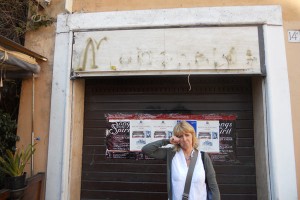
Tiny black cobbles slope downhill to the ancient street level at the Pantheon’s portico. From there, I look up at a symphony of images: designer shades and flowing hair glinting and backlit in the magic-hour sun; a flute section of ice-cream-lickers sitting on their marble bench in the spritz of the fountain under the obelisk exclamation point; strolling Romanian accordion players who refuse to follow the conductor; and the stains of a golden arch on a wall marking where a McDonald’s once sold fast food, as if to celebrate its demise. The entire scene is corralled by pastel walls ‘ providing the visual equivalent of good acoustics.

As I let go of the Pantheon’s Egyptian columns, the current sweeps me past siren cafés, past the TV news crew covering something big in front of the parliament building, and out into Via Cavour. This is the deep end, which hosts the rough crowd from the suburbs who come in to the center for some cityscape elegance and concrete-people friendliness. They’ve gooped on a little extra grease and are wearing their best leggings, heels, and T-shirts.

Veering away from the busy pedestrian boulevard, I come upon Fausto, a mad artist standing proudly amid his installation of absurdities. While crazy, he always seems strangely sane in this world. And this year, with the opening of the giant and trying-too-hard MAXXI modern art gallery (11 years and 150 million euros for very little), Fausto seems downright brilliant. He’s the only street artist I’ve met who personally greets viewers. After surveying his tiny gallery of hand-scrawled and thought-provoking tidbits lined along a curb, I ask for a card. Giving me a handmade piece of wallet-sized art, he reminds me his “secretary” is at the end of the curb ‘ a plastic piggy bank for tips.

The Campo de’ Fiori, which creates its own current, feels like a punished child. Just last week, after a Roman teenager drank herself into a coma, the police forbade drinking outside of bars and restaurants ‘ and now it’s like someone turned on the lights at a party before midnight. Farther down the street, the fun is replaced by an uptight vibe. It’s Prime Minister Silvio Berlusconi’s headquarters, with military police poised as if expecting an attack. There’s a sourness among locals on the street here. This marks the point of what used to be a very helpful and popular bus stop that was replaced with police vans to provide security for Italy’s bombastic leader. Locals gossip that he wears a bulletproof vest and shows his teenage girlfriend videos of him with president Bush at Camp David for foreplay. To some Italians, Berlusconi is everything they wish they could be, exaggerated. Some marvel at how he stays in office. Others understand that when a politician owns his own media empire and has 24/7 news networks at his service, even a Berlusconi can hoodwink an electorate.
No More McDonalds

I pass a homeless man, tattered but respectfully dressed, leaning against a wall savoring a cigar and a bottle of wine while studying Rome’s flow as if it had a plot. I chat with twins from Kentucky, giddy about their Roman days as they celebrate their fortieth birthday. Their Doublemint smiles on high energy make their very presence on the streets of Rome an ad for embracing the good life.

On Piazza del Popolo (no one can figure out whether it’s named for the poplar trees that framed it, or the people who fill it), a very good Michael Jackson, with shifty shoulders and transformer ankles, moonwalks ‘ sending a huge crowd into orbit. Moving on, I slip into a church just as the ushers close the doors for the 6:30 Mass. Inside, the white noise of Roman streets becomes the incense-d hummm of a big church with a determined priest and not enough people. I slip down the side aisle, hands folded as if here to worship, to catch a glimpse of a Caravaggio, that thriller of the 17th century.

Stepping back outside, I’m at the north entrance of the city. Piazza del Popolo was a big deal before the age of trains and planes. The 16th-century pope pulled out all the stops to welcome pilgrim Europe (anyone arriving from the north). Twin domed churches create a trident of straight boulevards emanating from an obelisk, taking pilgrims lacking maps or guidebooks to whatever they hiked here for: the Vatican to the right, the ancient city directly ahead, and the other big pilgrimage churches (St. John Lateran and Santa Maria Maggiore) to the left. Three churches on this square, each dedicated to Mary, set the religious tone for any pilgrim’s visit to the Mecca of Christendom.

Determined to swim back to my hotel to get back into my data-entry task at hand, I pass the same well-dressed bum with the cigar and the buzz, still intently caught up in the plot of the city. I imagine being in his pickled head for just a moment.

The twilight sky is just right for sales now, as guys from Somalia launch their plastic florescent whirlybirds high into the sky while their friends slam plastic doll heads into boards so hard they become spilled goop, and then creepily reconstitute themselves, ready for another brutal slam. These street trinkets that somehow keep illegal African immigrants from starving make me wish I had bought all the goofy things people have sold on the streets of Rome over the years ‘ from the flaming Manneken-Pis lighters to the five-foot-tall inflatable bouncing cigars to the twin magnets that jitter like crickets when you play with them just so ‘ and made a museum.

Finally I swim with a struggling stroke back to the safety of my hotel, where none of that Roman current is allowed in. The problem: While taking a break from inputting all I’ve learned, I come home with even more to input. In Rome, one thing leads to another, and, if you’re trying to get on top of your notes, it can be dangerous to go out.
Rome Is a Pain in the Knees

As you read this, I’m in Rome, updating my guidebook and running into lots of happy travelers. I’ve been here just 48 hours, and the Eternal City is pelting me with experiences.

For centuries, pilgrims have been climbing the Scala Santa on their knees. And for decades, I’ve been watching them. (These are the “Holy Stairs” of Pontius Pilate’s palace that Christ climbed the day he was condemned. Emperor Constantine’s mother Helena brought the staircase home to Rome after a trip to the Holy Land in 334. I can imagine Constantine rolling his eyes and saying, “Mom, bring home smaller souvenirs!”)

Yesterday, a voice inside me said “do it!” and I tried the climb myself. Knees screaming, weathered faithful struggling up the staircase with me, fresco of a crucified Christ high above, I climbed the 28 wooden steps. With each polished step, I learned a bit about both the bone structure of my knees and the value of pain when praying.

Last night, in an entirely different mindset, as I was finishing up a fine meal with a Roman friend, he paused to savor his glass of grappa. I tried my best to enjoy the local firewater, and failed. Sipping the grappa, Stefano instructed me: “You must not be in a hurry when taking a grappa!” He then shared with me his ultimate joy: having a glass of grappa with a Tuscan cigar on his sailboat halfway to Corsica. (A Cuban cigar tastes better, but on a sailboat, “the wind will smoke it for you” ‘ so a slower-smoking Tuscan best completes the scene.)

From holy stairs to sacred firewater, I’ll be reporting all month from Italy on this blog and my Facebook page. Join me, and I promise some fun and vivid insights into my favorite country.

A Different Way to Trim the Budget

As Wisconsin-type protests are threatening to break out all over the USA ‘ and regular people are taking huge hits because, as we are being constantly told, “our country is broke” ‘ many are becoming concerned that money spent on our military is money denied other needs in our society. And that comes with a human cost. Reading in The Atlantic, March 15 issue, about how the USA plans to spend $900 billion to buy and operate a fleet of 2,400 new F-35 fighter jets ‘ and then hearing how our country has no money for public-employee benefits, schools, parks, and so on ‘ got me going. (I completely support the USA having the military wherewithal to take swift and decisive action when necessary, and I support our support of the rebels in Libya. But the time has come when the domestic cost of our military budget needs to be considered.)

People in Minnesota are taking action. At breakfast in Minneapolis last week, a friend of mine shared a resolution Minnesotans are giving to their state legislature in hopes of balancing their state budget not by stripping away services to poor and middle-class people, but by reconsidering our military budget. Like many good ideas, it’s courageous but (sadly) probably futile. Still, these numbers are hard to refute. Here’s the resolution:

Whereas Minnesota is faced with a $5 billion budget shortfall; and,

Whereas past budget cuts have resulted in painful reductions in essential services and future cuts would further erode the quality of life for and, in fact, endanger the lives of many citizens; and,

Whereas many cities and communities in Minnesota are laying off police, firefighters, teachers and other essential employees; and,

Whereas past budgets have been balanced by cutting social services, under investment in essential infrastructure, and other measures that push the crisis onto local governments and the poor; and,

Whereas Minnesota taxpayers even during these times of economic crisis and fiscal austerity are poised to pay approximately $26 billion over the next two years for their share of the Defense Budget of the Federal government; and,

Whereas Minnesota taxpayers alone have already spent more than $27.5 billion, and will spend $8.4 billion more over the next two years for the ongoing wars in Iraq and Afghanistan; and,

Whereas 58 cents of every dollar of federal discretionary spending is devoted to military purposes; and,

Whereas military spending priorities at the national level negatively impact budgets and quality of life at all levels of government and society; and,

Whereas our nation desperately needs to better balance its approach to security to go beyond military defense and include the economic, social, and environmental needs of our communities, state, and nation;

Therefore be it resolved that we call on Senators Klobuchar and Franken, and Representatives Walz, Kline, Paulsen, McCollum, Ellison, Bachman, Peterson and Cravaack as well as President Barack Obama, to shift federal funding priorities from war and the interests of the few, to meeting the essential needs of us all.

All statistics are available from the National Priorities Project.

Imagine the impact of US military expenditures on your state’s budget. Maybe you’ve fantasized about winning the lottery. You could do the same for your state if somehow our country (which spends as much as the rest of the planet combined on weapons) became only modestly militaristic and hammered a few extra swords into plowshares.

Talking about the dollars wasted on the military incenses many good security-minded Americans. But I believe the irony of our age is that our military itself ‘ because of the way it bleeds us economically and frays the fabric of our society ‘ is actually becoming a threat to our national security. Yes, that’s irony. What is it about the sacred cow of military spending in today’s USA? Thoughts?