As I update my “Europe Through the Back Door” guidebook for next year, I’m trying to distill Europe’s economic problems into layman’s terms. I want to help travelers get their minds around the struggles there–giving their visit a little more context. It’s dangerous to simplify these things, but for a guidebook, it needs to be simplified. Here’s my attempt at Euro Econ Crisis 101. I’d love your feedback and advice on making this more true and helpful. Thanks.
After seeing news reports of violent demonstrations, angry marchers, and frustrated workers rioting, some are wondering if this is still a good time to travel in Europe. I’m certainly not an economist. But here’s my take on the situation from a travel writer’s perspective.
When assessing the seriousness of any civil unrest, remember the mantra of commercial news these days: “If it bleeds, it leads.” In the era of Walter Cronkite, network news contributed to the fabric of our society by providing solid journalism as a public service without worrying about their bottom line. But today, commercial TV news has to make a profit. In order to sell ads, it has become entertainment masquerading as news. Producers will always grab video footage that makes a demonstration appear as exciting or threatening as possible. Unrest is generally localized–it looks frightening with a zoom lens and much less so with a wide-angle shot.
And also remember that, while we in the USA and Europe may consider ourselves in an “economic crisis,” the vast majority of people on this planet would love to have our economic problems. By any fair measure, as societies, both the USA and Europe are filthy rich. Still, if you’re unemployed or if your retirement is suddenly in jeopardy, your times are, indeed, tough.
Europe’s economic problems are much like ours here in the USA. It seems on both sides of the Atlantic we’ve conned ourselves into thinking we are wealthier than we really are. Enjoying wild real estate bubbles, we’ve had houses that were worth half a million suddenly worth a million. Then, when they dropped in value by 50 percent, we felt like we’d lost half a million dollars or euros. Truth be told, we were never millionaires to start with, and what we “lost” we never honestly gained in the first place.
As societies, we’ve been consuming more goods than we’ve been producing for a long time. We import more than we export–and things are finally catching up with us. Here in the USA, our priorities are warped. Many of our best young minds are going to our finest schools to become experts in finance: Rearranging the furniture to skim off the top…aspiring to careers where you produce little while expertly working the system in hopes of becoming unimaginably rich. (Recently, surveying the extravagant châteaux outside Paris–such as Vaux-le-Vicomte–I was stuck by how many of them were the homes of financiers. Lately, the USA is reminding me of old regime France. It’s striking that over 10 percent of the USA’s economy is tied up in the financial industry.)
Europeans and Americans have some of the most generous entitlements in the world combined with aging societies. Because of that, our comfortable status quo is not sustainable. Whenever a society gets wealthy and well-educated, it has fewer children. That’s simply a force of nature. Western Europe, being one of the wealthiest and best educated parts of the world, logically has one of the lowest birth rates.
Europe’s generous entitlements were conceived in a post-war society with lots of people working, fewer living to retirement, and those living beyond retirement having a short life span. That was sustainable…no problem. Now, with its very low birth rate, the demographic makeup of Europe has flipped upside down: relatively few people working, lots of people retiring, and those who are retired living a long time. The arithmetic just isn’t there to sustain the lavish entitlements.
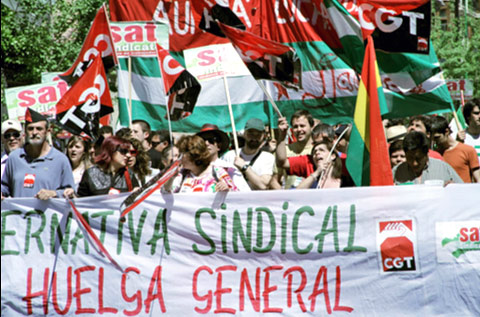
Politicians in Europe have the unenviable task of explaining to their citizens that they won’t get the cushy golden years their parents got. People who worked diligently with the promise of retiring at 62 are now told they’ll need to work an extra decade–and even then, they may not have a generous retirement waiting for them. Any politician trying to explain this reality to the electorate is likely to be tossed out, since people naturally seek a politician who tells them what they want to hear rather than the hard truth. And any austerity programs necessary to put a society back on track are also tough enough to get people marching in the streets.
I expect you’ll see lots of marches and lots of strikes in Europe in the coming years as they try to recalibrate their economy. Europeans demonstrate: It’s in their blood and a healthy part of their democracy. When frustrated and needing to vent grievances, they hit the streets. I’ve been caught up in huge and boisterous marches all over Europe, and it’s not scary; in fact, it’s kind of exhilarating. “La Manifestation!” as they say in France. All that marching is just too much exercise for many Americans. When dealing with similar frustrations, we find a TV station (on the left or right) that affirms our beliefs and then shake our collective fists vigorously.
When Europe united, the poor countries (Ireland, Portugal, Spain, and Greece) received lots of development aid from the rich ones (mostly Germany and France). I remember when there were no freeways in any of the poor countries. Now they are laced with German-style (and mostly German-funded) superhighways. These countries traded in their lazy currencies for the euro (which is, in a way, the mighty Deutschmark in disguise, as the European economy is driven and dominated by Germany).
Today, it’s no coincidence that the European countries that have received the most development aid are the ones who are the most debt-ridden and at risk of failing. Even with that aid, their productivity has lagged far behind the stronger economies. And, while their workforce doesn’t produce as much per capita as German workers, they have a mighty currency tied to Germany. By earning wages and getting aid in euros, these nations enjoyed a false prosperity that they might not have merited–and the bursting real estate bubble made it worse. Before unity, if a nation didn’t produce much and slid into crippling debt, the economy could be adjusted simply by devaluing that nation’s currency. Today, there’s no way to devalue the currency of a particular county on the euro, so this fix is not an option. It’s much easier to get into the eurozone than to get out. (One of the biggest questions facing Europe today is: Can and should an economically weak country–namely Greece–leave the eurozone?)
Will Greece and other struggling economies within the EU be safe and stable places to visit as they work out these problems? No one can predict the future for certain. But, as a traveler, I don’t worry about it. True, I wouldn’t want to be a Greek worker counting on a retirement that may not come. But as a visitor, I expect you’ll be scarcely aware of these problems. I was just in Greece and enjoyed a warm welcome, great food, and wonderful beaches. Expect a few demonstrations and a few strikes. Expect your loved ones to be worried about you if you are in a country when there’s a demonstration. (So be in touch.) But you can also expect rich travel experiences and a society thankful that you decided to spend a slice of your vacation time and money in their country.