Here you can browse through my blog posts prior to February 2022. Currently I'm sharing my travel experiences, candid opinions, and what's on my mind solely on my Facebook page. — Rick

Shopping, Cairo-Style

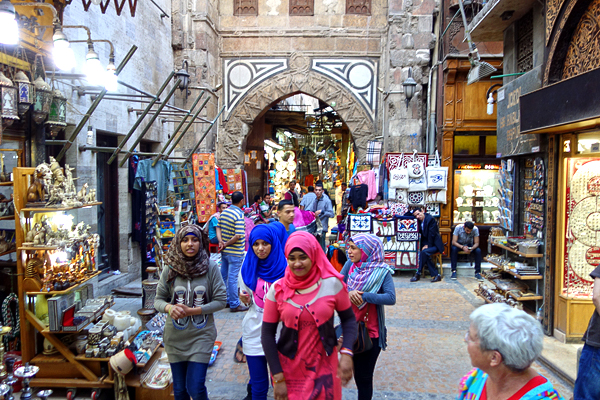
While Cairo has modern suburban malls as glitzy as anything in Houston, and it has its 20th-century attempt at a European-style downtown, I like the dusty, donkey-cart world of the old Islamic city center. Khan el-Khalili, one of the largest markets in the Arab world, is a tourist magnet. And even today — with almost no tourism — it still feels touristy.

The market’s main drag is a gauntlet of hungry merchants. They drape you with a headdress or a bracelet, and you can’t give it back. I’m a sucker for the charming English lines they toss my way with the grace of fly fishermen casting:

“You’re breaking my heart.”

“How many camels for your woman?”

“Just look. No problem.”

“Can I sell you something you do not need?”

“No charge for looking.”

“Special price… 90 percent discount.”

“Come upstairs where we make things.”

“You are back! How can I take your money?”

Suburban malls in a city like Cairo give wealthy locals a place to buy their name-brand shirts and pick up a Starbucks. While the unwashed masses jostle for penny loaves of subsidized bread to feed their children, I sip my $4 grande latte. Most locals shopping here manage to create an alternate reality in which there's no desperation.
Suburban malls in a city like Cairo give wealthy locals a place to buy their name-brand shirts and pick up a Starbucks. While the unwashed masses jostle for penny loaves of subsidized bread to feed their children, I sip my $4 grande latte. Most locals shopping here manage to create an alternate reality in which there’s no desperation.

But Khan el-Khalili is just a springboard for wandering deeper into Islamic Cairo. (That’s “Islamic” as opposed to the more European-feeling, French- and British-designed streets that make up the modern downtown.) My favorite areas to explore were along Souk el-Selah street, the “Street of the Tentmakers” (Chareh el-Khiamiah), and the gate named Bab Zuela.

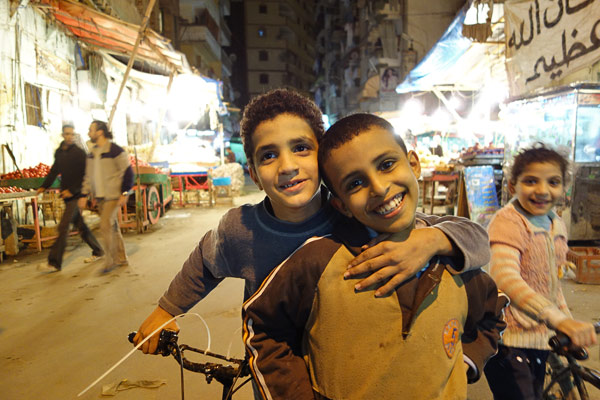
Simply walking down the streets — dodging families riding motor bikes as if skewered on kebabs, rambling shipping dollies slaloming through browsers, and boys on bikes balancing rustic racks of bread on their heads — is treacherous. I duck to avoid being scalped by a rack of government-subsidized baladi bread (crispy little wheat balloons of feed-the-poor nutrition). The new government (as governments have done since Louis XVI lost his head to hungry peasants a couple of centuries ago) provides bread to its struggling masses at about a quarter its actual cost — the equivalent of a penny each.

I spent the last month explaining to friends why I’m traveling to Egypt. I’m here for lots of reasons. While letting my staff carry more of the updating burden with my existing guidebooks, I’m taking this chance to spend some steep learning-curve time in a country I don’t know well. At the same time, I’ll do some scouting for a TV special I plan to produce in the next year. Also driving this trip is my concern that the American public’s fear of traveling here is an overreaction. A firsthand experience will help me knowledgably advise people on Egypt’s merits and relative riskiness. One thing is certain: Egypt will be in the news a lot during the coming months. After ten days here, I think I’ll better understand the context of whatever the future brings. And finally, I have always liked the people and culture of this nation that’s as great as it is misunderstood and underappreciated.

As an American on the streets of Egypt, I received only warm and enthusiastic welcomes.

I’m taking notes constantly for my TV project. For example, thinking about returning with my crew to this particular market street, I noted to film these things: towering stacks of rat traps, motorcycle minibuses (ride one, shoot point-of-view), bread boys on bikes, chiselers engraving grave stones, and the shop making shredded wheat kind of like cotton candy; avoid market streets on Friday and Saturday, when they are too crowded.

People are absolutely everywhere. While we have the refuge of our hotel, many people here have no escape. They seem to be out, in part, because it’s just better than being in. Egyptians are good-humored. They don’t stare. They’re generally friendly to my camera. I sensed absolutely no anti-Americanism. Children everywhere are ready to steal your heart with a warm and gentle smile.
p11-DSC00865

Welcome to Cairo — Capital of the Arab World

Vast as Cairo is, it’s a small world for the traveler when it comes to sights and tourist-friendly stops. Local guides, local friends, and both guidebooks I’m using all dip into the same tiny pool of a handful of sights, restaurants, cafés, parks, concert venues, and hotels in this teeming city of 17 million. Every time my guide takes me somewhere, I check my guidebook…and it’s there. Every time I see something in my guidebook I want to visit, my guide is taking me there anyway.

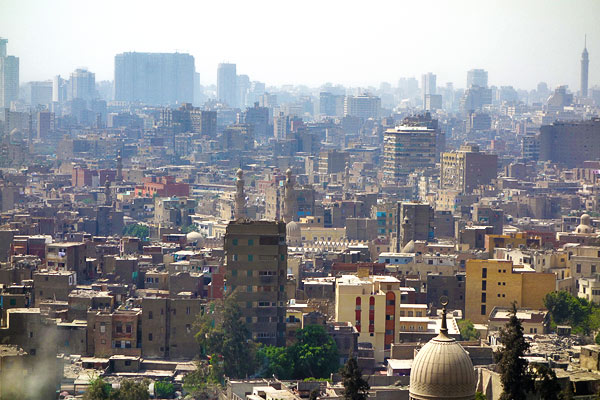
Cairo teems with 17 million people, most of them scrambling to make ends meet.

Cairo’s grand sights — the pyramids and the Egyptian Museum — are magnificent…absolutely world-class. Those are enough in themselves to make the long trip to Egypt worthwhile. But the other sights in Cairo are humble. Mosques, while historic, feel forlorn except when filled with worshippers on Friday. Oddly, in the National Museum — with the most beautiful things I saw, the treasures of ancient Egypt — photos are strictly forbidden.

Egypt is 10 percent Coptic Christian, and the history of Christianity in Egypt goes back to the first-century visit of St. Mark (whose bones rested in Alexandria until stolen by Venetian merchants in the ninth century to put their city on the pilgrim map). But the Christian presence is small and low-key.

With the rise of Muslim power (a persistent dimension of the nascent democracies of the Arab world), Christian communities throughout Islam lay low, build taller fences, and come with lots of police security. Just this week, several Christians were killed in a small riot here in Cairo. (I know that might sound shocking. But during the same week, several Christians were also killed in Chicago — a city with half of Cairo’s population.)

Cairo’s Coptic Museum, set in the restored walls of the ancient Roman fort, is charming, if humble. It seems the scant surviving artifacts of a rich heritage speak to centuries of edgy coexistence (alternating with periods of plunder) with the dominant Muslim society. The narthex of the Coptic church was lined with photos of Coptic patriarchs through the ages powwowing warily with Egypt’s various Muslim political bosses.

There’s been a Christian community in Egypt since the time of St. Mark. In Coptic Christian churches, mosaics remind all that Mary and Joseph fled with their baby to Egypt to escape King Herod’s decree to kill all newborn boys.

Any person in Cairo with 5 Egyptian pounds (about a dollar) can buy entrance into Al-Azhar Park, the only park in the center — an oasis of green where young couples enjoy a respite from the intensity of the city and a stroll through a rare garden with ponds and fountains and shade. Sitting in circles, friends giggle and flirt. Joining them for the standard tourist-meets-locals conversation, I pondered the downside of population density and the upside of population sparsity.

Cairo’s lone park, Al-Azhar, offers an escape from the intensity of the seething streets.

Egypt — Something Different for a Change

I just flew from Seattle to Cairo. After being here for just a day, it seems like a week. Of course, I swung by the pyramids, got my mug shot with the Sphinx, and rode a camel. But the real fun has been feeling the pulse of post-revolutionary Egypt in the chaotic streets of ancient Egypt, nothing about life survives. No palaces — only tombs. But experiencing and exploring today’s Egypt is all about life: struggling, finessing, surviving, embracing.

In Egypt, some things never change.

The big news this decade: a people’s revolution to replace the 30-year dictatorship of Hosni Mubarak with the only alternative well-organized enough to win an election, the Muslim Brotherhood…and the resulting nervousness about what the current government’s true vision for the people is.

The revolution in Egypt is clearly about freedom. With my guide, Hammad, I take a welcome-to-Cairo stroll under once-elegant French facades that seem battered to a pulp and caked in soot. Watching a car pull a U-turn into oncoming traffic, Hammad points out the fine line between freedom and chaos: A four-lane street is now a two-lane street with clothing sales racks swinging under commercial neon, constricting traffic. Women in scarves browse through displays of daring dresses, ignoring the commotion filling the sidewalks.

The streets of modern Cairo are busy with window shoppers.

A merchant tells me, “People can talk freely about our government now. Before the revolution, bite your tongue. But our revolution is only just starting. We have much left to do.” While the country has veered in the direction of fundamentalism and religious rule, the people are most disappointed not with the new religious fervor…but with simple incompetence. There’s a pretty clear consensus on the streets: People think the guys in power simply don’t know how to rule. They’ve managed to put up racks of free books about Islam at all of the tourist attractions, but have yet to figure out how to organize the streets…or even collect the garbage.

On a crisp day, from my hotel window I can see beyond the intensity of Cairo to the majestic pyramids.

Tourism is vital for the Egyptian economy. Oil-rich countries can afford their crazy leaders: Ahmadinejad, Chávez, Gaddafi — Iran, Venezuela, and Libya all had oil to fund their crazy and corrupt ways of governing. But Egypt has little oil, and its economy is in crisis. Egypt needs tourism. The tourist industry here directly employs four million people, and indirectly supports many, many more. I say, “The airport was quiet today.” Hammad says, “That’s not the word. It is dead.” He points to a towering Sofitel Hotel and says, “Only two floors are open out of 20. This is killing us.”

The streets of Cairo are jammed — but, except for in a few in fancy hotels or at the major sights, I never saw an American.

I saw a few German cruise groups at the pyramids, but I didn’t see an American tourist all day. And yet, while tourists are scarce, there are masses of locals everywhere. The city is absolutely teeming. Working my way through chaotic traffic back to the refuge of my hotel, I thought, “Egypt is too intense for many, but I’m really glad I’m here.”

I often call Europe “the wading pool of world exploration.” A city like Cairo isn’t the wading pool. It’s the deep end — and someone turned on the jets. If you can swim, the water’s great. But if you’re not quite ready to dive in, follow me here on my blog for some armchair Egyptian adventures. Starting today, and for the next two weeks or so, I’ll be sharing a couple of posts a day, including video clips, so you and I will be riding the same camel.

Egypt offers a very friendly welcome.

Photo by Trish Feaster (For her Egypt blog, see http://thetravelphile.com/.)

Radio Series Attracts EU Underwriting

Rick-Radio

The public radio series “Travel with Rick Steves” has secured major underwriting support from the European Union Delegation to the USA through April 2014.

According to a statement from the delegation, “Rick Steves celebrates the diversity of Europe while at the same time reminding people how much Europe has achieved by working together. In this way — in the context of a radio series that brings the entire world closer to home — he also gives Americans a deeper understanding of Europe and the EU.”

Soon, with every episode, listeners will hear:   “Travel with Rick Steves is made possible in part by the European Union Delegation to the USA. The European Union received the 2012 Nobel Peace Prize for promoting peace, human rights and democracy. Information available at EUintheUS.org

…and…

“Travel with Rick Steves is made possible in part by the European Union Delegation to the USA. Tips about traveling in Europe and information about the EU is available at EUintheUS.org