The Hypostyle Hall at Luxor’s Temple of Amun, which dates from about 1300 B.C., is one of my favorite wonders of the ancient world. Here’s why:
If you can’t see the video below, watch it on YouTube.
Here you can browse through my blog posts prior to February 2022. Currently I'm sharing my travel experiences, candid opinions, and what's on my mind solely on my Facebook page. — Rick
The Hypostyle Hall at Luxor’s Temple of Amun, which dates from about 1300 B.C., is one of my favorite wonders of the ancient world. Here’s why:
If you can’t see the video below, watch it on YouTube.
Thanks so much for all your comments as you’ve traveled along with me through Egypt. I’m struck by how much apparent ill will there is against Egypt and how people think I’m promoting aspects of Egypt that anger them. Egypt simply “is.” Rather than condemn or condone aspects of its culture, I’m experiencing it. Being here (as a tourist with enough money for a guide and good hotel) is no less safe than being in America. I’m loving it, but I would not personally take tours from my company here because it’s a bit rough for my “demographic.” I can hardly wait to return with my film crew next season.
As I’ve mentioned, I’m traveling here with my partner, Trish Feaster (who’s writing a wonderful blog of her own at The Travelphile. With all the talk of Egypt’s treatment of women–and American women wondering what it’s like for a woman to be here, I thought it would be instructive to get Trish’s take on it. Here’s her latest post written after about 10 days on the streets of Egypt.
To enjoy more of Trish’s insights, writing, and great photography, like her Facebook page. She’ll report on Egypt, Israel, and more travels in the coming weeks. Thanks.
–Rick
Women, Religion and Politics in Egypt
By Trish Feaster, The Travelphile
As a woman, I cherish the hard-earned rights, freedom, and respect that my gender enjoys in America and throughout the Western world. We’ve come a long way in the last century, but we still face challenges and work diligently to hurdle them. And because we recognize the value and contributions of women, no matter where they live, we want all women to savor the same opportunities we have. Here in Egypt, I’m finding out that although the current definition of rights, freedom, and respect may seem to differ a bit compared to my home, many women are finding ways to express themselves religiously and politically loud and clear.
Visiting various neighborhoods in Cairo, we met mostly Muslims and just a smattering of Coptic Christians, but you might not know who’s who just from looking. Naively, I subconsciously believed that any woman wearing a headscarf would be Muslim, and anyone who’s not would be Christian. Our guide Hanna–a devout Muslim with liberal politics whose curly locks were hidden under a tight black wrap and a fancy baseball cap–explained that many Copt women also wear headscarves, and that wearing one is a personal choice for any woman. While Islamic tradition would have women appropriately covered in public except for their hands and face, in practice, how Egyptian Muslim women interpret that tradition ranges from wearing no hair cover at all to dressing in the full hijab/burka (a gown-like dress with head covering that exposes only the eyes). Hanna quipped, “Some think they’re doing extra so they can earn more favor with God.”

Another friend, twenty-something Marwa, shared with me that how one dresses is an expression of individuality–and even rebellion–as much as it is of religion. In big cities like Cairo, Alexandria, and Luxor, I found myself entranced by the women’s visual expressions of religion and modesty: full hijab, primly wrapped headscarves accompanying black muumuu-like galabiyas that cover everything from the neck down, and modern attire with peek-a-boo bangs under headscarves that look like they’re about to come undone.

Only in the villages and countryside do you find practically every woman in all black, wearing the long, shapeless dresses that denote conformity to the conservative view. Still, Marwa was confident that no Egyptian woman is forced to wear a particular type of garment, and rebellion against the norm is not exclusive to the less religious or the wealthy. In urban areas (which tend to lean liberal), extreme conservatism has flowered lately because rules have become less enforced in Egypt, not more–and women want to express their opposition to that trend. If how you express your religion (and yourself) is a choice, plenty of women in Egypt–conservative and liberal–are exercising that right to its fullest.

While how one dresses can correlate with one’s religion and how devout one may be, people I spoke with assured me that it’s irrelevant to how most Egyptians interact with one another. The degree of piety doesn’t prevent socializing with another group. Asking my Muslim friend Heba for her take on this (she chooses to dress modestly and to meticulously cover her hair in public or when her family has male guests who aren’t relatives), she agreed, saying, “What you do and what you believe is between you and your God. It’s no one else’s business.”

In a country where conservative attire is pretty standard, in my usual clothes I would stand out like a sore thumb. So, pants or long skirts with long-sleeve shirts were my daily uniform, and a fashionable scarf around my neck could quickly double as a headscarf when more modest attire was required in mosques, churches, or in certain private homes. I came to appreciate the practicality of wearing a headscarf (not having to fix my hair, protecting myself from the sun or wind). I felt comfortably more engaged with the people, and I think people appreciated me showing my heartfelt respect for their social and religious cultures.

With respect to how I was treated as a woman, I really can’t complain. Most everyone I met–male and female–was not only courteous but genuinely friendly, too. Nonetheless, Egypt is a man’s world where women abide by a certain expected level of decorum in public, and I was conscious of that. Walking down the streets at whatever hour, I was mindful of staying close to Rick or our guide. Yet despite recent isolated yet horrific incidents or violence towards women, I never once felt like I was in danger or sensed any degree of animosity. Intermittent stares and barely audible comments from men like “Hey, beautiful! Where you from?” or “Pretty lady, you Japan?” were about as lascivious as a middle-schooler awkwardly trying to flirt with his teacher. I’ve been treated worse on a New York subway train or walking through downtown San Diego.

Because of their contributions and prominence in the Revolution, women, who rarely had a voice until then, are gaining confidence that their role is evolving ever forward. Even so, there are some in this country who would have them return to their “proper” place: Be seen and not heard, and don’t upset the pomegranate cart. This has been manifested in serious assaults on and violence towards women during demonstrations in Tahrir Square. My friends here (male and female) give me various versions of these incidents–all condemn them, but each qualifies the events with varying degrees of blame on the individual attackers, mob mentality, and even the government itself.
Turning to Heba again, I asked whether she thought life for women has improved or worsened since the Revolution. She told me, “So many women in Egypt now realize that their voice matters, but conservative and extremely traditional groups want to keep us silent. It’s hard for us now, and some women have paid a terrible price. But we’ve tasted freedom, and we will never go back.”

Progress is evolutionary. Sometimes it feels likes change happens overnight. Other times, things move so slowly that we can’t even perceive those transformations. But things do change…and usually for the better. Things are complicated but evolving here for women in Egypt–differently than they have in other parts of the world, but still in forward motion. We may not fully understand the cultural context but it’s fascinating to try and learn about it.
It’s poignant to be far from home–having fun and enjoying the people I’m meeting–in a land regarded by some as a place where Christians are being killed and women being abused…and where the government tacitly approves of these atrocities. Christians and women may justifiably wonder whether it’s safe–or even moral–to go to Egypt. Clearly, the alarming plight of Christians and women in Egypt can’t be ignored. That’s one reason why I’m traveling here.
I’m doing my best to be open-minded. I want to learn firsthand and sort through this moral quagmire. I don’t want to be duped, and I know my guides are doing their best to keep me both safe and seeing the best of their country (and, therefore, not the worst). After a week here and talking to lots of people, here’s my take:
Recently, four Coptic Christians were killed in sectarian violence north of Cairo (one Muslim also died), and then a mob raided the funeral at Cairo’s Coptic Cathedral–killing one. This wouldn’t have happened under former Egyptian President Hosni Mubarak. But Muslim Brotherhood “control” of Egypt’s government seems to mean less government control of the people here. The once-feared Mubarak-era police force was essentially dissolved; today in Egypt there’s almost a celebratory ignoring of the law as one of the fruits of the revolution.
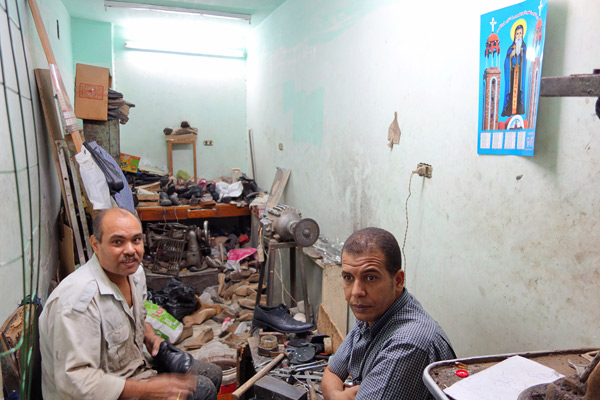
One day, I saw a cobbler doing his work in a cluttered shop. He was surrounded by shoe parts, scraps of leather, and Hindu-esque Christian posters. (Coptic Christianity, which goes back to ancient Roman times, has an exotic, Eastern flair here.) I asked him if the posters were good or bad for business, given the recent tension between Muslims and Christians. I mentioned that a Muslim serving Christians in the USA would find displaying similar Muslim-style posters bad for his business. He said it was no problem at all. Then, his customer turned to me and said, “I’m Muslim. In this community, Muslims and Christians are like one family; our roots are deep. We’ve lived together for centuries.” The cobbler said he calls his Muslim friends on Muslim holidays and his Muslim friends call him with warm wishes on Christian holidays.
But I asked another Christian, who worked at our hotel, for his take on the murder of the Christians. He said with no police power and with President Muhammad Morsi in control, perpetrators of such crimes are not brought to justice. “If we fight back they just kill us more. We pray…it’s all we can do. On Twitter Morsi says one thing in English and something entirely different in Arabic,” he said. “Many Christians are leaving.” Then he added that he, too, would leave, but it’s hard to get visa because host countries know that most Egyptians wouldn’t return.
If I was to relate this sectarian violence to the USA, its equivalent would be hate crimes. Thankfully America has an engaged police force, a populace that demands law and order, and a political landscape that wouldn’t put up with any group ignoring our hate-crime laws. In our society, if we had no police force enforcing the law, bigots, radical fundamentalists, and homophobes might be murdering doctors performing abortions or killing gay people (and, sadly, this has happened even with our legal protections). In my view, it’s not that Egypt is uniquely violent or hateful. It’s just that it’s in an interim period without an effective police force, and it has a government that can turn a blind eye to hateful and violent sentiment boiling up from their angry base (like we’ve seen some American politicians do in the past), and still remain in power.
On the women’s rights front, clearly Muslim women have not earned the same respect, freedom, and equality that their Western counterparts have. History teaches us that societies evolve on parallel tracks and in that in the horse race for equality and justice, the American horse is way ahead.
I’ve had three guides in the last week, all Muslim, Egyptian women. I’ve enjoyed talking about the women’s place in Muslim society with them. They are quick to acknowledge, “It’s a man’s world.” With the masses and mobs waving Egyptian flags and overcoming their repressive government, there have also been horrible atrocities directed at women. In fact during a Tahrir Square demonstration last January, there were at least 18 sexual assaults on women in one day. Egyptian society is riddled with extremist leaders who are both political and religious. One TV preacher said not to sympathize with “naked women who go to Tahrir Square to get raped.”


While this violence against women is inexcusable, locals I talked with blame the assaults on Muslim Brotherhood gangs who want to intimidate women into keeping out of the public arena. They say the move is backfiring. They feel that their society is supporting women, and women are speaking out more than ever. Of course, Morsi and his government are guilty of not condemning outlandish actions by their angry, frightened fringe followers. And Egyptians I met say he’s paying a steep political price.
The Muslim Brotherhood’s lack of political sophistication is the subject of widespread satire. It seems half the country looks forward eagerly to Friday evenings at 11 p.m. when the TV comedy star famous as “the Egyptian Jon Stewart” tells it like it is. My friends say, “Bassem Youssef is talking with our tongues.” The Muslim Brotherhood is trying to counter with comedy of their own, which is about as funny and effective as a Clint Eastwood monologue at a political convention.
When a sexually repressed society like Egypt almost does away with the police, and sexual assault can go on with impunity, that’s a very dangerous and disturbing trend. Still, while lots of Americans are too angry at Egypt to consider even traveling there, I think traveling here is constructive. While I am as against the society’s treatment of Christians and women as anyone, I believe that–even though Egypt’s baby democracy has been hijacked by religious conservatives for now and the police have scattered–little by little, respect and toleration will become the norm. As they would be quick to say here…inshallah.
While Alexandria, or “Alex” for short, has its ancient sites and its striking modern library, the highlight of the city for me was exploring its crusty old town: the Anfoushi district. I don’t know why, but I’m a hopeless romantic when it comes to broken concrete, faded-elegant facades, kids with big bright eyes and dirt-caked bare feet, and colorful oxcarts of produce under bare light bulbs. Alex’s thriving Souk el-Medan market street, which cuts right through Anfoushi, offers exactly that.

Photo by Trish Feaster (for her Egypt blog, see http://thetravelphile.com/).
Strolling the length of this street one evening was the most entertaining experience I can remember anywhere on the Mediterranean coast. Dangling bulbs create puddles of light, spotlighting a surreal montage of slice-of-life vignettes. A toothless man sends shoots of sugar cane five at a time into a wood chipper. Pulp poops out the back while sweet, fresh juice dribbles out the front, filling my glass. A wedding party takes over five picnic tables with a tiny band, working the multigenerational family gathering into a frenzy. We’re invited into the mosh pit to clap, bob, and dance. Teenage boys sit triple on motorbikes, rented just for an hour-long joyride of people-dodging. The cackle of dice on backgammon boards mixes with the satisfying gurgle of old men sucking on giant, bong-like shishas. For a break, we plop into an open-air restaurant for piles of grilled sea bream, bass, and prawns, with baba ghanoush, tahini, and fried eggplant, all washed down with tall glasses of mint lemon juice.

Photo by Trish Feaster (for her Egypt blog, see http://thetravelphile.com/).
After dinner, we walk on. With the street theater of Egyptian life, you can drop in and out as you like and not miss a beat. Dodging shoeshine boys and old men carrying trays of tea adds to the mix. I marvel out loud about the shared poverty (which is what I call a society with lots of ad-lib jobs that aren’t quite jobs). Tarek explains that as Egypt has no real social security, hiring these struggling people is considered kind of a societal duty for those who have the money. “We don’t shine our own shoes because it’s better to employ the man on the street. I hire a domestic servant because it helps employ that person. When I no longer need the help, it’s very hard to let a good domestic go.”

Popping out of the chaos and back onto the harborfront, we come upon a tiny children’s park. Two women entirely shrouded in black were enjoying a viewpoint with their children from the castle overlooking the Corniche. One was taking a photo of the other with both their children. I offered to take the photo so she could be in the shot, too. She said, “No, thank you. We’re both wearing a burka, so it’s not necessary — I can just pretend it’s me.”
When waved by revelers into a wedding party on the streets of Alexandria, I’d say join right in.
If you can’t see the video below, watch it on YouTube.