Here you can browse through my blog posts prior to February 2022. Currently I'm sharing my travel experiences, candid opinions, and what's on my mind solely on my Facebook page. — Rick

West Bank Necropolis

Across the Nile from Luxor is a valley with more ancient treasures than any place I’ve seen. I spent a long day visiting tombs and temples to find the best places for my upcoming TV episodes on Egypt. With the help of an excellent guide, I enjoyed Egyptian art and history more than I ever have. Here’s a bit of what I learned:

Everything I saw was art for dead people and gods. Ancient Egyptians lived on the east bank (where the sun rose) and buried each other on the west bank (where the sun died each evening). In about 1600 B.C. there was a big change in the style of tombs. Until then, kings were buried in pyramids. A string of about 70 of them are scattered along the Nile between the border of the Sudan and the Mediterranean–all on the west bank. But these pyramids were consistently being robbed, which meant kings were waking up in heaven with none of their favorite stuff. So, rather than mark their tombs with big pyramids, they started hiding their tombs in the folds of these valleys.
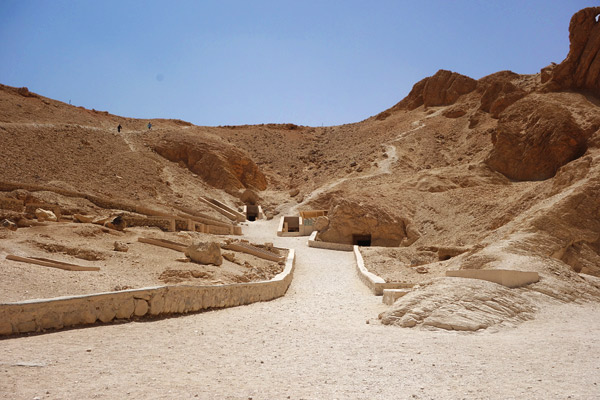
The Valley of Kings: Where pharaohs hide out while awaiting eternity.

This coincided with a new age when Egypt became an expansionist power. The money and labor saved by not building pyramids could literally populate and fund armies. The pharaohs (that’s the Egyptian word for king) buried near Luxor were aggressive leaders who conquered and ruled an empire stretching from the Sudan to Syria. Of 63 tombs found so far in the Valley of the Kings, only two were found intact. Most were plundered in ancient Egyptian times and then buried and forgotten for centuries until our age. Archeologists expect there are about a hundred tombs still awaiting discovery–and likely just a handful will be found intact.

Sights generally mobbed by tour buses are empty in 2013. Ever since a horrible massacre of tourists by terrorists at Luxor back in the 1990s, police have been stationed at every ancient sight.

It’s all about gaining eternal life. Eternity required an intact body and food for the soul’s journey. The body was mummified and hidden in the Valley of the Kings. While commoners’ tombs were simply gravel pits–traces of which you can see today–the fabulously rich and powerful kings had elaborate tombs. They were dug with long underground ramps elaborately painted, leading down to big tomb chambers deep in the mountain. The biggest fears were that a jackal would dig up and eat your body or that grave robbers would loot your stash before you made it to heaven. My guide explained, “When you fear something, you worship it. So the god Anubis is portrayed as a jackal. He’s the god of embalmers, guardian of tombs.”

Tombs with their colorful paintings, hidden in the dark and dry desert of Egypt for over 3,000 years, are remarkably well-preserved.

The soul needed nourishment to make it to the goal line of salvation. Because the body was effectively hidden in the valley–and therefore couldn’t be fed, each major tomb would have a correlating mortuary temple nearby, in full view between the hidden tombs and the Nile. This is where offerings of food were brought to the dead. While the most famous mortuary temple was that of Queen Hatshepsut, I found the much less famous mortuary temple of Ramses III, called Medinet Habu, far more visual and better for TV.

With a guide to explain the symbolism--in this case, how great Ramses III was--you learn how meaningful every inch of this carved surface is.
With a guide to explain the symbolism–in this case, how great Ramses III was–you learn how meaningful every inch of this carved surface is.

Photo by Trish Feaster (for her Egypt blog, see http://thetravelphile.com/).

There’s a separate valley for kings, queens, and nobles. We toured tombs in each. One of my favorites was the Tomb of Ramses IV for its original colors and cosmic ceiling over the burial chamber. A portrait of the dead king greets the sun god at the top of the ramp. There’s a great shot looking down the ramp to the tomb chamber with its huge granite sarcophagus (the stone was quarried in distant Aswan). Another favorite was the Tomb of Ramses III. Judging by the glamorous attire on the figures painted on the walls of his tomb, Ramses III was more of a fashionista. But the walls are all covered with glass, which will be tough to film. The very best paintings I saw were in the Tomb of Amenherkhepshef, a son of Ramses III.

The foreman of the workers who decorated the pharaoh’s tomb got a cool perk--a very colorful tomb of his own.
The foreman of the workers who decorated the pharaoh’s tomb got a cool perk–a very colorful tomb of his own.

Photo by Trish Feaster (for her Egypt blog, see http://thetravelphile.com/).

Russian Good Luck

There are a lot of Russian tourists in the Middle East these days. (Dangerous is a relative thing.) And they are famously gullible among Egyptian guides. Here’s an example.

If you can’t see the video below, watch it on YouTube.

Nile Cruise

Egyptians have always respected and loved their Nile. They say, “The Nile is our life, our water, our electricity, it fertilizes our land. Without the Nile, there would be no Egypt.” The 135-mile stretch of Nile from Luxor south to Aswan is the most touristed. Three hundred elegant river cruise ships are primed and ready to take their loads of tourists on the four-day cruise. But this terrible third season after the revolution, only about 50 are working…and most of those are sailing with as few as 10 paying passengers aboard.

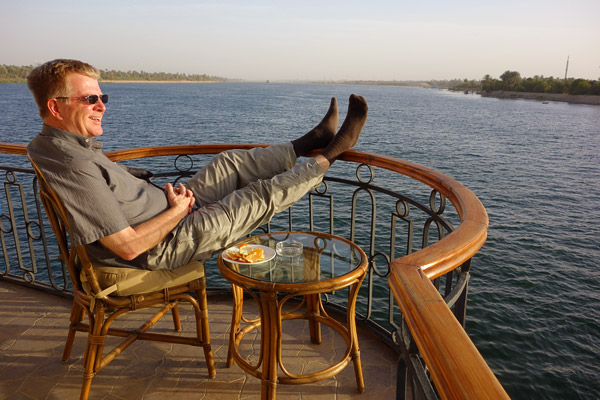
A few cruise ships still take a few tourists on lazy trips down the Nile.

We hopped a cruise ship for five hours from Luxor to Esna. The manager, eager to please this American journalist, gave us the ship’s best suite for the afternoon. We dined with the tiny group of passengers–Europeans and Aussies, no Americans–lounged around the pool on the top deck, and marveled at the idyllic passing river scenes. While not quite as glitzy as a Mediterranean cruise, it was plenty elegant.

As you cruise, small boats captained by hungry merchants lasso the ship and haggle with passengers while being dragged by the ship upstream. I’ll share a video of this amazing stunt on my next post.

Photo by Trish Feaster (for her Egypt blog, see http://thetravelphile.com/).

The beauty of this trip for me is having my Egyptian guide, Tarek (who runs “Egypt and Beyond Travel”) working to help me maximize my experience and make sure things go smoothly. We jump ship where it docked for the first night of the cruise, and our trusty van was right there, ready to pick us up.

It’s easy to get into the lazy rhythm of a Nile River cruise.

Part of the fun of having a van is having a driver to joke around with. Muhammad (it seems half the men here share that name) had mint sprigs on the seats and the air-conditioning on. I lauded him as a hero and he said, “Yes, very much” while blowing on his thumb to comically inflate his shoulders and biceps. Having just drunk a Coke, I belched–and then learned that was very rude in Egypt. I said, “It’s in our Constitution. Thomas Jefferson wrote, ‘It’s better to burp and bear the shame than not to burp and bear the pain.'” My guide said, “Very detailed.” Later, I sneezed, and he said, “When you sneeze, somebody is talking about you.”

Driving an hour north, downstream, back to Luxor, the road was very slow with police checks (generally just a wave through, locals say they appreciate them for the safety) and speed bumps every quarter mile or so. They have these because street lights are rare, and people live, work, and hang out dangerously along the roadside. It was fun to watch drivers manage without headlights–diligently flipping them on every so often to check the road. They insist on believing that it saves electricity.

Being in Egypt, with people standing around everywhere trying to earn a pathetic living, get a tip, or keep a job, you see a kind of shared poverty. It’s like that all over the developing world. Rather than employ a few people with good pay and high expectations to be productive, it seems that the work and pay is shared with many. And sometimes, it seems work is just created. Toilet paper dispensers have been put out of service so a man can stand in the restroom and hand out a couple feet of TP to each user for a tip. Of course, you’d never pump your own gas here. Stop for gas, and you’re swarmed by boys eager to help. In Luxor at the Winter Palace Hotel, I was actually given a personal butler–Ahmed. With the country empty of tourists, we always got the best room in the hotel…and there seemed to be more staff than customers.

Luxor–The City of Palaces

Luxor is an hour’s flight up the Nile from Cairo. The name means “palaces” in Arab because it was the capital of Egypt from about 1500 to 1000 B.C. Important as the city was in the days of the pharaohs, only temples and tombs–structures for the gods and the dead–survive. Buildings for real people were made of mud brick–cooler, cheaper, and quick to wash away with time. But the temples (which were made of stone) and the tombs (which were carved underground) survive in an amazing state of repair.

Luxor, with the ambiance of a city much smaller than its population of half a million, has none of the intensity of Cairo. Even with tourism down to a trickle, the town feels vibrant and the streets are much better kept. Like in ancient times, people live on the East Bank (where the sun rises). Most of the sights–being built for the dead–are on the West Bank, where the sun dies each evening.

The city faces the river with a fine riverside promenade, lots of ferries and pleasure boat traffic, huge hotels facing the Nile, and a market comprised of a single long street–its first half completely touristy and its distant half as local as can be. The streets jingle with horse carriages, which seem ultra-touristic but actually are part of the local transport scene–still a good mix of gas-powered and alfalfa-powered vehicles. Standing tall in the city of Luxor are two massive temples–the Temple of Amun at Karnak and the Temple of Luxor.


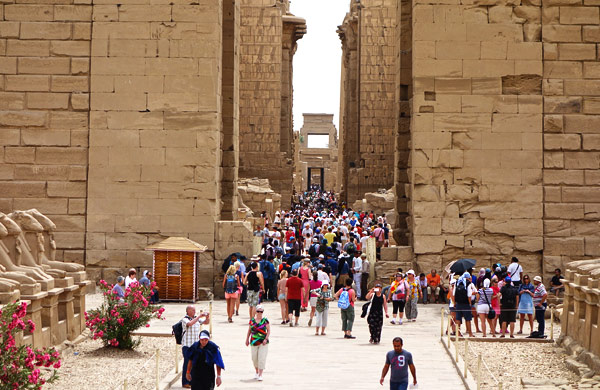
Luxor’s Temple of Amun is filled with cruise-ship travelers side-tripping in from Red Sea ports.

The vast Temple of Amun, sitting on 64 acres of land, is what guides claim is the biggest temple on earth. It honors Amun–god of Luxor, god of gods, god of empire–and was built over 2,000 years, from 2000 B.C. to the first century A.D. It’s actually a complex of three temples honoring Amun, Mut, and Khonsu–a kind of grandiose holy family…like Mary, Jesus, and Joseph but with none of the humility. A forest of 134 towering columns fills the Hypostyle Hall (from 1300 B.C.), my favorite architectural space from Ancient Egypt. It leads to “The Holy of Holies”–the ultimate high altar.

The series of grand courtyards, each separated by an equally grand pylon, is covered by finely carved reliefs which drape the place with meaning. As I walked from courtyard to courtyard, marching through towering doors, toward the Holy of Holies, I couldn’t help singing the “Get Smart” TV show theme (showing my age).


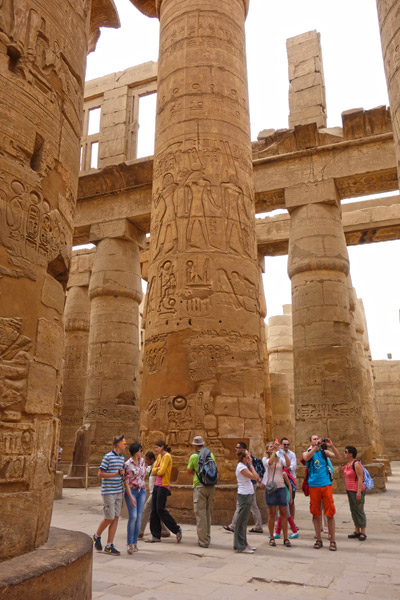
This is the towering Hypostyle Hall with each column a stack of drums: Design it, quarry it, ship it, stack it, polish it, carve it, paint it--done all for the glory and favor of the god.
This is the towering Hypostyle Hall with each column a stack of drums: Design it, quarry it, ship it, stack it, polish it, carve it, paint it–done all for the glory and favor of the god.

Gaping up at the massive, intricately designed columns–each a perfectly fitting stack of drums, I thought of the vision and work and investment that went into this: Design it, quarry it, ship it, stack it, polish it, carve it, paint it–all for the glory and favor of the god. While that religion may seem goofy, it is an impressive measure of the depth of the people’s faith. All this–built at massive expense–was not seen by the public. It was only for priests, royals, and the gods.


The Temple of Luxor is particularly awe-inspiring when visited floodlit at night.

The Luxor Temple is the second of the town’s great sights. Making sure that I sleuthed out all the best angles for our upcoming TV production, I visited it at night. Gorgeously flood-lit with towering statues of Ramses II looking down on me, it was particularly dramatic under the stars.

The Luxor Temple is all about the great warrior pharaoh, Ramses II. Exploring the temple, it’s all Ramses II, all the time. A towering obelisk stood like a victory column touting Ramses propaganda. Its sister stands in Paris. It’s impressive to think there are more ancient obelisks standing in Europe than in Egypt. They were popular gifts to European kings and big shots.