Here you can browse through my blog posts prior to February 2022. Currently I'm sharing my travel experiences, candid opinions, and what's on my mind solely on my Facebook page. — Rick
For several years, I’ve been wanting to return to the Algarve (southern Portugal), my favorite stretch of Iberian coastline. I’m generally in Iberia in April, when the beach towns are pretty dead, so I don’t bother. Being here in June this year makes a huge difference — it’s lively, warm, and a great place to relax (as I wind up an intense two-month trip). And even after all this time, my favorite Algarve town remains Salema.
The economic hard times seem to be hitting both Spain and Portugal very hard. I can see the sadness in the eyes of the people. A “tough times future” seems to be the diagnosis, and there’s no promising cure. The character of the idyllic fishing towns (like Salema) is changing. Fewer people are fishing, and government policies (regulation and taxation) have tightened up, causing the little widows to not bother renting their rooms. Gourmet restaurants and boutique accommodations are appearing in spite of the tough times, as fishing towns are becoming the playgrounds of the gated communities and golf clubs of the jet-setting international crowd, who stay on the hilltops a bit inland. Still, the children of the old fisherman — at least, the ones who don’t go to the big city in search of economic promise — continue to cook up the fish and man the weather-beaten fort. And Salema remains a delightful stop on any Iberian itinerary.
I hope you enjoy these images from my recent visit.
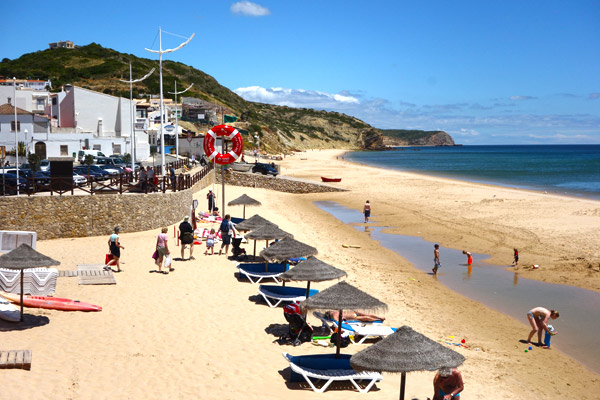
Salema, the Back Door jewel of the Algarve, comes with a delightful sandy beach overlooked by characteristic restaurants and the tranquil strum of a steady surf
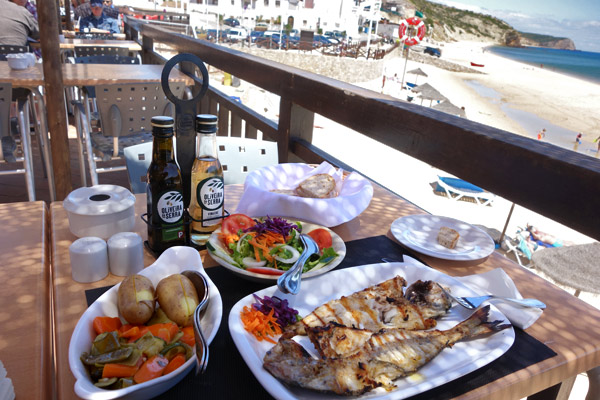
In beach resorts across the Mediterranean, competition is stiff. The fish is fresh, the vegetables are crunchy, and in the case of Portugal…the wine is green.
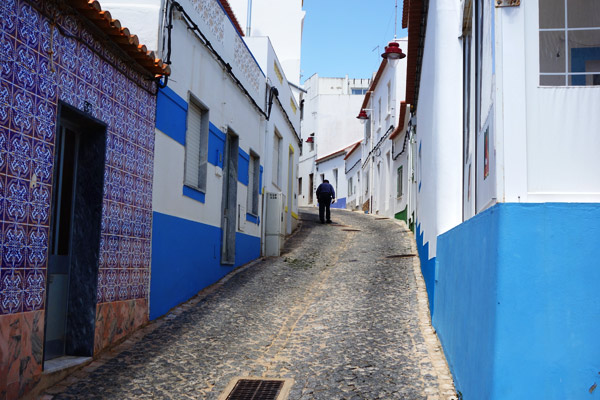
When I first came to Salema, in the late 1970s, I was driving a minibus of tourists. We’d park at the base of Salema’s “street of the fishermen” (Rua Pescador) and find rooms (quartos) in private homes for a few bucks each. Now the fishermen do more sitting and gazing at the sea than fishing (the business is done in bigger fish markets nearby, in Sagres and Lagos). The women have been terrorized out of running their small businesses by stricter (and necessary, as Southern Europe learns to pay its taxes) government regulations. There are fewer old-school, shoestring-budget backpackers to keep them in business anyway. Still, while it feels different, the street looks exactly the same.
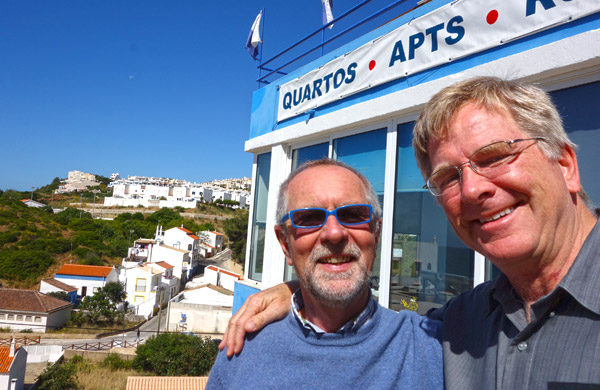
My friend John, from England, has run Pension Mare for three decades. I’ve been sending my readers there just about from the start, and we are like a team. I love his place. He lives in Bath and flew down to hang out with me as I updated my chapter on Salema. He was a great resource as I put the pieces of this town’s social puzzle together. This same weekend, John sold Pension Mare. The new owner promises to run it the same for my readers… but it’s a bit of a sad event for me.
The most horrible thing happened to me while doing my work in Rome. An evil man pretending to be me did all sorts of wicked things. It’s a long story…kind of a nightmare. But thankfully, three young and courageous girls — forces for cuisine justice — rescued me, and everything turned out OK. This video tells the saga of a day in Rome I’ll never forget.
Milano may be Italy’s no-nonsense business and banking capital, but locals still have a sense of humor. Here’s a new listing (from my upcoming Rick Steves’ Italy guidebook for 2014) about a new monument that has quickly become a fixture:
Piazza degli Affari and a towering middle finger mark the center of Milano’s financial district. The bold Fascist buildings in the neighborhood were built in the 1930s under Mussolini. Italy’s major stock exchange, the Borsa, faces the square. Stand in the center, appreciate the modern take on ancient aesthetics (you’re standing atop the city’s ancient Roman theater), and find the stern statues representing various labors and occupations, and celebrating the nobility of workers—typical whistle-while-you-work Fascist themes. Then, notice the equally bold modern statue in the center. After a 2009 contest to find the most appropriate sculpture to grace the financial district, this was the winner. Of course, Italy has its financial problems, and a similar sentiment that powers the Occupy Movement in the USA rumbles in this society as well. Here we see how “the 99 percent” feel when they stand before the symbol of corporate power in Italy. (Notice how the finger is oriented–it’s the 1 percent, and not the 99 percent, that’s flipping the bird.) The 36-foot-tall, Carrara marble digit was made by Maurizio Cattelan, the most famous—or, at least, most controversial—Italian sculptor of our age. L.O.V.E., as the statue is entitled, was temporary at first. But locals liked it, and, by popular demand, it’s now permanent.
Even though I’ve been coming to Milano for a long time, I enjoyed some great new sights on my latest visit. Here’s another first-time-ever listing that will be part of the new and improved Rick Steves’ Italy guidebook for 2014.
Art from Milan’s Gallerie d’Italia takes you back into the 19th century—even into the confession booth.The Galleria Vittorio Emanuele II was famously the first place to be illuminated with electric lights in Italy. Imagine the wonder of it all.An entire section of the Gallerie d’Italia is devoted to art of the Risorgimento (the fight for Italian unification). Here we see a touching scene of a mother and her soldier son with a portrait of the inspirational revolutionary leader, Garibaldi, on the dresser, calling all good men to war.
Gallerie d’Italia
This museum fills two adjacent palaces that were once banks with the amazing art collections of those banks. One palace dates from the 19th century and boasts the nicest Neoclassical interior I’ve seen in town; the other is 20th century—Tiffany-like Historicism, with a hint of the coming Liberty Style. Impressive buildings in their own right, they are filled with the exquisite work of 19th- and 20th-century Italian painters. One has romantic landscapes; hyper-realistic, time-travel scenes of folk life; and Impressionism. And in the adjacent palace, marble reliefs by Antonio Canova are displayed in appropriately Neoclassical rooms, while upstairs you’ll find dramatic scenes from the Risorgimento—showing the thrilling story of the unification of Italy. You can even go downstairs and peer into the original bank vault, which now stores racks and racks of paintings not on display. Cost and Hours: Free entrance, free audioguides (for as long as the bank is feeling generous), Tue-Sun 9:30-19:30, Thu until 21:30, closed Mon, across from La Scala Opera House at Piazza della Scala 6, tel. 800-167-619, www.gallerieditalia.com.
I capped my Italy travels this year in the great city of Milano. And even though I’ve been coming here for a long time, I enjoyed some great new sights. Here’s a first-time-ever listing that will be part of the new and improved Rick Steves’ Italy guidebook for 2014.
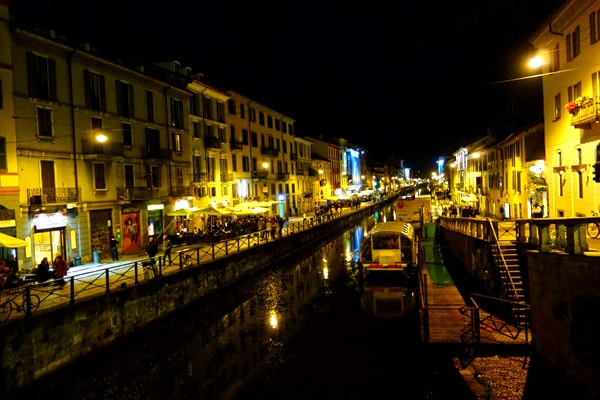
Milan’s rejuvenated old industrial canal is becoming one of the city’s top nightspots.
Naviglio Grande
Milan, while far from any major lake or river, has a sizable port. It’s called “The Big Canal.” Since 1170, a canal has connected Milan with the Mediterranean via the Ticino River (which flows into the Po River on its way to the Adriatic Sea). Five hundred years ago, Leonardo helped further develop the city’s canals and designed a modern lock system. Then, during the booming Industrial Age in the 19th century—and especially with the flurry of construction after Italian unification—the canals were busy shipping in the marble and stone needed to make Milan the great city it is today. In fact, a canal (filled in in the 1930s) once circled the walls of the city and allowed barges to dock with their stone right at the building site of the great cathedral. And in the 1950s, landlocked Milan was actually the seventh-biggest port in Italy, as its canals were instrumental in the rebuilding of the bombed-out city. Today, disused train tracks parallel the canal, old warehouse buildings recall the area’s working-class heritage, and former workers’ tenements—once squalid and undesirable—are much in demand and being renovated smartly. While recently rough and characteristic, today the area is trendy, traffic-free, and pricey—thriving with inviting bars and eateries.
The canal district, with its lively restaurants and bars lining the old industrial canal that once so busily served the city, is an understandably popular destination for dinner or evening fun. To get here, ride the Metro to Porta Genova, exit following signs to Via Casale, walk the length of Via Casale one block directly to the canal, climb halfway across the metal bridge, and survey the scene. To the left, on both sides of the canal, are plenty of great places to eat and drink. The best bars line the canal within a half-block of the bridge.
Eating at the Canal
Consider ending your day at the port of Milan. The Naviglio Grande has a bustling collection of bars and restaurants where you have your choice of memorable and affordable options that will come with a great people scene.
La Vineria is a fun place, serving wine from giant vats and cheap and fun plates of cheese and meats to a cool crowd with streetside seating (open daily, June-Sept dinner only from 15:30, Oct-May lunch and dinner except no lunch on Mon, Via Casale 4, tel. 02-8324-2440).
Pizzeria Tradizionale is a local favorite for pizza (open daily, at the far end of canal walk, Ripa di Porta Ticinese 7).
Ristorante Brellin is the top romantic splurge, with a dressy crowd and fine food. The menu is international while clinging to a bit of tradition (€14 pastas, €24 secondi, daily 12:30-15:30 & 19:00-24:00, behind the old laundry tubs at Vicolo dei Lavandai, tel. 02-5810-1351, www.brellin.it).
Osteria Cucina Fusetti is a charming little place serving good Sardinian cuisine. What’s that? Giuseppe speaks English, and enjoys explaining (€8 pastas, €15 secondi, closed Sun; near the curved bridge with the zigzag design at the Japanese restaurant, go away from canal to Via Fusetti 1; mobile. 340-861-2676).
Pizzeria Spaghetteria La Magolfa is a local fixture offering good, cheap €5 salads, pastas, and pizzas. You can sit inside, on a veranda, or at a table on the street. For €15, two people could split a hearty pizza and a good bottle of wine and get full…and a bit drunk (no cover, a long block off canal at end of Via M. Fusetti at Via Magolfa 15, tel. 02/832-1696).