Here you can browse through my blog posts prior to February 2022. Currently I'm sharing my travel experiences, candid opinions, and what's on my mind solely on my Facebook page. — Rick
Continuing on our Northern European cruise, we enjoyed a classic cruise day in Oslo. Our cruise ship docked right in Oslo’s harbor, and we popped off the ship to see the city before “all aboard” at the port. Photos by Trish Feaster, see her blog at The Travelphile.com.
When I was a 14-year-old kid, traveling through Europe with my parents, one of my best memories was sleeping on the ship from Copenhagen to Oslo and waking up to the pristine Oslofjord. Sitting on the deck and enjoying the Norwegian scenery — the land of my grandparents — for the first time was a delight. So, forty-plus years later, sailing down this same fjord was a wonderful travel déjà vu. That evening, sailing south, the fjord scenery was just as beautiful.Oslo is a relatively small city, and seeing the sights is easy. Facing the harbor is the City Hall. Built with Norwegian materials and Norwegian talent, it’s the pride of the city.Throughout Europe, heavy industry is moving away from the costly city-center real estate, and industrial harborfronts are being dug up and turned into people-friendly parklands. If there’s an industrial wasteland where a great European city hits the harbor — Oslo, Copenhagen, Hamburg, Antwerp, Barcelona, Cardiff, you name it — it’s slated for a major work-over. In a few years, Oslo’s waterfront will be a five-mile-long strolling and biking promenade — with nearly all the noisy traffic zipping through the city in underground tunnels.Each morning, a giant cruise ship ties up just next to the sparkling new Oslo Opera House. As thousands of visitors pour out of the ship and into the city, many explore this striking new icon on the skyline of Oslo. We happened in just as the fine, hour-long English tour was departing. Sure, it costs money — but how do you put a price on bringing high culture to an entire city? Artisans were sewing costumes and making stage sets, musicians were practicing, children were at ballet lessons, schools were attending matinées performances…the place was a hive of activity.In Oslo’s main train station, I was impressed by the modern departure boards and how people-friendly the place was. This was just a 10-minute walk from our cruise ship.Oslo gathers around its main street, Karl Johans Gate, which runs from its royal palace on the hilltop to the main train station. Oslo is so expensive that people share their drinks and munch sandwiches on park benches. It seems you chew slower and order smaller quantities here in Norway. Still, there’s lots of fun and color in the streets to enjoy. And the best museums and sights (such as City Hall, the National Gallery, and Frogner Park with Vigeland’s evocative sculptures) are free. These yogis who levitate their partner gather crowds all over Europe. People ask, “How do they do it?” (The stunt is made possible by a steel frame that the lower guy sits upon; the frame goes up his arm, and then around to support his partner up in the air.)
Our two cruise ports guidebooks (for both the Mediterranean and Northern Europe) are derived from our existing country guidebooks. To make them, we tailor existing chapters from these guidebooks to the needs of the independent-minded cruise traveler and assemble them in special editions so people can buy a single book rather than several to cover their itinerary. And my main research focus on this trip will be the ports.
Northern European ports lend themselves to independent travel. In many cases (including certain ports in Tallinn, Bergen, Oslo, and Copenhagen), they’re right in the city center and an easy walk from the sightseeing action — and when they aren’t, there’s good public transportation to the center of town. The ports themselves are generally not pretty, but mighty — industrial zones giving you a very honest look at the workings of these great cities. (Photos by Trish Feaster, see her blog – The Travelphile.com.)
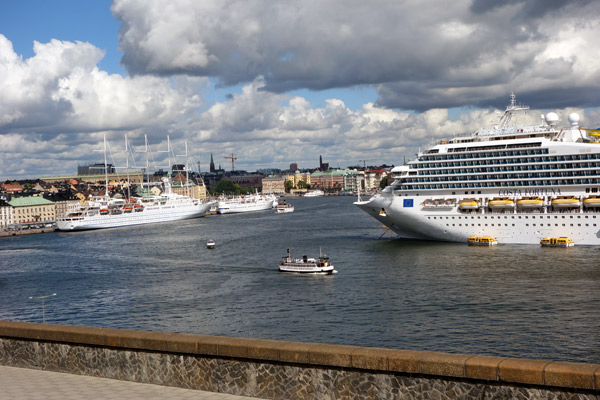
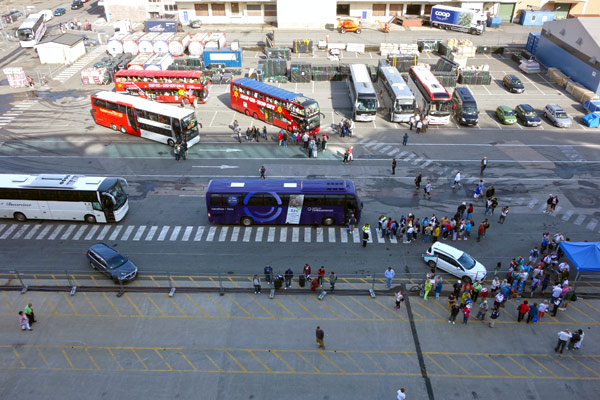
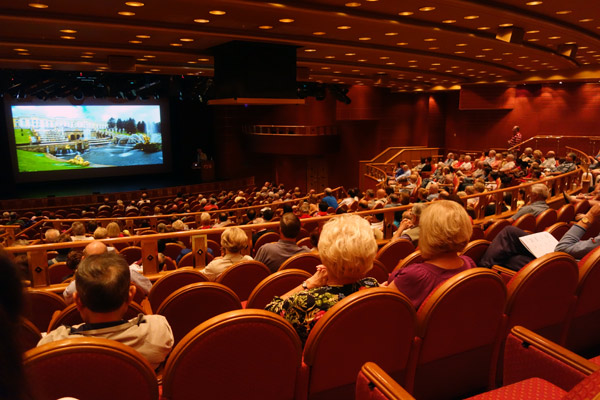
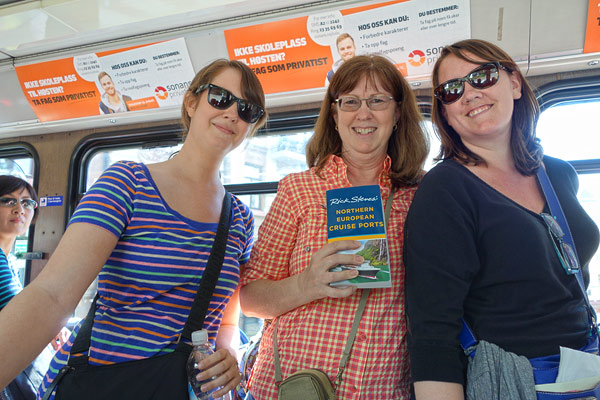
This is Stockholm, where, as in many cities, there’s a cruise dock in the center and a bigger one a bus ride away. Smaller and more expensive ships often dock right downtown, while most of the full-sized ships dock in the industrial zone farther out. You almost never drop anchor and use tenders to get ashore in Northern Europe — although in this shot, a big ship has dropped its hook just off Stockholm’s Gamla Stan (old town).Cruise ports work hard to organize the masses. There are clear charts of each port (like this one for Copenhagen), shuttle buses if necessary, small temporary tourist information tents that are set up when a ship is in, and even painted lines in the pavement that take the guesswork out of getting to and from the town center.Each ship dumps off thousands of tourists, raring to have the best seven or eight hours possible in each port. Just off the gangplank, you’ll find several options: Tour buses awaiting those who signed up for ship-sponsored excursions (the standard option); hop-on, hop-off buses for budget and independent travelers (all-day, $25 tickets cover a 90-minute loop with a recorded narration, and include hop-off-and-on privileges as buses come by about every 20 minutes all day); public buses dedicated to connecting cruisers with the town center; and taxis (both standard and minibus — economical for small groups).Princess Cruise Lines puts a big effort into helping its cruisers be prepared for each port (better than the other lines I’ve sailed with). On the Emerald Princess, our ship lecturer was John Lawrence, who has decades of experience cruising Northern Europe and knows each port intimately. Each evening, John gives a talk to a full theater about the next day’s port of call. That talk would then air repeatedly on the ship’s TV station. John even provided a live, guided narration of the most scenic stretches of island scenery we passed (like the archipelago we sailed through leaving Stockholm).As I had to have my hot-off-the-press copy of our Rick Steves’ Northern Europe Cruise Ports guidebook expressed to me in Copenhagen, I was surprised to find this family with the brand-new book in hand. After two years in print, our Rick Steves’ Mediterranean Cruise Ports guidebook is already the leading seller for that region. It’s my hope that this book will be a hit, too. Judging from the fun these travelers were having with the help of our new book, I think we’re on the right track.In each city, when it comes to tour guides, it’s all hands on deck when a cruise ship docks. I tagged along on this young man’s tour on a cruise excursion from Warnemünde (Germany), and he was great. Perhaps I enjoyed it so much because he seemed like he could be my son.If there are 3,000 tourists relaxing on vacation, it’s because there are over a thousand crew members working day and night to keep them fed, watered, and clean. I have always been very impressed by the crews of our ships. Most are from the developing world and work very hard for low wages plus tips to support families they left behind. Our ship was staffed by several dozen nationalities, but mostly by Filipinos. Most ports have a special lounge for crew members, who make a beeline there to get online cheaply and connect with loved ones back home. Tourists are welcome to use the same cheap Wi-Fi service at these port lounges (which is a big help, as on-ship Wi-Fi is notoriously expensive and slow).
To fine-tune our newest guidebook, Rick Steves’ Northern Europe Cruise Ports, I’m taking a Princess Cruise that hits many of the major ports. Our route: We start in Copenhagen, and then (sleeping on board each night and spending one day per port) we visit Oslo, Aarhus, Warnemünde (Berlin), a day at sea, Stockholm, Helsinki, and St. Petersburg, where we leave the ship early to do some exploring. (Without us, our ship stays two days in St. Petersburg — the only two-day stop — before a day in Tallinn, and a day at sea returning to Copenhagen.) Here are a few photos from our first few hours on board.
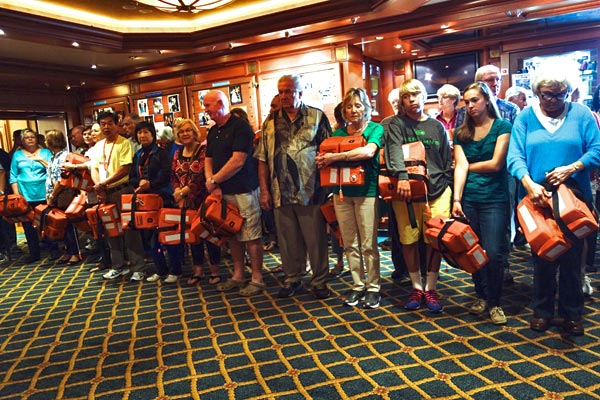
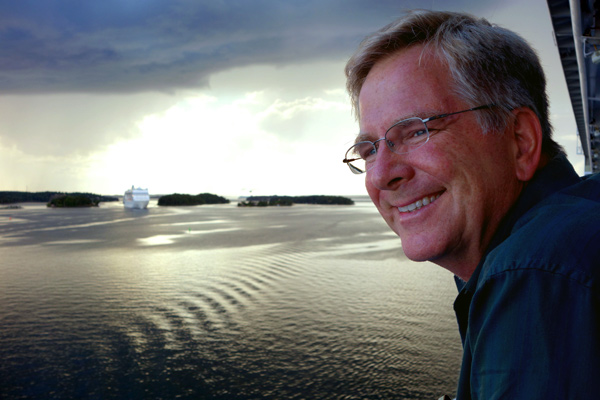
Our beautiful ship, the Emerald Princess, sailed full with over 3,000 passengers. Princess Cruise Line ships are known for having lots of private decks — something I really enjoyed, as there was so much scenery and it was light until late at night at these Alaskan latitudes.The first face I saw as we checked in came with a big smile, and over the entire cruise, we enjoyed nothing but friendly and happy crew.With big ships typically carrying over 3,000 passengers and everyone sharing their gripes online, cruise lines work very hard to avoid any congestion. Here at the embarkation port in Copenhagen, a long line of stations made sure no one had to wait to check in. In four cruises I’ve enjoyed lately, I’ve been impressed by crowd management. There’s almost never a congestion problem. In fact, very often I marvel at how empty the big ship feels — even though they are always sailing full.Each cruise starts with the safety drill, with everyone reporting to their “muster station.” It’s fun to see everyone decked out in life vests. While they explain how, in the event of an emergency, we’ll all remain calm and walk to our assigned station, I can imagine pandemonium breaking out if there were a problem.If you have to abandon ship, don’t jump off. Just step off. And plug your nose and hug your vest so it doesn’t hit you in the face.My partner, Trish Feaster, is a better photographer than I am. And with Trish in charge of photos, I’m free to take notes. We both use a Sony Cybershot RX-100. Nearly all of the photos you’ll see in the next couple weeks of entries were taken by Trish. To enjoy her take on our travels and lots more great photos, see her blog at www.thetravelphile.com.A great thing about cruising Scandinavia and the Baltic Sea is the island scenery. I’m all moved in. We’ve scouted the ship. And we’re ready to enjoy our Princess Cruise Line’s Best of Northern Europe cruise. Thanks for sailing with us.
Northern Europe (Scandinavia and the Baltic Sea) lends itself to cruising–that’s why it was a natural destination for my new cruising guidebook. While in most cases the ship ties up right in the city center, the “port of Berlin” is an exception. Cruisers visit Berlin by the tens of thousands via the northern German port town of Warnemünde, which is a whopping 150 miles away. From Warnemünde, cruise lines charter buses or trains (in the case of my cruise, two entire trains), and over a thousand travelers from each ship get an early start and make the three-hour trip to the German capital for a busy five hours before hopping back on the same train or bus for the three-hour return trip. It’s a long day, but if you’ve never seen Berlin, it’s a real hit. While I didn’t make the excursion south, everyone I talked to enjoyed their day. I stayed in the north, visiting Warnemünde, a beach town with a popular boardwalk; and Rostock, less than a 30-minute train ride away.
The cruise port of Warnemünde feels made-to-order for the arrival of cruise ships. Here you see the port, the terminal building (with exchange desk, tourist info, clichéd bars and eateries, and souvenir shops), buses gathering for various excursions, the train station (where private trains chartered by the cruise line await to whisk their cruise travelers south)…and the town itself, awaiting your business.Northern German beach resorts feel a bit like English ones: prepared for bad weather. Here, the beach is decorated with traditional rentable windshield lounge chairs.
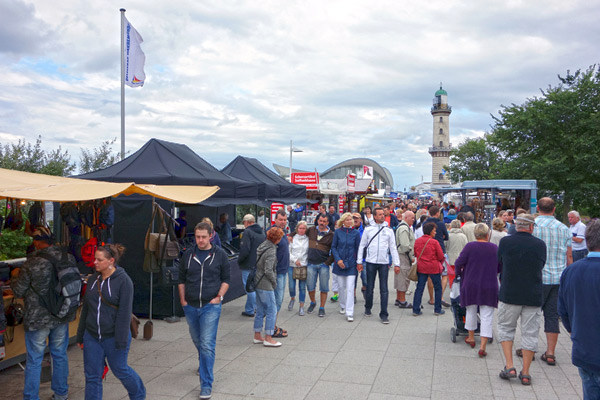
Even on a blustery day, the promenade of Warnemünde was packed with people bundled up and out looking for a nice sausage.Rather than spend six hours on the train side-tripping to Berlin, I toured Rostock, which has a rustic Hanseatic League flavor evoking a day when it was an economic powerhouse.
I’m on a Baltic Sea cruise, taking my brand-new Rick Steves’ Northern European Cruise Ports guidebook on its maiden voyage. The fun thing about cruising is that every morning when you look out your window or step out onto the deck, it’s a different great city. While land travelers often see only the fairy-tale half-timbered centers, cruisers are not shielded from the economic realities of keeping a city fed and powered. Ports are busy industrial machines…and you become part of them. Here’s my first look at Warnemünde, the port on the northern coast of Germany, from where most cruise travelers catch the train into Berlin.
If you can’t see the video below, watch it on YouTube.