Here you can browse through my blog posts prior to February 2022. Currently I'm sharing my travel experiences, candid opinions, and what's on my mind solely on my Facebook page. — Rick

My Holy Land Shoot Finally Arrives

For the last year, my usual laser focus on Europe has been diverted with preparation for our Holy Land shoot. With our regular TV production in Europe, I do the scouting, rough up the script, and line up local contacts as I research my guidebooks. With our Iran special in 2009,  we wrote the script pretty much on the fly as we were filming. But for the Holy Land, I dedicated a special trip this spring just to sort through the options and come up with a plan. While this project has distracted me from my normal work, I have great hopes to help my American audience understand (as much as a travel writer/TV producer can) the context of the problems in this notoriously troubled part of the world. And now, I’m thrilled at the opportunity to take our crew to the Holy Land.

For our shoot, we have a week in Israel followed by about a week in Palestine. El Al Airlines flew us from LA to Tel Aviv (non-stop in 15 hours, amazingly efficient and comfortable), where my producer Simon Griffith (middle) and I were met by our Israeli guide, Benny Dagan (left). Benny — a former press relations officer in the Israeli army and a very experienced guide — was my guide in April, and he was my first choice to be with us in the countryside of Israel. Considering his life experience, I can’t imagine a better person to share the Israeli narrative.
The port city of Jaffa is the Ellis Island for Zionism — the place where many Jews joyfully first set foot in the homeland of their ancestors after the creation of the modern state of Israel in 1948. Overlooking the dazzling skyline of Tel Aviv (a city created from sand dunes by Israelis in the last century), I huddle with my crew — cameraman Karel Bauer, producer Simon Griffith, and guide Benny Dagan — to finalize the writing of an "on-camera" bit I’m about to do. (By the way, many of the photos you'll see here were artfully taken by one of our cameramen, Dean Cannon, who has generously let me use them. Thanks, Dean!)
The port city of Jaffa is the Ellis Island for Zionism — the place where many Jews joyfully first set foot in the homeland of their ancestors after the creation of the modern state of Israel in 1948. Overlooking the dazzling skyline of Tel Aviv (a city created from sand dunes by Israelis in the last century), I huddle with my crew — cameraman Karel Bauer, producer Simon Griffith, and guide Benny Dagan — to finalize the writing of an “on-camera” bit I’m about to do. (By the way, many of the photos you’ll see here were artfully taken by one of our cameramen, Dean Cannon, who has generously let me use them. Thanks, Dean!)
The Mediterranean coast of Israel is densely populated, and perhaps its most beautiful city is Haifa — famous as a place where modern Jewish Israelis and Arab Israelis (about a quarter of the population) can work and play together without the baggage of the religious and political tensions. The gorgeous foreground is the Baha'i shrine gardens. The center of the Baha'i faith is in Israel, but there’s so much to jam into a 30-minute show, it didn’t make the cut.
The Mediterranean coast of Israel is densely populated, and perhaps its most beautiful city is Haifa — famous as a place where modern Jewish Israelis and Arab Israelis (about a quarter of the population) can work and play together without the baggage of the religious and political tensions. The gorgeous foreground is the Baha’i shrine gardens. The center of the Baha’i faith is in Israel, but there’s so much to jam into a 30-minute show, it didn’t make the cut.

Exploring Israel and Palestine — In Search of Understanding (and Some Great TV)

Earlier this month, my crew and I flew to Tel Aviv to film three new public television shows on the Holy Land: individual half-hour episodes on Israel and Palestine (part of our new eighth season of Rick Steves’ Europe, premiering in October of 2014); and an hour-long special on the Holy Land as a whole, designed to give context to the challenges of that region, and to help viewers better understand and empathize with the people sharing it (scheduled to air in mid-2014).  Over the next month or so, I’ll be posting every day right here about my experiences filming these new shows.

Hearing about my travel plans, several people have asked me whether I really want to wade into the quagmire of Israel and Palestine, where it seems like anyone who probes for the truth will anger people on one side or the other. Believing that the vast majority of Americans are not partisan on the issues here — and emboldened by the burgeoning movement among Palestinians and Israelis to find an enduring solution that gives dignity and security to people on both sides of the divide — I think this is an exciting and timely project. And, frankly, I’m tired of extremists exploiting social media to exaggerate their numbers, creating the illusion that a vocal fringe of our society is more legitimate than it actually is. With these new shows, my only agenda is to appeal to open-minded people who simply want to do some armchair travel, hear a variety of perspectives, and be given the opportunity to form their own opinions.

I was in the Holy Land this spring scouting for these new shows. Now I’m excited to head back and start shooting with our crew: my producer, Simon Griffith; two cameramen, Karel Bauer and Dean Cannon; and a cadre of both Israeli and Palestinian local guides, drivers, and helpers. We’ll be working in Jerusalem (bursting with history and culture); Tel Aviv and Haifa (so joyful and full of modern life); and Masada and Yad Vashem (which give poignancy to the Jewish struggle, from Roman times to the Diaspora to our own generation). Then, heading into the West Bank, we’ll be curious sightseers in Bethlehem, Hebron, Jericho, Nablus, and Ramallah — experiencing “reality travel” in places almost completely unknown to most Americans. We’ll walk in the sandal-steps of Jesus with Christian pilgrims at the Sea of Galilee, taking Bible stories to a new level. And we’ll learn about the Separation Wall and the settlements that vex the desire for peace.

With the help of local Israeli and Palestinian guides, we’ll make a point to listen to local voices on both sides of the issues. In Israel, I’ll be wearing my yarmulke and eager to learn. And in Palestine, I won’t be wearing my keffiyeh — but I’ll be equally ready to learn.

After several weeks of traveling throughout the Holy Land this year, it’s my hunch that the majority of both Israelis and Palestinians have come to the conclusion that violence is not the answer. And I believe that, while any sane person wants peace, a wise person understands there can be no real peace without justice. Like the destinations themselves, these themes will prove to be a fascinating area to delve into.

The Holy Land — which is “holy” to about a third of humanity — is a richly rewarding place to travel. Join me right here over the next month, as I’ll be posting every day about my explorations of this fascinating land. And share a link with your friends who might be interested in traveling along. Together, we’ll strive to overcome fear with understanding.

Happy travels!

DSC01693

Spray-Painting Vienna

My niece, a street artist in New York City who goes by the name Nicolina, is off on another trip adding color to Vienna, Venice, and Naples. I’m so inspired by her waif-with-a-paint-brush (or, in her case, can of spray paint) approach to travel and the way she writes about her adventures, that I’m re-connecting her personal blog to our travel site. Not many of us will travel with just a satchel of art tools, nearly no money, and no hard plans, but we can all be inspired by Nicolina’s spirit of adventure and love of art.

Nicolina, who just finished decorating a series of unused doors in New York City (a project Nicolina and her “Free Art Society” calls “13 Portals”), is in Vienna now scouting for an interactive public art installation she’ll create next year. Then she heads to Venice for the Biennale (a gathering of avant-garde artists from around the world), and finally to Naples. While in Naples, she has a commission from the city to paint one of the city’s traditional trolleys as she did to great acclaim in Valparaiso, Chile. In Naples, she’ll also host “Hearts of the World,” a project Nicolina has taken all around the world letting (often very poor) children fill in the outline of an anatomically correct heart with whatever is in their hearts. The intent of “Hearts of the World” is to introduce art as a tool to help people realize their passion.

Nicolina has taken her passion for street art to Cuba, Haiti, Chile, Brazil, China, and India. Now she’s in Europe for her first time. As she writes, “It’s fun to dive into a city not really knowing what to expect. Free of preconceived ideas, a new world opens up to you.”

Nicolina will be blogging (follow her on her site or from the home page of ricksteves.com). I promise you, you’ll travel through Vienna, Venice, and Naples in a way you’ve never even imagined.

Nicolina-01

Nicolina-02

Nicolina-03

Nicolina-04

Rick Steves’ Radio Gets the Gold

This year the Society of American Travel Writers recognized my public radio show Travel with Rick Steves with a prestigious Lowell Thomas Award Gold Medal. While perhaps not as well-known as my guidebooks and television show, my weekly radio show is one of my favorite endeavors. Rather than being the guide, I get to be the curious traveler–I act as a conduit between experts on travel/cultural topics and my traveling listeners.  We’re in our eighth year and air on over 200 stations, so I’m thrilled this show and its talented production crew are getting the recognition they deserve. Here’s a huge thanks to the show’s producer–Tim Tattan–and his production assistants–Sarah McCormic and Isaac Kaplan-Woolner. This show is great because of their hard work and expertise.

In particular, the award committee recognized our 2012 Mother’s Day episode that followed a mom as she relocated her family to a village in Croatia, an American raising her first child in Paris, and a tribute to my own mother after her death in 2011. You can listen to it below.

Our weekly program is available free to any public radio station, so if your station isn’t airing it, ask them why. You can also go to my radio show to browse our archive and subscribe to our podcast. All my interviews are a simple click away.

Congrats again to Tim Tattan and his staff for crafting a beautiful program.

Even More Vintage Photos: European Tours Edition

In 2013 we took over 16,000 North Americans through Europe on more than 600 tours. But a few years ago, 100 travelers in one year was a goal hard to imagine. Here are a few photos from those days:

I escorted this small group along on a big tour, serving as an unofficial guide within the confines of a typical, 50-person bus tour. Our motto was, “If you feel the urge for an American-style breakfast, beat it to death with a hard roll.” It was during these early trips on mainstream, cheap, big-bus tours that I dreamed up my tour program--it inspired me to start leading my own tours.
I escorted this small group along on a big tour, serving as an unofficial guide within the confines of a typical, 50-person bus tour. Our motto was, “If you feel the urge for an American-style breakfast, beat it to death with a hard roll.” It was during these early trips on mainstream, cheap, big-bus tours that I dreamed up my tour program–it inspired me to start leading my own tours.
In the mid-1970s --while my group was sitting through a waltz concert--I was having a drink in this Viennese cafeteria, thinking that this was lame travel. There’s got to be a more honest and experiential way for Americans to enjoy Europe. It was in moments like these that I compared the potential magic of travel to the standard experience most American tourists were getting. I decided there was a big need for a better option, and I wanted to provide it.
In the mid-1970s –while my group was sitting through a waltz concert–I was having a drink in this Viennese cafeteria, thinking that this was lame travel. There’s got to be a more honest and experiential way for Americans to enjoy Europe. It was in moments like these that I compared the potential magic of travel to the standard experience most American tourists were getting. I decided there was a big need for a better option, and I wanted to provide it.
This was one of the first Europe Through the Back Door tours, back when I wore plaid in Europe. The standard breakdown: me and eight women.
For years my entire tour program consisted of me driving a series of minibuses around Europe. Picnics were a big part of our diet.
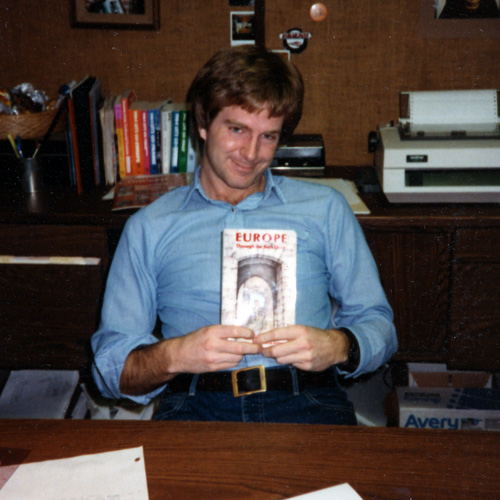
After leading tours for a few years, it occurred to me that I could take the strategies and skills I employed in leading tours and incorporate them into a guidebook. That way, independent travelers could travel smarter on their own. Glassy-eyed, like a mother embracing a newborn infant, I’m cradling the fourth edition of Europe Through the Back Door--still warm from the press. After three amateurish, self-published editions, this was the first done with a publisher.
After leading tours for a few years, it occurred to me that I could take the strategies and skills I employed in leading tours and incorporate them into a guidebook. That way, independent travelers could travel smarter on their own. Glassy-eyed, like a mother embracing a newborn infant, I’m cradling the fourth edition of Europe Through the Back Door–still warm from the press. After three amateurish, self-published editions, this was the first done with a publisher.