Here you can browse through my blog posts prior to February 2022. Currently I'm sharing my travel experiences, candid opinions, and what's on my mind solely on my Facebook page. — Rick

Daily Dose of Europe:  Living History  

In my travels, I love to connect with people — including ones who actually lived through the local history and make it real for me. I can’t wait to get back to Europe and have more of these unforgettable experiences.

Travel dreams are immune to any virus. And, with  so many of us stuck at home,  I believe a daily dose of travel dreaming can  actually be  good medicine. Here’s another one of my favorite travel memories — a reminder of what’s waiting for you in Europe  at  the other end of this crisis.

On one of my earliest trips to Europe when I was just 14 years old, a family friend in a dusty village on the border of Austria and Hungary introduced me to a sage old man. I remember thinking he was a caricature of a classic old Austrian, with a handlebar moustache, a wardrobe that looked like it was stolen from a museum, and an intricately carved pipe. Spreading lard on rustic bread, he shared his eyewitness account of the assassination of Archduke Franz Ferdinand in 1914, which sparked the beginning of World War I. I leaned forward with awe as he described the motorcade, the archduke and his wife in an open car, the explosion of gunfire, and the hysteria that followed. That encounter, beside an onion-domed village church and in the shadow of the Iron Curtain, helped spark in me a lifelong interest in history.

Decades later in Prague, I walked with my Czech friend Honza down the path that he walked in 1989 with 100,000 of his countrymen, demanding liberation from their Soviet overlords. Stopping in front of a grand building, Honza said, “Night after night we assembled here, pulled out our keychains, and all jingled them at the President’s window, saying, ‘It’s time to go home now.’ Then one night we gathered…and he was gone. We had won our freedom.” Hearing Honza tell this story as we walked that same route he did all those years ago made me understand — and really feel — the jubilation of a small country winning its hard-fought independence.

As an advocate of freedom, I made a pilgrimage to the Gdańsk Shipyard where the Polish shipbuilders’ union, Solidarity, was born, marking the beginning of the end of the USSR — and communist rule of half of Europe. Standing at the gate under a “Solidarity” banner hanging where the big letters “LENIN” once were, I met a retired worker who walked with us to the adjacent monument. As my guide translated, the man told us of the part he played in this pivotal fight for workers’ rights.

He explained that when Solidarity negotiated its way to victory in 1980, one of their conditions was that the Soviets let Poland erect a monument to workers killed a decade earlier while demonstrating for those same workers’ rights. The government agreed, marking the first time a communist regime ever allowed a monument to be built to honor its own victims. Lech Wałęsa called it “a harpoon in the heart of the communists.” The towering monument, with three crucified anchors on top, was completed just four months after the historic agreement was signed. It was designed, engineered, and built by shipyard workers — and our new friend was one of them. The trio of 140-foot-tall crosses still honors his martyred comrades today on Gdańsk’s Solidarity Square. When you visit, there’s a good chance that someone who helped build it — someone who stood up to tyranny and helped change history — will be there to tell the story.

In Northern Ireland, my guide Stephen made his country’s struggles come alive for me when he took me to Belfast’s Felons’ Club. Stepping through a black metal security cage to reach the door, he whispered, “Membership here is limited to those who have spent at least a year and a day in a British prison for political crimes…but I think I can get you in.” Once inside, I was spellbound, listening to heroic stories of Irish resistance while sharing a Guinness with a celebrity felon. His gift of gab gave me a deeper under-standing of their struggles. The next day I walked along the green-trimmed gravesites of his prison-mates. Because of my time at the Felons’ Club, I better understood what these people sacrificed — why they starved themselves to death for the cause of a united Ireland.

My uncle Thor lived through the Nazi occupation of Norway. He took me into Oslo’s grand City Hall to show me the huge “Mural of the Occupation” and share his story of those dark days with the visual support of powerful art. Walking slowly, with a soft voice, he narrated the story scene by scene in the present tense — as if the mural told his personal experience as it was happening: “The German blitzkrieg overwhelms our country. Men head for the mountains to organize a resistance movement. Women huddle around the neighborhood well, traditionally where news is passed, while traitors listen in. While Germans bomb and occupy Norway, a family gathers in their living room. As a boy clenches his fist and a child holds our Norwegian flag — we love it so much — the Gestapo storms in. Columns lie on the ground, symbolizing how, by closing newspapers and the university, Germans did what they could to shut down our culture. Finally, years later, the war is over, prisoners are freed, and Norway celebrates its happiest day: May 17, 1945.” Thor’s voice cracked as he added, “Our first Constitution Day after five years under Nazi control.” He finished by waving his arm wide and saying, “And today, each December, the Nobel Peace Prize is awarded in this grand hall.”

We can go to places like Austria, the Czech Republic, Poland, Northern Ireland, or Norway to do some sightseeing yet learn nothing of their people’s lives or their struggles. Or we can seek out opportunities to connect with people who can share eyewitness stories. Travel can — and should — change our perspectives and broaden our worldviews.

(These daily stories are excerpted from my upcoming book, For the Love of Europe — collecting  100  of my favorite memories from a lifetime of European travel, coming out in July. It’s available for pre-order. And you can also watch a video clip related to this story: Just visit Rick  Steves  Classroom  Europe and search for “prague communism”).
Daily Dose of Europe:  Estonia — The Song of Freedom

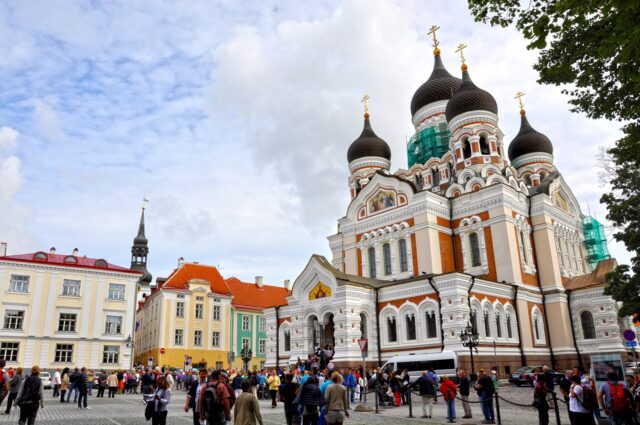
I was a piano teacher before I was a travel teacher. And I find a special spirit in Estonia, where the people celebrate their cultural identity by singing.

Travel dreams are immune to any virus. And, with  so many of us stuck at home,  I believe a daily dose of travel dreaming can  actually be  good medicine. Here’s another one of my favorite travel memories — a reminder of what’s waiting for you in Europe  at  the other end of this crisis.

In Tallinn, my guide Mati suggests that we visit the cemetery just outside of town. As we arrive and step out of his beat-up Soviet-made car, I realize this is no ordinary cemetery. The lovingly tended tombs are scattered throughout a dense pine forest.

“Estonia is a thickly forested country,” Mati explains. “Many Estonians see trees as spiritual. Since ancient pagan times, we have buried our loved ones with the trees. We are people of the trees. This is one way we are still connected with our pagan past…still uniquely Estonian.” Walking under these towering trees makes me think about the Estonians’ connection to their land and heritage.

It’s amazing what a stretch of water can do. The Baltic Sea separates Estonia from Sweden and Finland. The struggles of the last couple of generations couldn’t be more different on these opposite shores. When I visited the Baltic states back in the 1980s, labor was cheaper than light bulbs. While I was touring museums, an old babushka would actually walk through the museum with me, turning the lights on and off as we went from room to room.

Those days are long gone. Estonia’s busy capital, Tallinn, is like a petri dish of capitalism. Since winning its freedom in 1991, the country has blossomed. Mati brags that Estonia has the strongest economy, most freedom, and highest standard of living of any republic that was part of the USSR. He says that by some measures, Estonians are now one of the freest people on Earth.

Mati points out the great irony of Russia’s communist experiment. Russia, once the supposed champion of radical equality — as far as Leninism and Marxism were concerned — is now infamous for having the worst inequality. In the dirty derby of unequal wealth distribution, Russia is one of only a few countries to actually beat the US. Estonians are better off today than Russians not because they have more money per capita (they don’t), but because the wealth in this country is distributed much more evenly. Mati, who’s spent half his life under communism and half under capitalism, says, “Politics. It’s all about the distribution of wealth.”

Mati drives us back into Tallinn to explore the Old Town. Strolling the street in need of a coffee break, we step into a courtyard. At the entry the landlord has hung a photo of the place back in 2000. It looked like a war had hit it. Today, while it looks much the same, it’s inhabited by thriving businesses.

The courtyard’s trendy little café has wicker chairs rocking on the rough cobbles. The first seat I eye seems empty, but it has a vest hanging on it. So I look for another empty spot…it has a vest, too. I really, really need coffee. Then I realize that on the back of every chair hangs a different vest. They’re not saving anyone’s seat, they’re just decor. Noticing my confusion, Mati explains, “Estonian chic.”

Over coffee, I ask Mati more about the USSR. Mati spent time in the USSR military, driving Soviet officers around the Crimea. Estonian boys got this plum assignment because they were considered smarter (and therefore safer drivers) than village boys from the interior of Russia.

With Finland within distance of rabbit-ear antennas, Estonians were the only people in the USSR who got Western TV during the Cold War. Mati remembers when the soft-porn flick Emmanuelle aired. No one here had seen anything remotely like it. With that single broadcast, there was a historic migration of Estonians from the south of the country to Tallinn, where they could receive Finnish TV. He said, “Nine months later, we Estonians experienced a spike in births.”

In Mati’s youth, the entire USSR — one-sixth of the world — was theoretically open to him, but he had no way to get a plane ticket or a hotel room, so in practice travel was not possible. The other five-sixths of the world was simply off-limits. In 1950s and 1960s, the USSR ordered all Estonian recreational boats destroyed because they were considered potential “escape vehicles.” It was an era in which Estonia was virtually a prison.

When Mati was young and asked his grandmother where his grandfather had gone, she said, “He’s a tourist in Siberia.” Because loved ones were routinely imprisoned in the far east of the Soviet Union, that was the standard answer to shield kids from knowing about the hell their family members were living in. After Estonia’s independence, Mati learned that his grandma had a bag packed under her bed for the surprise visit from the local police that she both dreaded and expected.

In the early 1990s, after the fall of the USSR, a kind of Wild West capitalism swept the country. The country’s first millionaire was a clever entrepreneur who dismantled the physical trappings of Soviet control and sold it as scrap metal. Mati and five friends made good money by importing classic American cars and selling them to rich Russians. But one day, four of Mati’s friends went to Russia to collect payment on a car and were killed — riddled with machine-gun bullets. Mati decided to drop his car business and become a tour guide.

Mati says, “The Russian mob makes Sicily’s mob look like a church choir. Putin directed the KGB back then. If you think Putin doesn’t understand how to hold on to power, forgive me, but you are a fool or you are blind.”

Mati and I visit Tallinn’s huge Song Festival Grounds, which looks like an oversized Hollywood Bowl. Overlooking the grassy expanse, with the huge stage tiny in the distance, Mati explains that in 1988, when Estonia was breaking away from the USSR, over 300,000 people — a third of the country — gathered here to sing patriotic songs.

Mati says, “Stuck between Russia and Germany, we were almost invisible. Our national songfest was a political statement. We are so few in number that we must emphasize that we exist. We had no weapons. All we could do was be together and sing. This was our power.”

Their Singing Revolution, peaceful and nonviolent, persisted for several years, and in the end, Estonians gained their freedom in 1991. The Song Festival Grounds, still used for concerts today, is a national monument for the compelling role it played in this small country’s fight for independence. Traveling with Mati through Estonia, I’m reminded that I simply inherited freedom. For many, freedom has to be earned.

(These daily stories are excerpted from my upcoming book,  For the Love of Europe — collecting  100  of my favorite memories from a lifetime of European travel, coming out in July.  It’s  available for pre-order. And you can also watch a video clip related to this story: Just visit Rick Steves Classroom Europe and search for Estonia.)

Coronavirus Reports from Our Guides in Europe — Week 3

Both at home and in Europe, people are settling in for the long haul of self-isolation. And my workmates and I are finding that being in touch with our European guides is bringing us a lot of joy and relief. Continuing our Friday tradition, here are a few of the European reports we received this week.

Our European guides are keeping in touch with each other as they all weather the same crisis, in different places. For example, Cameron Hewitt, the co-author of my Eastern Europe guidebooks, told me: “I spent an hour early this morning on a virtual ‘happy hour’ with nine of our Eastern Europe guides — each video-calling in from a different country — and I was moved by the camaraderie, caring, and good nature of everyone involved. The screen was like a ‘Brady Bunch’ of warm Slavic spirit.”

As we’ve been in touch with our guides, we’ve been receiving touching responses back from them. One of our German guides — having just received government assistance due to unemployment — emailed us volunteering to forego his assigned tours this year, so we could offer that work to other guides in tougher financial straits. It’s a reminder of the generous spirit that makes our guiding team so special.

Andrea Wolf, from Austria, described how important it is for her to be a part of the Rick Steves’ Europe family:

“When I tell my friends that I might not be able to work this year because of the global and local travel bans, they think that I am primarily worried about the lost income and should try to find a new job. But the truth is that for me being a guide for RSE is so much more than ‘just a job’ — it’s a lifestyle! A rather privileged lifestyle, I would say. And a vocation. I love traveling and working as a guide for RSE, and I am especially grateful and also a little proud to be part of this great team for many years. … I also wear my ‘Keep on travelin” T-shirt when I go for walks around the woods here. Mostly to remind myself that this situation is temporary and that I will be on the road again soon, doing what I love and sharing my passion for traveling with others.”

We also received a pair of reports from France-based guides, describing what their everyday lives are like right now.

Safely self-isolating on a farm in Burgundy, Virginie More writes:

“On our farm with four goats, five hens, and a lot of gardening and landscaping to do, I cannot complain. I have plenty of space and I am busy. I am just glad I do not live in Lyon anymore… However, the traveling bug will be kicking in very soon as my guiding season was supposed to start. To cope with this lack of traveling, I am going to share on my Facebook page (Virginie More Travel) a post every day about the place where I was supposed to be guiding. I will keep it short and entertaining, but with cultural and historical information: sharing a French word of the day, food specialty, traditions, meeting the locals, photos, etc. I am excited to get people, future travelers, involved in this virtual travel: Keep on traveling!”

To join Virginie’s virtual tour, you can follow her on Facebook.

And finally, in Paris, Veronique Cauquil Savoye  (on her blog French Girl in Seattle Takes Paris) describes how her world has shrunk to a small triangle where she now spends all of her time:

“Week 2 of le confinement (it always sounds so much better in French!) is wrapping up. My life, these days, is much smaller: Hours go by within a few blocks in a quiet (too quiet) neighborhood in the French capital’s outskirts. These days, there are three landmarks, or parameters, in my new life: The Parisian studio where I spend most of my time. The streets where I walk about twice a week to shop for food and essentials at the few stores that remain open. And finally, le Bois de Vincennes, where so many excellent adventures and workouts take place year-round. That was then, this is now: I can use my daily exercise allowance there for less than an hour before returning indoors for the rest of the day. My Parisian life used to be a matrix of interconnected streets, metro lines, landmarks, parks, and gardens. Because of the Paris lockdown, it’s turned into a triangle.

“Le Bois de Vincennes is my favorite corner of the triangle. … During the Paris lockdown, I can’t use my favorite trails and disappear deep inside the wooded areas. I still head to a small, empty section of le Bois at the end of my street every morning. There, nature is oblivious to the dramatic and stupefying events unfolding in Paris and around the world: Thanks to nature, the show is going on. The Canadian geese have returned, fighting loudly, as majestic swans, ducks, and other creatures glide along a small lake. Yesterday, I spotted the first fluffy ducklings swimming around, their small legs furiously batting in the clear water to keep up with their mom. On the trees, I spot trail markings, taunting me.

“This dedicated observer of urban life catches herself noticing more details than usual on her way to the store, a plaque on a façade, an arresting architectural ornament on an Art Nouveau building. … When I can, I patronize small businesses. I buy fresh produce at le Primeur around the corner. For everything else, I head to the Parisian’s Mecca: Monoprix. I was pleasantly surprised they offered a delivery service, or a second option, ‘le Click and Collect’ (everything sounds so much cooler in English!). During the Paris lockdown, you can click all you want: You will only collect frustration. The local Monoprix is swamped. If you want to eat, you need to hoof it, wear gloves, and a mask if available.

“Meanwhile, I have grown quite fond of the 20 square meter (265 square foot) studio I have called home — nicknamed ‘the 7th Heaven’ — since I relocated to Paris a year ago. It may be small, yet it’s also bright and peaceful (the next-door neighbor moved out during the holidays). When I return from shopping, feeling like Jeremiah Johnson after he survived yet another winter in the Rocky Mountains, I unpack supplies and try to make it all fit inside my diminutive fridge, freezer, and pantry. The windowsills come in handy!

“We may come out of this with bad hairstyles, a few extra pounds, and an increased addiction to Wi-Fi and social media. One thing’s for certain: The sun will rise tomorrow morning, and the morning after that, above the 7th Heaven. A bientôt!

We’re wishing continued good health to our many European friends. Now would be a great time to reach out and say hello to a guide, or another European, who looms large in your happy travel memories.

Daily Dose of Europe:  The High Life and Humble Devotion on Montenegro’s Bay of Kotor

I miss exploring Europe — especially its lesser-known corners, like Montenegro.

Travel dreams are immune to any virus. And, with  so many of us stuck at home,  I believe a daily dose of travel dreaming can  actually be  good medicine. Here’s another one of my favorite travel memories — a reminder of what’s waiting for you in Europe  at  the other end of this crisis.

Driving south from Croatia, I enter one of the many small, independent nations that emerged from the ashes of Yugoslavia: Montenegro. During my travels through this region, my punch-drunk passport has been stamped, stamped, and stamped again. While the unification of Europe has made most border crossings feel archaic, here the breakup of Yugoslavia has kept them in vogue. Every time the country splintered, another border was drawn. The poorer the country, it seems, the more ornate the border formalities. By European standards, Montenegro is about as poor as it gets. They don’t even have their own currency. With just 600,000 people, they decided, “Heck, let’s just use euros.”

For me, Montenegro, whose name means “Black Mountain,” has always evoked the fratricidal chaos of a bygone age. I think of a time when fathers in the Balkans taught their sons that “your neighbor’s neighbor is your friend” in anticipation of future sectarian struggles. Back then, for generation after generation, So-and-so-ovich was pounding on So-and-so-ovich, so a secure mountain stronghold like this was worth all of that misery.

A recent visit showed me that this image is now dated. The country is on an upward trajectory. Many expect to see Montenegro emerge as a sunny new hotspot on the Adriatic coastline. International investors (mostly from Russia and Saudi Arabia) are pouring money into what they hope will become their very own Riviera.

Unfortunately, when rich people paste a glitzy facade onto the crumbling infrastructure of a poor country that isn’t ready for it, you get a lot of pizzazz with no substance. I stayed at a supposedly “designer” hotel that, at first glance, felt so elite and exclusive that I expected to see Idi Amin poolside. But the hotel, open just a month, was a comedy of horrible design. I felt like I was their first guest ever. My bathroom was far bigger than many European hotel rooms, but the toilet was jammed in the corner. I had to tuck up my knees to sit on it. A big hot tub for two dominated the bathroom, but there wasn’t enough hot water available to fill it. I doubt it will ever be used — except as something to ponder as you sit crunched up on the toilet.

A huge thunderstorm hit with enough fury to keep the automatic glass doors opening and closing on their own. Nothing drained — a torrent cascaded down the stairs and through the front door. The rain also brought a backed-up sewage smell that drove me out of my room. And just as I sat down for a cup of coffee in the lounge, the lights went out. Peering past the candelabra on my table, the overwhelmed receptionist explained with a shrug, “When it rains, there is no electricity.” The man who ran the place just looked at me and said, “Cows.” (I think he meant “chaos.”)

Eventually the rain stopped, the clouds parted, and I went out to explore. My first stop was the Bay of Kotor, where the Adriatic cuts into steep mountains like a Norwegian fjord. At the humble waterfront town of Perast, young guys in swim trunks edged their boats near the dock, jockeying to motor tourists out to the island in the middle of the bay. According to legend, fishermen saw the Virgin Mary in the reef and began a ritual of dropping a stone on the spot each time they sailed by. Eventually the island we see today was created and upon that island, the people built a fine little church.

I hired a guy with a dinghy to ferry me out to the island where I was met by a young woman who gave me a tour of the church. In the sacristy hung a piece of embroidery — a 20-year-long labor of love made by a local parishioner 200 years ago. It was exquisite, lovingly made with the finest materials available: silk and the woman’s own hair. I could trace her laborious progress through the line of cherubs that ornamented the border. As the years went by, the hair of the angels (like the hair of the devout artist) turned from dark brown to white. Humble and anonymous as she was, she had faith that her work was worthwhile — and two centuries later, it’s appreciated by a steady parade of travelers from distant lands.

I’ve been at my work for more than four decades now, and my hair is also getting a little gray. I have a faith that it — my work, if not my hair — will be appreciated after I’m gone. That’s perhaps less humble than the woman was, but her work reminds me that we can live on through our deeds. Her devotion to her creation (as well as to her creator) is an inspiration to do both good and lasting work. While traveling, I’m often struck by how people give meaning to their lives by contributing what they can.

I didn’t take a photograph of the embroidery that day. For some reason, I didn’t even take notes. At the time, I didn’t realize I was experiencing the highlight of my trip. The impression of the woman’s tenderly created embroidery needed time to breathe — like a good red wine. That was a lesson for me. I was already moving on to the next stop. When the power of the impression did open up in my mind, it was rich and full-bodied…but I was long gone.

If travel is going to have the impact on you that it should, you have to climb into those little dinghies to discover those experiences. The best encounters won’t come to you. And you have to let them breathe.

(These daily stories are excerpted from my upcoming book,  For the Love of Europe — collecting  100  of my favorite memories from a lifetime of European travel, coming out in July.  It’s available for pre-order. And you can also watch a video clip related to this story: Just visit Rick Steves Classroom Europe and search for Montenegro.)

Daily Dose of Europe:  Baden-Baden — Getting Naked with Strangers

Relaxing at the spa resort of Baden-Baden in southern Germany’s Black Forest, I see more naked people in two hours than many Americans see in their entire lives.

Travel dreams are immune to any virus. And, with  so many of us stuck at home,  I believe a daily dose of travel dreaming can  actually be  good medicine. Here’s  another one of my favorite travel memories — a reminder of what’s waiting for you in Europe  at  the other end of this crisis.

Ever since the Roman emperor Caracalla bathed in the mineral waters here, Baden-Baden has welcomed those in need of a good soak. In the 19th century, the town was Germany’s ultimate spa resort, and even today, the name Baden-Baden is synonymous with relaxation in a land where the government still pays for its overworked citizens to take a little spa time. And since the beginning, the dress code has always been naked.

Americans who can’t handle nudity don’t know what they’re missing. My first time was with some German friends — a classy, good-looking young couple. We were swept into the changing area with no explanation. Suddenly they were naked and I felt like the Road Runner just beyond the cliff’s edge. Then — easing up, and stripping down — I realized it’s not sexy…simply open and free.

For me, enjoying the Friedrichsbad Roman-Irish Baths in Baden-Baden is one of Europe’s most elegant experiences. Traditional, stately, indoors, these baths are extremely relaxing… and not very social. It’s just you, your body, and an unforgettable experience.

Wearing only the locker key strapped around my wrist, I start by weighing myself — 92 kilos. The attendant leads me under the industrial-strength shower. This torrential kickoff pounds my head and shoulders and obliterates the rest of the world. He gives me plastic slippers and a towel, ushering me into a dry-heat room with fine wooden lounges — the slats too hot to sit on without the towel. Staring up at exotic tiles of herons and palms, I cook. After more hot rooms punctuated with showers, it’s time for my massage.

Like someone really drunk going for one more glass, I climb gingerly onto the marble slab and lay belly-up. The masseur holds up two mitts and asks, “Hard or soft?” In the spirit of wild abandon, I growl, “Hard,” not even certain what that will mean for my skin. I get the coarse, Brillo-Pad scrub-down. Tenderized like a slab of meat, I feel entirely relaxed. The massage is over, and with a Teutonic spank, I’m sent off into the pools.

Nude, without my glasses, and not speaking the language, I bumble like Mr. Magoo in flip-flops through a series of steam rooms and cold plunges.

The steamy labyrinth leads to the mixed section. This is where the Americans get uptight. The parallel spa facilities intersect, bringing men and women together to share the finest three pools in Friedrichsbad. Here, all are welcome to drift under the exquisite domes in perfect silence, like aristocratic swans. A woman glides in front of me, on her back. Like a serene flotilla, her peaceful face and buoyant breasts glide by, creating barely a ripple. On my right, an Aryan Adonis, staring at the ethereal dome, drapes himself over the lip of the pool. Germans are nonchalant, tuned in to their bodies and focused on solitary relaxation. Tourists are tentative, trying to be cool…but more aware of their nudity. I remind myself there’s nothing sexy about it. Just vivid life in full flower.

The climax is the cold plunge. I’m usually not a fan of cold water — yet I absolutely love this. You must not wimp out on the cold plunge.

For my last stop, the attendant escorts me into the “quiet room” and asks when I’d like to be awakened. I tell him closing time. He wraps me in hot sheets and a brown blanket. Actually, I’m not wrapped…I’m swaddled: warm, flat on my back, among 20 hospital-type beds. Only one other bed is occupied; the guy in it is as still as a corpse. I stare up at the ceiling, losing track of time and myself. Sometime later, I’m jolted awake by my own snore.

As I leave, I weigh myself again: 91 kilos. I’ve shed two pounds of sweat. It would have been more if tension had mass. Stepping into the cool evening air, I’m thankful my hotel is a level, two-block stroll away.

Back in my room, I fall in slow motion onto my down comforter, the big pillow puffing around my head. Wonderfully naked under my clothes, I can only think, “Ahhh…Baden-Baden.”

(These daily stories are excerpted from my upcoming book,  For the Love of Europe — collecting  100  of my favorite memories from a lifetime of European travel, coming out in July.  It’s available for pre-order. And you can also watch a video clip related to this story: Just visit Rick Steves Classroom Europe and search for Germany.)