Here you can browse through my blog posts prior to February 2022. Currently I'm sharing my travel experiences, candid opinions, and what's on my mind solely on my Facebook page. — Rick

Pretzel Love in Germany

When I’m in Germany, it just feels right to have a pretzel lying beside my main dish, or to enjoy a big, frosty lager with a big, salty pretzel close at hand. The pretzel culture is near and dear to Germans, as you’ll find in your travels.

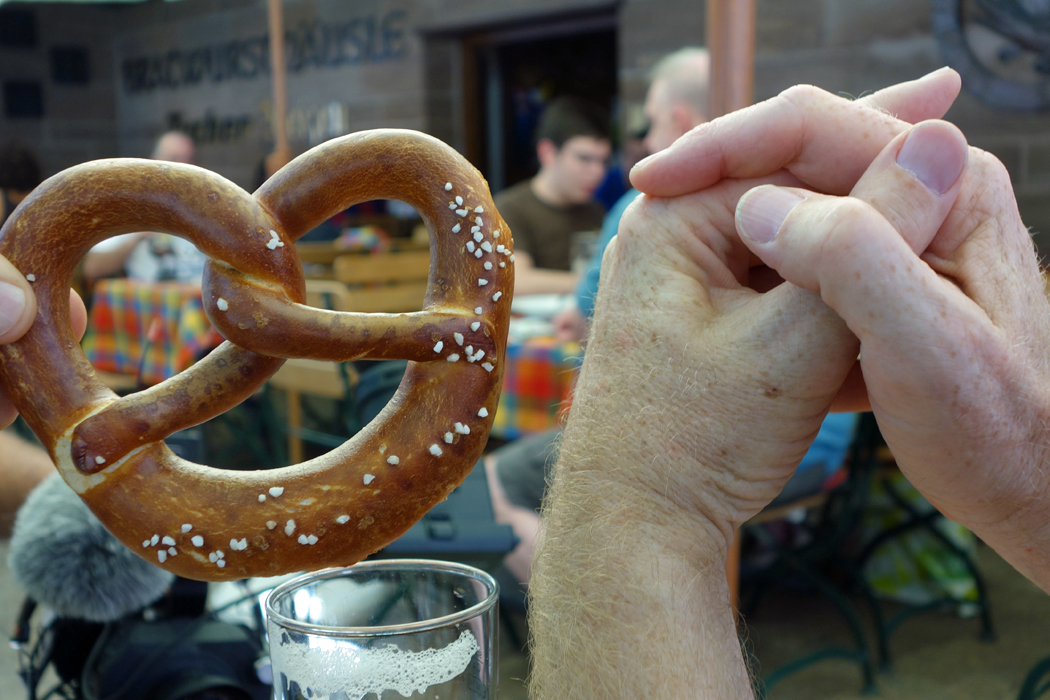
Pretzel and hand with crossed thumbs

Even after decades of travel, it’s so fun to still be learning fun little factoids about the cultures we visit. It never ends! In Dresden, my German friend explained that the dough woven into a pattern in a pretzel represents the way our thumbs cross when we fold our hands in prayer.

pretzel drive-thru

Most of our work is in the old centers of great cities. Staying here, you can miss entire dimensions of a culture. For example, driving out of a German city you may see a big drive-in pretzel place — fast food with a German touch.

Germany’s Complex, Tumultuous History

I’m just wrapping up three weeks of filming in Germany, and I’m impressed by the souvenirs of its tumultuous history. Doing TV shows on Frankfurt, Nürnberg, Dresden, Leipzig, and Hamburg, you can’t avoid the flipside of Germany’s greatness. Here are a few historical artifacts that have stuck with me.

War Memorial

Outside of Leipzig is the wildest war memorial I’ve ever seen. This is the 300-foot-tall Völkerschlachtdenkmal. Just saying it makes you think “huge casualties.” It is the Monument of the Battle of the Nations, built in 1913 to commemorate the biggest battle of its day: when Prussia, Austria, Russia, and other allies teamed up to beat Napoleon in 1813. Half a million men were involved, and there were about 100,000 causalities. The powerful art and symbolism inside makes you weep and salute at the same time. Do you have a personal “most impactful war memorial” in Europe?

Statue in Leipzig

This statue, on Leipzig’s main drag, recalls the dual dictatorships — first from the far-right, then from the far-left — that Germany lived under in the 20th century. It features the flat-palmed Sieg Heil! Nazi salute and the proletariat’s raised communist fist at the same time. Meanwhile, the poor fellow who has little choice but to raise his arms scrunches down under his collar, hoping to somehow get through it all.

Luther statue in front of church

After spending ten days filming our upcoming public television special on Martin Luther and the Reformation, we were tuned into statues of Martin Luther. He seems to be on squares and in front of churches all over Germany. Here in Dresden, in front of the Frauenkirche, we met another Luther — hand on his Bible, as if reminding people of his mission to translate the Word of God from Latin into the people’s language, so all could read it for themselves.

Nazi Gold Room

At the Nazi parade grounds in Nürnberg, we stood on the tribune platform where Hitler stoked the fears and hatreds of 200,000 assembled Nazis. And then our guide took us inside the structure, through several huge, stark, gold-veneered rooms with massive dishes for devilish flames. As these rooms aren’t open to the public, we didn’t film them (because we have an ethic of not showing things on TV that our viewers can’t personally experience). But it was a chilling little side-trip.
Millions of German Americans Sailed From Here

Being in Hamburg, I kept thinking, “I love this city.” And one highlight was seeing the place from where millions of Germans emigrated to the New World. Imagine the fun of filming this city with a local guide to help locate the best angles. We’ve just filmed three great shows on six underrated German cities: Hamburg, Leipzig, Dresden, Nürnberg, Würzburg, and Frankfurt. These will be released as a part of Season Nine of our public television series, in the fall of 2016. Stay tuned!

Hamburg Doesn’t Want a Storm Surge Flood

After being in Germany as it suffered through an unprecedented 30 days in a row of temperatures between 90 and 100 degrees, and now in the midst of several days of torrential thunder storms, I’m clued into climate change as it affects Europe. Here in Hamburg, in anticipation of storm surges that could push the Elbe River into people’s living rooms, you’ll find all-new riverside construction basically on stilts. The city’s 60-mile-long embankment is also beefed up. In an effort to make beer out of lemons, the city has gone to great lengths to make the new embankment not an eyesore, but an elevated, parklike people zone.

Hamburg’s Biggest WWII Bunker Now Filled with Music

Although it was almost completely destroyed in a horrific bombing in 1943, today’s Hamburg has rebounded as a surprisingly fun and fascinating city. While little remains from WWII, scores of the city’s old Nazi bunkers are simply too stout to be worth destroying. So they survive and are used in various creative ways. This bunker (Flakturm IV, on Feldstrasse in the St. Pauli neighborhood) is the biggest, designed to give 25,000 people shelter. It’s now filled with concert venues, recording studios, and dance clubs — and was fun to include in our TV show on Hamburg.

By the way, we’re just finishing our Germany shoot, and all three of our new Germany shows will air on public television in October of 2016. (These three shows are the first to be produced in our next series. We’ll likely produce 7 more in order to release 10 new episodes next year. Stay tuned!)