 I’m done traveling for the year, but other members of my staff are still in the field. While I regroup from 100 days in Europe, I invited my frequent collaborator Cameron Hewitt to share some posts from his blog. Cameron has traveled about as much as me this year, updating our guidebooks in Italy and France, and turning our already strong material in Scotland into a stand-alone Rick Steves Scotland guidebook (due next spring). While Cameron and I are in perfect sync in terms of travel styles and priorities, he gives voice to the next generation of Rick Steves travelers.
Right now, Cameron is heading to Croatia, Bosnia, and Slovenia, where he’ll be updating our guidebook to those countries. Then, he will be in Bulgaria and Romania where he’ll scout for our upcoming TV shoots there. He’ll be blogging from all of these destinations. In the meantime, for the next 10 days, I’ll be sharing dispatches here from Cameron’s summer travels. Today, we join Cameron in Italy, at a Sorrento B&B, where some fellow travelers had lots of questions about his job working with me as a travel writer. If you like Cameron’s insights, you can read much more on his travel blog, and you can also follow Cameron on Facebook. — Rick
So, You’re Really a Travel Writer?
By Cameron Hewitt
It’s 11 a.m. in Sorrento. I just arrived yesterday from Seattle for a five-week guidebook-updating trip in Italy and France. I should head out soon to get to work. But first I’ll procrastinate by sharing this exchange I just had at the breakfast table, with a friendly twentysomething couple from New York. Over the next few weeks, I’ll have this same conversation many times. Like these people, you may be curious what it’s like to update and write guidebooks for a living.
So, you’re really a travel writer?
Yes.
Like, you get paid to travel around and write about it?
That’s right.
Wow.
Uh-huh.
How do you get to be a travel writer?
It’s a combination of hard work and luck. You have to love traveling and love writing, and do both things as much as possible. I was an English major in college, and got a job writing movie reviews for my hometown newspaper. But no matter how well you prepare, you still need a break at some point to get your foot in the door. I started working at Rick Steves’ Travel Center, our retail store, and eventually got an opportunity to try updating some guidebook chapters. I worked hard, they liked what I did, and I got more and more work.
You must love your job!
[Reluctantly] Yes, It’s great.
What, don’t you love it?
No, I absolutely love my work! But it is work…very hard work. My friends have, understandably, zero tolerance for me complaining about my job, and I totally get it — I get paid to travel around Europe, for Pete’s sake! But it’s not easy, and it’s not always fun.
You may imagine “travel writing” is sitting at a café on a sun-dappled square, sipping a glass of wine or a cappuccino, and occasionally jotting down notes. But that’s not travel writing. That’s a vacation (with some light journaling). The reality is much more demanding, and often quite tedious. Basically, in every town I update, I personally visit each and every hotel, restaurant, museum, tourist office, laundromat, public toilet, train station, and so on, that’s listed in the book. That means lots of slogging around, having the same conversation a hundred times a day, figuring out ways to tease useful information out of a wide variety of people, and keeping very careful notes so I can write it up later…which usually happens after dinner, when I’m typing on my computer until 1 or 2 in the morning. The next day I get up and do it again…for five weeks in a row. It’s also physically demanding. When I updated the Rome book a year ago, my pedometer clocked 90 miles in seven days…all on foot.
Wait, doesn’t Rick write and update those books?
Yes and no. The series includes dozens of books, each of which is updated in person either every year or every other year. So there’s no way Rick could update all of them. That said, most people would be surprised (and impressed) by how involved Rick is in the books. He rotates which destinations he visits each year, so over time he sets foot in a major destination about every two or three years (at least), and in minor ones every four or five years. The rest of the time, it’s up to the other researchers, like me.
How many people work on these books?
Our office production team — editors, maps, and graphics — are about 14 people. (Our publisher, Avalon Travel Publishing, also has its own staff dedicated to Rick’s books.) There are about 20 people like me, who do research in Europe. There’s a lot of overlap — many of the editors also travel to update the books.
That doesn’t sound like many researchers, given the number of books Rick has!
We try to be very efficient with our time. Each chapter is budgeted the minimum amount of time we feel it’ll take to do a judicious update. And it’s a demanding job. If you ever run into any of our researchers in Europe, you’ll see that they’re constantly scrambling around. Fortunately, we have an outstanding team of researchers who understand our priorities and share a passion for travel — and for improving people’s trips.
Do you ever read other guidebooks, like Lonely Planet, or check out TripAdvisor to see how the competition matches up?
We don’t really view it as “competition.” What we do in our books is pretty specific; when I use Lonely Planet books, I’m struck by how different their focus is from ours. As for TripAdvisor, I do sometimes skim their reviews for hotels or tour companies, just to see if I’m missing something or to confirm my impressions. But I always corroborate anything I find there, independently and personally, before including it in our book.
This is a whole other conversation, but in general I’m a bit of a TripAdvisor skeptic. It’s become so powerful, and I’ve seen many businesses resort to aggressive tactics to boost their ranking — for example, a hotel offering its guests a free breakfast if they post a positive review. With hotels, keep in mind that the person reviewing a place on TripAdvisor only had an experience with one hotel in that town; a guidebook writer, on the other hand, has visited and assessed dozens, so they have a broader basis for comparison. I find TripAdvisor least helpful when it comes to restaurants; the listings can include some gems, but really skew toward tourist traps that we wouldn’t want to recommend in our books. (To try this out, just browse the rankings for restaurants in your hometown.)
In short, I use TripAdvisor as one of many sources of information — but like anything, I take it with a grain of salt. Many travelers I meet tell me they check the TripAdvisor ratings in conjunction with our guidebook’s description, and I think that’s the smart approach. But I also meet a lot of people these days who design their itinerary based exclusively on TripAdvisor rankings…and these people seem to be having a less successful trip than people who have done more homework. The sad thing is, because review sites tend to be an echo chamber, you may never even realize what you’re missing out on.
[lowering voice nervously] Wait, does this hotel know who you are?
Yes. Usually the hotel I stay at knows what I’m up to. When I visit other businesses during the day, I can choose whether to identify myself or “go incognito.” If we’ve gotten bad feedback about a place, I’m more likely to pretend to be a clueless tourists — just to see how they treat me. But other times, the espionage isn’t worth the trouble. For example, at museums, I identify myself immediately to make it easier to quickly update the information.
[noticing I’m getting a little antsy] It seems like you have a busy day ahead of you.
Yeah, sorry — I’d really better be going, if I’m going to get to everything on my list today. See you tomorrow at breakfast!

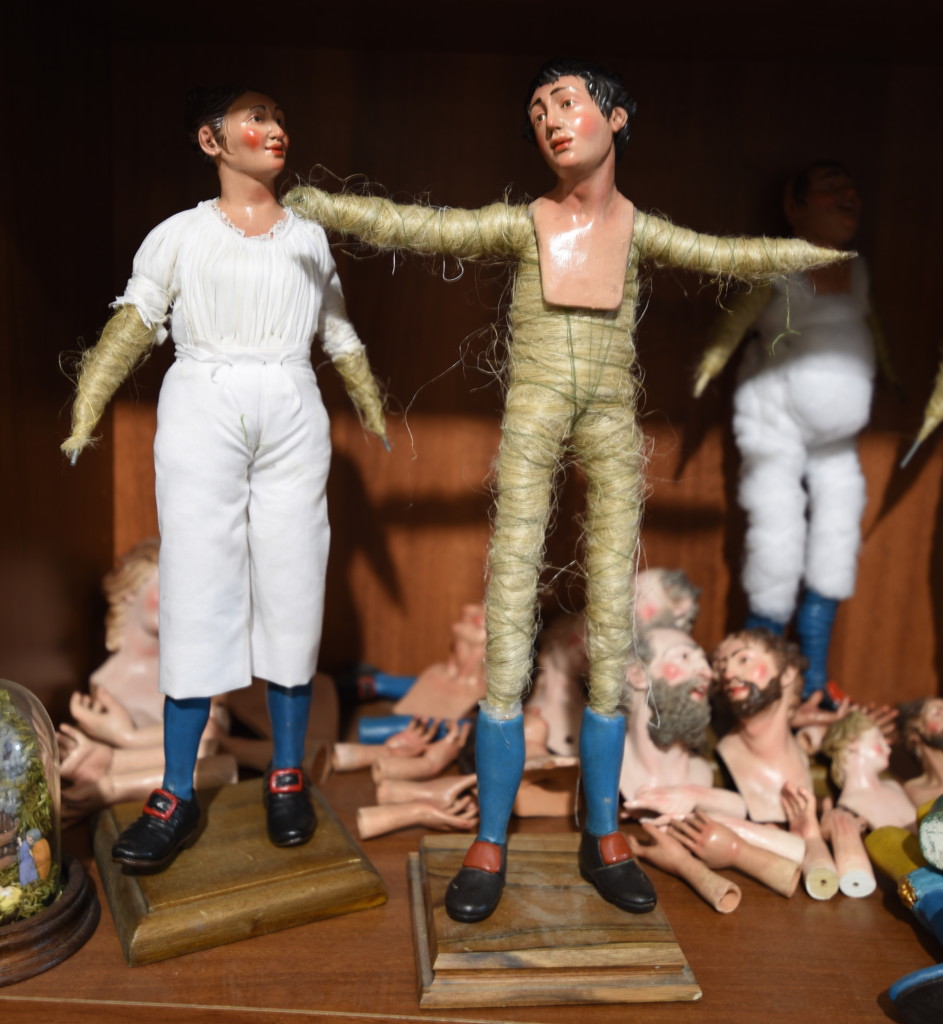 In the workshop, building these Barbie doll-sized presepi figures is a painstaking process: They begin with an articulated metal skeleton, which is wrapped in string and padded with cotton to give volume to the body, and finally dressed with clothes as finely tailored as the real thing.
 Neapolitans’ affection for their presepi may stem from their deep family ties. “Each figure in a presepe becomes a new member of the family,” Virgilio explained.

