Here you can browse through my blog posts prior to February 2022. Currently I'm sharing my travel experiences, candid opinions, and what's on my mind solely on my Facebook page. — Rick

A Log Cabin or a Guidebook

I was recently asked to recount my “start as a travel guidebook writer.” Perhaps you’ll find this obscure history interesting.

I wrote my first book in the mid-1970s — accidentally — over years of giving my Budget Travel Skills talk at the University of Washington’s Experimental College. The book matured and its structure tightened with the class. When a relative suggested I write a book, my first thought was, “You’re crazy.” Then I realized it was already there. I just needed to transcribe it from my mind onto paper.

In 1979, a little battle was waging in my mind: Should I build a log cabin or write a travel book? I had the wooded lot in the Cascade Mountains, had picked the spot for the cabin, and took a log-cabin building class. I even had a line on the trailer I’d live in while constructing the cabin. When the reality of peeling logs and aging them set in, the competing big project — writing a travel book — won out.

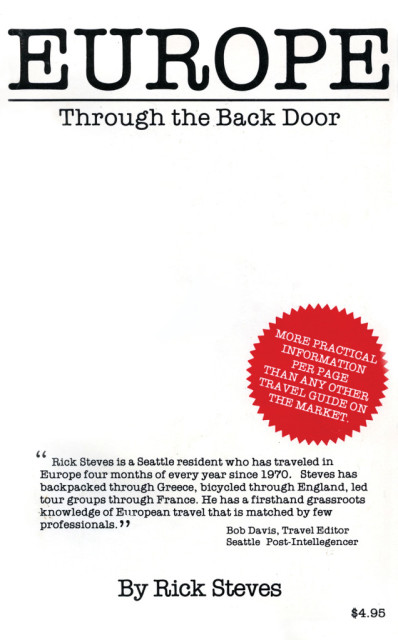
I wrote the first edition of Europe Through the Back Door by simply writing out my lectures. The book came out almost effortlessly. My girlfriend typed it, and my UW roommate sketched the illustrations from my favorite photographs. Corrections were typed, carefully cut out, and glue-sticked onto the pages. And one winter day in late 1979, I drove the precious 180 pages of that first edition an hour north of Seattle to Snohomish Publishing with a check for $2,400. A few weeks later I drove home with two thousand books in the back of my station wagon.

rick-steves-original-europe-through-the-back-door-1980-vintage-1.jpg
The first edition of Europe Through the Back Door

I was so green, I didn’t know to put on an ISBN. The cover was so simple, people in the media thought the finished product was a pre-publication edition. But it sold. In 1981, I invested in typesetting for the second edition. (I remember rationalizing the substantial expense because typeset copy took up ten percent fewer pages than the same typewritten copy.) In 1982, the book looked less like the Beatles’ White Album when I put a sketch of “the” back door (an old door in Rothenburg) on the cover.

In those first years, Ira Spring (of Mountaineers Books) and I went to computer classes — we were so in love with Spellbinder and our clunky Eagle computers. Cliff Cameron (of Signpost Books) would join me for brown bag lunches to explore ways to distribute books. I still remember my first customers: Cliff, who’d stick a box in his trunk before visiting bookstores up and down the Oregon Coast; Leroy Soper, then the trade book buyer at the University of Washington Bookstore, who purchased several boxes (that was my first big break — one year they even had them on their Christmas table); George Bradt of Boston’s Globe Corner Bookstore, who gave me my first out-of-state order. And then, the big break: Vito Perillo, of Pacific Pipeline, agreed to distribute it. He seemed to really enjoy giving self-publishers a boost. I’d meet Vito late at night in Seattle, where — as if passing drugs in the wee hours — I’d shuttle a couple of boxes from my trunk into his.

In 1984, for the fourth edition of Europe Through the Back Door, I landed a publisher. I was at a little book festival sponsored by the Edmonds Library in Edmonds’ Old Milltown shopping mall. I remember meeting Lensey Namioka, author of the marvelous Japan: A Traveler’s Companion, which I had used to get the most out of a trip there — and I didn’t even know she was local. And across the aisle from me and my pile of books was Carl Franz — and a whole pile of his (now-classic) People’s Guide to Mexico.

Carl had wanted to meet me, and I had wanted to meet Carl. When we finally got together, we clicked, finding that we were both motivated by a love of travel and wanting to share our passion with others. I explained to him my frustrations of being self-published and my fear that a publisher would take the fun out of the work. He sold me on his publisher, John Muir Publications (of How to Keep Your Volkswagen Alive fame). Back then, JMP was a hippie publishing house with a handful of books in their catalog and an interest in expanding their line of travel books. Turns out we were a perfect fit.

Steve Cary came to JMP and replaced the munchies with a serious appetite for book sales. I distinctly remember the American Booksellers’ Convention in San Francisco when, walking down the street to the convention center, Steve and JMP boss Ken Luboff put their arms around my shoulders and said, “Rick, if you want to make it as a travel writer, you need to give us more titles to sell.” (At that time, in the late 1980s, I had four or five titles.)

I got the message and have since have added a book or two a year ever since. Today, I have over 30 guidebooks in print (and many more if you consider spin-offs). JMP is no longer, but their wonderful spirit survives at Avalon Travel Publishing, my current publisher (who purchased JMP). I enjoy collaborating with a well-traveled staff of 100 employed at the home office in Edmonds. The books are selling better than ever. And I’m one hardworking, and very happy, travel writer.


Your Responses to My Thoughts on Drug Policy Reform

Over the weekend, more than a million people read my Facebook post about marijuana, more than 8,000 shared it (thanks a lot!), and thousands commented with thoughts of their own. Reading through these comments Sunday night, I couldn’t resist responding to some. This morning, I read over our dialogue and wished that more people could see it. So I compiled and edited this selection of a few of the more notable back-and-forths — see below. (For the full and unvarnished version, you can read the comments on the original post.) This is a serious issue and I appreciate your thoughtful comments.

By the way, I’m a board member of NORML (the National Organization for the Reform of Marijuana Laws). I just spent all day Saturday in a Washington DC hotel conference room with my fellow board members. To celebrate our productive board meeting, a bunch of us walked down the street together (in a city where it’s legal now to smoke pot recreationally) and took a “groupie” in front of the White House.
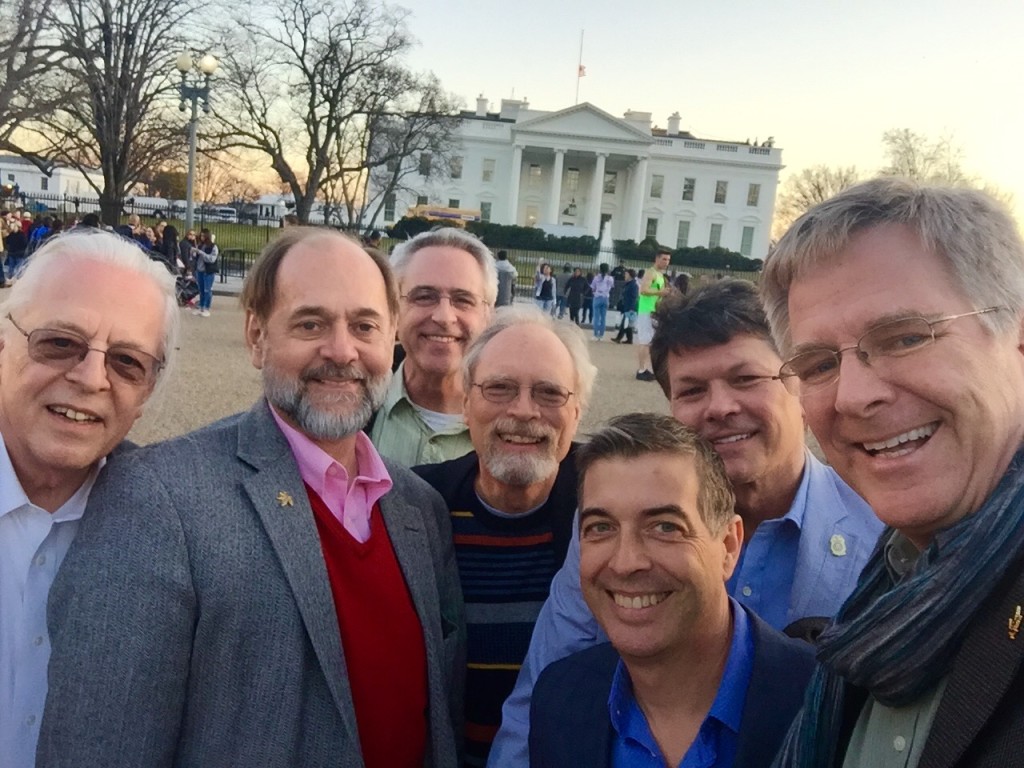
NORML board members at White House

The year 2016 promises to be an exciting one in the ongoing effort to end our federal government’s prohibition on marijuana, and I’m hoping to help out. Every two years, I spend 8 or 10 October days before a November election on a barnstorming tour explaining to people and local press why taxing and regulating pot is smarter than locking up responsible adults for smoking it. In 2012, it was in Washington; in 2014, in Oregon; and in 2016, I’ll be working in Massachusetts and Maine.

I keep thinking that there are so many people who care about this…but so few who actually do anything. It’s easy, fun, and rewarding to actually become a supporting member of an advocacy group that is working on this issue (see NORML.org).

Happy Travels!


Chelsea said: As a Christian we must follow the law of the land. We can’t have the mentality of “well people are gonna do it anyway so why not?” As a Christian you can not love two masters. Love of sin without repentance and go to church. It is illegal. We must follow the law of the land.

My reply: Ten years ago, I took my pastor on a long walk and explained to him my motivation for speaking out against the war on marijuana. There is nothing at all inconsistent with being both a Christian and someone who thinks the law is a bad law. In fact, I think you could make a case that it’s more Christ-like to speak out against it than to favor it. But I wouldn’t condemn thoughtful people who disagree with me on this.


PJ said: Hopefully someone else is watching your kids while you indulge. Also I’m sure your example is to be admired by them. My $$ spent on travel books will go else where since you have plenty to purchase drugs legal or non.

My reply: There’s responsible adult use and irresponsible adult use.


Anna Tinsman said: I don’t smoke pot but as someone who lives in Colorado I’m happy that we were able to work out all the issues with legalization of pot so it would be easier for other states. It’s funny now that it’s legal here, the arrests of people driving under the influence of pot has actually dropped. :)

My reply: In both Washington and Colorado, after several years of a track record, the worries about legalizing (like DUI concerns) are not playing out. On balance, we are learning that taking the crime out of the equation lessens the harm this drug use causes society.


Linda said: Yes, everyone who knows it’s a right to be enjoyed needs to stand up & say “legalize it”. Thank you for being counted in the movement to make legalize. You’re awesome.

My reply: More than standing up and saying something…find an advocacy group working to end the war on drugs (there are many — I’m a board member of NORML) and support it financially. Then you actually make a difference!


Lee wrote: I used to enjoy watching your show and buying your books and listening to your travel advice. You became too political, too self-absorbed, and I don’t care to listen to you rant and rave about your dope and drinking. There is still right and wrong in this world.

My reply: Right and wrong relates to a law that is enforced inconsistently, with rich white guys smoking with impunity and poor people and black people getting locked up and being marked then for life. Our government’s “war on marijuana” is the new Jim Crow in this country.


Miccilina said: I have always admired you, but because of a personal tragedy, I have to disagree. Ask yourself, if you would feel the same if one of YOURS was killed in an accident caused by a 20 year old driver stoned on pot, no other drugs or alcohol, JUST marijuana. Would your opinions still be the same?

My reply: There are 80,000 personal tragedies in American prisons today because of this law we’re trying to change. And the law we passed in Washington State is extremely tough on DUI. That’s one reason so many leaders in law enforcement in our state supported it. I only support pot laws that are “public safety” rather than “pro-pot” laws. There’s a very big difference.


Alexandra said: Opposition to drug freedom is so tied into the security business. Think how many fewer sniffer dogs need to be trained, how many fewer DEA people need to risk their lives, how much freeer borders could be, and so on, if pot were legal. Think of the huge dent in chasing down drug shipments, and the cost of incarceration. We just have to convince security companies to invest in marijuana farms and the pressure to keep it illegal will diminish. Look at how alternative energy opened up once big oil started diversifying. And I don’t smoke now and wouldn’t if it were legal.

My reply: And what about private prisons for profit? Talk about an incentive to needlessly lock people up. Plus, it disenfranchises lots of black men. Sadly, that’s a twofer for many.


Kate said: After trying it again last year for the first time in many years, all I can say is this is NOT what I smoked back in the 70’s. I would not only be staring at the fire, but also trying to converse with it and probably suspect it of trying to get very deep messages across to me if I could only stop laughing long enough to pay attention! To each, his or her own – enjoy!

My reply: One problem with a prohibition is that the controlled substance gets stronger because it’s illegal. The USA went into Prohibition on alcohol as a beer-drinking country, and came out of it a hard liquor-drinking country. The same thing is happening during the prohibition on pot.


Danne said: We legalized pot in Washington. The only people who are unhappy are the drug dealers and folks who were making a bundle growing for the black market. Now, the state is making a lot of money from taxing legal sales. Charges against people smoking or possessing marijuana were dropped. All is well! It makes sense to legalize pot! Thanks for speaking out.

My reply: These are the groups I call the “PPP” (pot prohibition profiteers). There’s a fascinating movie about our winning campaign to legalize in Washington State called Evergreen — you can watch it online (on iTunes and Netflix).


Barbara said: I live in Colorado where smoking bud is just like popping the tab on a beer, only safer. Keep up the great work Rick. We need the federal government to allow our weed shops to be able to use banks!

My reply: Washington State congressman Denny Heck is doing a heroic and effective job of getting the Feds to let banks accept money from legal marijuana businesses. This is another important issue.


Greg said: I have no problem with that. You’re an adult, you hopefully understand the problems daily pot use can cause, and you accept those risks. Good luck. I am a former pothead. Never again. My big problem with proponents of legalization is they act as if it’s all wonderful, as if there will be no detrimental effects, thus they have no plan for dealing with those issues. My other problem with politicians who are proponents of legalization is: many of them want to do it for budgetary reasons. It should not be about money.

My reply: I am not “pro-pot.” I believe marijuana is a drug, it’s not healthy, and it can be abused. I also believe it is wrong to criminalize it. I’m into “pragmatic harm reduction,” and I believe treating it as a health and education challenge rather than a criminal problem is smarter. (About the money: Many believe the Great Depression accelerated the end of Prohibition. It was just too expensive to continue it. To be honest, we leverage the fiscal pros of ending the prohibition of marijuana because, sadly, that gets more traction than things like racial justice or civil liberties.)


Tony said: If second hand cigarette smoking is bad for children in the car or home, can you imagine what it will be like with marijuana. It may become legal/permissible but that does not make it right. But nowadays we think most about ourselves rather than others in legislation and that is what is sad.

My reply: Tony, you need to learn more about what motivates the non-pot-smoking people who are making pot legal. Washington legalized pot because of sheriffs, prosecutors, legislators, teachers, and caring citizens who recognized an expensive, racist, and non-productive law that was causing far more harm to society than it was helping. And we changed it. That’s democracy in action…simply good citizenship.


Jim said: I would actually be interested in hearing some discussion of, not simply legalizing it, but offering legal workplace protection to users. Drug tests have their place, if you’re testing for something illegal, or being under the influence at work. Show up to work drunk and you’re probably going to lose your job, but your boss can’t fire you on Monday because a test shows you had a beer on Saturday. It’s terrible to hear stories of people using marijuana in a state where it is legal, but being drug tested 4 days later and losing their jobs.

My reply: Breaking down a federal prohibition needs to go step-by-step (as was the case with alcohol). Eventually impairment will be the measure, rather than what’s still in your blood. As an employer of well over a hundred people, I care about impairment and nothing more.


Elizabeth said: I have always thought it was a mistake of for Rick to mix this political, drug policy stuff into his show. The two are not inseparable. My estimation of Rick actually went down when he did this bit with the marijuana support.

My reply: I’ve been mixing my travel teaching and my political beliefs for about 20 years now. I do it regardless of the impact on my business. (But if I did consider that, in retrospect, it seems to have been a net plus.)


Joyce said: Ironic, the biggest high I get is in traveling with a clear mind! Whatever floats your boat! Glad life alone makes me happy!

My reply: I’m a travel writer. For me, high is a place. And sometimes… I like to go there.


Guest Post: Pasta-Making Night at the Agriturismo

As I like to do every couple of weeks, today I’m sharing a post from Cameron Hewitt (co-author of many of my Europe guidebooks). If you like this tasty slice of Tuscany, be sure to “like” Cameron on Facebook.

In this post, Cameron captures both the sweet life of rural and traditional Tuscany as well as how American travelers can actually experience it. While in practice this entry includes a recipe for a special pasta, it’s also (and more importantly) a recipe for good living in disguise. Once again, Cameron, you inspire me to not just travel…but to travel well. Enjoy!

At Agriturismo Cretaiole, Thursday night is pasta night. Guests return from a busy day of tooling around Tuscan hill towns and wineries to make pasta — specifically, the local hand-rolled noodles, called pici.

cameron-italy-tuscany-cooking-class-cretaiole-009

After a lively week of group bonding, all of the guests pack into the glassed-in veranda. They squeeze behind rustic tables with a hubbub of anticipation. In front of each small group is an oversized, rough-wood board with just the right texture for rolling noodles.

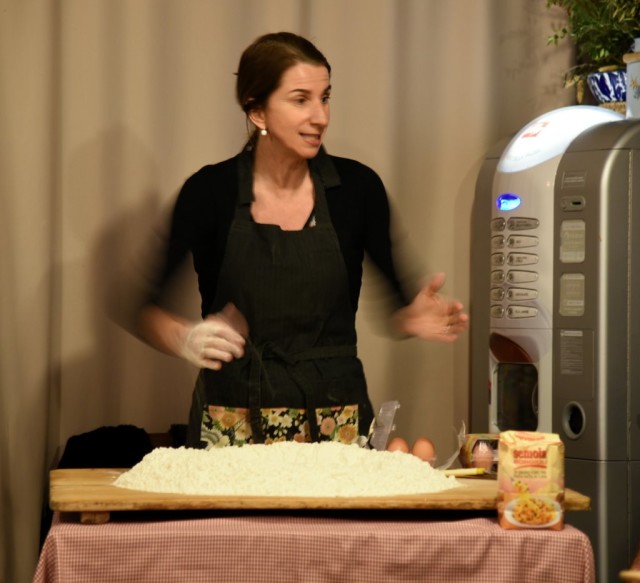
In one corner of the room, our agriturismo host, Isabella, stands at a small table and addresses the group. The board in front of her is piled high with a 10-pound mountain of flour. She explains — with the seasoned confidence of someone who’s taught hundreds, maybe thousands, of travelers how to make perfect pasta — the precise procedure.

cameron-italy-tuscany-cooking-class-cretaiole-003

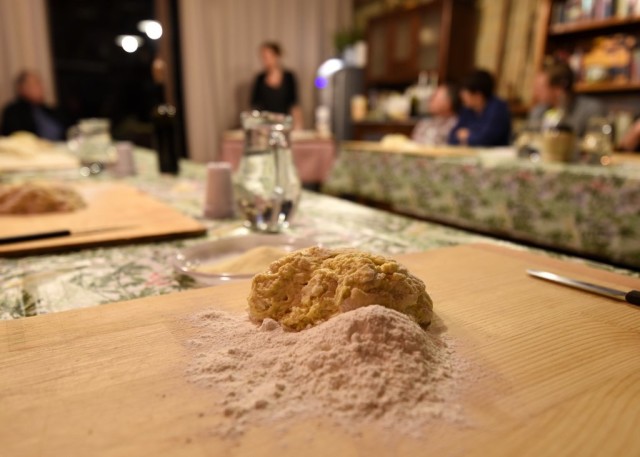
First, she dredges out a crater in the top of her flour mountain, turning it into a volcano. Into this precarious container she cracks eight eggs. She gingerly beats the eggs with a fork, gradually sprinkling in water — a few drops at time — as she pulls in more and more flour from the lip of the crater. With each stir, the sea of eggy goo threatens to breach the fragile walls. But gradually, liquid turns to solid. And with one last vigorous stir, it becomes a mound of sticky dough.

cameron-italy-tuscany-cooking-class-cretaiole-006

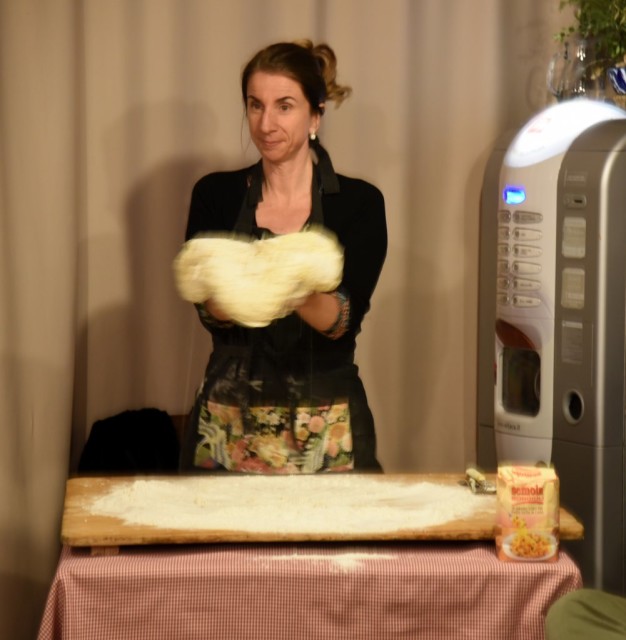
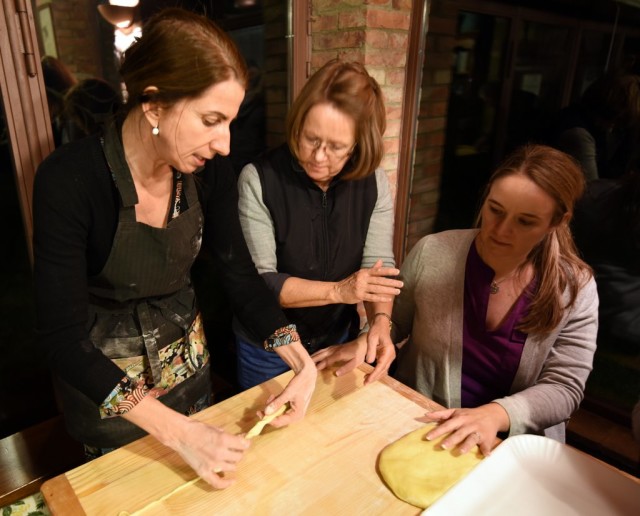
It’s time to knead. Isabella carefully explains the importance of keeping the “cut” — or, in more pleasant terms, the “smile” — facing you at all times. After each knead, you rotate the dough a quarter-turn, then repeat. It’s a steady rhythmic, motion — like waves crashing on a beach: Pull, push, push, rotate. Pull, push, push, rotate.

Each family huddles around their communal wad, taking turns. Isabella circulates through the room, gently correcting our awkward technique. “Done?” someone asks her. She sticks an accusing finger deep into the center of the seemingly finished ball of dough, and withdraws a sticky fingertip. “Not done yet,” she says. “Keep going.”

Finally, the dough is ready, and it’s time to make the pasta. Pici (pronounced “pee-chee”) are peasant noodles. Pici are hand-rolled — not neatly extruded from a metal tube. But it’s deceptively tricky to master.

cameron-italy-tuscany-cooking-class-cretaiole-041

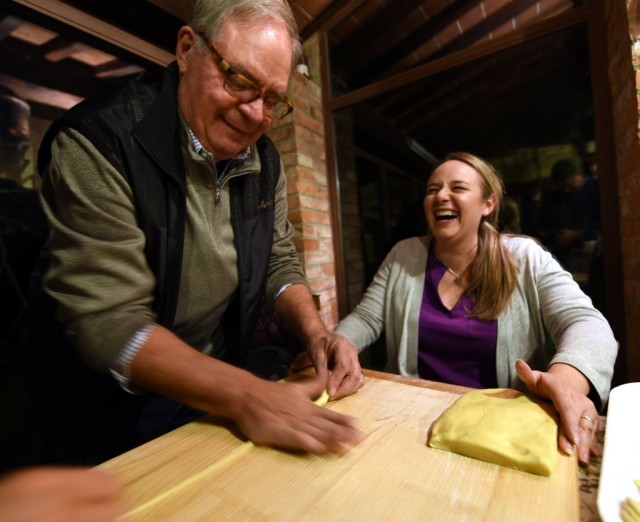
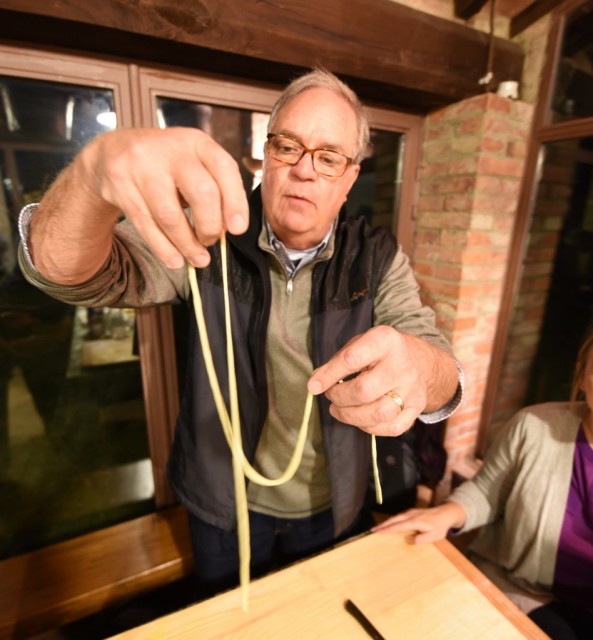
Here’s the technique: Cut off a hunk of dough, hold it in your left hand, and roll it with your right.  Continually massage the dough with the heel of your hand against the cutting board, always gently tugging on the dough clump to tease out a strand. It’s harder than it sounds. Too little pressure, and you get thick, inedible ropes. Too much pressure, and it breaks into bits. But if you do it right, you get pasta shaped like a four-foot-long earthworm. This is where those special boards come in: They offer just enough texture to provide friction for rolling the pici, but not so much that it sticks.

cameron-italy-tuscany-cooking-class-cretaiole-029

Families take turns rolling their pici, offering each other tips and encouragement. Some people go fast. Others go slow. Some pick up the technique immediately, churning out long strands of perfectly uniform noodle. Others can’t quite get the hang of it, and spend most of their time pinching together broken strands…while nervously eyeing Isabella across the room, hoping she doesn’t notice.

cameron-italy-tuscany-cooking-class-cretaiole-036

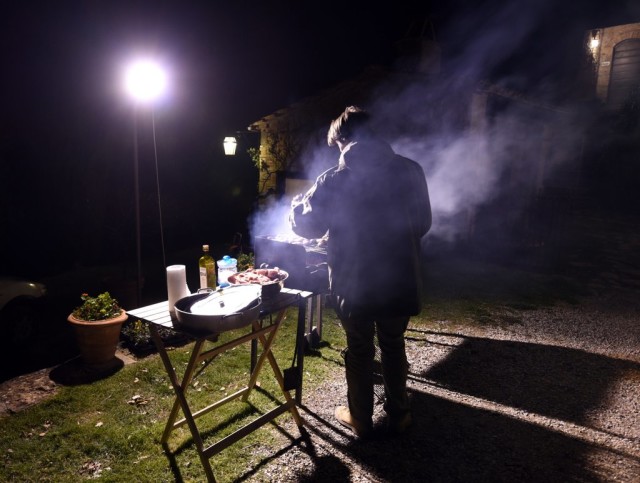
I take a break to head outside, where I find Isabella’s husband Carlo at the grill. His roaring fire has died down, and he’s repositioning his glowing coals. Carlo gently nestles his pork sausage and ribs onto the hissing grill.

cameron-italy-tuscany-cooking-class-cretaiole-057

In the little garden shed nearby, Isabella has brought a 20-gallon pot of water to a rolling boil. To season the noodles, Isabella pours three generous handfuls of coarse salt into the water. It tastes as salty as soup. Then she drops in the handfuls of pici, which squirm around the bubbles like miniature eels.

In just five minutes — when the water starts to foam up — it’s done. Isabella tosses the pici with some meat ragù she’s been simmering all day long, then takes the giant, overflowing, stainless-steel bowl back to the veranda.

At Cretaiole, pasta night is also potluck night. Each guest brings down a salad, side dish, or dessert they’ve prepared in their apartment. Some use it as an opportunity to try out recipes they’ve picked up at cooking classes this week: a radicchio salad with pecorino and fennel, or a lightly sweetened, simple ricortta. Others import favorites from back home — my mother-in-law’s apple crisp (made with Tuscan apples) is a hit.

cameron-italy-tuscany-cooking-class-cretaiole-058

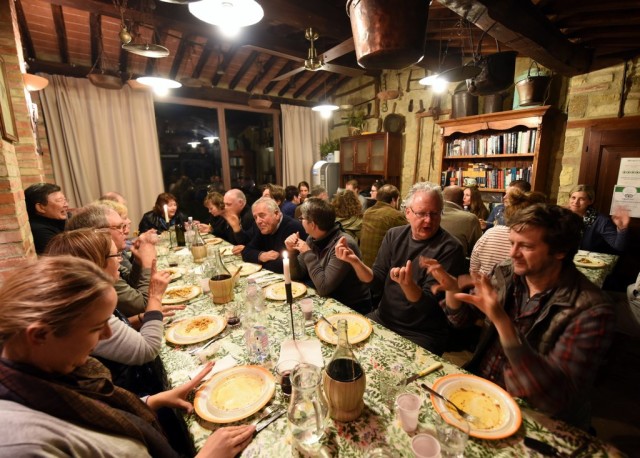
Settling in to a delicious (and hard-earned) dinner, the Cretaiole guests chatter and drink and eat and laugh. Old Man Luciano shows up, clutching bottles of Vin Santo and grappa that he’ll be sharing later in the evening. Once-strangers, now-friends animatedly discuss all they’ve experienced this week. That great art museum in Siena. That stunning scenery from the drive to Monticchiello. Adorable Milli, our canine companion who sniffed out truffles during our hike through a wooded valley. People swap the Italian words they’ve learned and the Italian gestures they’ve mastered.

Digging into my pici, I screw my index finger deep into my cheek, then wave my hand alongside my head: Delizioso! The noodles we made are firm but tender. Each noodle clings to just the right amount of flavorful ragù, exactly as it was designed to do. As time stands still around this convivial dinner table — so far from home, yet so familiar — it’s clear why here in Tuscany, the traditional ways are still the very best ways.

Learn More About Cuba Before Your Trip

My trip to Cuba was a fascinating and memorable way to kick off 2016. And sharing it with you (and reading so many insightful comments) has been a joy. I hope you enjoyed traveling with me during the last 30 or so posts. If you missed any posts along the way, you can find them all right here on my blog.

Rick Steves and Cuban man with cigars

To put the many questions to rest: While I enjoyed the experience and highly recommend travel there, I have no plans to lead tours, write a guidebook, or film a TV show on the island.

If you live in the Seattle area and want to learn more, I will be giving my 90-minute Cuba talk on March 28 at Town Hall Seattle ($5); and on April 2 at the Edmonds Center for the Arts (free). A filmed version of this talk may also be available later online. Stay tuned.

It’s my hope that this Cuba series has inspired you to consider traveling there yourself. For a complete and practical listing of the B&Bs we slept in, the restaurants that we’d recommend, and our sources of information — as well as more posts about our Cuba trip — visit Trish Feaster’s blog, The Travelphile.

Thanks again for adventuring with me…and happy travels!