Here you can browse through my blog posts prior to February 2022. Currently I'm sharing my travel experiences, candid opinions, and what's on my mind solely on my Facebook page. — Rick

Daily Dose of Europe: Caravaggio’s David with the Head of Goliath

The grotesque, in-your-face style of the painter Caravaggio feels fitting in our time of crisis. Here’s a close look at one of his most iconic works.

As America continues to suffer crisis upon crisis, it has never been more important to broaden our perspectives and learn about the people and places that shape our world. And for me, one of the great joys of travel is seeing art masterpieces in person. Learning the stories behind great art can shed new light on our lives today. Here’s one of my favorites.

In Caravaggio’s take on this familiar Bible story, David the shepherd boy has killed the giant Goliath with a rock and decapitated him with a sword. Now David holds the dripping head out at arm’s length, sticking it right in the viewer’s face.

Like David, the artist Caravaggio loved to shove startling images in the public’s face. While most artists amplified the world’s prettiness, Caravaggio painted its grittiness. Here he chronicles every gruesome detail: the dripping blood, rotting teeth, bloody wound in the forehead, and Goliath’s final expression of despair (or is it surprise?) frozen in death. David dangles the head by the hair and watches the life drain away. David’s expression is complex. He’s not gloating over his triumph, but detached, like he didn’t want to kill the poor bastard, but he had to — an executioner dispensing justice.

What exactly is David thinking? Well, Caravaggio knew. He knew exactly how it felt to have just killed someone, because he had recently murdered a man with a sword. Even as he painted this, he was running from the law.

Caravaggio’s life, like his art, was dark and dramatic. By his twenties, he was rich and famous for his startling talent and innovations. But he lived a reckless, rock-star existence — hanging out in dive bars, trashing hotel rooms, and picking fights. He used the low-life people he knew as models for his paintings, turning blue-collar workers into saints and prostitutes into Madonnas. Here, David is no heroic Renaissance man like Michelangelo’s famous statue — he looks like a teenage runaway in a dirty shirt.

Caravaggio’s specialty was stark lighting — creating a film-noir world of harsh light and deep shadows. This painting is bled of color, virtually a black-and-white crime-scene photo. Caravaggio shines the spotlight on just the details he wants to highlight: David’s skinny torso and cheek, and the giant’s horrified face.

The severed head of Goliath is none other than Caravaggio himself — an in-your-face self-portrait. That’s led scholars to see a lot of Caravaggio’s personal life in this painting. Some say David is also a portrait — of Caravaggio’s young lover, symbolizing how the young man has conquered him in love, leaving him literally smitten. Others say David is another self-portrait of Caravaggio, this time in his youth — in which case, David would be the artist’s youthful self reflecting on the ugly brute he’d become.

Caravaggio spent his final years wanted on murder charges. During that time, he forged a new direction in art. With his heightened realism, strong emotions, uncompromising details, and dramatic lighting, he set the tone for a new style: Baroque.

This painting — perhaps Caravaggio’s last — was a gift sent to the authorities along with a request that they pardon him. He portrays himself as Goliath, a message of his own self-disgust and contrition. Caravaggio was eventually pardoned, but he died shortly afterwards — appropriately, from a stab wound. Though only 38, in his short life he’d rocked the world of art — as his paintings continue to do to this day.

This art moment — a sampling of how we share our love of art in our tours — is an excerpt from the full-color coffee-table book Europe’s Top 100 Masterpieces by Rick Steves and Gene Openshaw. Please support local businesses in your community by picking up a copy from your favorite bookstore, or you can find it at my online Travel Store. To enhance your art experience, you can find a clip related to this artwork at Rick Steves Classroom Europe; just search for Caravaggio.
Daily Dose of Europe: The Parthenon

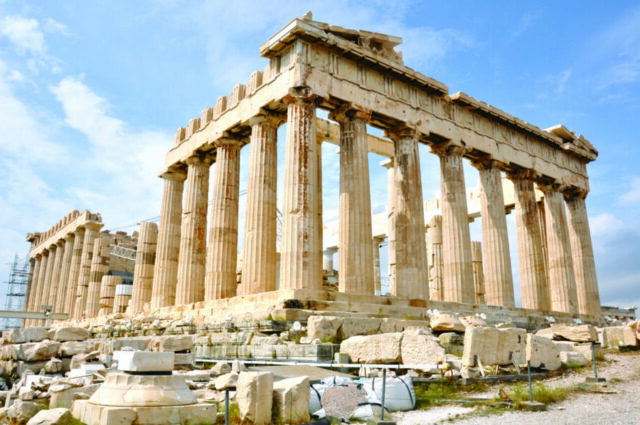
Rising up from the teeming heart of modern Athens, this gleaming temple shines from the top of the Acropolis hill like a beacon…a beacon of civilization.

As America continues to suffer crisis upon crisis, it has never been more important to broaden our perspectives and learn about the people and places that shape our world. And for me, one of the great joys of travel is seeing art masterpieces in person. Learning the stories behind great art can shed new light on our lives today. Here’s one of my favorites.

The temple — dedicated to the goddess Athena, the patron of Athens — was the crowning glory of the city’s enormous urban-renewal program during its Golden Age in the fifth century BC. After the Persian War, Athenians set about rebuilding the Acropolis, creating a vast and harmonious ensemble of temples and monuments with the Parthenon as the centerpiece.

Climbing the fabled hill, you reach the summit and, of everything there, bam: The Parthenon is the showstopper — the finest temple in the ancient world, standing on the highest point, 500 feet above sea level. Constructed about 440 BC, it’s massive, the largest Doric temple in Greece — about 230 feet long and 100 feet wide. It’s surrounded by 46 white-marble columns, each 34 feet high, 6 feet in diameter, and capped with a 12-ton capital.

But even more impressive than its sheer size is the building’s sheer beauty. The columns are in the classically simple Doric style — lightly fluted, with no base, and topped with plate beneath a square slab. In its heyday, the pure white structure was adorned with colorful statues and reliefs painted in vivid colors. Inside was a legendary 40-foot-tall statue of Athena (though now lost to history). All in all, the temple was a model of balance, simplicity, and harmonious elegance. It epitomized the goddess of wisdom, Athena, as well as the enlightenment of the Athenian people.

The architects achieved that harmonious effect with some clever optical illusions. For example, the Parthenon’s steps subtly arch up in the middle — to compensate for the sagging effect a flat line makes to the human eye. Similarly, the columns lean slightly inward to appear parallel, and they bulge imperceptibly in the middle to give a pleasing sturdiness as they support the stone roof.

The Parthenon’s builders used only the finest white Pentelic marble — 100,000 tons of it, brought in from a quarry 15 miles away. Unlike ancient structures constructed by the Egyptians and Romans, the Parthenon was not built by slaves, but by paid workers. The columns were made from huge marble drums, stacked like checkers, and fixed with metal pins in the center. Each piece of the Parthenon was unique — individually sized and cut to fit — then assembled on the spot like a giant 70,000-piece jigsaw puzzle.

The Parthenon, then and now, stands as the symbol of Athens’ Golden Age — that 50-year era of prosperity and enlightenment when the city laid the foundations for what came to be known as Western civilization. It’s one of the most influential works ever created by humankind. For 2,500 years, it’s inspired architects, sculptors, painters, engineers…and visitors from across the globe.

This art moment — a sampling of how we share our love of art in our tours — is an excerpt from the full-color coffee-table book Europe’s Top 100 Masterpieces by Rick Steves and Gene Openshaw. Please support local businesses in your community by picking up a copy from your favorite bookstore, or you can find it at my online Travel Store. To enhance your art experience, you can find a clip related to this artwork at Rick Steves Classroom Europe; just search for Parthenon.

Rick Steves Guides’ Marketplace

Let the Rick Steves Guides’ Marketplace bring a little Europe to you!

As long as the COVID-19 crisis continues, travelers have no way to enjoy Europe in person and our Europe tour guides have no income. But our guides are wonderful teachers, bursting with energy and information to share.

This little market square is designed to connect our guides with our homebound travelers, sharing their creative projects with everyone who’s hungry for “travel experiences” — even if they’re just virtual for the time being.

I know that many of our travelers care as deeply as we do about our guides. We are friends. And supporting them in their creative business ventures during this crisis, as we await the day we can all travel again, is a wonderful way for friends to help friends.

Enjoy this marketplace. We hope it will bring you a little taste of “happy travels” to tide you over until Rick Steves tours are running again and the amazing guides our travelers so appreciate are back at work.

Browse virtual experiences, blogs, and more on the Rick Steves Guides’ Marketplace.

Daily Dose of Europe: The Bust of Nefertiti

The most famous piece of Egyptian art in Europe is this 3,000-year-old bust of a Queen of Egypt named Nefertiti.

As America continues to suffer crisis upon crisis, it has never been more important to broaden our perspectives and learn about the people and places that shape our world. And for me, one of the great joys of travel is seeing art masterpieces in person. Learning the stories behind great art can shed new light on our lives today. Here’s one of my favorites.

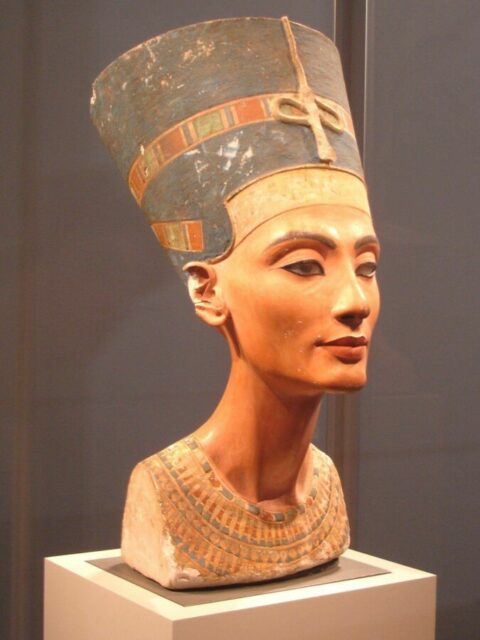
Nefertiti has all the right features of a classic beauty: long slender neck, perfect lips, almond eyes, symmetrical eyebrows, pronounced cheekbones, and a perfect spray-on tan.

Her pose is perfectly symmetrical from every angle — front, back, and side. From the side, her V-shaped profile creates a dynamic effect: She leans forward, gazing intently, while her funnel-shaped hat swoops up and back. Her colorful hat is a geometrically flawless, tapered cylinder.

And yet, despite her seemingly perfect beauty, the real person shines through. In real life, Nefertiti was born a commoner and renowned for her beauty. Her name means “the beautiful one has come.” She married the pharaoh, Akhenaton, and soon became the most powerful woman in the land. The newlyweds moved into a large palace and had six daughters. (Nefertiti became the mummy-in-law of Tutankhamen, the famous “King Tut” whose tomb was unearthed in 1922, sparking a worldwide fascination with Egypt.) During the reign of the dynamic power couple, Egypt’s 1,000-year-old traditions were challenged, and the once-stiff art styles broke out of the rigid mold.

Unlike earlier statues of generic gods, Nefertiti’s bust has unique human details. Looking close, you can make out fine wrinkles around the eyes — these only enhance her beauty. She has a slight Mona Lisa smile, pursed at the corners. Her eyebrows are so delicately detailed, you can make out each single hair. From the back, the perfection of her neck is marked with a bump of reality — a protruding vertebra. And because she’s missing the quartz inlay in the left eye, it gives the impression she’s winking at you. Her look is meditative, intelligent, lost in thought. Like a movie star discreetly sipping a glass of wine at a sidewalk café, Nefertiti seems somehow more beautiful as a real person with real flaws.

The bust is made out of limestone, with a stucco surface. This bust served as the master model for countless other portraits of the queen scattered across the kingdom.

Today Nefertiti’s bust is displayed in a room all her own in a museum in Berlin. How the queen arrived in Germany is a tale straight out of Indiana Jones. A German archaeologist uncovered the bust in the Egyptian desert in 1912 and spirited it out under questionable circumstances. Since her arrival in Berlin, she’s been surrounded by controversy. Some scholars condemned the bust as a fake. Meanwhile, the masses adored Nefertiti and made her a virtual symbol of Germany itself — Germany’s “queen.” Hitler promoted her as a pagan symbol of his new non-Christian Reich. When Germany was split in the Cold War, both sides fought to claim her. Today Nefertiti’s timeless beauty has come to represent the aspirations of the reunited German people. And around the world, her intriguing allure has made her Egyptology’s cover girl.

This art moment — a sampling of how we share our love of art in our tours — is an excerpt from the full-color coffee-table book Europe’s Top 100 Masterpieces by Rick Steves and Gene Openshaw. Please support local businesses in your community by picking up a copy from your favorite bookstore, or you can find it at my online Travel Store.

Understanding Islam with George Gorayeb

Islam, which is practiced by a quarter of humanity, is the fastest-growing religion on earth. Any well-educated person should understand the Muslim faith. That’s why, when an email hit my inbox suggesting that I watch this video, I decided to give it a few minutes. I could not stop watching. It’s a simple and straightforward lecture by a caring person who has done a masterful job of explaining Islam in 75 minutes.

This video was produced by Anne Arundel Community College in Arnold, Maryland. It was written and presented by George Gorayeb, a former Peace Corps Volunteer in Morocco, and now a realtor in Annapolis. George is an Arab-American Christian whose family emigrated from Syria. He produced this video simply because he cares. And that’s why I’m recommending it to you.

If your traveling spirit is eager to get out, give this an hour and a quarter. I’d love to read your comments—but only after watching George’s lecture. (Thanks, George!)