Here you can browse through my blog posts prior to February 2022. Currently I'm sharing my travel experiences, candid opinions, and what's on my mind solely on my Facebook page. — Rick

Video: Learning History’s Lessons at Zeppelin Field

Fascism is in the news these days: White-supremacist groups are waving their flags, blustery strong men with a disregard for the norms of democratic governing are using the same playbook that worked for dictators a century ago, and Europeans who thought a repeat was not possible are now looking with a wary eye at countries sliding to the extreme right. (Of course, we’re not talking Holocaust-type fascism, but an ideological cousin — built on fear and promises — that can lead a society astray.)

We’re in Nürnberg, filming an hour-long doc on fascism that will air next September on public television. We need to take advantage of the buildings and artifacts that survive from the Reich (“empire”), which Hitler boasted would last a thousand years (which lasted from 1933 to 1945). Much was destroyed by WWII bombs, but Zeppelin Field, where Hitler held his enormous rallies, remains. In this clip, we visit the rally ground’s Golden Hall — the best surviving Hitler interior I’ve seen.

Fascism in Germany

notes

I’m in Germany with my TV crew, filming a new one-hour special about 20th-century fascism in Europe that will air next September on public television. Over the next several days, I’ll be sharing photos and videos from behind the scenes.

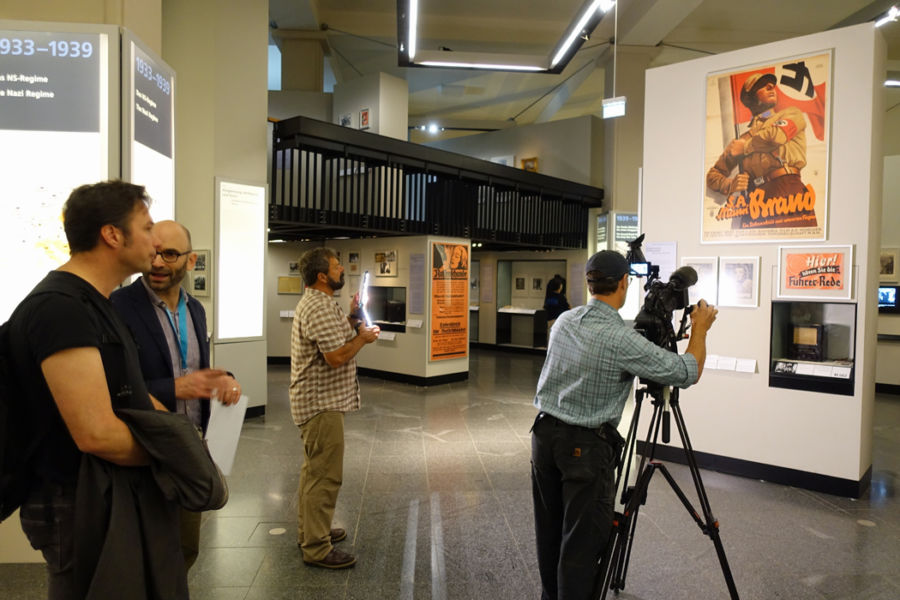
Here’s a look at the powerful propaganda art on display in Berlin’s Museum of German History (which has the best artifacts from the Hitler years I’ve seen anywhere in Germany):

filming in german history museum

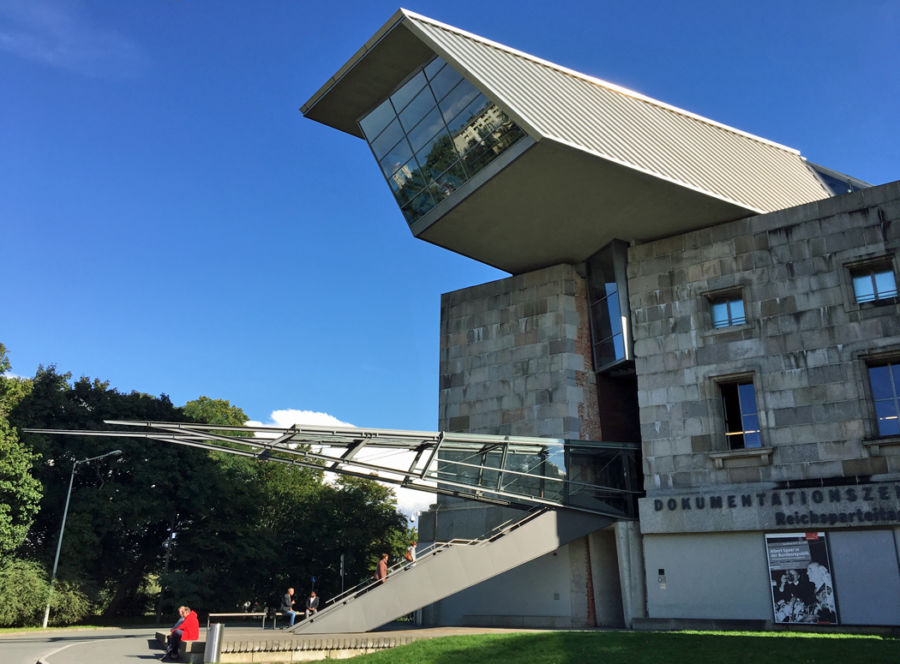
The entry of the Documentation Center in Nürnberg architecturally cuts like a dagger through Hitler’s massive, yet unfinished, Nazi Congress Hall:

nazi documentation center

A famous statue evokes the human suffering at Hitler’s first concentration camp, Dachau:

rick steves filming at dachau

Mussolini: Bombast and Braggadocio

My crew and I are in Europe, filming a new TV special about fascism which will air across the USA next September. Our first stop is Rome, to see the stony remnants of Mussolini’s bombastic years.

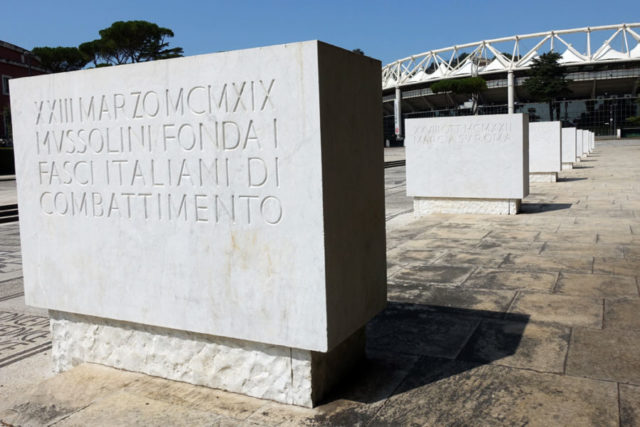
Every time Mussolini signed the equivalent of an executive order, he’d have a marble stone engraved with the new law. Even minor actions were memorialized with bombast and braggadocio by these marble monuments to the big guy who got it done.

Mussolini's laws written in stone

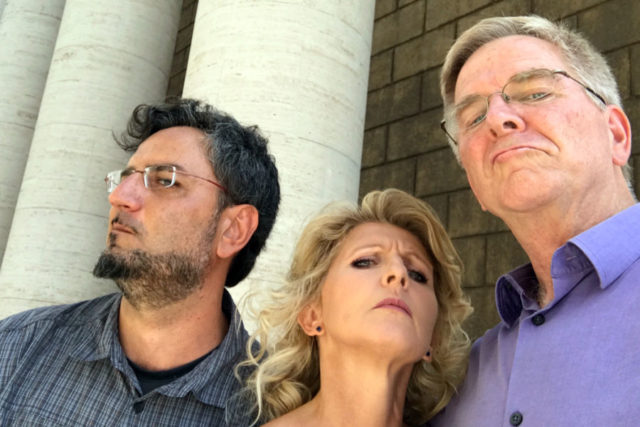
Local guides Alfio Di Mauro and Francesca Caruso have been helping me at each stop in Rome. (Their families both lived through Mussolini’s fascist nightmare.) Here, they are teaching me the tough guy pose that Il Duce used as he strutted around in public and gave rambling speeches at rallies designed to energize his angry base.

Rick Steves with guides Alfio and Francesca

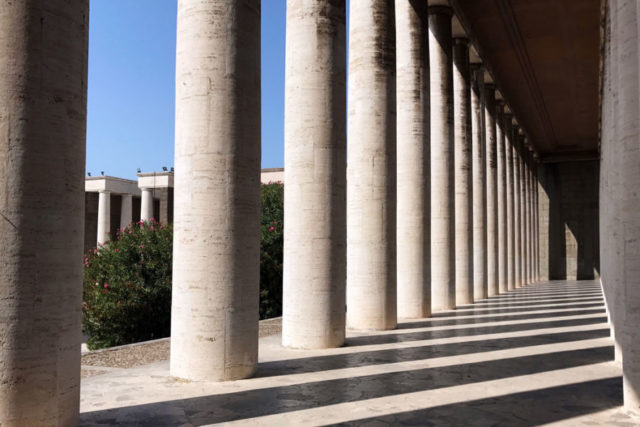
Mussolini planned a futuristic city called “EUR.” We needed fascistic-looking places to shoot “on cameras” (when I am speaking on camera), and there were plenty here. This colonnade is text-book fascist — inspired by ancient Rome, but even bolder.

EUR collonade

Video: Learning About Fascism through History and Travel

I packed uncharacteristically heavy for this trip. Along with a cruise-ship wardrobe, I flew to Europe with a copy of “Mein Kampf” and a homemade fasces (the bundle of sticks with an ax in it that Mussolini used as his symbol of a fascist state) in my luggage. These were props for our new “Fascism in Europe” TV special, which will air across the USA next September.

Ever since the Patriot Act was hastily passed in the days after 9/11, I’ve wanted to make a one-hour TV special helping Americans understand how and why fascism rose after World War I in Italy and Germany — and how, by the outbreak of World War II, only a handful of democracies survived in Europe (primarily in Britain, France, and Scandinavia). Those were wild times. And today, Western democracies from the USA to Poland, Hungary, and Turkey are navigating choppy waters.

Things change incrementally, and the societies that suffered through periods of fascism between the world wars had some surprises in common: that it could happen to them, that losses of freedom snowball, and that it can all happen so quickly.

The more you study this history, the more you see that autocrats and wannabe dictators all follow the same playbook. I’m a big proponent of the notion that you can learn from history and you can learn from travel. For this important topic, we’ll learn from both. Over the next week or so, I’ll be sharing insights gleaned from filming in Rome, Berlin, Nürnberg, and Munich. Here’s a little clip from Rome.

Shifting from Big to Small

Talk about whiplash. We just finished our Mediterranean cruise shoot, and we’re jumping immediately into filming our next special: “Rick Steves’ The Story of Fascism in Europe.” We’re traveling in Rome, Berlin, Nürnberg, and Munich as we film material for the special, which will air across the USA next September.

In a fascist regime, the individual is lost to the state, and the architecture is designed to make you feel small — as you can see at this stern edifice in EUR, the futuristic city Mussolini was developing next to Rome.

EUR fascist building

It’s been a big mind shift from filming on a cruise to filming about fascism. On the cruise, I was struck by the name of the attendant who took care of my stateroom, Adolfo — the only Adolf I can remember ever meeting. But while Adolfo (a wonderful man from Nicaragua) was all about making people feel big…the evil Adolf was all about making people feel small.

Rick and his stateroom attendant, Adolfo